Kindle$43.48Available instantly
Audiobook1 CreditAvailable instantly
Paperback$21.84
Other Used and New from $21.84
Temporarily out of stock.
Order now and we'll deliver when available. We'll e-mail you with an estimated delivery date as soon as we have more information. Your account will only be charged when we ship the item.
Read sample
 Audible sample
Follow the author

Jill LeporeJill Lepore
Follow
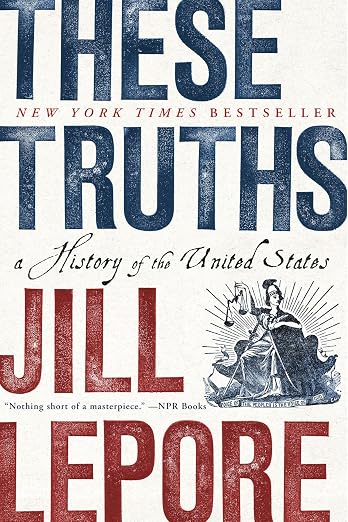
These Truths: A History of the United States
by Jill Lepore (Author) Format: Paperback
4.6 4.6 out of 5 stars (4,599)
Widely hailed for its "sweeping, sobering account of the American past" (New York Times Book Review), Jill Lepore's one-volume history of America places truth itself-a devotion to facts, proof, and evidence-at the center of the nation's history. The American experiment rests on three ideas-"these truths," Jefferson called them-political equality, natural rights, and the sovereignty of the people. But has the nation, and democracy itself, delivered on that promise?
These Truths tells this uniquely American story, beginning in 1492, asking whether the course of events over more than five centuries has proven the nation's truths, or belied them. To answer that question, Lepore wrestles with the state of American politics, the legacy of slavery, the persistence of inequality, and the nature of technological change. "A nation born in contradiction… will fight, forever, over the meaning of its history," Lepore writes, but engaging in that struggle by studying the past is part of the work of citizenship. With These Truths, Lepore has produced a book that will shape our view of American history for decades to come.

From the Publisher


TopAbout this itemSimilarFrom the BrandFrom the AuthorQuestionsReviews
 These Truths: A History of the United States
Product details
Publisher : W. W. Norton & Company
Publication date : 22 October 2019
Edition : 1st
Language : English
Print length : 960 pages
ISBN-10 : 0393357422
ISBN-13 : 978-0393357424
Item weight : 907 g
Dimensions : 15.49 x 4.06 x 23.37 cm
Best Sellers Rank: 70,926 in Books (See Top 100 in Books)7 in United States History Textbooks
43 in U.S. State & Local History
266 in Modern History (Books)
Customer Reviews:
4.6 4.6 out of 5 stars (4,599)
About the author
Follow authors to get new release updates, plus improved recommendations.
Follow
Jill Lepore
Jill Lepore is the David Woods Kemper '41 Professor of American History at Harvard University and a staff writer at The New Yorker. She received her Ph.D. in American Studies from Yale in 1995. Her first book, "The Name of War," won the Bancroft Prize; her 2005 book, "New York Burning," was a finalist for the Pulitzer Prize. In 2008 she published "Blindspot," a mock eighteenth-century novel, jointly written with Jane Kamensky. Lepore's most recent book, "The Whites of Their Eyes," is a New York Times Book Review Editors' Choice.
==
From Australia
Helpful
du
5.0 out of 5 stars Recommend to readReviewed in Australia on 9 March 2020
Format: KindleVerified Purchase
Good book and at a time where we need the truths the most. Full of funny historical facts and details.
HelpfulReport
Anthony E. Moore
5.0 out of 5 stars Why America isReviewed in Australia on 1 May 2019
Format: KindleVerified Purchase
This wonderful and detailed history takes us from the savage and religious origins to where and why America is today.
HelpfulReport
Christine Wittlinger
3.0 out of 5 stars Very nice writing style and some new and interesting perspectives.Reviewed in Australia on 29 January 2021
Format: Hardcover
Nevertheless, it can hardly count as a compendium of the History of the United States. Instead, in vast parts, it merely reflects the zeitgeist of the current political left in the US. However, since it was extremely well written and informative in regards to some sections of American History, I can cautiously recommend it. However, I would say its reading requires ideally a lot of background knowledge, particularly in order to debunk or expand some of the relatively one-sided opinions and hypotheses it presents us with. Imagining that students learn about American History from it (or other sources with similar content) only would really not be a pleasant perspective.
Written by Miguel Bader
HelpfulReport
From other countries
Maria Jose
5.0 out of 5 stars PerfectoReviewed in Spain on 29 December 2019
Format: HardcoverVerified Purchase
Perfecto
Report
Translate review to English
Schryps
5.0 out of 5 stars Wohl eines der besten Bücher über die USA vor TrumpReviewed in Germany on 21 September 2025
Format: PaperbackVerified Purchase
Was die USA waren, bevor eine Ballung aus Kapital, Technologie und überheblicher Ideologie die Führungsmacht des Westens aus den Angeln hob. Hervorragend geschrieben, a lot of value for your buck!!
Report
Translate review to English
BARRY JOSEPH
5.0 out of 5 stars serviceReviewed in the Netherlands on 27 September 2025
Format: PaperbackVerified Purchase
take the time and you will need it but it is worth it
Report
Client d'Amazon
5.0 out of 5 stars Une superbe Histoire pas comme les autres de la dévastation du nouveau monde. Bravo Ms Lepore.Reviewed in France on 6 September 2021
Format: PaperbackVerified Purchase
J'aime lire l'histoire pour comprendre où nous allons, et à quel prix.
Report
Translate review to English
Abhishek Kumar
5.0 out of 5 stars Very goodReviewed in India on 29 August 2020
Format: KindleVerified Purchase
Jill lepore has made history a fascinating subject.

Report
Daniel James Fogarty
5.0 out of 5 stars An eminently readable American historyReviewed in Brazil on 24 October 2023
Format: KindleVerified Purchase
This is the first thing I've read of Jill Lepore, apart from an article in the New Yorker. I can't wait to read more from her. In this book, history becomes narrative, never bogged down in unneeded density. Those people who were there come alive on the page, and the themes of each period are plain to see.
Report
Translate all reviews to English
Richard List
5.0 out of 5 stars Excellent- a brilliant political historyReviewed in the United Kingdom on 23 April 2025
Format: PaperbackVerified Purchase
This is a book of exceptional quality. Lepores knowledge is deep, she is superbly analytical and provides tremendous insight into the history of the United States. This is certainly not a standard history, it is fundamentally political and I would humbly suggest there are few who will not learn much, or see things afresh, after reading (or listening to) this book. A magnificent achievement and highly significant contribution.
Report
Marcello Mazzucotelli
5.0 out of 5 stars Bella edizione, anche senza copertina rigidaReviewed in Italy on 25 November 2020
Format: PaperbackVerified Purchase
Libro molto corposo, sono solo all'inizio ma é scritto benissimo e mi sta appassionando molto. La versione "paperback" o copertina non rigida é comunque molto ben fatta e ha il grande vantaggio di essere economica.
Report
Translate review to English
渡邉知行
5.0 out of 5 stars 素晴らしい一冊Reviewed in Japan on 19 July 2020
Format: PaperbackVerified Purchase
米国史を知るのに最高の一冊。
面白い!
Report
Translate review to English
Scott Schiefelbein
5.0 out of 5 stars A magnificent single volume history of the United States and our founding aspirationsReviewed in the United States on 6 May 2025
Format: HardcoverVerified Purchase
This is a re-read for me, and upon a second review this book hits a lot harder. When I first read "These Truths," by Harvard history prof Jill Lepore, I somehow focused more on what she was leaving out than including . . . perhaps I was so shocked that someone dared to write a single-volume history of the United States that my judgment was knocked askew. I should have remembered the core of appreciating any creative work - look at what it is, not what it isn't.
And by any estimation, "These Truths" is an amazing, unflinching look at American history. Lepore asks the core question - has America lived up to the founding "truths" of equality for all, natural rights for all, and self-government for all? As Lepore points out, a country promoting equal rights for all that is founded on slavery and initially denied women the right to vote is going to have some reckoning to do.
Lepore informs the reader up front that this book is a political history, so that whole swaths of historical events and analysis is outside the book's scope. Even with that focus, it's obvious that "These Truths" needs to move quickly through its points . . . even a 900-page book cannot cover everything as thoroughly as it deserves. But Lepore's narrative flows extremely well - this is history, but it is not "history for historians," where jargon and myopia frustrate the casual reader. This is broad, sweeping stuff that includes some of the most famous events in American history - the rise of Jacksonian Democracy, the Civil War, Watergate, and so on. But it also includes several aspects of U.S. history that readers may not be as familiar with, such as the rise of political consultants in the modern age. The through line of all these events is Lepore's question - how well was America living up to its founding truths?
Perhaps surprisingly, in Lepore's telling, the modern age sees as much of a betrayal of those truths as the American decades that included slavery and the denial of the right of women to vote. Americans have abandoned their obligation to become informed through independent analysis and simply want to be told what to think, and even the progressive left - through speech codes and the like - has become as intolerant of dissent (and, in Lepore's analysis, free thinking) as the right wingers.
If you are looking for a jingoistic "was America always great or always really great?" analysis, this is not the book for you. Lepore is critical of America, but she does not indict America. This is not a "America was flawed from the beginning" assessment. Rather, the tone of Lepore's book is of respectful awe that America dared to use such high-minded founding truths in the first place, but then holds America to the scrutiny of whether we have risen to the moment by honoring those truths. Sometimes we have, and many times we have not.
If you're looking for a readable, comprehensive, thoughtful single-volume history of the United States, this is a terrific choice. This is a bold undertaking and one that invites criticism (and Lepore's book has its critics). I would just ask the critics of this book to name a better one-volume history that should be read instead, and those answers would be quite revealing.
Highest recommendation.
Report
Amazon Customer
5.0 out of 5 stars an objective, beautifully written historyReviewed in Canada on 6 December 2018
Format: HardcoverVerified Purchase
This is an objective, balanced, and beautifully written history. She points out the good as much as she points out the bad, often highlighting ironic contradictions along the way. It's all written in a wonderfully majestic, poetic yet simple style. Every page or two I would be taken aback by a sentence or metaphor. Easily the most readable American history book of them all.
Report
sreeni
5.0 out of 5 stars Brilliant effortReviewed in India on 5 January 2019
Format: HardcoverVerified Purchase
As honest review of the history of USA as possible..
Report
M Clark
5.0 out of 5 stars The truths listed in the Declaration of IndependenceReviewed in Germany on 14 March 2021
Format: KindleVerified Purchase
"TheseTruths" looks at the truths listed in the Declaration of Independence and how truthful they have been seen by Americans throughout US history. As such, the book is more of an extended essay than a pure history of the US.
Report
markb
5.0 out of 5 stars Thought provoking reflection on America's founding truthsReviewed in the United Kingdom on 23 February 2021
Format: KindleVerified Purchase
This book is far from a standard political, social and economic history of the USA. Instead it is a considered in-depth reflection on how the founding principles of the American constitution have developed since the United States came into being 250 years ago. In parallel, Lepore describes how mass communication has evolved to inform, or to distort, U.S. politics.
She points out the irony of how a nation founded on a constitutional commitment to equality was in fact built on inequality. A constitution tolerating slavery accepted black people were property and would only count as three fifths of a person. From the outset then slavery represented a betrayal of America's founding ideals. Civil War and the abolition of slavery could not just simply dispel racism from American life. The now highly polarised American party system evolved in a context of how debates about how human rights and dignity were to be understood and put into practice. The book ends somewhere around Trump's mid-term. The now President Biden has a walk on part as a hardbitten senator.
Lepore also charts how American newspapers, opinion polls, broadcasting and social media have evolved. In her view, the mass media has grown by firing politics to become evermore combative and partisan. The result has been a compromised US political culture resting on parties shouting the opposition down, rather than on working towards reaching an understanding of a common good.
This book helps us understand the persistence of racial conflict, white supremacy and injustice in the USA up to the present day. It offers an historically informed perspective, directly linking the nation's founding fathers with twentieth century Civil Rights campaigns and with today's Black Lives Matter movement.
It helps readers, especially those like me from the other side of the pond, understand how America's constitution remains a work in progress. The founding truths of the USA - equality, freedom and democracy - will always be fought over.
Whilst this is a lengthy detailed book, it is well worth persisting. I certainly feel reading Lepore's work has helped me to a greater appreciation of the lifeblood and pulse of American culture and politics.
Report
tornado
5.0 out of 5 stars Une véritable Odyssée extrêmement bien documentée.Reviewed in Canada on 12 January 2023
Format: KindleVerified Purchase
Je ne peux que recommander ce gros livre d’histoire magnifiquement écrit pour qui veut dépasser les clichés sur l’histoire américaine. On ne peut plus penser la force et la vulnérabilité de cette république et sa démocratie après cette lecture.
Vous voulez approfondir votre connaissance des États-Unis aujourd’hui, le livre de Jill Lepore est une excellente entrée en matière.
Report
Translate review to English
EAS
5.0 out of 5 stars The best single-volume history of the United StatesReviewed in the United States on 30 January 2026
Format: PaperbackVerified Purchase
This was without a doubt the best history volume I have ever read. Lepore's writing style is engaging, making this book a "page-turner," even though the subject matter is very familiar. I couldn't put the book down. She presents the history of the US in such a way that I just wanted to keep reading. But it wasn't just her writing style--the content was equally impressive. No one can possible include every historical event in a single volume, but her choices are terrific, giving a comprehensive and fair summation of the history of the US. Simply put, this history explores the greatness of the nation based on the founding idea of "these truths" without ignoring the ways that many people opposed and denied the very concepts included in that extended phrase from the Declaration of Independence.
Report
Translate all reviews to English
Mario Sergio Lacerda
5.0 out of 5 stars ValiosoReviewed in Brazil on 3 August 2023
Format: KindleVerified Purchase
Conteúdo histórico sensacional
Report
Translate review to English
historybuff
4.0 out of 5 stars Lots of information wrapped into about 800 pages.Reviewed in the United States on 2 February 2019
Format: HardcoverVerified Purchase
Yes, just finished and wanted to see what others wrote in review. Whew! I see Lepore's work is criticized (appropriately) on many accounts. Most of this book which I read through without notice and did find some statements that I thought might be unintentional oversight.
Often when finding a work about the "Great American Experiment" the author certainly will taint the reader with his/her frame of mind which will move me towards their (political, religious, social, etc.) position, because I have a respect for the writer. To have a writer explain what a 19th century speech is saying in words used differently than I am exposed to is helpful. So many of these books are not written alone, but with others to research, proofread and advise. I seem to want to take the references noted in the notes and read then as well. But, time is rare, so it may not become a reality.
Lapore has taken on an enormous and always interpretive (to the reader and his/her experiences) subject. Whenever the U.S. Constitution is up for discussion, it's sort of like the Bible, good luck. The History of the U. S. of America can easily fall into the ungrateful position. As I read it (as a possible history book) I thought how different this book is from the books I was taught mid 20th century. Wow, let's open the doors to the case of the black American, the races of all whom have for many reasons come to live and prosper in this country. She brings more to the point as a more liberally (that's how we seem to look at writers of this ilk) minded enlightened writer. I liked her attempt at consolidating such a long and rich history. It's not how much is left out of this commentary, but it's how she has picked at what are "important" issues that make the reader see who Americans are, and why we think and do act as we do.
Sure, we can read other American history historians books and wonder why the important issues in those books are not explained at length in her book about say, the Gold Rush, or the triumphant antebellum orators of AW, JC and HC. But, really no one should expect the details of such exciting and nation forming issues to be put into one volume.
If you are just a reader who enjoys American History, this is delightful, and with care think about some of the facts, If you're reading this (I naturally assume you have red much of detailed American, issues and biographies, etc.) you will see some of the gaffs, but just correct them and go on.
Is it the editor's responsibility to find and make corrections, or a league of researchers? Lepore is evidently a very busy academic; teaching, journalistic writings, essays and offers, commentary, books, etc. I'm giving her a break and will say I enjoyed this offer.
I do however, give much credit for other reviewers much more poised, evidently from their expertise than I, and hope you check out the details of her (minor) faults.
Report
Amazon Customer
4.0 out of 5 stars Want to understand why the USA is what it is today?Reviewed in Canada on 14 November 2020
Format: KindleVerified Purchase
This book gives an interesting review of how the Unmuted States constitution developed, why it contains many of the provisions that are controversial to this day, and how the USA, in compromising to put the nation back together the way it did, shaped the current issues it faces today. Black Lives, Electoral College, divided communities, etc. It seems authoritative and complete.
Report
George Thomas
4.0 out of 5 stars Mama triedReviewed in India on 15 August 2020
Format: KindleVerified Purchase
Written with verve, vivacity and wit this is an ambitious work. It is not a dispassionate recital of events. The author has opinions and is not shy to state them, sometimes with vehemence and sometimes gently. What then is there to dislike? The main, almost shocking void, is the near absence of Native Americans from the narrative. Except for a few cursory references, it seems as if they had and have no agency. Surely the history of one of the major genocides documented in history, and the brave struggle to prevent it, deserves at least fifty pages if not a hundred in a book of nearly 800 pages of narrative.
The story of slavery and African Americans still sounds like a white person's narrative - the horrors are chronicled, but to me, a native of a country once colonized (India), it still reads like mostly a white view. In the words of the Grateful Dead, Mama tried. Did she succeed? I think not.
Part four (The Machine) 1946 to 2016 seems to have knocked the author off balance. This is history at least parts of which many readers have lived through and may have opinions on. The author seems to have a visceral dislike for Bill Clinton and he is heaped with opprobrium.
The author has a mostly negative view of the internet and social media. For us in the Third World, the internet has been truly a positive force. As a student, I remember struggling to find references because our libraries were (and still are) poorly funded. In the last decade or so, people like me can access virtually any document thanks to the internet.
Is a dystopian view of the future justified? The times they are achanging. As Bob Dylan said,
Come writers and critics
Who prophesize with your pen
And keep your eyes wide
The chance won't come again
And don't speak too soon
For the wheel's still in spin ....
Come mothers and fathers
Throughout the land
And don't criticize
What you can't understand
Your sons and your daughters
Are beyond your command
Your old road is rapidly agin'
Please get out of the new one
If you can't lend your hand
For the times they are a-changin'
Report
buncl
4.0 out of 5 stars ein StandardwerkReviewed in Germany on 14 May 2025
Format: HardcoverVerified Purchase
... um zu verstehen, wie die Vereinigten Staaten zu dem wurden, was heute Gesprächsthema Nr. 1 ist: zwar merklich mit linksliberaler Brille verfasst, dennoch eine bereichernde Lektüre, im Kontrast zum täglichen Gegackere der deutschen Medien. Deren Konsumenten hätten bekanntlich zu 90% Frau Harris gewählt, was meinen Kulturpessimismus weiter befördert.
Report
Translate review to English
Amazon Customer
4.0 out of 5 stars Answers all those questions about the modern USAReviewed in the United Kingdom on 30 June 2020
Format: PaperbackVerified Purchase
Lepore ends her narrative with the election in 2016 (and who can blame her?) For those of us around the world who want to understand how the US ended up where it did at this time, this is a scholarly, lucid and highly informative account. This is not a quick or easy book, but is well worth the time and effort that you will need to invest.
Report
eduardo almeida
4.0 out of 5 stars Um Estados Unidos DiferenteReviewed in Brazil on 17 June 2021
Format: PaperbackVerified Purchase
Uma abordagem diferente da história dos Estados Unidos. Mostrando muito daquilo que outros livros omitem
Report
Translate review to English
gabriele schmitt-meyer
5.0 out of 5 stars TOLLES P-L VERHÄLTNIS!Reviewed in Germany on 27 February 2020
Format: PaperbackVerified Purchase
SEHR GUT
Report
Translate review to English
Himanshu Manchanda
2.0 out of 5 stars Poor quality productReviewed in India on 7 November 2023
Format: PaperbackVerified Purchase
The book has a big stain at the bottom as shown in the image. The pages have started turning out to be yellow indicating this is likely an old book. Disappointing overall given the high price of the book.

Report
blue
5.0 out of 5 stars Brilliant!!!!Reviewed in the United Kingdom on 27 July 2025
Format: PaperbackVerified Purchase
Guaranteed to get the MAGA crowd frothing at the mouth - well the few who know how to read that is. A brilliant gripping political history, fluent and to the point. The more you read the stranger the USA becomes.
Report
Translate all reviews to English
Sigmund Travis
5.0 out of 5 stars Great book but you will have read more than the percentage shows.Reviewed in Canada on 27 December 2025
Format: KindleVerified Purchase
These Truths is an extraordinary book. However, this review is for Amazon Kindle Division. The book is accurate in its Kindle edition. The pages are accurate and coincide with the print edition. However, the percent read is inaccurate. When you reach the end of the book, the percentage read shows 67%.
Report
Mark Twain
5.0 out of 5 stars A superb history book that reads like a novel you wish would never endReviewed in the United States on 12 October 2018
Format: KindleVerified Purchase
Jill Lepore is a national treasure, a writer-with-attitude who rose from being a secretary at Harvard to chair of its History Department. She is an obsessive researcher, unearthing bits that keep the narrative moving and often funny. She writes for the New Yorker and her obsession with excellent prose and factual detail shows. (In a book this length, there will be exceptions, and on page 674 she commits a howler: "By 2000, the number of foreign-born Americans had risen to 28 million, constituting 29 percent of the U.S. population." This implies a US population of <100 million at a time we know the US had 280+m residents. She meant about ten percent).
Lepore does not mask her politics. She writes with assurance about the tortured history of American racism and sexism without victimizing or sanctifying African Americans or women. Her final chapters reflect a merciless critic of modern NRA/pro-choice religious conservatism and a pen equally dismissive identity liberalism. She is utterly unsparing of her postmodern structuralist colleagues in the academy. She portrays Bill Clintons as a spoiled buffoon and Hillary as smart but politically clueless.
Lepore weaves several themes throughout. America was born to struggle with "These Truths" as described in the opening sentence of the Declaration of Independence. What does "created equal" mean? What are our "inalienable rights"? How can we form a government that reflects "the consent of the governed"? These Truths are, at best, a work in progress -- but the work is noble and worthwhile. She writes as well of the history of single-volume histories of the United States -- acknowledging the shoulders on which her massive contribution stands. She tells the stories of immigrants, native peoples, slaves, and women not only from their perspective but from the perspective of those privileged to rule.
Order this book like you would order a fine meal. Savor each bite and treasure each course not only for the freshness but for the spices and the display. Because when your meal ends some 700 pages later, you will discover that you are not full. If you are like me, you will beg for more.
Final point: I read this in hardback but ordered the Kindle version to enable searches, bookmarks, and notes. I urge Amazon to give a Kindle copy of this or any other book to readers who purchase hardback copies. These are complementary, not rival goods. I am not getting more content, nor is a publisher incurring more cost, when I get the book in both analog and digital formats. There is a place for both, but no reason to charge us twice.
Report
Antonio Brito
5.0 out of 5 stars A história lida ao revesReviewed in Brazil on 28 December 2020
Format: KindleVerified Purchase
Sem usar os clichés comuns mostra o papel importante da escravidão e da mulher na constituição de uma grande nação. Haja fôlego para ler tantas páginas, porém vale o esforço.
Report
Translate review to English
Eric Wolff
3.0 out of 5 stars AnstrengendReviewed in Germany on 24 April 2021
Format: PaperbackVerified Purchase
Für mich persönlich anstrengend zu lesen, da ständig neue Namen / Organisationen etc. genannt werden. Selbstverständlich lebt Geschichte vor allem von den Personen, aber gefühlt auf jeder Seite (tlw. mehrere) neue Personen etc. "eingeführt" zu bekommen, ist zumindest für einen Laien wie mich sehr ermüdend ... Ich war auf der Suche nach einem allgemeinen, einführenden Überblick über die US-amerikanische Geschichte, und da schießt dieses Werk vielfach über das Ziel hinaus. Ich hätte mir gewünscht, dass der Fokus stärker das große Ganze in den Blick nimmt und historisch bedeutsame Ereignisse detaillierter schildert (z.B. finde ich die Ausführungen zu Korea, Vietnam etc. sehr oberflächlich - was aber häufig für meinen Eindruck damit zusammenhängt, dass die Eckdaten z.B. solcher wie der genannten außenpolitischen Konflikte beim Leser vorausgesetzt werden).
Was nicht heißen soll, dass das Werk für Leser mit profunden Vorkenntnissen in amerikanischer Geschichte nicht durchaus gut sein mag.
Report
Translate review to English
Sara Stotzer
5.0 out of 5 stars A Brilliant American History BookReviewed in the United Kingdom on 24 June 2025
Format: HardcoverVerified Purchase
This is my favorite American History Book ever.
Jill Lepore, has obviously researched extensively and writes beautifully, with truthful, clear perspective.
Report
ASB
1.0 out of 5 stars Book sent in terrible conditionReviewed in India on 27 April 2021
Format: HardcoverVerified Purchase
The book has completely opened up after spending 2K on it

Report
Michael A
5.0 out of 5 stars A good choice!Reviewed in Canada on 26 January 2020
Format: PaperbackVerified Purchase
In this era of misinformation and outright lies in service to political agendas, it is refreshing to read a history that seems credible and honest. Good read, delivered by service oriented book supplier
I would read this author and use Wordery again! Thanks, guys!
Report
daveyd
5.0 out of 5 stars Where have all the flowers gone?Reviewed in the United States on 31 October 2018
Format: HardcoverVerified Purchase
On final page 791 under Acknowledgments the author writes "It is a truism that every book takes a life to write".
These Truths is a 789 page tome of scholarly researched and presented manuscript with countless historical incidents.
Early pages tell of the dangers pilgrims confronted in their sixty six day journey of daily uncertainties, questing toward the dreams envisioned at journey's end. The ship was Mayflower; it leaked, a wind was so fierce that a beam split, and a mast bowed. We know they survived and prevailed but, as subsequent pages reveal, countless challenges to history makers never end.
European ships destined for New World opportunities brought along cargoes of unseen diseases including smallpox, measles, bubonic plague, malaria, typhoid, diptheria, dysentery, yellow fever... People of the New World died by numbers in the tens of millions.
The origins and evils of slavery are iterated in many pages and chapters throughout much of the book's first half. Haiti in the eighteenth century was the largest and richest colony in the Caribbean with 452,000 slaves engaged in sugar and coffee production.
George and Martha Washington housed more that 300 slaves at Mr. Vernon. In December, 1799 George died but left a will that freed all slaves under his personal ownership. Many remained under Martha's continuing personal ownership as before George's death.
Many readers may find pages 242-244 perhaps the book's most interesting and pertinent to relations today between Mexico and the U.S.
Referred to as the imperial president by some Americans, James K. Polk lusted after the U.S. acquisition of land masses that now include Oregon, Idaho, Washington, Montana and Wyoming that were in the 1840s, all parts of Mexico. In a defiant demand to Congress, by a narrow margin, Polk was granted permission to wage war wherein under U.S. military superiority a treaty resulted in The addition of one million square miles of Mexico to the U.S., creating a 64 percent increase in Territory. Today's Mexicans know.
The Civil War: 2.1 million Northerners battled 880,000 Southerners in 200 plus conflicts. Seven hundred fifty thousand died, more from disease than from wounds. Five thousand fallen horses and more that 20,000 men from each side punctuated the turning point in the war on July 1 1863 at Gettysburg.
January 1, 1863 was Emancipation Day. Slavery had prevailed for centuries, cut down children; crushed mothers, poisoned a people and nation, free for millions of slaves now to …? They traveled hundreds of miles on foot, on horseback, by stage and by train, searching….
The political and economic power of railroads became more visible and manifest during the 1800's when Congress promoted the growth of corporate interests and a national transportation infrastructure. This prosperity was not shared by farmers and wage workers. Through foreclosures bankers acquired 90 percent of farmland and 1 percent of Americans controlled half of the nation's wealth. This latter dynamic of inequality remains a contemporary force to this day.
Report
Jonathan D.
5.0 out of 5 stars Both heavy and stirringReviewed in the United Kingdom on 8 February 2021
Format: PaperbackVerified Purchase
This book promises to tell the story of U.S. politics from the first settlers to the present day. But it does so much more.
My knowledge of politics in general, U.S. history, human rights and media, has at least doubled thanks to this exceptional and mighty piece of work.
But there's more. Questions of philosophy I already asked were deepened and crystallised. Questions I hadn't thought of before were seeded in me and regularly tended.
This book is literally mind-expanding.
Report
Jack Thompson
5.0 out of 5 stars Jill lepore rocks itReviewed in Canada on 2 November 2023
Format: PaperbackVerified Purchase
Very accurate telling if a history many have not heard before
Report
Translate all reviews to English
An actual buyer
5.0 out of 5 stars Eye opening and very comprehensive!Reviewed in the United States on 21 March 2026
Format: KindleVerified Purchase
This book is perfect for those who want to capture the big picture of American history, sentiment and the main forces and actors behind American politics. If you wonder why we are so polarized and why lasting change is so hard to achieve this book seems to be a great start.
Report
uwe.o.petersen
2.0 out of 5 stars A History of the United StatesReviewed in Germany on 15 February 2022
Format: PaperbackVerified Purchase
Aus einer sehr linken, fast kommunistischen Sicht geschrieben.
Report
Translate review to English
Andrew Desmond
5.0 out of 5 stars America for Good and IllReviewed in the United States on 2 August 2019
Format: HardcoverVerified Purchase
I thoroughly enjoyed Jill Lepore’s “These Truths”. In one volume, Lepore has encapsulated the European history of the United States. Yet despite having 932 pages including footnotes, Lepore’s style is such that the book is a very easy read. If only more historians could make reading such a comparatively effortless task.
“These Truths” is directed at the general reader. It presupposes no special prior knowledge of American history. In addition, Lepore is able to describe America in a very objective manner. She can see that the country has emerged from a handful of small colonies to become the world’s pre-eminent superpower. But she is also able to see the flaws of slavery, which were a dreadful stain upon the emerging republic. Indeed, the residual after effects of this truly horrible policy are still washing through the system today.
Along the way, Lepore provides some fascinating snippets of information. Two that struck me were:
1. The population of the Americas at the time of Columbus exceeded that of Europe.
2. The population of Hispaniola when Columbus arrived was about three million. Fifty years later had seen the population collapse to a mere five hundred.
I was also taken by Lepore’s description at the end of the book of the American experiment in general:
“A nation born in revolution will forever struggle against chaos. A nation founded on universal rights will wrestle against the forces of particularism. A nation that toppled a hierarchy of birth only to erect a hierarchy of wealth will never know tranquillity. A nation of immigrants cannot close its borders. And a nation born in contradiction, liberty in a land of slavery, sovereignty in a land of conquest, will fight, forever, over the meaning of its history.”
America has been and is a remarkable country that I have had the privilege to visit on numerous occasions. No book in recent times has succeeded as much as “These Truths” in explaining its history.
Report
Sam Theodore
5.0 out of 5 stars A must readReviewed in the United Kingdom on 12 November 2020
Format: KindleVerified Purchase
I did not finish yet but I have the feeling this book should be read by as many people as possible. A different angle on history, one that was incredibly glossed over in the past. The author does not shatter the American myth, but she enriches it. No longer black and white but a wide range of grey.
Highly recommended.
Report
Sherry Cooper
5.0 out of 5 stars OutstandingReviewed in Canada on 5 March 2021
Format: KindleVerified Purchase
A masterpiece--is a must-read for anyone who wants to understand why America is in the current state of division, hatred, and violence.
I wish I believed that everyone would read this.
Report
Dr. S
5.0 out of 5 stars A must readReviewed in Canada on 3 November 2020
Format: PaperbackVerified Purchase
Extremely well-written and engaging, and a new and important perspective on events.
Report
mark l wilder
5.0 out of 5 stars perspectiveReviewed in the United States on 6 March 2026
Format: PaperbackVerified Purchase
I for one ( a 75 year old man) am shocked at the direction our country has taken. I kept asking myself "why" when I should have asked myself, "what". What is it about the United States that has allowed the current situation. History is a potent educator. Jill Lepore informs the reader on the dynamics inherent in our beginnings that keep us in cyclical turmoil.
Every American needs to read this book.
Mark Wilder
Report
Sharris
5.0 out of 5 stars An intelligent and informative readReviewed in the United Kingdom on 3 March 2021
Format: KindleVerified Purchase
Makes connections between the divisive politics of America today and the origins of the flawed ideals which lead to the Constitution. An excellent lesson in the evolution of ideas not only in America but in global politics.
Report
Benn Pamphleteer
4.0 out of 5 stars Well, almost.Reviewed in the United States on 30 May 2026
Format: KindleVerified Purchase
This is a long and challenging book, and deserving of attention. Continue, even over the places where the author’s own prejudices and favors challenge her ability to find the essence of what she observes in the U.S. history. What she does reveal is often ugly; keep your own eyes and perceptions open to what we can learn from it.
Report
pTsd44
3.0 out of 5 stars After the rave reviews, a disappointmentReviewed in the United States on 13 December 2018
Format: KindleVerified Purchase
I agree with those who have said we very much need a book of this scope, aim, and ambition: a sweeping political history of the United States, intended also to serve as a kind of civics primer, its topics chosen with an eye to what seems most significant in light of our own rather desperate political situation. I also agree with the author's major interpretative decision: to make slavery, sexism, xenophobia, and ethnic/racial hostility an important part of the central narrative of our history. And I share what seem to be Ms. Lepore's moderately left-of-center political views.
Why then my strong sense of an opportunity missed, a worthwhile project botched? I'll try to list the problems in ascending order of importance.
As is perhaps inevitable when one person attempts something of this scope, there are many factual errors (for example, that in 2000 29% of the US population was foreign-born; that Roosevelt was accompanied to Yalta by "fighter jets," that Allan Bloom was "a literary critic," and so forth). Some of these are so strange that one can't possibly ascribe them to any genuine defects in the author's knowledge; they must be some kind of editing blunder or something going horribly wrong in the text's journey from word-processor to printed text (a single example: the astounding statement, on p.298 of the Kindle version, that Virginia just prior to the Emancipation Proclamation was "a border state not part of the Confederacy"; of course, at the time in question Virginia was hardly a "border state"; Richmond was the capital of the Confederacy)
No author of a work of this kind could reasonably be asked to give an account of the competing interpretations of any/every significant historical event; doing so would require not one but many 900 page volumes. But on some questions, there's an option that lies somewhere between doing this, and adopting/stating a controversial position as though it were a matter of established historical fact, or the majority or consensus view of reputable historians. Two examples of the author doing the latter, both having to do with the Supreme Court. It is true that there is no specific listing of a right of judicial review of Congressional legislation in the Constitution. But to present the Court's assertion of such a right in Marbury v. Madison as a pure and simple power grab (as Lepore does) ignores a great deal of evidence that one of the reasons judicial review was not stated explicitly in the Constitution was that so many people took it for granted. (There's also nothing in the Constitution that says explicitly that whites should rule blacks, or men rule women--but as the author herself repeatedly points out, almost nobody in the America of 1787 thought that things could possibly be otherwise) How else, after all, was the Constitution's claim to be "the supreme law of the land" to be effectuated and enforced? Should it have been left to another branch of the Federal Government, or to the states, or to some kind of negotiated agreement between any or all of these? The only feasible alternative--one which in my opinion should have been adopted by the Framers--would have been to require such Supreme Court decisions to be unanimous, given their extreme gravity, their profoundly anti-democratic character, and the allegedly clear guidance provided by the Constitution. But I digress.
To take another example, the author asserts a kind of interpretive equivalence between the Court finding (in Roe v. Wade) of a "right to privacy" in the Constitution as a basis for abortion rights, and its finding in the Heller decision of an individual "right to bear arms" independent of militia service. This reminds me of one of the hostile definitions of a "liberal": someone who believes that the Constitution contains a right to abortion, but not a right to bear arms. [To forestall any possible misguided outrage here, I support abortion rights and also very strict gun control laws. The problem is that the author treats both these rights as Constitutional hallucinations, inventions, or deliberate distortions. But that's much more clearly the case with the right to an abortion than the right to bear arms.] There are all too many other places where Prof. Lepore adopts a position on a controversial question without any indication, except now and then in a footnote reference, that there are serious evidence-based arguments for opposing or alternative points of view. As mentioned earlier, there has to be some area between entering into endless discussions of historical controversies, and presenting one side of a controversy as undisputed historical fact--especially when the issues involved are really important ones.
But the greatest problem with this book can be simply stated: whatever her many skills and virtues as a historian, Prof. Lepore just does not have the extremely rare combination of analytical and narrative gifts needed to pull off a project like this--perhaps no one does, or ever did, or ever will. The text for long stretches meanders from one topic, event, theme, period in time, or person to another without (often) any discernible rhyme or reason. In my opinion, any reader without a reasonably solid prior grasp of American History will find this book difficult to follow. The writing is flabby and pedestrian; when it strains to go beyond this, it all too often falls into mawkishness or melodrama. There are too many examples of these failed attempts to attain the status of literature or epigram to list here; reading the embarrassing and, frankly, cringe-inducing epilogue/peroration ought to be enough to convince anyone.
Report
Show 10 more reviews
==
책의 배경과 핵심 전제
이 책의 제목은 1776년 미국 독립선언서의 유명한 문구인 "우리는 다음의 진실을 자명한 것으로 받아들인다(We hold these truths to be self-evident)"에서 비롯되었다. 저자 질 르포어는 하버드대학교 역사학 교수이자 <뉴요커>의 기고가로서, 토머스 제퍼슨이 선언한 세 가지 기본 진실—정치적 평등, 자연권, 그리고 인민주권—이 과연 미국이라는 거대한 국가적 실험 속에서 온전히 입증되었는가를 묻는다. 알렉산더 해밀턴이 연방주의자 논집 제1편에서 던진 화두, 즉 "인류 사회가 사고와 선택을 통해 훌륭한 정부를 수립할 수 있는가, 아니면 우연과 무력에 의해 정치 질서가 결정될 운명인가"라는 질문이 전체 서사를 관통하는 축이다.
르포어는 콜럼버스의 신대륙 도착(1492년)부터 2016년 도널드 트럼프의 당선 직후까지를 다루며, 거대 담론에 묻히기 쉬운 미국사의 모순을 정면으로 해부한다. 그녀의 서술은 미국의 역사를 결코 일직선상의 진보나 일방적인 승리의 연대기로 보지 않는다. 오히려 자유를 부르짖는 순간에 노예제가 동시에 확장되고, 기술과 미디어가 발전하는 순간에 대중의 분열과 반지성주의가 깊어지는 필연적 긴장과 역설의 과정으로 포착한다.
내용 요약
저작은 크게 네 가지 시기적 구분(아이디어, 인민, 국가, 기계)으로 전개된다.
첫째, <아이디어(1492–1799)>에서는 식민지 시대부터 건국기까지를 다룬다.
- 영국령 아메리카가 영국의 폭정에 맞서 자유와 평등의 권리를 주장하는 동시에,
- 아메리카 원주민을 축출하고 대서양 노예무역을 통해 흑인들을 속박했던 치명적인 태생적 모순을 파헤친다.
- 제퍼슨의 펜 끝에서 탄생한 고결한 문장들은 흑인 노예의 피땀과 나란히 존재했다.
- 르포어는 노예 반란, 여성의 역할, 잊힌 인물들의 기록을 끌어올려 건국 신화의 단일성을 해체한다.
둘째, <인민(1800–1865)>에서는
- 잭슨 민주주의의 대중정치 발흥과 급진적 팽창, 그리고 끝내 피할 수 없었던 남북전쟁을 조명한다.
- 백인 남성 보통선거권의 확대는 역설적으로 인디언 이주법과 노예제 확대라는 폭력성을 수반했다.
- 프레더릭 더글러스와 에이브러햄 링컨의 논쟁과 행적을 축으로 삼아, '헌법이 노예제를 옹호하는 문서인가 아니면 파괴할 무기인가'를 둘러싼 지적·정치적 투쟁을 상세히 추적한다.
- 결국 미국은 유혈 참극을 치른 뒤에야 노예제를 공식 폐지하지만, 인종 갈등의 심연은 메워지지 않는다.
셋째, <국가(1866–1945)>는
- 재건 시대의 좌절, 도금시대의 자본 독점, 진보주의 개혁 운동, 그리고 두 차례의 세계대전과 뉴딜 정책을 망라한다.
- 헌법 수정 제14조와 제15조는 남부의 짐 크로 법에 의해 무력화되었고, 거대 기업의 권력은 개인의 시민권을 압도했다.
- 이 시기 미국은 경제적 불평등을 완화하기 위해 정부의 규제 권한을 강화하고, 국제무대에서 제국주의적 팽창을 시도하며 초강대국으로 자리 잡는다.
- 르포어는 언론의 상업화와 여론 형성 기술의 출현이 민주주의의 성격을 어떻게 변형시켰는지에 특히 주목한다.
넷째, <기계(1946–2016)>는
- 냉전, 민권운동, 보수주의의 재집권, 그리고 디지털 미디어 혁명을 다룬다.
- 20세기 후반은 시민권, 여성권, 성소수자 권리의 약진이라는 괄목할 성취를 이룬 시대였으나, 동시에 정치적 양극화가 극에 달한 시기였다.
- 컴퓨터 연산과 정치 컨설팅 회사의 등장, 24시간 케이블 뉴스 채널의 탄생, 그리고 인터넷과 소셜 미디어의 보급은 미국 사회를 공론장이 붕괴된 부족주의적 상태로 밀어 넣었다.
- 저자는 분열된 현실 속에서 치러진 2016년 대선으로 서술을 매듭짓는다.
심층 평론
<이러한 진실들>이 거둔 가장 눈부신 성취는 파편화된 현대 역사학계를 향해 '단권 종합사'라는 대담한 양식을 성공적으로 복원해냈다는 점이다. 지난 수십 년간 미국 역사학은 미시사, 정체성 역사학 등으로 잘게 쪼개져 국가적 차원의 거대 서사를 제시하지 못했다. 이는 보수주의 진영의 맹목적 애국주의 신화화나, 반대로 냉소적인 해체주의적 비관론에 대중 역사의 주도권을 내어주는 결과를 낳았다. 르포어는 900여 쪽에 달하는 방대한 분량을 유려하고 흡인력 있는 문체로 엮어내며, 비판적 시각을 견지하면서도 시민적 공론을 회복하기 위한 통일된 국가 서사를 설득력 있게 재구축했다.
또한 르포어의 시선은 '주변부의 역사'를 주류 정치사와 유기적으로 결합하는 탁월함을 보여준다. 기존의 통사가 대통령, 의회, 전쟁 위주로 흐르거나, 반대로 급진적 민중사가 제도 정치를 부차적인 것으로 치부했던 것과 달리, 이 책은 워싱턴과 제퍼슨의 논쟁 바로 곁에 프레더릭 더글러스, 필리스 휘틀리, 제인 애덤스, 메리 리스본 같은 여성과 유색인종 지식인들의 텍스트를 나란히 배치한다. 이를 통해 '진실'을 지키고 확장하려 분투했던 이들이야말로 권력자가 아니라 소외되었던 주체들이었음을 명징하게 드러낸다.
특히 돋보이는 저자만의 독창적 통찰은 '미디어와 정보 기술의 변천이 어떻게 헌정 민주주의를 왜곡했는가'에 대한 분석이다. 활자 인쇄술과 팸플릿 문화가 초기 공화국의 토대를 닦았다면, 20세기의 라디오, TV 여론조사, 그리고 실리콘밸리의 알고리즘과 빅데이터는 유권자의 이성적 숙의를 감정적 선동과 분열로 대체해버렸다. 정치 컨설팅 기업 '시뮤매틱스(Simulmatics)'에 대한 르포어의 선구적 연구가 이 책 후반부에 녹아들면서, 현대 민주주의의 위기가 단순한 정당 간 대립이 아니라 정보 생태계의 기술적 타락에서 기인했다는 서늘한 진단을 던진다.
반면 이 책에도 일정한 한계는 존재한다. 철저히 '말, 글, 미디어, 헌정 사상'을 중심으로 전개되다 보니, 물질적·구조적 토대라 할 수 있는 경제사, 산업 구조의 기술적 변화, 계급 갈등의 물질적 조건에 대한 분석은 상대적으로 엷다. 또한 냉전 이후의 미국 대외 정책이나 글로벌 패권 국가로서 세계 체제에 미친 영향보다는 국내 정치적 분열에 논의가 집중되어 있어, 세계사적 맥락에서의 미국을 온전히 조망하기에는 다소의 아쉬움을 남긴다.
결론적으로 <이러한 진실들>은 신화화된 찬양도, 냉소적인 허무주의도 거부하는 성숙한 역사서다. 저자는 미국이 건국의 약속을 지키는 데 수없이 실패했음을 가감 없이 고발하면서도, 여전히 그 '자명한 진실'이라는 이상 자체가 부당한 권력을 심판하고 평등을 쟁취하는 가장 강력한 무기였음을 웅변한다. 폭풍 속을 표류하는 배처럼 위태로운 오늘날의 민주주의를 지키기 위해 우리는 어떤 역사를 기억해야 하는가라는 준엄한 물음을 던지는 역작이다.
세진님, 르포어가 다룬 건국기 노예제 모순이나 현대의 미디어 양극화 분석 중 더 깊이 살펴보고 싶으신 부분이 있으신가요?
==
===
질 르포어의 <이러한 진실들(These Truths)>에서 퀘이커(Quakers, 종교친우회)는 주로 종교적 자유와 관용, 노예제 폐지 운동의 태동과 청원, 그리고 양심적 병역 거부 및 시민적 불복종이라는 핵심 주제와 밀접하게 연관되어 등장한다
책의 검색 결과와 서사를 바탕으로 정리한 주요 주제별 맥락은 다음과 같다
1. 종교적 피난처와 식민지 관용의 기틀 (50~51쪽 맥락)
종교적 망명지로서의 중부 식민지: 영국의 찰스 2세 치하에서 박해받던 침례교, 장로교, 유대인과 함께 퀘이커 교도들이 뉴욕, 뉴저지, 펜실베이니아로 이주하는 과정이 다뤄진다
. 윌리엄 펜과 펜실베이니아 실험: 1681년 찰스 2세로부터 토지를 특허받은 퀘이커 교도 윌리엄 펜(William Penn)이 평화와 종교적 관용에 기반한 공동체를 세우고, 이것이 훗날 미국의 정치적 다양성과 사상의 자유에 기초가 되었음을 짚는다
.
2. 초기 노예제 폐지 운동의 불씨: 벤저민 레이와 필라델피아 모임 (73~76, 86, 92쪽 맥락)
책에서 퀘이커가 가장 집중적이고 극적으로 조명되는 부분이다
급진적 퀘이커 벤저민 레이(Benjamin Lay): 동굴에 살며 노예 노동으로 생산된 설탕이나 옷감을 거부했던 왜소증의 퀘이커 교도 벤저민 레이의 파격적인 행보가 비중 있게 다뤄진다
. 1738년 퀘이커 연례 모임에서 성경 속에 붉은 과즙을 채운 돼지 방광을 숨겨와 칼로 찌르며 "노예를 부리는 자들의 영혼이 이와 같다"고 외친 일화 등, 도덕적 충격을 통해 동료 신자들을 각성시킨 과정이 서술된다 . 노예 매매 공식 규탄(1758년): 벤저민 레이의 급진적 외침과 존 울먼(John Woolman) 등의 노력이 결실을 맺어, 1758년 필라델피아 퀘이커 모임은 공식적으로 신자들의 노예 매매를 금지하고 규탄하기에 이른다
. 미국 최초의 노예제 폐지 협회 설립(1775년): 제2차 대륙회의가 열리기 직전인 1775년, 필라델피아에서 결성된 세계 최초의 노예제 폐지 단체(펜실베이니아 노예폐지협회)의 핵심 주축 24명 중 17명이 퀘이커 교도였다는 사실을 밝히며, 이들이 초기 폐노예제 운동의 실질적인 뼈대를 놓았음을 강조한다
.
3. 연방 헌법과 최초의 의회 청원 충돌 (135쪽 맥락)
1790년 퀘이커의 노예무역 금지 청원: 연방정부가 출범한 직후인 1790년 2월 11일, 펜실베이니아와 뉴욕의 퀘이커 대표단이 연방 의회에 대서양 노예무역을 즉각 중단하고 폐지할 것을 요구하는 청원서를 제출한다
. 건국기 정치권의 모순 노출: 이 청원은 헌법 제정 당시 남부 주들과 타협해 1808년까지 노예 수입 금법을 만들지 않기로 한 조항(헌법 1조 9관)을 정면으로 건드렸으며, 제임스 매디슨을 비롯한 남부 의원들과 북부 대표들 사이에 건국 후 최초의 거대한 의회 격돌을 촉발한 도화선으로 등장한다
.
4. 20세기 공직자 및 전시 민권·양심적 저항 (405, 495쪽 맥락)
허버트 후버 대통령의 배경(405쪽): 하딩 행정부의 상무장관을 거쳐 제31대 대통령이 된 허버트 후버가 청빈하고 검소한 아이오와의 퀘이커 가정에서 태어나 자란 성장 배경과 윤리의식을 설명할 때 언급된다
. 제2차 세계대전기 일본계 수용 반대: 고든 히라바야시(495쪽): 진주만 공습 이후 프랭클린 루스벨트의 행정명령으로 일본계 미국인들이 강제수용소로 끌려갈 당시, 워싱턴 대학교 학생이자 퀘이커 교도였던 고든 히라바야시(Gordon Hirabayashi)가 종교적·양심적 신념에 따라 통행금지와 강제 이주를 거부하고 위헌 소송을 제기한 시민적 저항 사례로 등장한다
.
요약하자면, 질 르포어는 퀘이커를 단순히 하나의 종교 분파가 아니라 '미국 헌정 체제가 인종과 전쟁이라는 도덕적 위기에 직면했을 때, 남들보다 한발 앞서 제도의 모순을 고발하고 양심의 소리를 냈던 초기 시민사회의 양심'이라는 맥락에서 지속적으로 소환하고 있다
세진님, 퀘이커 교도들이 주도했던 1790년 최초의 노예제 폐지 의회 청원 사건이나 벤저민 레이의 일화 중 더 자세히 살펴보고 싶으신 부분이 있으신가요?
네. 화면에 나온 24개의 검색 결과를 따라가 보면, <These Truths>에서 “Quaker”는 단순히 미국 종교사의 한 교파로 등장하는 것이 아닙니다. 오히려 레포어는 퀘이커를 미국사가 내세운 “자유·평등·양심”의 원칙을 실제 사회에 적용하려 할 때 생기는 긴장을 보여주는 일종의 반복되는 사례로 사용합니다.
특히 중요한 것은 퀘이커가 등장하는 장면들이 거의 모두 <관용 → 노예제 → 평등 → 민주주의 → 양심적 저항>이라는 흐름으로 연결된다는 점입니다.
<These Truths>에서 퀘이커가 등장하는 주요 맥락
| 대략적 쪽수 | 주제 | 주요 인물·사건 | 레포어의 역사적 의미 |
|---|---|---|---|
| 50–51 | 종교적 관용 | William Penn, Pennsylvania | 종교적 박해를 피해온 퀘이커와 소수 종파가 미국 식민지에서 종교의 자유를 실험 |
| 73–76 | 노예제 폐지 | Benjamin Lay | 퀘이커 내부에서 노예제를 정면으로 공격한 급진적 양심 |
| 76 | 퀘이커와 노예무역 | Philadelphia Quaker Meeting | 1758년 노예매매를 공식적으로 규탄하는 단계에 도달 |
| 86–87 | 남녀의 영적 평등 | Benjamin Lay | 퀘이커의 “영적 평등”이 인종뿐 아니라 여성평등 논리와도 연결 |
| 92 전후 | 도덕혁명 | Lay → Franklin·Rush | 미국혁명 이전에 이미 시작된 “또 하나의 혁명”, 즉 노예제 폐지운동 |
| 113 | 급진 민주주의 | Pennsylvania Constitution | 퀘이커 전통과 결합된 강한 인민주권·민주주의 실험 |
| 135 | 청원권과 노예제 | 1790년 Quaker petitions | 새 연방정부에 노예무역 중단·해방을 요구 |
| 205 | Nat Turner 이후 | Virginia Quakers | 남부에서도 노예제 폐지를 요구하는 양심적 소수자로 등장 |
| 405 | 개인주의·봉사 | Herbert Hoover | 퀘이커 출신 대통령의 성장배경과 도덕적·사회적 가치 |
| 495 | 양심적 불복종 | Gordon Hirabayashi | 일본계 미국인 강제수용에 맞선 퀘이커 평화주의·헌법적 양심 |
뒤의 801쪽, 881쪽, 920쪽, 924쪽 등은 본문이라기보다는 주석·참고문헌·색인에서 다시 검색된 것이므로, 실제 중요한 본문 논의는 위의 대목들에 집중되어 있다고 보는 것이 좋습니다.
1. 첫 번째 주제는 <종교의 자유와 관용>입니다
초기 식민지 부분에서 레포어는 17세기 영국의 종교적 갈등을 설명하면서 퀘이커, 침례교도, 장로교도, 유대교도 같은 비국교도들이 북미에서 새로운 공간을 찾는 과정을 다룹니다.
그 핵심 사례가 Pennsylvania입니다.
1681년 Charles II가 William Penn에게 영지를 주면서 Pennsylvania는 종교적 관용을 중요한 원칙으로 삼은 식민지가 됩니다. 실제로 William Penn의 정책은 박해받던 여러 종파를 끌어들였습니다. 국립공원관리청
여기에서 레포어에게 중요한 것은 단순히 “퀘이커는 관용적이었다”는 이야기가 아닙니다.
곧바로 모순이 나타납니다.
종교의 자유를 주장하면서 노예를 소유할 수 있는가?
Pennsylvania에서도 노예제가 허용되었으며 William Penn 자신도 노예 노동을 이용했습니다. 바로 그 때문에 1688년 Germantown의 퀘이커들은 “우리가 종교의 자유를 찾아왔으면서 어떻게 다른 인간에게 자유를 거부할 수 있는가”라는 초기 반노예제 청원을 내놓았습니다. 국립공원관리청
이 모순은 <These Truths> 전체의 축소판입니다.
<자유를 요구한 사람들이 다른 사람의 자유를 빼앗을 수 있는가?>
2. 가장 중요한 퀘이커는 Benjamin Lay입니다
검색결과에서 73–92쪽 사이에 “Quaker”가 유난히 많이 나오는 이유가 이것입니다.
Benjamin Lay(1682–1759)는 레포어에게 단순한 흥미로운 괴짜가 아닙니다. <These Truths> 제3장 <Of Wars and Revolutions>의 중요한 출발점입니다. 학술 서평에서도 이 장의 핵심 사례로 Lay가 지적됩니다. IUScholarWorks
Lay는 노예를 소유한 동료 퀘이커들을 매우 공격적으로 비판했습니다.
1738년 한 퀘이커 모임에서는 성경책 속에 붉은 pokeberry 즙을 넣어두었다가 칼로 찔러 피가 흘러나오는 것처럼 만들면서 노예소유자들의 손에 피가 묻어 있다고 극적으로 항의했습니다. WRAL News
여기에는 상당히 중요한 점이 있습니다.
레포어는 “퀘이커 = 노예제 폐지론자”라는 단순한 이야기를 하지 않습니다.
오히려 초기 퀘이커 공동체에도 노예소유자가 많았고, Lay 같은 사람은 퀘이커 내부에서도 지나치게 과격한 사람으로 배척받았습니다. 따라서 Lay의 이야기는 <퀘이커의 훌륭한 전통>이라기보다 <한 종교공동체가 자기 자신의 원칙에 의해 비판받고 변화해 가는 과정>입니다.
이것이 훨씬 흥미로운 부분입니다.
3. 그래서 레포어는 미국혁명이 사실상 “두 개의 혁명”이었다고 봅니다
이 대목이 <These Truths> 전체를 이해하는 데 매우 중요합니다.
레포어가 제3장에서 제시하는 핵심 구도는 대략 이렇습니다.
영국으로부터 자유를 얻기 위한 혁명이 있었고, 동시에 노예제에서 인간을 자유롭게 하려는 혁명이 있었다.
그런데 첫 번째 혁명은 성공했고 두 번째 혁명은 실패했습니다.
한 학술서평이 레포어의 논지를 정확하게 요약합니다. “두 개의 혁명” 가운데 하나는 영국으로부터의 독립이고 다른 하나는 노예제를 끝내려는 혁명이었으며, 당시에 성공한 것은 하나뿐이었다는 것입니다. IUScholarWorks
Benjamin Lay를 독립혁명 이전에 길게 등장시키는 이유가 바로 여기에 있습니다.
즉,
1776년에 갑자기 “모든 인간은 평등하다”는 생각이 생긴 것이 아니다.
그보다 수십 년 전부터 Lay 같은 퀘이커들이 이미 그 논리를 노예제에 적용하고 있었습니다.
따라서 Jefferson보다 먼저 “그렇다면 흑인은 왜 평등하지 않은가?”라고 물었던 사람들이 있었다는 것입니다.
4. 더 흥미로운 것은 <여성평등>입니다
화면의 86쪽 검색 결과가 의외로 중요합니다.
레포어는 Benjamin Lay의 말을 인용하면서 퀘이커의 17세기적 영적 평등 전통을 소개합니다.
Lay의 논지는 “남자와 여자는 모두 그리스도 안에서 하나”라는 것이었습니다. 레포어는 이것이 17세기 퀘이커의 영적 평등 사상에서 나온 것이라고 명시합니다. 이어 James Otis의 “여성도 남성과 똑같이 자유롭게 태어난 것이 아닌가?”라는 질문으로 넘어갑니다. Studocu
따라서 이 부분에서는 퀘이커 사상이
<영적 평등 → 노예제 비판 → 여성의 평등>
으로 확장됩니다.
이것은 레포어가 퀘이커를 중요하게 보는 또 하나의 이유입니다.
미국의 평등사상이 반드시 계몽주의 철학자 Locke나 Jefferson에게서만 나온 것이 아니라, 종교적 급진주의에서도 나왔다는 것입니다.
5. Pennsylvania의 퀘이커 전통은 <급진적 민주주의>와도 연결됩니다
113쪽은 특히 흥미롭습니다.
레포어는 1776년 Pennsylvania 헌법을 설명하면서 매우 강한 표현을 씁니다.
Pennsylvania의 헌법은 “its Quakers”처럼 가장 급진적이며 다른 사람들의 눈에는 놀라울 정도로 민주적이었다는 것입니다.
이 헌법은 매년 선거를 실시하고, 주지사를 두지 않으며, 단원제 의회를 만들고, 제안된 법률을 시민들에게 공개하여 숙고하게 하는 등 당시로서는 매우 급진적인 제도를 채택했습니다. Nerd
여기에서 퀘이커는 단순한 종교집단이 아니라
<권위에 대한 불신 + 평등 + 공동체적 숙고 + 인민주권>
이라는 정치문화와 연결됩니다.
물론 실제 Pennsylvania 정치가 항상 퀘이커 이상대로 움직였다는 뜻은 아닙니다. 오히려 독립전쟁 중 평화주의 퀘이커와 혁명세력 사이에는 상당한 충돌도 있었습니다.
그럼에도 레포어가 “Pennsylvania’s constitution, like its Quakers”라고 연결한 것은 의미가 큽니다.
6. 퀘이커는 <청원과 비폭력적 정치행동>의 전통으로도 등장합니다
1790년 새 미국 의회가 출범하자 퀘이커들은 노예무역과 노예제 문제를 즉시 제기합니다.
1790년 2월 퀘이커 대표들이 의회에 노예수입 중단과 점진적인 해방을 요구하는 청원을 제출했습니다. 이어 Benjamin Franklin이 회장으로 있던 Pennsylvania Abolition Society 역시 노예제 문제를 의회에 제기합니다. SuperSummary
여기에서 흥미로운 연결이 생깁니다.
Benjamin Lay → Philadelphia Quakers → Benjamin Franklin → Pennsylvania Abolition Society → Congress
라는 약 반세기의 흐름입니다.
레포어는 Lay를 괴짜 개인으로 끝내지 않습니다.
한 사람이 공동체의 양심을 자극하고, 공동체가 바뀌며, 그것이 조직적인 정치행동으로 발전하는 과정을 보여줍니다.
그래서 92쪽 부근에 나오는 “Lay가 심은 씨앗”이라는 표현이 중요합니다.
7. Nat Turner 이후에도 퀘이커는 <남부의 불편한 양심>으로 등장합니다
화면의 205쪽도 같은 흐름입니다.
1831년 Nat Turner 반란 이후 Virginia에서는 노예제를 계속 유지할 수 있는지를 놓고 실제로 상당한 논쟁이 벌어졌습니다.
이때 Virginia의 퀘이커들도 노예제 폐지를 요구하는 청원을 냈습니다. Charles City County의 퀘이커들은 노예제를 하나님의 법과 인간의 권리에 어긋나는 제도라고 주장했습니다. The Washington Post
그러나 Virginia는 결국 폐지의 길로 가지 않았습니다.
따라서 여기에서도 퀘이커는 “승리자”라기보다 다수 사회가 받아들이기 싫어하는 도덕적 문제를 계속 제기하는 소수자로 나타납니다.
8. Herbert Hoover는 조금 다른 경우입니다
405쪽의 Herbert Hoover는 앞의 경우만큼 중요하지 않습니다.
Hoover가 퀘이커 가정에서 자랐다는 것은 그의 검소함, 개인책임, 노동, 자선과 공공봉사라는 성격을 설명하는 전기적 배경으로 사용됩니다. Hoover의 어머니는 실제 Society of Friends의 목회자였고, 그의 성장환경에는 단순함·평등·평화·봉사라는 퀘이커 가치가 강하게 작용했습니다. Hoover Library and Museum
그러나 레포어가 여기서 “퀘이커 정치사”를 전개하는 것은 아닙니다.
초기 부분의 Benjamin Lay와 비교하면 부차적 언급입니다.
9. Gordon Hirabayashi에서는 다시 퀘이커의 핵심 테마가 돌아옵니다
495쪽의 Gordon Hirabayashi가 오히려 매우 중요합니다.
일본계 미국인인 Hirabayashi는 University of Washington 재학 중 퀘이커가 되었고 양심적 병역거부자가 되었습니다. 제2차 세계대전 당시 일본계 미국인에게 부과된 통행금지와 강제수용 명령을 헌법에 어긋난다고 보고 의도적으로 거부했습니다. Densho Digital Archive
여기에서는 Benjamin Lay와 놀라운 평행선이 생깁니다.
1730년대 Lay는 말합니다.
<공동체 전체가 받아들이고 있더라도 노예제는 잘못이다.>
1942년 Hirabayashi는 말합니다.
<전쟁 중 정부 전체가 명령하더라도 인종에 따른 시민권 박탈은 잘못이다.>
둘 사이에는 200년이 있지만 행동양식은 같습니다.
<개인의 양심 → 다수와 국가권력에 대한 거부 → 그 결과를 스스로 감수함>
이라는 구조입니다.
그래서 제가 보기에 레포어가 퀘이커를 사용하는 핵심은 이것입니다
<These Truths>에서 퀘이커는 미국사의 “주류”라기보다 미국이 자기 자신에게 한 약속을 시험하는 <양심의 소수자>입니다.
가장 흥미로운 흐름을 압축하면 다음과 같습니다.
종교적 자유
→ 양심의 자유
→ 영적 평등
→ 인종적 평등
→ 여성평등
→ 노예제 폐지
→ 인민주권
→ 청원과 비폭력적 정치행동
→ 전쟁과 국가에 대한 양심적 불복종
그리고 여기에서 아주 중요한 점이 하나 있습니다.
레포어는 퀘이커를 성인화하지 않습니다. 초기 Pennsylvania 퀘이커들 가운데도 노예소유자가 있었고, William Penn도 그 모순에서 자유롭지 않았습니다. Benjamin Lay는 오히려 자기 퀘이커 공동체에게 배척당했습니다. 국립공원관리청
바로 그래서 이 이야기가 더 퀘이커적이라고도 할 수 있습니다.
<우리는 이미 진리를 소유하고 있다>가 아니라,
<우리가 profess하는 Truth에 우리의 실제 삶이 합당한가?>
라는 끊임없는 자기심문이기 때문입니다.
그리고 이것은 레포어가 미국 전체에 던지는 질문과 거의 정확하게 겹칩니다. 미국이 정치적 평등, 자연권, 인민주권을 “self-evident truths”라고 선언했다면, 실제 미국의 역사는 그 진실에 합당했는가를 묻는 것이 이 책 전체의 질문입니다. Jill Lepore
그래서 저는 <These Truths>에서 퀘이커가 예상보다 자주 등장하는 것이 우연이 아니라고 봅니다. 특히 <Benjamin Lay → 1758 Philadelphia Friends → 1790 Quaker petitions → 1831 Virginia Quakers → 1942 Gordon Hirabayashi>를 하나의 계보로 읽으면, 레포어의 미국사 안에 숨어 있는 매우 흥미로운 <퀘이커적 양심의 역사>가 드러납니다.
질 르포어의 <이러한 진실들>에 등장하는 벤저민 레이의 파격적인 행동과 1790년 퀘이커 교도들의 의회 청원 사건에 대한 구체적인 내용이다.
1. 동굴에 살던 급진주의자, 벤저민 레이(Benjamin Lay)의 일화
벤저민 레이는 18세기 초 펜실베이니아에서 활동한 퀘이커 교도로, 키가 약 130cm에 꼽추 체형을 가진 인물이었다. 그는 당대 사회는 물론 동료 퀘이커 교도들 사이에서도 지나치게 과격하다는 평가를 받을 만큼 타협 없는 도덕적 순결성을 추구했다.
완전한 비폭력과 자급자족 생활: 레이는 노예의 피땀으로 생산된 설탕, 담배, 차, 면화 제품을 전혀 소비하지 않았다. 그는 노예 노동에 기생하는 문명사회를 거부하고 필라델피아 인근 애빙턴의 천연 동굴에서 은둔 생활을 하며, 자신이 직접 짠 삼베옷을 입고 채소만 먹으며 살았다.
1738년 필라델피아 연례 모임의 충격적인 퍼포먼스: 레이는 말과 설교만으로는 노예를 소유한 부유한 퀘이커 지도자들의 위선을 깨뜨릴 수 없다고 판단했다. 1738년 버링턴에서 열린 퀘이커 연례 총회에 군복 차림에 칼을 차고 나타난 그는, 두꺼운 성경책의 속을 파내어 붉은 포크베리(미국자리공) 과즙을 가득 채운 돼지 방광을 숨겨두었다.
붉은 피를 뿌리며 던진 경고: 단상에 오른 그는 자리에서 일어나 다음과 같이 외쳤다.
"신께서는 인간의 겉모습을 보지 않으신다. 노예를 소유한 그대들이 기독교인의 옷을 입고 신을 섬긴다고 말할 수 있는가? 이는 주님의 말씀을 칼로 찌르는 것과 다름없다!"
그 직후 그는 차고 있던 검을 뽑아 성경책을 힘껏 찔렀다. 돼지 방광이 터지며 붉은 피 같은 즙이 사방으로 튀어 회중석에 앉아 있던 퀘이커 원로들과 지도자들의 얼굴과 옷을 적셨다. 그는 "그대들이 해방시키지 않는다면, 신께서 장차 노예 소유주들의 피를 이처럼 쏟아부으실 것이다"라고 일갈했다.
역사적 결실: 당시에는 집회에서 강제로 끌려 나가고 출교 조치까지 당했으나, 그의 충격 요법은 퀘이커 내부의 젊은 세대와 존 울먼(John Woolman) 같은 후대 개혁파에게 지대한 영향을 미쳤다. 벤저민 프랭클린은 그의 저술을 인쇄해 주었고 자택에 그의 초상화를 걸어두었으며, 레이가 사망하기 직전인 1758년 필라델피아 퀘이커 모임은 마침내 신자들의 노예 매매를 공식적으로 금지했다.
2. 1790년 제1회 연방 의회 노예제 폐지 청원 사건
미국 연방정부가 뉴욕에서 갓 출범한 1790년 2월, 펜실베이니아와 뉴욕의 퀘이커 대표단이 의회에 제출한 청원서는 건국 초기 미국 헌정 질서가 직면한 가장 뜨거운 뇌관을 건드렸다.
청원의 발단과 벤저민 프랭클린의 서명: 1790년 2월 11일과 12일, 퀘이커 대표단은 대서양 노예무역의 즉각적인 중단과 노예제 폐지를 촉구하는 청원서를 연방 하원에 제출했다. 이 청원서의 마지막 서명자는 당시 미국 최고의 현인이자 펜실베이니아 노예폐지협회 회장이었던 84세의 벤저민 프랭클린이었다. 그는 죽음을 두 달 앞두고 이 문서에 이름을 올렸다.
헌정적 타협에 대한 정면 도전: 1787년 제정된 미국 헌법 제1조 제9관은 1808년까지 최소 20년간 연방 의회가 기존 주의 노예 수입을 금지하는 법률을 제정할 수 없도록 보장하고 있었다(남부 주들의 연방 탈퇴 위협에 굴복한 타협이었다). 퀘이커의 청원은 이 타협안의 도덕적 정당성을 의회 단상에서 정면으로 문제 삼은 최초의 공식 행동이었다.
남부 의원들의 격렬한 반발: 조지아와 사우스캐롤라이나 출신 남부 의원들은 격앙되었다. 조지아의 제임스 잭슨(James Jackson) 의원은 성경 구절을 인용하며 노예제가 신의 섭리라고 강변했고, 북부의 퀘이커 교도들이 남부의 정당한 사유재산을 침탈하고 연방을 파괴하려 한다고 맹비난했다. 심지어 퀘이커들이 독립전쟁 당시 총을 들지 않고 평화주의를 내세웠던 과거를 들먹이며 애국심이 결여된 광신도들이라고 공격했다.
제임스 매디슨의 타협과 입막음(Gag Rule의 맹아): '헌법의 아버지'로 불리던 버지니아 출신의 제임스 매디슨은 남부의 분노를 달래고 연방의 결속을 지키기 위해 물밑 조율을 주도했다. 하원 특별위원회는 1808년 이전에는 연방 의회가 각 주의 노예 수입을 금지할 권한이 없으며, 개별 주 내부의 노예 해방 문제에는 의회가 개입할 헌법적 권한이 전혀 없다는 결론을 내렸다.
결국 1790년의 청원은 기각되었고 의회는 노예제 문제를 회피하는 길을 택했으나, 이 사건은 "헌법 제정으로 봉합해 둔 노예제 문제가 언제든 국가를 두 동강 낼 수 있다"는 공포를 건국 주역들에게 각인시킨 미국사 최초의 중대한 헌정적 충돌이었다.
세진님, 1790년 의회 청원 이후 노예제 논쟁을 억누르기 위해 의회에서 도입했던 이른바 침묵 규정(Gag Rule)의 전개 과정이나, 퀘이커 교도들이 개척했던 지하철도(Underground Railroad) 활동에 대해서도 더 나누어볼까요?
미국사를 주도해 온 기독교 종파들의 성격과 역할을 퀘이커와 비교하여 정리한 내용이다.
미국의 종교 지형에서 주류를 형성해 온 교파들은 시대에 따라 변천했다. 식민지 시대와 건국기에는 뉴잉글랜드의 청교도(회중교회), 남부와 중부 상류층의 성공회(에피스코팔교회), 스코틀랜드-아일랜드계의 장로교가 주류를 이루었다. 19세기 대각성 운동을 거치며 프런티어와 대중을 사로잡은 침례교와 감리교가 최대 교파로 급부상했고, 이들이 훗날 백인 앵글로색슨 개신교 주류 문화, 즉 WASP(White Anglo-Saxon Protestant)의 핵심 축을 형성했다.
이 주류 기독교 종파들과 소수 분파였던 퀘이커(종교친우회)는 국가 권력, 인종과 사회 정의, 영성관 등 여러 핵심 영역에서 뚜렷한 대비를 보인다.
1. 국가 권력과 국가 형성(Nation-Building)에 대한 태도
주류 종파 (청교도, 성공회, 장로교 등):
'언덕 위의 도시'와 국가 정당화: 청교도는 자신들이 신과 계약을 맺은 선택받은 백성(선민)이라는 구약적 신학을 발전시켰다. 이 '새로운 이스라엘' 사상은 훗날 미국의 예외주의와 팽창주의(명백한 운명, Manifest Destiny)를 정당화하는 국가적 이데올로기로 작동했다.
제도 권력과의 결합: 남부의 성공회와 북부의 회중교회는 식민지 시절 사실상의 국교 역할을 하며 정치 엘리트 계층을 배출했다. 독립전쟁 시기에도 대다수 주류 교파 목회자들은 전쟁을 '의로운 성전'으로 규정하고 병사들을 전장으로 내보냈다.
퀘이커 (종교친우회):
절대적 평화주의와 양심적 거부: 퀘이커는 그리스도의 가르침에 따라 모든 형태의 무력 충돌과 살상을 전면 거부했다. 독립전쟁, 남북전쟁, 양차 세계대전 등 국가적 전시 동원 국면마다 징집을 거부하여 '국가에 충성하지 않는 불온 세력'이라는 비난과 투옥을 감수했다.
관용과 비권력 지향: 윌리엄 펜이 세운 펜실베이니아 식민지는 어떤 교파도 특권을 누리지 못하는 완전한 종교의 자유와 원주민과의 평화 조약을 기반으로 삼아, 당대 기준 가장 급진적인 다원주의 실험을 실천했다.
2. 신학 체계와 교회 권력의 구조
주류 종파:
성직자 중심주의와 교리적 엄격성: 칼뱅주의에 뿌리를 둔 청교도와 장로교는 원죄론과 예정설, 철저한 성경 중심주의를 고수했다. 안수받은 엘리트 성직자가 교회의 권위를 독점했으며, 신앙의 정통성을 지키기 위해 이단을 배척하고 사상을 검열했다.
제도적 위계: 성공회는 주교제, 감리교는 감독제를 통해 중앙집권적이고 위계적인 교단 체계를 발전시켜 대규모 조직력을 발휘했다.
퀘이커:
내면의 빛(Inner Light)과 만인 평등: 퀘이커는 직업 성직자, 교단 위계, 의식(성찬식·세례), 정형화된 교리를 거부했다. 모든 인간의 내면에 하나님의 성령(내면의 빛)이 깃들어 있다고 믿었기에 성직자와 평신도의 구분이 없었다.
침묵의 예배: 정해진 설교자 없이 회중이 모여 침묵 속에서 기도하다가, 성령의 감동을 받은 사람이면 남녀노소 신분 고하를 막론하고 자유롭게 발언했다.
3. 노예제와 인종 문제에 대한 궤적
주류 종파:
체제 타협과 남북 분열: 초기 식민지 시절부터 조지 화이트필드를 비롯한 수많은 대부흥사들과 남부의 성공회, 장로교, 침례교, 감리교 지도자들은 대규모 노예 소유주였다. 성경 구절(창세기 노아의 저주, 바울서신 등)을 끌어와 노예제를 '성경적으로 정당한 제도'로 변호했다.
교단의 정치적 분열: 1840년대에 이르러 노예제 문제로 인해 미국 최대 교파였던 감리교와 침례교는 북부와 남부로 쪼개졌으며(미국 남침례회의 기원), 남부 백인 복음주의 교회는 남북전쟁 당시 남부 연합의 도덕적 방패막이가 되었다.
퀘이커:
제도적 노예제에 대한 최초의 거부: 퀘이커 내부에서도 초기에는 노예를 둔 신자들이 있었으나, 벤저민 레이와 존 울먼의 치열한 내부 각성 운동을 통해 1758년 공식적으로 노예 매매를 금지했다. 이는 모든 주류 교파보다 거의 한 세기 앞선 결단이었다.
의회 청원과 실천적 저항: 1775년 최초의 노예폐지협회를 결성하고, 1790년 연방 의회에 노예무역 폐지 청원을 냈으며, 19세기에는 목숨을 걸고 도망 노예를 돕는 은신처 망인 '지하철도(Underground Railroad)'의 중추적 연결망 역할을 맡았다.
4. 여성의 지위와 초기 민권 운동
주류 종파:
가부장적 위계 질서: "여자는 교회에서 잠잠하라"는 전통적 성경 해석을 바탕으로 여성에게 설교권이나 지도자 직분을 부여하지 않았다. 공적 영역은 남성의 몫, 가정 내 도덕적 훈육은 여성의 몫이라는 '분리된 영역(Spheres of Domesticity)' 이론을 종교적으로 뒷받침했다.
퀘이커:
영적 평등과 여성의 목소리: 모든 영혼이 평등하다는 신념에 따라 17세기부터 여성에게 동등한 발언권과 사역의 기회를 열어두었다.
여성 참정권 운동의 산실: 1848년 세네카 폴스 대회에서 미국 최초의 여성권리선언을 주도한 루크레샤 모트(Lucretia Mott)를 비롯해, 수전 B. 앤서니 등 19세기 미국 여성운동과 참정권 운동의 핵심 개척자 다수가 퀘이커 신앙의 토양에서 배출되었다.
종합 비교 요약
| 구분 | 미국사 주류 기독교 (청교도, 성공회, 장로교, 침례교 등) | 퀘이커 (종교친우회) |
| 국가 및 권력관 | 국가 형성의 주도 세력, 미국 예외주의·패권주의 정당화 | 절대적 평화주의, 징집 거부, 양심적 불복종 |
| 교회 및 신학 구조 | 성직자 중심, 교리 체계화, 제도적 위계 | 무(無)성직자, 무(無)의식, '내면의 빛' 중심 영성 |
| 사회적 규모 | 압도적 다수파 (정치·경제 엘리트 및 대중 장악) | 인구학적 소수파 (정치 권력의 외곽) |
| 노예제 대응 | 체제 순응, 성경적 옹호, 남북 분열 초래 | 최초의 폐지 운동 전개, 지하철도 망 구축 |
| 여성의 지위 | 가부장적 침묵 강요, 공적 사역 배제 | 영적 완전 평등, 여성 참정권 운동의 산실 |
주류 교파들이 국가의 제도를 설계하고 거대한 사회 질서를 떠받치는 '체제의 기둥' 역할을 해왔다면, 퀘이커는 그 체제가 도덕적 위선과 폭력(전쟁, 노예제, 차별)에 빠질 때마다 가장 먼저 균열을 내고 방향을 교정하려 했던 '사회의 예언자적 양심' 역할을 감당했다.
세진님, 주류 교파 중에서도 남북전쟁 전후로 미국 남부 백인 사회의 중심축이 되었던 남침례회의 역할이나, 퀘이커의 여성 운동가들이 초기 민권 운동을 형성해 간 구체적인 궤적에 대해 더 깊이 나누어볼까요?
<These Truths>를 읽으면서 퀘이커가 눈에 띄는 이유를 더 분명하게 하려면, 퀘이커를 미국 기독교 전체 속에 놓아보는 것이 좋습니다. 중요한 전제는 “미국사의 주류 기독교”가 한 종파였던 적은 없다는 것입니다. 17세기에는 뉴잉글랜드의 청교도·회중교회, 남부의 성공회가 중요했고, 19세기에는 감리교·침례교·장로교가 대중적 중심이 되었으며, 20세기에는 주류 개신교(mainline Protestantism), 가톨릭, 복음주의, 흑인교회가 각각 커다란 정치·사회적 역할을 했습니다. 대각성운동 이후 장로교·침례교·감리교가 급성장하여 19세기 초 미국 개신교의 중심이 되었고, 의회도서관은 1800년에서 남북전쟁 사이 복음주의가 사실상 일종의 “national religion”처럼 기능했다고 설명합니다. The Library of Congress
이 전체 흐름을 퀘이커와 비교하면 다음과 같습니다.
| 주제 | 미국 주류 기독교 | 퀘이커 |
|---|---|---|
| 국가 형성 | 국가·공화주의와 적극 결합 | 국가와 일정한 거리 유지 |
| 미국혁명 | 혁명을 종교적으로 정당화 | 다수는 평화주의로 전쟁 거부 |
| 서부 팽창 | 선교·개척·문명화와 결합 | 상대적으로 원주민과 평화관계 강조, 그러나 정착민 사회의 일부 |
| 노예제 | 종파 내부가 남북으로 분열 | 비교적 일찍 조직적 반노예제로 이동 |
| 여성 | 성직·교회지도력에서 대체로 배제 | 여성 설교자·지도자를 일찍 인정 |
| 사회개혁 | 금주·교육·빈곤·노동·Social Gospel 등 대규모 개혁 | 노예폐지·여성권·감옥개혁·평화운동에서 선구적 |
| 전쟁 | 애국주의·전쟁을 종종 정당화 | 양심적 병역거부·평화증언 |
| 정치권력 | 대통령·의회·엘리트 및 정당과 깊이 연결 | 직접 권력보다 “양심적 소수자” 역할 |
| 중심 신앙형태 | 성경·설교·회심·성직자 중심 | Inner Light, 침묵예배, 양심·평등 강조 |
| 미국사에서의 위치 | 국가와 사회를 실제로 만들어간 다수파 | 그 국가와 사회의 모순을 비판한 소수파 |
이 차이를 시대별로 보면 더욱 선명합니다.
1. 청교도: <하나님의 나라를 미국 사회로 만들려는 기독교>
17세기 미국 기독교의 첫 번째 큰 흐름은 뉴잉글랜드 청교도입니다.
청교도들은 종교적 박해를 피해 미국으로 왔지만, 오늘날 우리가 생각하는 종교다원주의를 목표로 한 것은 아니었습니다. 자신들이 옳다고 믿는 기독교적 공동체를 실제 정치사회로 건설하려 했습니다. 교회·가족·학교·지방정부가 긴밀히 연결된 “언약 공동체”였습니다. 의회도서관도 청교도들이 자신들의 신앙을 자유롭게 실천하기 위해 대규모로 뉴잉글랜드로 이주했다고 설명합니다. The Library of Congress
여기에서 미국의 오래된 종교적 자기상이 만들어집니다.
<우리는 하나님 앞에서 특별한 사명을 가진 공동체다.>
이것은 훗날 미국 예외주의(American exceptionalism), Manifest Destiny, “미국은 세계에 자유를 전파하는 나라”라는 관념으로 변형될 수 있는 종교적 토양이 됩니다.
퀘이커는 여기서 상당히 다릅니다.
청교도가 <거룩한 공동체를 제도화>하려 했다면 퀘이커는 <개인의 양심 속에 있는 하나님의 빛>을 더 강하게 강조했습니다. 그래서 성직자·교회 위계·국가권력에 대한 태도가 훨씬 회의적이었습니다.
그리고 역설적으로 종교적 자유를 찾아온 청교도 사회가 퀘이커를 박해하기도 했습니다.
즉 미국 초기부터 두 종류의 개신교적 자유가 존재했다고 볼 수 있습니다.
<우리 공동체가 옳은 신앙에 따라 살 자유>와
<각 개인이 양심에 따라 믿을 자유>입니다.
퀘이커는 후자에 훨씬 가까웠습니다.
2. 장로교와 미국혁명: <기독교와 공화주의의 결합>
미국혁명에서는 주류 개신교와 퀘이커의 차이가 훨씬 극적으로 나타납니다.
많은 개신교 목사들은 영국에 대한 저항을 종교적으로 정당화했습니다. 설교자들은 혁명을 하나님의 뜻, 자유의 투쟁으로 설명했고 실제로 군목·정치인·병사로 참가했습니다. 장로교 목사이자 Princeton 총장이었던 John Witherspoon은 독립선언에 서명하고 Continental Congress에서 활동했습니다. The Library of Congress
여기에서 미국 주류 개신교의 중요한 전통이 형성됩니다.
<기독교 + 애국주의 + 공화주의>
입니다.
반면 퀘이커는 난처한 위치에 놓였습니다.
독립을 반대해서라기보다 전쟁 자체를 거부했기 때문입니다. 일부는 혁명에 참가하여 “Free Quakers”가 되었지만 대부분의 Friends는 평화증언을 지켰습니다. The Library of Congress
따라서 미국혁명에서부터 이미 패턴이 생깁니다.
주류 교회는 “정당한 전쟁을 통해 자유를 지키자”고 말하기 쉽고,
퀘이커는 “자유라는 목적이 폭력을 정당화할 수 있는가?”라고 묻습니다.
이 차이는 독립전쟁뿐 아니라 남북전쟁, 제1·2차 세계대전, 베트남전쟁까지 반복됩니다.
3. 감리교와 침례교: <미국식 대중민주주의의 종교>
19세기가 되면 청교도보다 훨씬 중요한 종파가 감리교와 침례교입니다.
대각성운동은 회심과 “거듭남”을 강조했고, 감리교·침례교는 평범한 농민과 노동자들에게 매우 잘 맞았습니다. 복잡한 신학교육을 받은 성직자가 없어도 설교자들이 말을 타고 변방을 돌아다니며 교회를 만들었습니다.
Francis Asbury의 감리교 운동이 대표적입니다. 의회도서관에 따르면 감리교는 놀랄 만큼 빠르게 확산되어 19세기 미국의 대표적 대중교회가 되었고, 침례교와 함께 남부와 서부에서 특히 강력해졌습니다. The Library of Congress
이것은 미국 민주주의 발전과 깊게 연결됩니다.
<누구나 회심할 수 있다.
누구나 설교자가 될 수 있다.
새로운 공동체를 만들 수 있다.>
이런 종교문화는 평등주의적이고 민주주의적이었습니다.
그러나 여기에서 미국 기독교의 거대한 모순이 나타납니다.
4. 노예제: 주류 종파의 가장 큰 실패
19세기 전반 노예제 문제가 심각해지면서 감리교·침례교·장로교가 차례로 갈라집니다.
같은 성경을 읽는 기독교인들이 북부에서는 노예폐지를 주장하고 남부에서는 노예제를 성경적으로 정당화했습니다. 남북전쟁이 시작되자 북부와 남부 교회는 모두 “하나님이 우리 편”이라고 확신했습니다. National Park Service도 남북전쟁기의 교회들이 노예제 문제로 분열했고 양측 기독교인 모두 자신의 전쟁을 하나님의 뜻으로 해석했다고 설명합니다. National Park Service
여기에서 퀘이커와 차이가 가장 크게 드러납니다.
퀘이커도 처음부터 노예폐지론자는 아니었습니다. William Penn을 비롯해 초기 퀘이커 중에도 노예소유자가 있었습니다.
그러나 Benjamin Lay 같은 내부 비판자들의 투쟁을 거쳐 18세기 중반부터 퀘이커 공동체 전체가 노예소유와 노예무역을 교회규율의 문제로 다루기 시작합니다.
즉 퀘이커가 완벽했던 것이 아니라, <자기 신앙의 평등원리를 자기 공동체 내부에 적용하여 스스로를 바꾸었다>는 것이 중요합니다.
주류 기독교에서는 노예제 문제가 교회를 분열시켰습니다.
퀘이커에게서는 그것이 점차 공동체가 공식적으로 거부해야 할 도덕적 문제로 바뀌었습니다.
바로 이 차이를 Lepore가 Benjamin Lay를 통해 보여주는 것입니다.
5. 그러나 흑인교회를 빼놓으면 이야기가 완전히 왜곡됩니다
여기서 “주류 기독교 대 퀘이커”만 비교하면 한 가지 중요한 사실을 놓칩니다.
미국 기독교에는 또 하나의 거대한 전통이 있습니다.
<Black Church>입니다.
백인 침례교와 감리교가 노예제나 인종분리를 용인하는 동안 흑인들은 독자적인 Baptist Church와 African Methodist Episcopal Church 등을 만들었습니다.
남북전쟁 이후 흑인교회는 예배당을 넘어 학교·정치조직·상호부조·인권운동의 중심이 됩니다. Reconstruction기 흑인교회는 교육·정치·사회개혁의 핵심 기관이었다고 National Park Service도 설명합니다. National Park Service
그리고 20세기에는 Martin Luther King Jr.와 Southern Christian Leadership Conference가 등장합니다. 킹은 침례교 목사였으며 흑인교회 네트워크가 비폭력 민권운동의 핵심 조직기반이 되었습니다. National Park Service
이 대목에서는 오히려 흑인교회와 퀘이커 사이에 중요한 친연성이 생깁니다.
<신앙 → 양심 → 비폭력 → 사회적 행동>
이라는 흐름입니다.
물론 두 전통의 사회적 위치는 전혀 달랐습니다. 퀘이커는 주로 백인 소수종파였고 흑인교회는 인종적 억압을 직접 경험한 공동체였습니다.
6. 여성의 문제에서도 퀘이커는 상당히 달랐습니다
주류 개신교에서 여성은 교회생활의 다수를 차지하면서도 오랫동안 목사와 공식 지도자 자리에서는 배제되었습니다.
반면 퀘이커는 초기부터 남녀 모두에게 Inner Light가 있다는 원리에 따라 여성의 설교와 종교적 지도력을 인정했습니다.
이것이 미국 여성운동과 직접 연결됩니다.
Lucretia Mott 같은 퀘이커 여성들이 노예폐지운동에서 활동하다가 “왜 여성 자신에게는 동등한 권리가 없는가?”라는 질문으로 넘어갑니다.
1848년 Seneca Falls 여성권리대회에도 퀘이커 여성들의 영향이 매우 컸습니다. National Park Service도 퀘이커의 평등사상이 초기 여성권리운동의 중요한 토양이었다고 지적합니다. National Park Service
그래서 앞서 <These Truths>에서 보았던
<Benjamin Lay → 노예제 폐지 → 여성평등>
이라는 연결은 우연이 아닙니다.
7. 19세기 후반부터는 주류 교회도 강력한 사회개혁 세력이 됩니다
그렇다고 퀘이커만 사회개혁을 했던 것은 아닙니다.
19세기 후반과 20세기 초에는 감리교·침례교·장로교·회중교회 등에서 금주운동, 빈곤구제, 도시개혁, 노동조건 개선, 여성참정권 운동이 활발하게 일어났습니다.
특히 Social Gospel은
<개인의 영혼을 구원하는 것만으로 충분하지 않다. 사회구조 자체가 정의로워져야 한다>
고 주장했습니다.
이 점에서는 주류 개신교와 퀘이커 사이의 거리가 상당히 좁아집니다.
다만 차이가 있다면 주류 교회는 거대한 교단·대학·병원·선교기관·정치적 네트워크를 가지고 있었기 때문에 사회 전체를 움직이는 힘이 훨씬 컸고, 동시에 기존 권력질서와 타협할 가능성도 컸다는 점입니다.
8. 미국 제국주의와 전쟁에서는 다시 차이가 벌어집니다
미국이 서부로 팽창하고 해외 제국이 되면서 기독교 선교는 때로 미국의 “문명화 사명”과 결합했습니다.
원주민에게 기독교·영어·서양식 교육을 강요하거나, 필리핀·하와이·중국 등에서 미국의 정치·경제적 팽창과 선교가 서로 얽히는 현상이 나타납니다.
물론 모든 선교사가 제국주의자는 아니었습니다.
그러나 미국 주류 기독교는 자주
<미국 = 기독교 문명 = 자유와 진보>
라는 삼각관계 속에서 국가의 팽창을 해석했습니다.
퀘이커 전통에서는 이것에 대한 거부가 상대적으로 강했습니다.
전쟁 때에는 양심적 병역거부, 구호활동, 화해와 평화운동을 선택하는 경우가 많았습니다. 제1차 세계대전 때 만들어진 American Friends Service Committee가 대표적입니다.
그러므로 한쪽이 “나라를 위해 싸우는 것이 기독교인의 의무”라고 말할 때 퀘이커는 “기독교인은 적을 죽이라는 국가의 명령에도 복종해야 하는가?”라고 질문합니다.
9. 그러나 퀘이커를 지나치게 이상화해서도 안 됩니다
이 점은 중요합니다.
퀘이커도 미국 백인 정착사회 안에 있었습니다.
Pennsylvania 역시 원주민의 땅 위에 세워진 식민지였고, 초기 퀘이커도 노예를 소유했습니다. 경제적으로 성공한 퀘이커 상인도 많았습니다. 성별·계급·인종 문제에서 언제나 자신들의 이상에 충실했던 것도 아닙니다.
따라서
<주류 교회 = 악, 퀘이커 = 선>
이라는 이야기는 역사적으로 맞지 않습니다.
오히려 차이는 <위치와 작동방식>에 있었습니다.
10. 가장 중요한 차이: <국가를 기독교화하려는 전통>과 <국가를 양심으로 심문하는 전통>
제가 보기에는 이것이 가장 중요한 비교입니다.
미국의 주류 개신교는 역사적으로 미국이라는 나라를 만드는 데 엄청난 역할을 했습니다.
학교를 세우고, 시민도덕을 만들고, 선거와 정치에 참여하고, 서부로 이동하고, 선교하고, 사회복지기관을 만들고, 전쟁을 정당화하기도 하고, 노예제를 지지하기도 하고, 다시 노예제 폐지와 민권운동을 이끌기도 했습니다.
즉 주류 기독교는 <미국 그 자체의 일부>였습니다.
반면 퀘이커의 역사적 중요성은 숫자에 있지 않습니다.
퀘이커는 반복해서 한 걸음 옆으로 물러나 다음과 같이 묻는 역할을 했습니다.
자유를 말하면서 왜 노예를 소유하는가?
모든 인간이 하나님 앞에서 평등하다면 왜 여성은 말할 수 없는가?
종교의 자유를 믿는다면 왜 다른 사람의 신앙을 박해하는가?
예수가 원수를 사랑하라고 했다면 왜 국가가 명령한다고 사람을 죽이는가?
법이 부당하다면 그리스도인은 법에 복종해야 하는가?
이것이 <These Truths>에서 퀘이커가 유난히 눈에 띄는 이유라고 생각합니다.
질 레포어의 미국사 전체가 결국
<미국은 자신이 선언한 진실에 충실했는가?>
를 묻는 책이라면,
퀘이커의 역사도 놀랍도록 비슷한 질문을 반복해 왔습니다.
<우리는 우리가 고백하는 Truth에 충실하게 살고 있는가?>
그래서 미국 기독교사를 아주 압축해서 말한다면, 주류 개신교는 상당 부분 <미국을 만들어낸 기독교>였고, 퀘이커는 그 미국이 자기 원칙에서 벗어날 때 반복해서 <미국의 양심을 불편하게 만든 기독교>였다고 할 수 있습니다.
물론 가장 중요한 보완은 흑인교회입니다. 퀘이커가 주로 바깥에서 미국의 양심을 찔렀다면, 흑인교회는 미국이 만든 억압을 안에서 직접 견디면서 자유와 평등의 약속을 현실로 만들도록 미국을 강제했습니다. 이 두 전통을 함께 놓아야 미국 기독교의 비판적 계보가 제대로 보입니다. 국립공원관리청
이렇게 보면 <These Truths>를 읽을 때 <주류 백인 개신교–퀘이커–흑인교회>라는 세 축을 놓고 읽는 것이 상당히 유익합니다. 세 전통이 <노예제, 여성, 전쟁, 원주민, 자본주의, 민권운동> 각각에서 어떻게 달리 행동했는지를 비교하면 미국사 전체가 훨씬 입체적으로 보입니다.

댓글 없음:
댓글 쓰기