America, U.S.A.: How Race Shadows the Nation's Anniversaries: Glaude Jr., Eddie S.Kindle
US$14.99부터오디오북
US$0.99회원으로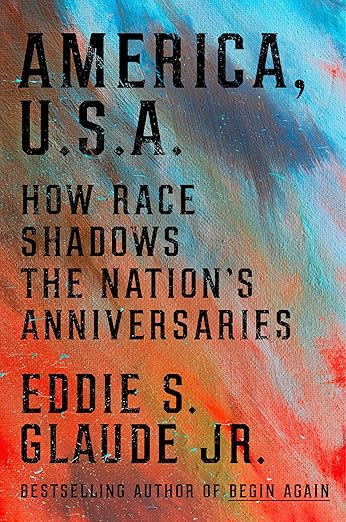
America, U.S.A.: How Race Shadows the Nation's Anniversaries
기준
Eddie S. Glaude Jr. (저자) 형식: 양장본
4.8 별 5개 중 4.8
(76) 4.6 등급 Goodreads
147 건
NEW YORK TIMES BESTSELLER • The New York Times bestselling author of Begin Again confronts America’s unfinished story in this blistering reassessment of race, freedom, and the myths that bind us.
“A thoughtful, insightful, beautifully written book that is timely and welcomed in these perilous times.”—Bryan Stevenson, #1 New York Times bestselling author of Just Mercy
“Eddie S. Glaude Jr. opens a necessary conversation as we reflect on the meaning of our country’s 250th anniversary.”—Annette Gordon-Reed, Pulitzer Prize– and National Book Award–winning author of The Hemingses of Monticello
Celebrated public intellectual Eddie S. Glaude, Jr. presents a groundbreaking analysis of the vicious cycles of American history and the country’s enduring refusal to face its true nature—especially at the moments when national anniversaries steer us back toward the mythology meant to disguise the truth.
America, U.S.A., deliberately formulated and beautifully written, details a heart-wrenching exploration of America’s legacy. It is a magnificently complex combination of lessons and voices—from W.E.B. DuBois and John Dos Passos to Herman Melville and Martin Luther King, Jr.—that, together, paint a sprawling and honest tableau of the United States, its complicated past, and ever more tenuous future. Glaude’s is a powerful voice of conscience in our tumultuous world. He pulls no punches, calling on us to interrogate our conceptions of innocence and freedom and the stories we tell ourselves about our past and present.
Centered around the major celebrations of America’s milestone birthdays across 250 years of history, the book offers a riveting look at the battles over who has a stake in writing the American story. Devastatingly candid, profoundly moving, and deeply reflective, America, U.S.A. is a shining meditation on how we must reckon with a grim past in order to strive for the better angels of our future.
간단히 읽기
==
출산사로부터
Bryan Stevenson says “Thoughtful, insightful, beautifully written”
Ken Burns says “No one understands better than Eddie Glaude”
Annette Gordon-Reed says “Open a necessary conversation”
Min Jin Lee says “honest, bracing”
Imani Perry says “So often referred to as the conscience of the nation”
Henry Louis Gates Jr. says “gifted us with a guide to understanding the history”
편집자 리뷰
리뷰
“No one understands the excruciating interiors of our ‘original sin’ better than Eddie Glaude. His scholarship extends into the darkest corners of our past. His insight offers fragments of a map leading to higher ground.”—Ken Burns
“Intriguing . . . Perfectly timed [and] refreshingly honest . . . Despite his despair, Glaude concludes that ‘the past still offers resources for us to freedom-dream.’ So, too, does this book.”—The New York Times
“America, U.S.A. is a bracing and elegant analysis of the contradiction at the heart of the American experiment: a country that claims to be committed to equality also adheres to white supremacy. Glaude opens a necessary conversation as we reflect on the meaning of our country’s 250th anniversary.”—Annette Gordon-Reed, Harvard University, Pulitzer Prize– and National Book Award–winning author of The Hemingses of Monticello
“Eddie Glaude reckons with the power of our stated values—liberty, freedom, equality, and independence—in the dim light of our actual unwillingness to share, sacrifice, yield, and prosper for the national good. Glaude is honest, bracing, and devastatingly brilliant.”—Min Jin Lee, author of Free Food for Millionaires and Pachinko, a National Book Award Finalist
“This is a thoughtful, insightful, beautifully written book that is timely and welcomed in these perilous times.”—Bryan Stevenson, #1 New York Times bestselling author of Just Mercy
“With exquisite prose, stunning moral clarity, abundant heart and soul, and utter genius, yet again Eddie Glaude proves why he is so often referred to as the conscience of the nation. It makes the stakes of America’s complex, anguished, and beautiful story clear as a bell.”—Imani Perry, Harvard University, National Book Award–winning author of South to America
“Glaude at once anticipates and rues the tumult of 2026, in a divided America whose reckoning with race and history remains woefully unfinished.”—Jill Lepore, Harvard University, New York Times bestselling author of This America
“Glaude provides a diagnosis of our current national shame, of our most bitter contradictions between promises and disappointments, and a vision of how real hope is born in a deep, transcendent sense of tragedy.”—David W. Blight, Yale University, Pulitzer Prize-winning author of Frederick Douglass: Prophet of Freedom
“As we approach the semi-quincentennial of American independence, Glaude has gifted us with a guide to understanding the history of our current moment and offers us ideas on how we can, in truth, forge a more perfect union.”—Henry Louis Gates, Jr., Harvard University, New York Times bestselling author of The Black Church
“Glaude offers a forceful counternarrative to the official commemoration of America’s 250th anniversary by surveying the horrors attendant to some of the nation’s previous anniversaries.”—Publishers Weekly, starred review
“A charged renunciation of American unfreedom that could not be timelier.”—Kirkus Reviews
저자 소개
Eddie S. Glaude, Jr. is the James S. McDonnell Distinguished University Professor at Princeton University and author of New York Times bestselling Begin Again and Democracy in Black.
==
It’s America’s Birthday, and He’ll Be Mad if He Wants To
In “America, U.S.A.,” Eddie Glaude Jr. looks back at the country’s past anniversaries with skepticism and pain.
A black-and-white photograph of men in robes marching away from the Capitol Building. A black-robed figure in the front holds an American flag.
The Ku Klux Klan parading in 1926.Credit...Bettmann, via Getty Images
By Richard Kreitner
Richard Kreitner is the host of the U.S. history podcast “Think Back” and the author of “Fear No Pharaoh: American Jews, the Civil War, and the Fight to End Slavery.”
May 25, 2026
Buy Book ▾
When you purchase an independently reviewed book through our site, we earn an affiliate commission.
AMERICA, U.S.A.: How Race Shadows the Nation’s Anniversaries, by Eddie S. Glaude Jr.
For those of us in the national memory-keeping business, anniversaries hold near-totemic power. Satisfyingly round units of time, ideally bearing fancy, Latin-derived names, serve as the overburdened pegs on which to hang think pieces and museum exhibits, revisionist documentaries and maudlin public ceremonies. The arbitrary nature of such occasions is precisely what gives them their charge, inviting us to set aside complacency and submit to a comprehensive check-in.
In his new book, “America, U.S.A.,” Eddie S. Glaude Jr. presents an intriguing variation on the genre, seeing the country’s 250th birthday as an anniversary of anniversaries: 50 years since the malaise-ridden, schlock-heavy Bicentennial. A century since the subdued Prohibition-era Sesquicentennial. A century and a half since telegraphed reports of George Armstrong Custer’s defeat by the Lakota and Cheyenne at Little Bighorn rudely interrupted the Gilded Age Republic’s 100th birthday party.
America, U. S. A.
America, U. S. A.
If an anniversary offers a snapshot of a moment, the core of Glaude’s book is an old-timey photo album, a collection of notable episodes from earlier national reckonings, long-ago glances in the mirror. An estimable scholar of Black history, politics and religion at Princeton — best known for “Begin Again,” his 2020 meditation on James Baldwin’s relevance for our times — Glaude focuses, as his subtitle puts it, on “how race shadows the nation’s anniversaries.”
Such celebrations, he contends, have never really been the moments for honest self-reflection they are often advertised to be. Instead, the nation usually shatters the mirror, refusing to accept what it prefers not to see. “American anniversaries are often moments to turn a blind eye to the evils of the past and the present,” Glaude writes, “to suppress the fact of America’s divided soul.”
Sign up for the Race/Related Newsletter Join a deep and provocative exploration of race, identity and society with New York Times journalists. Get it sent to your inbox.
It’s a clever concept, and, needless to say, perfectly timed. Last year, Glaude notes, the Trump administration executed a hostile takeover of the government’s studiously bipartisan 250th anniversary planning. It is now preparing a program that is certain to conceal more than it reveals about the country ostensibly being celebrated.
Glaude, in no mood for celebration, argues that such omissions and evasions also defined commemorations in the past. In 1875, Frederick Douglass predicted “one grand Centennial hosannah of peace and good will to all the white race of this country.” He was right: The nation reached 100 years old at a crucial moment in the post-Civil War fight over racial equality, with white Northerners ready to give up on Southern Reconstruction. The occasion would help the once-warring sections to reunite around a shared commitment to white supremacy. On May 10, 1876, at the opening of the Centennial Exposition in Philadelphia, the police tried to bar Douglass from the grandstand, until a white politician vouched for him.
Image
The cover of “America, U.S.A.,” by Eddie S. Glaude Jr.
The 150th anniversary came soon after a resurgent Ku Klux Klan successfully pushed for a restrictive immigration law aimed at keeping America a “Nordic” nation. At the lavishly funded, lightly attended celebrations in Philadelphia, Black veterans of World War I were excluded from marching in the opening parade. A writer with The Associated Negro Press wondered “what was in the breast of those black men who fought to make America safe for Democracy and on Monday stood on the sidelines, forgotten, as the Nordic strode by in all his vain pride.”
By 1976, when the nation marked its Bicentennial, the violence of the ’60s had destroyed any semblance of consensus. Vietnam and Watergate had eroded trust in the government. The commission initially tasked with organizing the anniversary was disbanded amid reports of corruption. Corporations filled the vacuum, Glaude explains, with “star-spangled whoopee cushions; patriotic toilet seats; Liberty hamburgers; red, white and blue beer cans.” The author, around 8 years old at the time, dimly remembers donning a pair of tricolor trousers.
A half-century later, Glaude is refreshingly honest about the depths of his despair. “I do not love America, and never have, especially now,” he writes in one of the more startling opening sentences I’ve read in some time. He dismisses this year’s Semiquincentennial as reaching back “to a storybook America that requires either the banishment of Black people from view or the reduction of our role in the country’s history, so as to affirm America’s ongoing quest to be a more perfect union.”
Undoubtedly true. But Trump doesn’t own the country, at least not yet, nor the 250th anniversary of one of the most radically liberatory and confusingly contradictory events in world history — an inspiration, as Glaude shows, even to critical observers of the American experiment, like Douglass. Far from the revanchist MAGA-palooza in Washington, I suspect this summer’s unasked-for invitation to national soul-searching may surprise us yet.
Despite his despair, Glaude concludes that “the past still offers resources for us to freedom-dream.” So, too, does this book.
AMERICA, U.S.A.: How Race Shadows the Nation’s Anniversaries | By Eddie S. Glaude Jr. | Crown | 270 pp. | $31
출판사 : Crown
발행일 : 2026년 5월 26일
==
미국에서
Mistress77
별 5개 중 5.0 ⭐⭐⭐⭐⭐ Powerful, Thought-Provoking, and Timely
2026년 6월 20일에 미국에서 리뷰됨
형식: 양장본확인된 구매
As an African American woman from the Mississippi Delta, this book truly spoke to me. Eddie S. Glaude Jr. challenges readers to look beyond the celebrations and anniversaries we commemorate as a nation and examine the deeper truths that often remain in the shadows.
This was more than just a book—it was an eye-opening experience. It encouraged me to reflect on history, race, identity, and the unfinished work that still lies ahead. The author's writing is insightful, honest, and engaging, making complex topics accessible while still provoking deep thought.
I found myself highlighting passages, reflecting on my own experiences, and discussing the book with others long after I finished reading it. Whether you agree with every point or not, this book will make you think—and that's the mark of a great read.
I highly recommend America, U.S.A. to anyone interested in history, race relations, and understanding America from a broader perspective.
A powerful and necessary read. Five stars! 🌟🌟🌟🌟🌟📚❤️🇺🇸✊🏾
15명이 유용하다고 평가했습니다
유용
신고
한국어(으)로 리뷰 번역하기
Ray Jaxon
별 5개 중 5.0 A Good Book, “America, U.S.A.”
2026년 7월 3일에 미국에서 리뷰됨
형식: 양장본확인된 구매
A good book that is very informative; the audio version may be even better.
유용
신고
한국어(으)로 리뷰 번역하기
Lola
별 5개 중 5.0 The author is intelligent and candid!!! Most appreciated!
2026년 6월 21일에 미국에서 리뷰됨
형식: 양장본확인된 구매
This book is awesomely written and thought provoking!! What a scholar
Eddie Glaude is!!! He is brilliant and intelligent, and very honest!!!!!
6명이 유용하다고 평가했습니다
유용
신고
한국어(으)로 리뷰 번역하기
Iris Wallace
별 5개 중 5.0 Take responsibility
2026년 6월 29일에 미국에서 리뷰됨
형식: 양장본확인된 구매
This should be required reading in High School. It demonstrates the issues America U.S.A. faces and is not able to overcome yet. Why is there a fear of true equal rights for all? We would only gain from accepting responsibility for our past and moving forward.
Highly recommend it.
4명이 유용하다고 평가했습니다
유용
신고
한국어(으)로 리뷰 번역하기
Peter Williams
별 5개 중 4.0 Very Educational !
2026년 7월 2일에 미국에서 리뷰됨
형식: 양장본확인된 구매
An interesting Read. Brilliant Author.
2명이 유용하다고 평가했습니다
유용
신고
한국어(으)로 리뷰 번역하기
Jane Maule
별 5개 중 5.0 Glaude brings the answer squarely to the fore!
2026년 6월 10일에 미국에서 리뷰됨
형식: Kindle확인된 구매
Love Eddie Glaude, Jr. Have missed him on TV programs... but understand why he has been "MIA" due to writing this book. Have a Masters+ education, am white and have searched for ways to address the racial gap. Grew up playing with black children and enjoyed their creativity and intelligence. The answer according to Glaude is really very simple, but far reaching... it is simply that love needs to become a reality... that black Americans' needs and the inequities they have suffered boil down to a lack of love and acceptance, (accountability in history) from which all social issues have arisen in our country's history.
I am sure I am oversimplifying... and he may think I have totally missed the mark here, but that is my take from reading this excellent era by era analysis of America's race issues. Like many, I thought we were finally on the way to solving this horrible reality for so many black Americans... The current administration is setting us back to before the Civil War... Thank YOU, Eddie Glaude. Thank YOU for challenging me to find ways to implement loving solutions and awareness within my community.
23명이 유용하다고 평가했습니다
====
Robert Butler
별 5개 중 5.0 Must read for everyone
2026년 6월 27일에 미국에서 리뷰됨
형식: 양장본확인된 구매
Dr Glaude has written another masterpiece in time for the 250th. He examines the 50th, 100th 150th 200th and what is developing with this 250
3명이 유용하다고 평가했습니다
유용
신고
한국어(으)로 리뷰 번역하기
S.Whigham
별 5개 중 5.0 The unvarnished truth of continuing racism in the United States today.
2026년 6월 24일에 미국에서 리뷰됨
형식: 양장본확인된 구매
Dr. Glaude reminds us we still have a substantial amount of racism still to overcome. I wish I fully understood what causes people to carry such irrational racist and xenophobic biases with them. I've seen them surface in my own heart, family and community. I hope we are getting better. But we need more direct, unvarnished conversation to continue to the process of making our country a more perfect union. Keep reminding us, Dr. Glaude. We are listening and learning as fast as we can how to live beyond the irrational prejudices causing so much pain and suffering in the world.
4명이 유용하다고 평가했습니다
유용
신고
한국어(으)로 리뷰 번역하기
Denise Brown-Saddler
별 5개 중 5.0 Brilliant
2026년 7월 1일에 미국에서 리뷰됨
형식: 양장본확인된 구매
Best Seller, you get much more information than your purchase. Eddie Glaude is a excellent writer!
유용
신고
한국어(으)로 리뷰 번역하기
Toni VG
별 5개 중 5.0 We Must Not Forget
2026년 5월 28일에 미국에서 리뷰됨
형식: 양장본확인된 구매
Charleston, SC born and bred. Raised by a beautiful dark skinned woman in a white household. Her history became mine through storytelling. Dr. Glaude, thank you for this book. Raw, painful, true in every way. The music score in four flats had me in immediate tears when I first saw that page. Those flats tell me the tone of the score. Everything thought through to bring your reader to the end conclusion. Every person with a love for fellow humans needs to read every single word you have written. When the book arrived and I touched the beautiful cover, I cried. We must never forget . We must never forget. We must do better. Thank you again.
22명이 유용하다고 평가했습니다
유용
신고
한국어(으)로 리뷰 번역하기
모든 리뷰를 한국어로 번역
RiverTim
별 5개 중 4.0 One example in support of Glaude's premise
2026년 6월 24일에 미국에서 리뷰됨
형식: 양장본
Recently I attended a large high school graduation in Charlottesville, VA. Of the 2000+ people there, about a quarter to a third were Black C'villers. During the national anthem it at least a third of them stayed seated. The many new immigrant families, from all over, and the long-time White locals, knew to stand. It made me wonder why this obvious difference.
3명이 유용하다고 평가했습니다
유용
신고
한국어(으)로 리뷰 번역하기
Trelani Michelle
별 5개 중 4.0 Important and Timely Work
2026년 5월 26일에 미국에서 리뷰됨
형식: 양장본
I feared this would be, as Toni Morrison once called them, another one of those “screw whitey books.” There’s nothing inherently wrong with those books—Toni herself acknowledged their necessity—but they can sometimes feel written with the white gaze sitting heavily on their shoulders.
Glaude manages to speak to everybody at once. Some books talk to Black folk. Some talk to white folk. This one talks to all of us. He isn’t merely telling readers what happened; he’s showing us. He layers the text with block quotes from figures like Du Bois, Douglass, and Baldwin, alongside lesser-known historical sketches like the story of Moses Gordon in 1797 to build his case.
The structure of the book is especially effective. By examining America’s major anniversaries from the Centennial in 1876, to the Sesquicentennial in 1926, to the Bicentennial in 1976, and now toward the upcoming Semiquincentennial, he forces readers to interrogate what we really mean when we say “progress.” How much has genuinely changed? How much oppression has simply changed faces? Are we a white republic or a beacon of freedom? Because we can’t be both. The book tracks those shifts across institutions, from the state to the church, revealing how deeply race shadows the nation’s self-celebrations.
One of the strongest realizations the book provoked in me was, as another reviewer pointed out, healing begins when we stop protecting the stories that are making us sick. Take the 1920s. Popular imagination remembers the Jazz Age. Eddie reminds us it was also the age of the Ku Klux Klan. During the Sesquicentennial International Exposition celebrating America’s 150th anniversary, the Klan was initially approved to hold its annual convention there. A celebration of the American flag unfolding alongside cross burnings. That contradiction may be the clearest summary of this entire book. And that’s only one example. I learned about multiple atrocities against Black Americans tied to July 4th celebrations throughout history, moments rarely included in the patriotic mythology many of us inherited.
Yet, despite how piercing the book is, it never feels academically cold or emotionally detached. As Eddie recently said in conversation with Imani Perry, this book gives us “the resources to speak back to the lies that these people are going to tell on July 4th.”
This is an important and timely work…one that asks America to not just celebrate itself, but to (finally) tell the truth about itself. Keep ya highlighter out with this one.
34명이 유용하다고 평가했습니다
유용
신고
한국어(으)로 리뷰 번역하기
Barb
별 5개 중 5.0 Brilliant! Ideally, it would be read by every human being
2026년 6월 29일에 미국에서 리뷰됨
형식: 양장본
A brilliant book; I was filled with incredulous anger and disbelief reading most of it. (After all, we live in a modern era which has had enough time to become enlightened!) It's desperately ironic that too many Whites, who identify as Christians, are bigoted racists. These people are somehow content (or in denial) to forget that 'God created all living things in his image'. Just like a bowl containing multiple kinds of fruits or a cacophony of different species of birds chirping in a forest, diversity should be lovingly embraced. Yet, on this note, America has not progressed as it should have by now. DEI and immigration are likened to cancers by White nationalists. I hope that this book is read by millions and that it will change, for the good, the hearts of a multitude.
1명이 유용하다고 평가했습니다
유용
신고
한국어(으)로 리뷰 번역하기
I. Perry
별 5개 중 5.0 Required reading
2026년 5월 26일에 미국에서 리뷰됨
형식: 양장본
Brilliant
3명이 유용하다고 평가했습니다
유용
신고
한국어(으)로 리뷰 번역하기
Brian Shevory
별 5개 중 5.0 The Fire This Time
2026년 5월 26일에 미국에서 리뷰됨
형식: 양장본
Princeton professor Eddie S. Glaude's new book America, U.S.A.: How Race Shadows the Nation’s Anniversaries is one of the most urgent and important books I've read this year, and it comes at an important time as many Americans will be celebrating the 250th, or semiquincentennial, anniversary of the nation's founding. I read and thoroughly enjoyed Glaude’s book Begin Again about 5 years ago. I found that book, which uses James Baldwin’s works and ideas as a way to examine race and injustice in America in the 21st century, to be both critical and hopeful in making the case that America has continuously faced issues of racial injustice, but that Baldwin’s writings and ideas can provide useful insight to examine these issues. Glaude never presents the ideas as solutions, but rather uses Baldwin’s life and experiences as like a lens for seeking understanding and contextualizing issues of race, injustice, violence, and inequality that we’ve experienced during the 21st century. I really appreciated how hopeful the book is while maintaining a critical eye on the injustice. Furthermore, I loved how Glaude revisits Baldwin, using literature, essays, and criticism to explore how other great thinkers and writers have navigated challenging times. I wasn’t necessarily expecting the same thing, but America, U.S.A. takes on an entirely different tone and approach in examining the existential questions surrounding the coming semi-quincentennial (250th anniversary) of the founding of the country. Nevertheless, like Begin Again, Glaude turns to other writers, thinkers, and activists, as well as the history of other celebrations of America’s founding, to examine how ideas of history and race have been co-opted, revised, or excluded in order to redefine the idea of America. Although this is a challenging and difficult book to read, it felt like the book I needed to read at this time, as I’ve been inundated with images of flags, stars, stripes, and Uncle Sams presented in a celebratory manner that don’t always seem to reflect my own complicated feelings about the country.
Glaude’s writing is clear and dynamic, not overwrought or dense. It’s not the prose of the book that is challenging, and if anything, the challenge and my own struggles with the book are necessary and contribute to a kind of growth and understanding. One of Glaude’s premises is that 250th celebration of America has been taken over, and with executive orders demanding a fictionalized history that fails to acknowledge the role of racism in the country’s founding, Glaude questions what kind of history and celebration will take place this year. It’s his call to interrogate the past, to reckon with the injustices of slavery that continue to be pushed aside or swept under the rug that plague America, creating a kind of storybook nation that only exists for certain groups of people. To quote spoken word pioneer Gil Scott Heron, this hagiography of history “ain’t no new thing”; it’s been happening since America’s first celebration in 1826, when African Americans couldn’t vote or even petition their representatives, for those who were not enslaved. Glaude examines how America celebrated these varying anniversaries, and how often African Americans and their contributions to the country were often excluded from these celebrations.
Glaude examines the history of these celebrations in Philadelphia, which I found fascinating since I’ve lived in the Philadelphia region my whole life and did not know about some of the events and instances he discussed in the book. Furthermore, it’s important to note that much of Glaude’s analysis examines Frederick Douglass’s seminal speech in 1852 “What to the Slave is the Fourth of July?” to further interrogate how history and celebrations of the ideals of America ring hallow. Douglass is an important figure to me. I graduated from the school where Douglass gave his last speech, and when I returned there a few years ago, I was excited to see a statue on campus memorializing not only his speech, but his contributions to society and Pennsylvania in particular. Glaude’s chapters not only present Douglass’s most famous speech as a reminder of how exclusionary the fourth can be, but also as a way to encourage readers to further interrogate history and the symbolism and meanings of what we sometimes take for granted as a day off to spend with friends and family at a barbecue or down the shore. Both Douglass and Glaude remind readers of how the “more perfect union” has failed to live up to its lofty standards set forth in the Declaration of Independence, where its initial lines clearly state that all men are created equal, endowed by their Creator with certain unalienable rights, including Life, Liberty and the pursuit of Happiness. Glaude also presents a story about how Douglass was denied a seat at the centennial dais in Memorial Hall during the centennial celebration in Philadelphia. Apparently police did not believe that a Black man would have anything to contribute to the celebration. Although he was later allowed to enter the exposition, he was never allowed to speak at the centennial celebration. Glaude presents this story to explore how it is emblematic of how African Americans are often silenced or pushed to the side during these celebrations of America, U.S.A. He later notes instances when Dr. King petitioned Kennedy for more recognition of the contributions of Black Americans, but he and A. Philip Randolph only received an invitation to dinner.
It was also fascinating to learn more about the 1926 celebration in Philadelphia. I’ve visited Memorial Hall, and spent time in the Please Touch Museum’s exhibit about the centennial celebration, but I wasn’t really aware of the 1926 celebrations, probably because, according to Glaude, these were plagued by lower interest and attendance and more funding problems, often related to graft and corruption. Nevertheless, as Glaude documents, it provided an opportunity for A. Philip Randolph to speak, which Glaude notes is an interesting choice since Randolph was the President of the Sleeping Car Porters, who helped to organize key Civil and Labor Rights events. The chapters between these “celebrations” focus on interludes, demonstrating key events that continued to represent the conflict between inclusion and exclusion of African Americans in the portrayal of the history of America. It’s fascinating and important to think about the different ways in which American continued to promote its ideals as it grew to be a global power, yet failed domestically to live up to its standards of liberty and justice for some, but not all. There’s much to unpack here, and I learned much from reading these chapters. However, I think that the book also made me feel so many complicated emotions, and that is even more a reflection of how important and necessary this book is today, especially as we approach a “celebration” that feels so dour and funereal. The last few chapters that focus on the last 50 years are fascinating to read, and I could not put the book down. Part of it is that these are the years which I’ve lived through and learned about through experience. It’s fascinating to learn the different battles and conflicts that have emerged and shaped the ways in which history and our own understandings of the country have been shaped and evolved over time. For me, it was important to know the myths and fairytales we tell about the founding of the country are continuing to erode, and that there are many who are interested in continuing to learn more about and reshape the truth we present to students and others. Yet, it’s also disheartening to know that there are many others who wish to grasp onto the myths and fairytales that we learned as children, and that when confronted with the facts of history, continue to pervert the truth and perpetuate the lies, choosing comfort and complacency over the struggles and challenges of learning and change. Glaude’s book is an important book for many people, but I think that this book is especially important for educators and others working with young people. It’s not only important to learn about the complicated feelings about this nation’s history and why “celebrating” it comes with its own complications and contradictions, but it’s also necessary to learn the kind of propaganda war that is being waged by those with positions of authority and voice in our government and media. It’s important and necessary to recognize the kind of whitewashing they intend in bad faith and disinformation they continue to spew about the diversity in America. Glaude frames this battle as one of consensus versus conflict, where over the past century, America has moved to an idea of consensus about the role of African Americans, and this consensus often neglects the more radical or revolutionary voices, who more often than not, reflect the kind of revolutionary spirit that won freedom from England. Again, it’s part of the complex and complicated nature of our country. However, as Glaude notes, Trump has moved from an idea of consensus that presidents from Reagan to Obama exerted about African American history, to one of imposition and erasure. In the past year, the Trump administration has authored executive orders that sought to erase Black, Indigenous, and other non-white voices and contributions from museums, parks, military libraries, websites, and classrooms. Not only is it a way to shape the history that students learn, but, as Glaude notes, it’s a way to indicate who deserves freedom and citizenship in society. Although Glaude ends the book with the annoyingly whiny words of VP Vance, he also ignites a call for resistance and change, to not only reclaim history, but also to continue to push against the untruths and the unserious and unsettling presentation of the storybook version of America, U.S.A.
There’s more that I need to unpack and examine from this book as it really made me experience a lot of different emotions. There’s much to learn from the book, but I wanted to mention Glaude’s references to DuBois throughout the book as well. Glaude not only includes music to begin each chapter, like DuBois did in Souls of Black Folk, but he also shares DuBois’s acknowledgement that the problem of the 20th century and beyond. DuBois declared that the color-line was the problem of the 20th century, and Glaude acknowledges that this continues to be a problem in the 21st century. It’s also important to call attention to Glaude’s references to DuBois, and that DuBois didn’t frame this as a problem of White people or Black people, but rather the division based on skin color and the oppression that results from this division. However, Glaude notes how DuBois’s color-line problem has evolved to the “desperate avoidance of self-awareness- its refusal to know itself fully, and the deadly consequences for people and the world that follow from that refusal. Ours is a time of shattered mirrors.” This line, and the shattered mirror reference from Baldwin at the end of the book, really resonated with me, and I felt like this demonstrated not only Glaude’s scholarship and references, but also his astute analysis at the ways in which the avoidance of race, injustice, and inequality continue to haunt us, leaving our homes with shattered mirrors that fail to reflect who we really are. Highly recommended and important book!
20명이 유용하다고 평가했습니다
유용
신고
한국어(으)로 리뷰 번역하기
Debra Howard
별 5개 중 1.0 Print to small for easy reading
2026년 7월 5일에 미국에서 리뷰됨
형식: 양장본확인된 구매
Print is very very small, I hate the print.
유용
신고
한국어(으)로 리뷰 번역하기
더 보시려면 모든 리뷰를 검색하
==
<아메리카, U.S.A.: 인종이 국가의 기념일을 어떻게 그늘지게 하는가> 요약 및 평론
1. 서론: 기념일의 화려함 뒤에 숨은 인종의 그림자
미국은 건국 정신인 자유, 평등, 민주주의를 자축하기 위해 다양한 국가 기념일을 지낸다. 그러나 에디 글로드 주니어(Eddie S. Glaude Jr.)는 그의 저서 <아메리카, U.S.A.: 인종이 국가의 기념일을 어떻게 그늘지게 하는가>(America, U.S.A.: How Race Shadows the Nation's Anniversaries)를 통해 이러한 기념일들이 인종주의라는 미국의 고질적인 모순을 은폐하는 도구로 작동해 왔음을 날카롭게 지적한다. 저자는 독립기념일, 노예해방기념일(준틴스) 등 국가적 이정표가 되는 날들을 분석하며, 미국이 과거의 잘못을 진정으로 성찰하기보다는 표면적인 축제를 통해 도덕적 결함을 세탁하고 있다고 주장한다. 이 책은 미국이 진정한 민주주의 국가로 거듭나기 위해서는 기념일의 환상에서 벗어나 그늘진 역사와 정면으로 마주해야 한다고 촉구한다.
2. 핵심 요약: 기억의 정치학과 위선적인 축제
글로드는 미국 역사에서 <기억>이 어떻게 정치적으로 편집되는지 탐구한다.
미국의 민주주의 신화와 건국기념일
미국은 1776년 독립선언을 통해 모든 인간이 평등하게 창조되었다고 선언했다. 하지만 저자는 이 선언이 선포되는 순간에도 수많은 흑인들이 노예로 종속되어 있었다는 사실을 상기시킨다. 국가의 탄생을 축하하는 기념일은 백인 주류 사회의 승리와 번영을 공고히 하는 장치일 뿐, 유색인종에게는 소외와 억압의 기억을 재생산하는 시간이다. 저자는 미국이 건국의 가치를 신화화함으로써 현재까지 이어지는 구조적 인종차별에 대한 책임을 회피하고 있다고 분석한다.
기념일의 제도화와 본질의 퇴색
책은 최근 연방 공휴일로 지정된 <준틴스(Juneteenth, 노예해방기념일)>를 주요 사례로 다룬다. 흑인 공동체의 고통과 해방의 투쟁을 기리는 이 날이 국가 기념일로 제도화되면서, 오히려 그 본질적인 저항의 의미가 퇴색되었다는 것이 저자의 지적이다. 지배 권력은 저항의 역사를 국가 서사 안으로 포섭하여 <미국은 스스로 오류를 바로잡는 위대한 나라>라는 이미지를 홍보하는 데 활용한다. 이 과정에서 현재진행형인 투표권 제한, 사법 체계의 불평등, 경제적 격차와 같은 실질적인 인종 문제는 축제의 폭죽 뒤로 가려진다.
인종적 가치 격차(Value Gap)의 지속
글로드는 미국 사회를 지배하는 가장 큰 문제로 <백인의 생명이 다른 이들의 생명보다 더 가치 있다>는 무의식적 믿음, 즉 <인종적 가치 격차>를 꼽는다. 국가 기념일은 이러한 격차를 좁히기보다, 미국이 이미 평등한 사회에 도달했다는 착각을 심어줌으로써 기득권 구조를 유지하는 역할을 한다. 저자는 진정한 진보란 과거의 상처 위에 승리의 깃발을 꽂는 것이 아니라, 상처의 깊이를 있는 그대로 인정하는 것에서 시작된다고 강조한다.
3. 비판적 평론: 신화의 해체와 진정한 성찰의 요구
날카로운 역사적 통찰과 담론의 확장
<아메리카, U.S.A.>는 미국의 애국주의적 서사가 가진 위선을 해체하는 데 탁월한 성과를 보여준다. 저자는 제임스 볼드윈의 비판적 지성을 계승하여, 미국이 스스로를 도덕적 결백주의자로 포장하는 방식을 정밀하게 타격한다. 단순히 인종차별의 역사를 나열하는 데 그치지 않고, 국가가 <기념(Commemoration)>이라는 행위를 통해 어떻게 대중의 기억을 통제하고 망각을 유도하는지 분석한 점은 문화 연구와 역사학적 관점에서도 매우 가치 있는 기여다.
제도화에 대한 회의주의와 현실적 딜레마
그러나 저자의 주장은 국가적 차원의 제도적 개선이나 기념일 지정을 지나치게 냉소적으로 바라본다는 한계를 지닌다. 준틴스의 연방 공휴일 지정은 오랜 세월 투쟁해 온 흑인 인권 운동가들의 결실이기도 하다. 이를 단순히 국가의 <화이트워싱(Whitewashing)> 전략으로만 치부하는 것은 제도적 진전이 가진 상징적, 교육적 효과를 과소평가할 우려가 있다. 구조적 모순을 지적하는 저자의 목소리는 강렬하지만, 그렇다면 국가적 기념 행사를 완전히 거부해야 하는가, 아니면 어떻게 대안적으로 기념해야 하는가에 대한 구체적인 실천 방안은 다소 모호하게 남겨져 있다.
결론: 애국심의 재정의
결론적으로 이 책은 미국이라는 국가의 정체성을 맹목적으로 추종하는 태도에 경종을 울린다. 국가에 대한 진정한 사랑은 화려한 기념일에 취하는 것이 아니라, 국가가 외면하려는 어두운 그림자를 직시하고 이를 바로잡으려는 고통스러운 노력 속에 존재한다는 점을 설득력 있게 논증한다. 미국 인종 문제의 심연을 이해하고, 기억의 정치학이 어떻게 작동하는지 파악하고자 하는 모든 이들에게 이 책은 무거운 질문을 던지는 필독서다.
==
==

댓글 없음:
댓글 쓰기