Postville: A Clash of Cultures in Heartland America - Wikipedia
From Wikipedia, the free encyclopedia
Background
The author travelled to and from his home in Iowa City and Postville, acquainting himself with the local native Iowan and Hasidic populations. Initially, Bloom sought out the Postville Hasidim in his quest to connect to his Jewish heritage in a largely Christian area, and to understand how the community adapted to life in small-town Iowa while surrounded by an insular, homogeneous and occasionally antisemitic culture. The Hasidim, who are involved in Jewish education and outreach initially accepted Bloom because of his Jewish heritage (though they viewed as a "wayward Jew" due to his secularism). Upon deciding that the Hasidim offered little enlightenment on either issue (as their sole concern was his religious awakening), Bloom's mission quickly changes from a personal quest to a journalistic exploration.
Summary
Bloom describes the arrival of the Hasidim in Postville. In 1987, Aaron Rubashkin, a Lubavitcher Hasidic butcher from Brooklyn, purchased an unused meat-rendering plant and turned it into a state-of-the-art facility for producing glatt kosher meat. A group of a few hundred Hasidim joined him to help manage and operate the facility, which grew to employ 900. The town's population of around 1,300 had a mixed relationship with the Hasidim.
Throughout the book, Bloom describes the power struggles between the two groups, culminating in a ballot referendum held by the town calling for annexation of the land where the plant was located, which permitted the town to gain the ability to tax and regulate the plant. According to the jacket, the book tries to the answer whether "the Iowans [were] prejudiced, or were the Lubavitchers simply unbearable?"
Bloom chooses sides in the culture clash. In the book, Bloom voices his opinions on the vote (he supports annexation) and his condemnation of the Hasidic community (whose behavior towards the local native Iowans he frequently describes as "despicable", and whose beliefs he characterizes as "racist"). At one point in the book, Bloom compares Menachem Mendel Schneerson, the Rebbe (religious leader) of the sect who died in 1994, to Louis Farrakhan, asserting that their messages of separatism are nearly identical.
In the Afterword of the updated edition of the book, Bloom describes the receiving in the aftermath of the book's publication frequent accusations of airing the Jews' "dirty laundry", and betraying his brethren.
Reception
The book became an important reference point in the wider perception of Orthodox Jewry in the United States. The book became especially well-read among liberal Jewish circles in the early 2000s.[citation needed] Many readers of American Jewish backgrounds found the book in tune with their sentiments toward the "ultra-Orthodox", reflective of the uneasy and occasionally antagonistic relationship between the modern and the Haredi Jewish communities today.
The book led many American Jews to rethink their assumptions about kosher meat. A movement toward kosher organic and free range meat was fueled by allegations of slaughterhouse conditions at Agriprocessors reminiscent of those described in Upton Sinclair's book The Jungle. By 2008, leaders within Conservative Judaism had called for an advisory against eating meat products from Agriprocessors, due to continuing allegations of mistreatment of workers.[1] Also in 2008, the Postville Agriprocessors plant was raided by Immigration and Customs Enforcement in what would be the largest such raid in American history. Hundreds of undocumented workers were arrested.[2] In 2004 and again in 2008, the Postville Agriprocessors facility was shown to use slaughter methods that opponents claimed were inhumane and therefore contrary to kosher law.[3][4]
Bloom did an interview in 2010 where he talks about all the pushback he received from non-Jews and Jews because of the content of his book. During this interview he tells a story that he says illustrates why the Orthodox Jews were being intentionally distant or hostile to the non-Jews of Postville, even to the point of being "racist". Bloom was walking down the street with a prominent member of the Jewish community there named Lazar. As they passed by some non-Jewish workers working on the sidewalk, Bloom told them "Good morning". Bloom asked Lazar why he didn't say good morning, or even acknowledge the workers at all. He replied to Bloom by saying that acknowledging them is "welcoming another Holocaust". Lazar then goes on to say that if they acknowledge non-Jews, then "our children will want to play with each other, then our children will want to go over to their homes, then our children will want to eat their food. Then we will be compromised".[5]
====
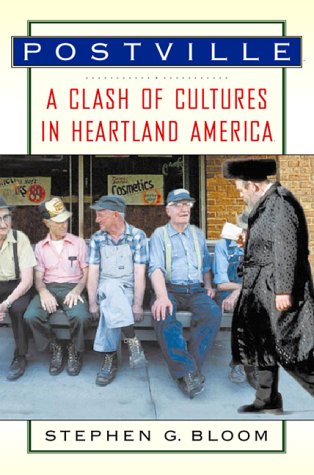
Postville: A Clash of Cultures in Heartland America
Format: Hardcover
4.2 4.2 out of 5 stars
(64)In 1987, a group of Lubavitchers, one of the most orthodox and zealous of the Jewish sects, opened a kosher slaughterhouse just outside tiny Postville, Iowa (pop. 1,465). When the business became a worldwide success, Postville found itself both revived and divided. The town's initial welcome of the Jews turned into confusion, dismay, and even disgust. By 1997, the town had engineered a vote on what everyone agreed was actually a referendum: whether or not these Jews should stay.The quiet, restrained Iowans were astonished at these brash, assertive Hasidic Jews, who ignored the unwritten laws of Iowa behavior in almost every respect. The Lubavitchers, on the other hand, could not compromise with the world of Postville; their religion and their tradition quite literally forbade it. Were the Iowans prejudiced, or were the Lubavitchers simply unbearable Award-winning journalist Stephen G. Bloom found himself with a bird's-eye view of this battle and gained a new perspective on questions that haunt America nationwide. What makes a community How does one accept new and powerfully different traditions Is money more important than history In the dramatic and often poignant stories of the people of Postville - Jew and gentile, puzzled and puzzling, unyielding and unstoppable - lies a great swath of America today.
Read less
Language : English
Print length : 338 pages
Customer Reviews:4.2 4.2 out of 5 stars
(64)===
From other countries
Jeff
5.0 out of 5 stars Clashes of cultures on many levels
Reviewed in the United States on 29 June 2020
Format: HardcoverVerified Purchase
Growing up decades ago in Northeast Iowa gave me a perspective of what the town of Postville was like before the Jews purchased the meat packing plant. Reading this book took me back to the innocence of my youth and it reflected the naivete of most small towns. The true clash of cultures is when people think that OTHER people should change to accept those around them. Some people in Postville were willing to accept the outsiders. They welcomed the newcomers with great hope that the Jews would integrate into the well-established culture of Postville. Other Postvillians were more skeptical. After arriving, the Orthodox Jews maintained their culture without commingling with the locals. The expectations of the locals hoping to welcome the outsiders proved to be a blow to their hopes. And in that, a clash between the welcoming locals and skeptical locals ensued.
In some ways, the author describes a clash of cultures on a personal level. A big-city Jew (albeit secular) moves to small-city Iowa and seeks to connect with the locals. His own personal struggle mirrors many of the aspects of both the Postville locals and the New York Jews. In his exploration of the town of Postville, he overcomes the clash of his own personal culture. Yet, he carries forth many aspects of his personal culture within himself.
Report
Glenn S. Leach
4.0 out of 5 stars Pre-ICE Raid Postville
Reviewed in the United States on 17 July 2008
Format: PaperbackVerified Purchase
Postville: A Clash of Cultures in Heartland America
This book describes the author's family move from the sophistication of life in San Francisco to Iowa in 1993. The author's acceptance of a position as professor of journalism at the University of Iowa necessitated not only a change of location, but also of world view and life style, as witnessed by his shock in reading a newspaper review of the better sea food retaurants in the Cedar Rapids area and finding Red Lobster and Long John Silver listed.
I purchased the book because like so many, I was horrified at the multi-million dollar raid performed by ICE (Immigration and Customs Enforcement) at the Postville Agriprocessor's meat packing plant in May 2008. The raid netted some 400 workers, principally of Guatemalan and Mexican descent, working at the plant that day. I wanted to know the history of the town and the plant that brought these people to this small Iowa town, to a factory operated by Hasidic (ultra-orthodox) Jews. At the time of the raid, the plant provided nearly 60% of the kosher beef, lamb and poultry in the US.
In an often humorous, but always serious and evenhanded way, Bloom tells the tale of the dying town that was ressurected by the opening of the kosher operations at the abandoned meat packing plant there. The creation of more than 400 jobs, even though the jobs did not attract workers from Iowa, was still an economic miracle for Postville, but as Bloom explains, the blessing was also a curse, as it meant the the Hasidic Jews had accomlished that which the town and state had not. It also meant that the Jews were the wealthy people in town who effectively called the shots on much of town life. Finally, there were the cultural and religious differences that had never quite been over come.
Bloom's tells this story of culture clash from several perspectives, and the people, real people (although some are re-named from their actual names) are living, breathing people, not stereotypes. One one level, Bloomn's book is a history of ecomic and culture clash in a small, rural town. On another level, possibly not intended, the book is a tale of globalization, and the shifting role of the US in a global economy. The tensions and clashes in the book seem to parallel or foretell the rise of globalism and and its clashes with rising nationalism and nativism.
The book is a valuable and comfortable read on its own. As we learn more and more of the social and economic paralysis now besetting Postville (not to mention the cost to tax payers for the raid itself), I believe Bloom's book will be a valuable tool in defining a basline and illuminaitng the very intangible sociological elements of the town's existence.
Report
S. Oppenheim
5.0 out of 5 stars Intriguing, well written, gripping story and really engaging narrative style.
Reviewed in the United States on 11 August 2013
Verified Purchase
I truly thought this could be a dry anthropologic treatment of the clash of cultures, but instead the journalist-narrative really strives to bring humanity dripping with details and candor in every page. It made me want to stay up late reading more about his journey into the partly-closed-off hasidic community and interviewing with friendly locals who eye the jews with a mixture of curiosity, racism, acceptance, and gratitude for rejuvenating the local economy. Highly recommended!
Report
Fred G.
5.0 out of 5 stars Left a lot of unanswered questions but I couldn't put it down.
Reviewed in the United States on 18 April 2013
Verified Purchase
Interesting read though I suspect it took both cultures out of context. There are good and bad in both. I am not sure if the author was seeking an answer to questions about his own beliefs about himself or developed a bias of his own. Whatever, it prompted me to think and do further research. It was worth the time to read it.
Report
Lydia Musher
3.0 out of 5 stars It's not journalism, but read it anyway.
Reviewed in the United States on 31 October 2004
Format: PaperbackVerified Purchase
No, it's not "good journalism," it's biased and even angering as the previous reviewers have stated. The author doesn't speak to as many Hassidic sources as he does to townspeople. Part of the way through the book, he takes a side completely and stops speaking to the Hassidim entirely. He doesn't break down many myths about either side but particularly he doesn't understand how the Hassidim treat women, which is disappointing given his natural position as potential ambassador between the two groups. It's clear that he does not practice what he preaches (that is, remaining objective and having two sources back up each fact that he uses). So, the first 200 pages of "analysis" are a little bit disappointing and predictable, speaking in vague terms about mild anti-semitism.
What makes this book truly worth reading is what happens about 200 pages in. Bloom stops reporting on the situation and starts reporting more correctly on several specific topics, namely: the business practices of the Hassidim in Postville, certain incidents in the local area, and - most fascinatingly - about the criminal actions of and obstruction of justice by a small handful of Hassidim in Northeast Iowa.
It's absolutely worth reading Bloom's tepid analysis for 200 pages to get to these 130 pages of rather engrossing stories.
Report
Rachel McElhany
4.0 out of 5 stars Reads Like A Novel - engaging and informative
Reviewed in the United States on 21 January 2010
Format: PaperbackVerified Purchase
This book was about the culture clash in the small town of Postville, IA (population 1500) between the white, Christian locals and the Hasidic Jews who moved in the late 80s and turned an old slaughterhouse into a kosher slaughterhouse. The author is a Reform Jew so he brought an interesting perspective to the conflict as someone sort of in the middle of the two extremes living in Postville.
I really liked this book, it reads like a novel. The only thing that bothered me was the author throwing in Yiddish or Hebrew words without telling me what they meant. The plant in Postville was raided in May 2008 and almost 400 undocumented immigrants, mostly from Somalia and Latin America were removed and the NYT reported that the plant is defaulting on a $35M loan. A sequel may be in order.
Report
E Snoddy
5.0 out of 5 stars Later came into the news bigtime
Reviewed in the United States on 4 January 2013
Verified Purchase
This Jewish author is so very even-handed. You will go with this side and then with the other side and then switch again and again. Things are not completely as they seem and you go on a journey of immersion in 2 cultures, only one prevailing. Years after the book, one of the main participants was involved in a huge federal scam and made national papers for years afterwards. Fascinating and well-written book.
Report
donald j. langston
5.0 out of 5 stars potsville
Reviewed in the United States on 5 June 2020
Format: PaperbackVerified Purchase
SO HAPPY TO FIND THIS BOOK AGAIN.IT CAME IN GREAT CONDITION AND LOOK FORWARD TO REREAING IT
Report
sharon7.4
4.0 out of 5 stars it is important to remember that the behavior of the ...
Reviewed in the United States on 4 November 2014
Format: PaperbackVerified Purchase
it is important to remember that the behavior of the Hasitic Jews clashed with the LOCALS in Iowa Much of their behavior would have gone unnoticed in New York.
This cloister treats all non Jews as outsiders and they are very difficult for other Jews to deal with also. it was a little choppy but very interesting.
Report
Grouchy Misanthrope
4.0 out of 5 stars Very interesting and good read.
Reviewed in the United States on 26 October 2013
Format: PaperbackVerified Purchase
Very thought provoking. It is easy to jump to conclusions and condemn one side or the other in this dispute based simply upon stereotypes, but after reading the book one gains insights into the thinking and culture of both sides. I was lead to conclude that the issues here were neither black nor white, but varying shades of gray.
Report
Sam
3.0 out of 5 stars but the writing style was not my favorite. No offense at all to the author
Reviewed in the United States on 31 January 2015
Format: HardcoverVerified Purchase
I had to read this book for a class. It was interesting, but the writing style was not my favorite. No offense at all to the author, but at certain points during the book it read as if a high school student had written it.
Report
D. Smith
4.0 out of 5 stars Four Stars
Reviewed in the United States on 13 December 2015
Verified Purchase
A shame this novel had never been a documentary would have been very interesting to see.
Report
Mary Johnson
4.0 out of 5 stars Great Read
Reviewed in the United States on 5 January 2013
Format: PaperbackVerified Purchase
I enjoyed this book very much - actually this is my second purchase - I bought it as a gift.
Report
Kathleen Byrne
3.0 out of 5 stars Three Stars
Reviewed in the United States on 24 December 2014
Format: PaperbackVerified Purchase
Another book about the exploitation of a small town and illegal aliens by a Kosher Meat Co.
Report
James A. Bergquist
3.0 out of 5 stars Three Stars
Reviewed in the United States on 26 November 2015
Format: PaperbackVerified Purchase
Descriptive and informative, but a bit snarky toward ordinary Iowans.
Report
micha
5.0 out of 5 stars Things up
Reviewed in the United States on 29 December 2020
Format: PaperbackVerified Purchase
Good book!
Report
LaDean
5.0 out of 5 stars A facinating book for people who are curious about the world!
Reviewed in the United States on 2 January 2014
Format: PaperbackVerified Purchase
Very interesting if you are a person who is interested in people, places and culture! I was born and raised in Iowa sothis was especially interesting to me.
Report
Carol Polk
5.0 out of 5 stars Great historical drama with insight into the world of ultra ...
Reviewed in the United States on 14 August 2015
Format: HardcoverVerified Purchase
Great historical drama with insight into the world of ultra conservative Jewish people in Iowa. Going to visit Postville in September.
Report
Terry R. Reiter
1.0 out of 5 stars One Star
Reviewed in the United States on 17 May 2015
Format: HardcoverVerified Purchase
Not worth the paper it was printed on.
Report
Happy Customer
5.0 out of 5 stars Great Product !!! Great Price !!!
Reviewed in the United States on 28 November 2018
Format: PaperbackVerified Purchase
Great Product !!! Great Price !!!
Report
Show 10 more reviews
Ethel Jean Saltz
5.0 out of 5 stars A Must for every Progressive Israeli/te
Reviewed in the United States on 19 August 2005
Format: PaperbackVerified Purchase
This was a personal recommendation by a Rabbi who handled my URJ ASK THE RABBI question about Kashrut. I couldn't let the book down. I wanted to know how it ended but refused to peek. It solved all my personal doubts forever. It helped me define "Who Am I?" as an Israeli/te.
Report
diver46
5.0 out of 5 stars Read
Reviewed in the United States on 17 June 2019
Format: PaperbackVerified Purchase
Book group
==========
Community Reviews
3.79
1,007 ratings168 reviews
5 stars
226 (22%)
4 stars
441 (43%)
3 stars
269 (26%)
2 stars
48 (4%)
1 star
23 (2%)
Search review text
Search review text
Filters
Displaying 1 - 10 of 168 reviews
Profile Image for Arthur Read.
Arthur Read
75 reviews
Follow
August 27, 2025
Nightmare Neighbors
This is genuinely one of the most fascinating books I have ever read on any subject. I was glued to every single page. It was even more interesting than its striking cover.
I'm going to see if I can email the author and suggest that he write a sequel, a Postville 2: Electric Boogaloo, taking us behind the curtain (like he did so masterfully yet accessibly here) and reveal the salacious details of the momentous occurrences that have taken place in Postville, Iowa since this book's first publication in October of 2000, even if Bloom himself is no longer a participating character in this troubling drama as a uniquely vantaged observer nominally belonging to both the Jewish and Gentile worlds but feeling truly at home in neither.
The most notable example of these occurrences would be Agriprocessors (the largest kosher meat processing facility in the United States) sensationally being shut down in 2008 after the largest ICE raid in American history revealed hundreds of illegal immigrants employed in the facility, including child labor. The undercover PETA investigation revealing horrifying animal cruelty that went even beyond the usual nightmarish brutality they're accustomed to seeing in slaughterhouses. Sholom Rubashkin being sentenced to prison for dozens of counts of financial fraud, proving that the Lubavitcher Hasids who descended upon the good people of Postville were more than just abrasive nuisances and were actually tied up in organized criminality. Was there really a methamphetamine lab guarded by attack dogs in a portion of the ever-expanding premises, as reported in several credible mainstream outlets but then buried without explanation? What was the inside story behind Rubashkin being pardoned by Donald Trump in 2017, despite the latter being swept into the White House largely on a platform of strictly cracking down on illegal immigration?
What is Postville like today? Has the once closely-knit, crime-free rural Midwestern town of German Lutheran farmers with a high sense of communal feeling and trust been permanently eviscerated after being so cruelly taken advantage of repeatedly by the invasion of Hasidim completely alien to them in custom and temperament?
Did Phillip Stillman eventually get released from prison, and did the rabbis make good on their sketchy agreement to shower him with luxuries upon release for taking the fall for Pinchas Lew's share of the duo's sickening crime spree? It is true, as Rubashkin said to the author, that Stillman and Lew were a couple of bad apples who could not be fairly said to impugn Postville's Hasidic colony. It's abundantly clear that the fastidious commitment to Jewish rituals that govern Hasidic behavior and activity from the moment they wake in the morning until they go back to sleep at night simply does not leave enough idle time to go on Grand Theft Auto-like rampages of mayhem. But the community's supercilious, indifferent response to the convenience store clerk - a grandmother - that Stillman shot and damn near killed is absolutely representative of the friction-causing attitude they brought with them to Postville at large:
None of the Hasidim denounced the shooting of Marion Bakken. No one apologized to her. They didn't raise money for her. No one from the Jewish community donated anything to her as a token of their sorrow or shame. None bothered to visit her or her family. They didn't even offer her free meat from the slaughterhouse. The Hasidim treated Marion Bakken the way they treated all the goyim. They ignored her.
I could go on and on. Read this book!
jewish-identity
judaism
race-relations
12 likes
1 comment
Like
Comment
Profile Image for Genia Lukin.
Genia Lukin
253 reviews
203 followers
Follow
March 31, 2017
This is a story of intolerance. Intolerance by the Chabad community, yes, and also intolerance from the Postville townsfolk, certainly, but above and beyond it all, the author’s own. He says he walked into the world of Chabad in an attempt to search for his own Jewish identity, but in reality what he seems to have wanted was a confirmation, or an affirmation, of the way he saw the world. And when he failed to get it, he passed harsh judgment over everything in sight.
The author is what here, in Israel, is viewed as the epitome of the modern Diaspora Jew, really; quiet, unassuming, keeping his Jewishness in a little closed in the back of the house and never letting it out for a walk much. He finds these extraverted, extraneous, clearly and overtly, unapologetically Jewish Chabadnikim to be… well, frankly, embarrassing. Look at them, being Jewish for just, well, everyone to see. Look at them not trying to make a good impression. Look at them… just… just not caring! What do I do with these people who are neither nice nor deferential nor unassuming nor trying to seamlessly find a home in this new place they came to. The author is confused, he’s stressed, and he is smitten with the apparently quintessentially “nice” Iowans who never put a finger into his own private business or ask personal questions. That the Chabadnikim are essentially practicing similar abstinence in regards to the Iowans – that they just want to be left alone, really – however, only raises his ire. He could never do that.
He has the secular lack of understanding to the way that orthodox Jews (and many other non-Western religious groups) deal with their religious observance, with a mixture of absolute devotion and a casualness that is straight-up foreign to a society that solemnized Christianity as its embodiment of the sacred. The author rails, for instance, about how the shul (the synagogue) looks disorganized, plain, even a bit dirty, like, he says, “a flophouse”. He’s ever so glad that none of the townspeople were invited inside, I would just shame him! He wants his synagogues to be like churches, quiet, solemn, dignified, and he wants his Judaism like Christianity too, quiet, solemn, dignified, confined to one day of the week. But they ain’t, and it ain’t, and he has no idea what to do with that.
He can’t understand that an orthodox shul is the center of a community’s life, including meals, random social events, people trucking in to study at every hour of the day, God knows what else. Of course it’s disheveled, it’s people’s house of worship, emphasis on the ‘house’. He can’t forgive an academic colleague for ‘not answering work calls from Friday evening to Saturday night’, considering it to be some sort of extreme manifestation of insularism and hard-liner religiousity, How dare this guy observe Shabbat, one of the key tenets of Judaism and perhaps the most serious one in modern times? Look at how they made an intolerant extremist out of him. His fellow university professors, who denied him tenure for being an observant Jew, are not judged so harshly in the author’s mind.
He makes so many mistakes and misassumptions in his dealings with his own (technically) culture, and describes incidents so weird and clichéd that sometimes they just stretch the threshold of believability; I mean, Chabad is well known for prepping its schlichim and outreach people. Does it really seem likely that one of these ‘missionaries’ would, when meeting a person he knows for a fact is unreligious on a Sabbath, start purposefully muttering about ‘who is this goy in shorts?’ Is this for real? Do you think them stupid?
There is something about this book that illustrates the victory of the “nice” in people’s minds. The chasidim are bad not, primarily, because of their unethical work practices, which are barely touched upon, or their actual purposeful interference in town life, but because they fail to be nice. They fail to be “neighbourly”, they fail to adhere to norms. I care about their treatment of the animals they slaughter, their employees and business partners, but I care a heck of a lot less if they mow their lawns or fail to invite people to a picnic.
I do not exonerate the chabadnikim. Ultra-Orthodox communities are notoriously insular, profoundly fundamentalist, and hard to live with. They have problems and I can go on about them from here until next Shabbat, at least. That, without even touching upon their business practices, which, as time has proven, were anything but laudable, just or righteous. But neither can I ‘side’ somehow with the good, nice, respectable townspeople of Postville, whom the author says came to see his “being of the same faith with” the Hasidim as unimportant, because they understood he was on their side. Sigh. I don’t think them to be anti-semites, but I do think this sort of problem, or a similar, would have arisen between these nice, lovely, respectable townspeople and their non-anti-semitic worldview, and any minority of a different cultural background that would’ve come to reside in their town. They can accept any 3ethnicity so long as that ethnicity acts and thinks more or less like small-town Iowans. But the chabadnikim, with their alienation and their essential refusal to blend in, with their desire to just be left alone are just too much.
The author doesn’t really do any favours to the Iowans, much though his sympathy is engaged. He doesn’t dig under the surface of pleasant, bucolic and uniform, even in Iowa City which seems like the kind of place to have, you know, actual metropolitan qualities.
I am very interested in the other book on this subject, Popstville, America. The authors of this book include someone from the Chabad community itself, and seem to be inclined to much more objective reporting in mind.
biography-history
11 likes
2 comments
Like
Comment
Audrey Evans
285 reviews
5 followers
Follow
February 16, 2026
I saw this book on another GReaders list, which reminded me to put into my “read books”. I read this book so long ago and yet I remember it distinctly. I read because it was the book chosen by my Temple bookclub. Actually, the discussion of the book became so heated that our bookclub stopped meeting for over a year. How could a book about Hasids “invading” a small town in Iowa cause such personal anger? Hint: notice that I use the word “invaded”, not a neutral term. But it is how I would describe the Hasidic Jews who moved to Postville; to say they kept to themselves would be an overstatement. They made no effort to be a part of the community or to observe the community norms. THIS Is the beginning of a review that will posted soon.
5 likes
1 comment
Like
Comment
Profile Image for Kecia.
Kecia
26 reviews
Follow
October 3, 2009
Having spent some time in Postville, pre-Hasidic Jew period, it was shocking to see how the town of working farmers was turned upside down and at complete odds with their new neighbors.
Now, after the fall of Agri-Processors (kosher meat plant), it gives even more perspective as to why the town was so angry about the influx of the Jewish sect that refused to interact with the 'natives'. Not only did they end up changing the landscape of the town, they have forever left a stain on the community making national news of employing hundreds of illegals. These people were treated very poorly, paid sub-standard wages and knowingly 'sponsored' by Agri-Processors to hide their illegal status. Greed know no religion.
6 likes
Like
Comment
Profile Image for Cwn_annwn_13.
Cwn_annwn_13
510 reviews
87 followers
Follow
December 13, 2008
Postville: A Clash of Cultures in Heartland America looks at how tensions gradually erupt between locals and hasidic Jews who opened a kosher slaughterhouse in a rural farming community. This book was written by a secular Jew from the west coast who had moved to Iowa to take a job as a university professor.
While the author certainly has issues of his own (he actually cites the scoutmaster mentioning Jesus Christ at his sons Boy Scouts meeting as an example of anti-semitism he has experienced in Iowa!) I don't think the most rabid Jew hater could have done a better job of making the Hasidic Lubavitchers look bad. After being taken under the wing of Lubavitchers who wanted to convert him, as a secular Jew, to their Hasidic sect, Bloom in the end exposes the Lubavitchers worst traits. From their petty haggling over prices in local stores over the smallest of items, to their racist attitudes towards "goyim" and "schwartzs", while simultaneously accusing anybody who disagrees with them of being anti-semitic, to their refusal to pay debts and honor contracts in business dealings and other bullying business practices, their importation of illegal immigrant riff raff to this once homogenous crime free town to cheapen their labor costs, even their cruel way of slaughtering animals to make the meat kosher are brought to light. All of these factors, along with the Hasidic Jews refusal to participate in the community other than by using it to make themselves rich, gradually over a period of time caused major tensions between multi-generational locals and the Lubavitchers. On the other hand he does show some of their admirable traits also, like being family oriented and their obsessivly strict adherence to preserving their own culture and customs.
Overall this a very good book that I would recomend to anybody interested in Jewish culture, or anybody that wants to delve into reasons why Jews, who seem to never be able to see the reasons themselves, are often disliked, throughout the world and history, by people of many races and cultures. You can also learn a lot about the tensions and infighting that goes on between secular Jews like Bloom and the Orthodox Jews too.
5 likes
1 comment
Like
Comment
Profile Image for Elliot Ratzman.
Elliot Ratzman
566 reviews
90 followers
Follow
November 21, 2017
A jaunty Jewish journalist paints a disturbing portrait of small town locals/yokels and out-of-town ultra-orthodox who open a kosher butchering plant in rural Iowa. The locals are rendered as somewhat ignorant and a tad xenophobic. The author’s descriptions of the Jews are a white supremacists’ dream: rude, unfriendly, haughty, obnoxious, pushy and disrespectful. The owners’ obsession with money, and the serial swindling and haggling with the gentiles is embarrassing. The rest of us—the vast majority, non-Orthodox Jews—have to manage the fallout from this, our conflicted feelings about rude Jewish supremacists making the locals’ mild anti-Semitism understandable. On the one hand, a serviceable portrait of pious orthodoxy; on the other, the intolerable warts of this insular community and its business practices. The story gets worse after the book was published: exploited labor, strikes, and the Chabad general disregard for law, order and non-Chabadniks. Do the Amish have such struggles?
2 likes
4 comments
Like
Comment
Profile Image for Susan.
Susan
525 reviews
Follow
June 8, 2012
“Postville” is fascinating…especially if you have roots in the Midwest and any experience with the customs of ultra-Orthodox Jews.
Published in 2000, four newspapers listed it on their best book of the year lists. Bloom is a reporter turned journalism professor at the University of Iowa making Iowa the “heartland America” setting for this piece of personal experience nonfiction that was hard to put down.
In the late 1980s a group of Hasidic Jews from New York opens a kosher slaughterhouse in Postville, Iowa. Right there you have the “clash of cultures” from the subtitle.
Recently relocating from San Francisco to Iowa City, Bloom, himself a Jew but not ultra-Orthodox, sets out to explore how things are going in Postville from all points of view. However, he remains an outsider because he’s not Orthodox enough for the Hasidic Jews and he’s not a native Iowan either.
I can’t fault Bloom – as some reviewers have – for not trying to be objective. Bloom admits his goal from the outset as one of searching for how he fits into Iowa after his recent move. At one point, he reminds the reader, “I knew in my heart that the conflict between the Postville locals and the Hasidic Jews continued to be a metaphor for my own transplanted life in Iowa. I wanted to belong, I just didn’t know to which group.”
Through masterful description and use of fiction techniques, such as dialogue and character development, Bloom immerses his readers in the lives of Postville residents right along with himself. Taken more generally, readers can understand how Postville in a microcosm of so many communities throughout our country today.
Once you’ve finished Bloom’s book, be sure to Google “Postville Iowa 2008” for an update.
2 likes
9 comments
Like
Comment
Profile Image for Muffin.
Muffin
370 reviews
16 followers
Follow
July 8, 2020
I was really unimpressed by this one. The story is definitely interesting, but the author seemed to have no frame of reference for anything, and the book is full of the kind of broad generalizations Bloom seems desperate to counteract with this book. He has almost no access to the Hasidic community he writes about so a small handful of individuals are used to stand in for an entire community. He also repeatedly dichotomizes "The Jews" and "The Iowans" as though The Jews don't also live in Iowa. It may be the way many of his subjects describe the Hasidic community of Postville but it's...not great. He also spends barely any time with the only members of the community who interact with both Hasids and Christians: the lowest-level workers at the slaughterhouse. I'm not surprised so many of the people profiled in this book hated the book. I think there's a documentary about Postville, I bet that's way more interesting.
2 likes
Like
Comment
Profile Image for Betsy.
Betsy
354 reviews
Follow
April 8, 2009
Having covered the fallout from the 2008 immigration raid in Postville as a reporter, this book was required reading - but it was published in 2001 so it was outdated in many ways. It did provide still-useful background about the Lubavitchers' early years in town and their eccentric way of life. But I was irritated that the book was as much about the author and his urban-Jew-out-of-water struggle to get used to living in Iowa after moving here from San Francisco (poor bubbala.) Bloom made Iowa City, of all places, sound like hicksville, and regurgitated knee-jerk stereotypes of Iowa/Iowans (if not Hasids) which made me question his assessment of all else in the book.
2 likes
Like
Comment
====
Kindle
$10.42
Available instantly
Paperback
$24.42Other Used and New from $16.78
$10.42$10.42
Buy now with 1-Click
By clicking the button above, you agree to the
Kindle Store Terms of Use.
Price includes tax, if applicable
Sold by: Amazon Australia Services, Inc..
Send a free sample
Add to Wish List
Never miss a Kindle deal
Receive a daily email with a selection of Kindle deals and special offers you might enjoy.
Learn more.Not now

Postville, U.S.A.: Surviving Diversity in Small-Town America
by
Aaron Goldsmith (Author) Format: Kindle Edition
3.7 3.7 out of 5 stars
(36)Postville is an obscure town in the northeast corner of rural Iowa where the nation’s largest kosher meatpacking plant flourished for more than a decade. As a result, unparalleled ethnic diversity sparked the curiosity of international media. But Postville’s momentum was stopped in its tracks on May 12, 2008, when Agriprocessors was crushed by a massive US Immigration and Customs Enforcement raid. More than 20 percent of the town’s population was arrested, a battery of criminal charges was levied against the company’s management and a disastrous immigration policy was exposed. The meatpacker’s ensuing bankruptcy contributed to the near economic and social collapse of the town. Today Postville is attempting to survive a near terminal blow. The lessons from Postville’s struggle provide urgently needed insights for small towns all across rural America undergoing rapid ethnic change in the face of new global economics and international migration.
“This is a book that had to be written, and Mark Grey and his colleagues are the right people – perhaps the only people – to write it…..Anyone who wants to understand immigration and diversity – and needs to understand that they aren’t necessarily the same thing – must read this book. So must those who think this nation can survive without immigrants, and those who think any of this will be easy. Postville USA is both a great yarn and a signpost to the American future.”
- Richard C. Longworth
Caught in the Middle: America's Heartland in the Age of Globalism
“An important close-up look at how the global economy, US labor policy and a dysfunctional immigration system have buffeted one community, and how residents drew on traditional Midwestern tolerance to accommodate this change.”
- Jennifer Ludden
Winner, Robert F. Kennedy Award and the Society of Professional Journalists' Award for Excellence in Journalism
"This fresh, thoughtful take on Postville shows a town crushed by greed, federal indifference and a badly flawed immigration system, all fueled by America's demand for cheap food. It is a sobering read."
- Sue Fishkoff,
The Rebbe's Army: Inside the World of Chabad-Lubavitch"and Kosher Nation, (forthcoming) on kashrut and kosher food production."
Mark A. Grey is professor of anthropology at the University of Northern Iowa and founder of the Iowa Center on Immigrant Leadership and Integration. Michele Devlin is professor of public health at the University of Northern Iowa and Director of the Iowa Center on Health Disparities. Aaron Goldsmith, former City Councilman of Postville, received a rabbinical degree from Yeshiva Tomchei Tmimim in Kfar Chabad, Israel, and is currently president and owner of Transfer Master Products.
Read less
Print length
209 pages
===
From other countries
H. Draper
5.0 out of 5 stars a good read
Reviewed in the United States on 22 April 2012
Format: PaperbackVerified Purchase
This book should be of interest to anyone concerned by the crisis in the rural heartland. Unlike much academic prose this book is very accessible to the general reader. And unlike Bloom's book, it never condescends to its subjects.
Report
Thomas H. Idema
4.0 out of 5 stars Are you kidding me?
Reviewed in the United States on 11 December 2012
Format: PaperbackVerified Purchase
Postville: USA. Unbelievable but true. You'll wonder if this could really happen here in the United States of America. Does anyone really know? Read it!
Report
Mary Jane
3.0 out of 5 stars Perspective
Reviewed in the United States on 1 December 2015
Format: KindleVerified Purchase
Interesting book about the development of a diverse community in Iowa. A Hasidic Jew moved his family from Brooklyn, NY, to Postville, Iowa, to open a Kosher meat packing plant. This had been a small rural community of white, European descended farmers, now confronted with a totally different culture of people who preferred to remain separate, to not assimilate. They brought more Hasidics from Brooklyn, and eventually other areas like CA. They began to hire illegal aliens from Central America to work in the factory. Things seemed to be working along until a 2008 ICE raid took down the town, the authors contend. The Hispanics who did not flea were arrested, held, and eventually deported, severely depleting the work force. This rendered the plant unworkable without laborers. With the plant shut down, the town neared bankruptcy. The only thing that seemingly kept the Postville residents afloat was a Catholic Church which got a charitable fund going to pay rents and other expenses of those who were left. The book ends before the major trials of the plant owner and managers.
This book presents a different perspective on this much studied clash of cultures and the immigration issue, which is very much alive in this year (2015-16) of the run up to the Presidential election in 2016, as the three authors, all college professors, one a trained rabbi, attempt to discuss the results of this "experiment" in rural America. It would be of interest to anyone who has lived and/or worked near a Hasidic community, as well as anyone who is involved in the discussion about undocumented workers in the American labor force.
Report
diver46
5.0 out of 5 stars Great
Reviewed in the United States on 17 June 2019
Format: PaperbackVerified Purchase
Good to learn about other cultures, book group
Report
Poetry Lover
2.0 out of 5 stars Postville
Reviewed in the United States on 25 January 2011
Format: PaperbackVerified Purchase
Very disappointing because so poorly written. Neither my husband nor I could finish it, and we both wanted to be updated on Postville after reading the earlier book on the town. This book just so vague a reader comes up empty.
Report
Ed Waters
4.0 out of 5 stars Four Stars
Reviewed in the United States on 20 August 2015
Format: KindleVerified Purchase
Not like the Iowa I knew as a child.
Report
Kindle Customer
1.0 out of 5 stars Expecting more from University Professors
Reviewed in the United States on 23 August 2017
Format: PaperbackVerified Purchase
This was a "historical" book about the difficulties in Postville Iowa, however, I feel the history played back burner to the many grammar and typing errors littered throughout this book. Not to mention you can tell, OBVIOUSLY, when the writers changed. The voices between the different authors was vastly different and wrenches the reader from the point of the book.
Report
Kathleen Byrne
3.0 out of 5 stars Three Stars
Reviewed in the United States on 24 December 2014
Format: PaperbackVerified Purchase
About exploitation of a small town and illegal aliens by Kosher Meat Industry.
Report
===
===


댓글 없음:
댓글 쓰기