2021년 6월 27일 일요일

[스압] First Nations 원주민 마을.. : 네이버블로그

[스압] First Nations 원주민 마을.. : 네이버블로그


Indian Horse-모든 캐나다인, 미국인, 그리고 이민자들이 꼭 봐야 하는 영화 (1)
    https://blog.naver.com/sjftlddbejq/221260302190

[스압] First Nations 원주민 마을 트립 4: 식민지 트라우마와 이별 (Residential School) (5)
   https://blog.naver.com/sjftlddbejq/221120513293

First Nations 원주민 화해 트립 part 3: 병원과 팟럭 (1)
   https://blog.naver.com/sjftlddbejq/221077975056

First Nations 원주민 화해 미션 트립 2: 학교와 문화/언어 갈등 (4)
   https://blog.naver.com/sjftlddbejq/221073038486

First Nations 원주민 마을 reconciliation&미션 트립 part 1 (6)
   https://blog.naver.com/sjftlddbejq/221060161914
---

2021년 6월 25일 금요일

캐나다 원주민 기숙학교 비극 또…무덤 751개 추가 발견 글로벌 | 한경닷컴

캐나다 원주민 기숙학교 비극 또…무덤 751개 추가 발견 글로벌 | 한경닷컴
캐나다 원주민 기숙학교 비극 또…무덤 751개 추가 발견 [글로벌+]
입력2021.06.25 15:51 수정2021.06.25 16:09
클린뷰
일반

캐나다 원주민 기숙학교
100년 가까이 이어져 와
백인 동화 교육, 학대 이뤄져


캠프루스 원주민 기숙학교에서 희생된 아이들을 위한 추모 공간/사진=REUTERS캐나다 옛 원주민 기숙학교 부지에서 표식도 없는 무덤 터 751개가 추가로 발견됐다.

24일(현지시각) 로이터통신, 뉴욕타임스 등의 보도에 따르면 캐나다 남서부에 위치한 새스캐처원주 소도시 카우세스의 옛 매리벌 원주민 기숙학교 자리에서 751명 정도가 묻힌 무덤터가 발견됐다.

원주민 대표 조직인 '원주민 주권 연합'(FSIN) 측은 지난달 브리티시 컬럼비아주 캠루프스의 원주민 기숙학교 부지에서 발견된 아동 유해 215구보다 3배 이상 규모라고 설명했다.

원주민 주권 연합 측은 이달 초부터 연방 정부의 재정 지원을 받아 옛 기숙학교 부지의 아동 매장지 발굴을 위한 탐사 작업을 벌여왔다.

이번에 발견된 메리벌 원주민 기숙학교는 1899년에 개교해 1997년까지 가톨릭교회가 운영한 것으로 전해진다. 원주민 주권 연합은 매리벌 기숙학교에서 레이더 탐사 작업을 집중적으로 벌여 매장지를 발견했다.

캐나다 정부는 원주민 기숙학교의 잔혹성과 관련한 증언이 지속적으로 나오면서 진실화해위원회를 설치하고 지난 6년간 조사를 벌여왔다.


원주민 기숙학교는 1890년대부터 1990년대에 이르기까지 정부와 가톨릭교회 주도 아래 운영됐다. 캐나다 전역에 139곳의 기숙학교가 운영됐고, 수용된 원주민 아동은 15만 명에 달하는 것으로 알려졌다.


캐나다 새스캐처원주 원주민 학교 사진/사진=REUTERS

기숙학교에서 원주민 어린이들은 토착 언어 사용 금지 등 백인 동화 교육을 받는 동안 성적, 물리적, 감정적 학대와 질병 등에 노출됐다. 이 과정에서 6000여 명이 사망한 것으로 전해진다. 실종자까지 포함하면 피해 규모는 1만 명에 달하리란 관측도 나온다.

캐나다 정부는 2008년부터 원주민 기숙학교와 관련해 공식적으로 사과의 뜻을 밝혀왔다.

캠루프스 기숙학교에서 유해가 발견된 후에도 캐나다 정부와 쥐스탱 트뤼도 총리는 "부끄러운 역사"라고 성명서를 발표하며 "원주민들이 마주했던 체계적인 인종차별과 정의롭지 못한 일들을 부끄럽게 상기시킨다"고 전했다.

프란치스코 교황은 캠루프스 기숙학교에서 유해가 발견되고 일주일 만에 "캐나다에서 전해진 소식을 접하고 경악했다"며 "이는 우리 모두 과거의 식민지 개척 모델과 거리를 두어야 함을 상기시키는 강력한 신호"라고 말했다.


다만 공식적인 사과나 유감을 표명하진 않았다.

김소연 한경닷컴 기자 sue123@hankyung.com

2021년 6월 23일 수요일

Has Dark Emu been debunked? Peter Sutton and Keryn Walshe take aim in new book

Has Dark Emu been debunked? Peter Sutton and Keryn Walshe take aim in new book

Good Weekend
Debunking Dark Emu: did the publishing phenomenon get it wrong?


In 2014, Bruce Pascoe’s Dark Emu revolutionised interpretations of Indigenous history, arguing that Aboriginal people engaged in agriculture, irrigation and construction prior to the arrival of Europeans. Now, in a new book, two highly respected academics say that there is little evidence for these claims.


By Stuart RintoulJUNE 12, 2021


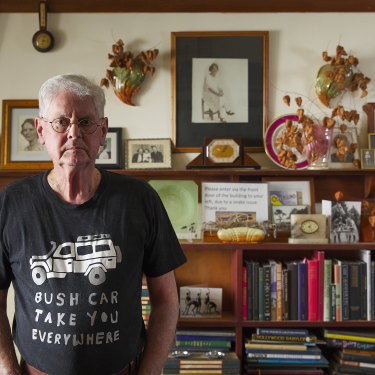
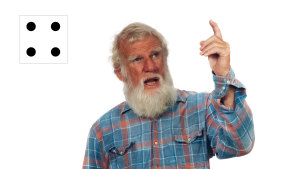
Academic Peter Sutton, one of Australia’s leading anthropologists, disputes many claims made in Dark Emu. CREDIT:DAVID SOLM
Save

Share
Normal text sizeLarger text sizeVery large text size
101

- Warning: The following article contains images of Indigenous people who are deceased.

The walls of Peter Sutton’s home in country South Australia are hung with ghosts – black-and-white photographs he has collected from second-hand shops over the years, the long-gone people he calls “poignant strangers”, staring out from the past, without families who want or remember them.

It’s a rambling old house of stone and timber, everything you would expect an anthropologist’s home to be: rooms filled with books, papers, a large volume of genealogies of Wik families from Cape York among whom he has spent much of his professional life, including some 2000 records of births and deaths. Sutton has spent many decades with the Wik people; danced with them, cried with them. There are other records, from western Arnhem Land, Daly River, the Murranji Track – ghost road of the drovers, Central Australia and the corner country of the Lake Eyre basin.

Sprawled across a dining room table is an almost-finished book about the early 20th century Queensland anthropologist Ursula Hope McConnel, who was brave and brilliant and solitary.

Sutton is one of Australia’s leading anthropologists. A gifted linguist, rigorous, sometimes controversial, a debunker of myths who stood, grief-stricken, in the little cemetery at Aurukun, on the west coast of Cape York, in September 2000 and began to think the thoughts that gradually formed themselves into his heretical essay and then book, The Politics of Suffering: Indigenous Australia and the End of the Liberal Consensus, which exposed the gulf between progressive ambition and dysfunctional reality in Aboriginal communities.

Quietly spoken, with a restless curiosity, independent-minded Sutton is now almost 75 years old but doesn’t seem it. An outsider in many ways throughout his life, he was born in working-class Port Melbourne at a time when men in hats and shabby suits played two-up on the other side of his grandmother’s back fence.
Advertisement


He was raised a Christian Scientist, steeped in its doctrines and uplifted by its faith in “life’s unlimited possibilities”, but ultimately found his emotional home in the lives and memories of the Aboriginal families with whom he has long been entwined. Such is his standing among his academic colleagues that in 2016, to mark his 70th birthday, a two-volume Festschrift was arranged, a collection of essays to honour his life’s work. Such is his standing among the Wik people that they contributed to its publishing costs.

We sit talking at his kitchen table. A visiting dog, owned by a friend and named after the irascible Daisy Bates – who lived on the edge of the Nullarbor Plain with Aboriginal people and tried to understand them when many did not – lies at my feet and keeps company with Sutton’s old dog, Hochi, who is blind and loving and finds his way by smell and memory.


It is a new book, just completed, that we meet to discuss – a rebuttal of one of the most popular Aboriginal histories of recent times, a publishing phenomenon, Bruce Pascoe’s Dark Emu, in which Pascoe argues that Aboriginal people in pre-colonial Australia were not “hapless wanderers across the soil, mere hunter-gatherers” – his expression – but were “in the early stages of an agricultural society”, were not “simply wandering from plant to plant, kangaroo to kangaroo in a hapless opportunism”, but were early farmers who tilled the soil, sowed crops that they irrigated, harvested and stored, altered the course of rivers, built dams, sewed clothes, and lived for long periods in substantial dwellings, sometimes made of stone.

First published in 2014, Dark Emu has won some of the nation’s richest and most prestigious literary awards, including the Victorian Premier’s Literary Award for Indigenous Writing and both the Book of the Year and the Indigenous Writers’ Prize in the NSW Premier’s Literary Awards, where the judges declared that Pascoe was “without peer in his field”.

RELATED ARTICLE


Indigenous culture
Bruce Pascoe says Aboriginality queries an attempt to discredit Dark Emu

A host of reviewers have spoken glowingly of it. Indigenous academic Marcia Langton called it “a profound challenge to conventional thinking about Aboriginal life on this continent” and “the most important book on Australia”. In 2018, Australia’s premier Aboriginal dance company Bangarra adapted the book into dance. Last year, Labor senator Penny Wong declared that Pascoe had helped free Australians from an “underlying supremacism”. A children’s version has been published and a documentary film is being made.
Advertisement


At the same time, Pascoe, who, like Sutton, also grew up in a working-class family (becoming a teacher and then a writer of literary fiction, non-fiction, poetry, essays and children’s literature before finding unexpected fame), has been targeted by conservative commentators and media who have questioned both his version of history and his Aboriginality.

Pascoe claims to have discovered Aboriginal ancestors on both sides of his family, including the Palawa people from Tasmania, Bunurong from Victoria and Yuin from the south coast of NSW. Some Aboriginal people have embraced him, others have not. The conservative magazine Quadrant, whose editor Keith Windschuttle has accused historians of fabricating the extent of colonial violence, called him a “fauxborigine”. A vitriolic website, “Dark Emu Exposed”, was created by “a collective of Quiet Australians from many walks of life who question, and want to hold to account, authors who appear to be rewriting our Australian history to progress their own particular, political narrative”.

It is into this fraught arena that Sutton and his co-author, archaeologist Keryn Walshe, now step with Farmers or Hunter-Gatherers? The Dark Emu Debate. And their rebuttal of Dark Emu, published next week by Melbourne University Press, is damning. In page after page, Sutton and Walshe accuse Pascoe of a “lack of true scholarship”, ignoring Aboriginal voices, dragging respect for traditional Aboriginal culture back into the Eurocentric world of the colonial era, and “trimming” colonial observations to fit his argument. They write that while Dark Emu “purports to be factual” it is “littered with unsourced material, is poorly researched, distorts and exaggerates many points, selectively emphasises evidence to suit those opinions, and ignores large bodies of information that do not support the author’s opinions”.

“It is actually not, properly considered, a work of scholarship,” they write. “Its success as a narrative has been achieved in spite of its failure as an account of fact.”

Keryn Walshe says that in presenting pre-colonial society as more “advanced” than was known, Dark Emu understates the complexity of hunter-gatherer life.CREDIT:JOSH ROBENSTONE

The Sutton/Walshe book is not the first criticism of Dark Emu. Australian National University anthropologist Ian Keen has said that Pascoe’s evidence for Aboriginal farming is “deeply problematic”, although he also believes that some of the criticism has been used to support a racist agenda. Christophe Darmangeat, a lecturer in social anthropology at the Sorbonne in France, wrote that in Dark Emu Pascoe mixes “perfectly proven elements, others possible but more doubtful, others very improbable, and finally frank fabrications, firing on all cylinders by handling concepts and facts with a disarming casualness”. Quadrant published a polemical book, Bitter Harvest, against Pascoe’s claims. But Sutton and Walshe’s Farmers or Hunter-Gatherers? is the most forensic and best credentialled examination and repudiation of Dark Emu.
Advertisement


Over his long career, Sutton has been credited with explaining Aboriginal art to the world in the sophisticated catalogue that accompanied the landmark Dreamings exhibition to America in 1988. He has written or contributed to 20 books, and about 200 anthropology and linguistics papers. He has been an expert anthropological researcher in 87 Aboriginal land claims since 1979. When barrister Ron Castan presented the landmark Wik case to the High Court in June 1996, he brandished a 1000-page anthropological report entitled Aak, the Wik word for homeland, written by Sutton and others, which he said would be the foundation for the argument.

Keryn Walshe’s work in archaeology over 35 years has included a decade at Koonalda Cave, a rich heritage site that has offered a glimpse of Aboriginal life on the Nullarbor Plain during the Pleistocene. In 2017, her work took her to Sturt Creek in the Kimberley, where she was asked to examine burned bone fragments at a place called “the goat yards”, where more than a dozen Aboriginal people were alleged to have been massacred in 1922. The examination found nothing to dispute Aboriginal accounts of the massacre and a “very high likelihood” that the remains were human, based on the intensity of the fire in which they were burned.

Sutton and Walshe’s book comes, uncomfortably, from the publishing house of the university that last year appointed Pascoe as Enterprise Professor in Indigenous Agriculture. At Melbourne University Press, which suffered an organisational seizure two years ago when chief executive Louise Adler and board members quit after the university ordered a focus on more academic works, Adler’s successor, Nathan Hollier, describes Farmers or Hunter-Gatherers? as an important book for MUP, “in the sense that it might well build awareness of what we are doing, namely publishing works of scholarship, for a broad readership, which build respect for us as an especially trusted source of knowledge and commentary and respect for scholarship more generally”.

He says that he did not know Pascoe was to be appointed to a professorship at the university until it was publicly announced, but even if he had known of it, it would not have affected MUP’s decision to publish Farmers or Hunter-Gatherers?.

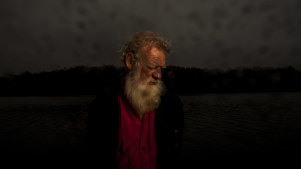
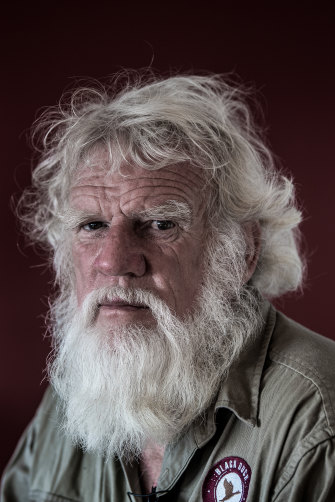
Dark Emu author Bruce Pascoe says he welcomes the difference of opinion in Sutton and Walshe’s book. CREDIT:JUSTIN MCMANUS

At his home at Gipsy Point, Victoria, Pascoe waits for the storm to break. He seems sanguine. In a written response to extracts shown to him, he tells Good Weekend, “Dark Emu has encouraged many Australians to recognise the ingenuity and sophistication of the many Aboriginal cultures, societies and land-management practices, which had not previously been brought to mainstream attention. The extent of Aboriginal social and economic organisation has been surprising to many Australians and a nuanced debate needs to be ongoing.”
Advertisement


RELATED ARTICLE


Good Weekend
Bruce Pascoe: ‘I was always in awe of Aboriginal spirituality'

He says it would be “disappointing” if Australia’s understanding of Aboriginal history and culture “digressed to a limiting debate about semantics and nomenclature”.

“Hunter-gatherer and farmer are both settler/colonial labels, and the long prevailing negative interpretation of hunter-gatherer has been used as a weapon against Aboriginal and Torres Strait Islander peoples (as a justification for terra nullius),” he writes.

“Language can be used to help people to see the world differently, to open minds to new ways of seeing. This is what I tried to achieve with Dark Emu.”


“Language can be used to help people to see the world differently, to open minds to new ways of seeing. This is what I tried to achieve with Dark Emu.”

Asked about MUP’s decision to publish Farmers or Hunter-Gatherers?, he says: “I would be alarmed if a university press began suppressing academic commentary. Certain academics may feel a particular book has flaws, but it would be an indictment on all our futures if we suppressed dissent. I have no problem with Sutton’s book being published by MUP. In fact, I welcome the discussion and difference of opinion as it should further this important examination of our history. Dark Emu has helped to shine a light on Aboriginal and Torres Strait Islander ingenuity, the stewardship of Aboriginal lands and First Nations’ agricultural practices in Australia.”
Advertisement


Peter Sutton did not see Dark Emu until 2016, when he was given a copy during a native title hearing in Broome, where he was giving expert evidence. Preoccupied by research, he put it to one side, regarding it as “optional reading, being the work of an amateur student of the subject who had no apparent direct knowledge or experience of how the Old People made a living in times gone by”.

It was not until 2019, when Dark Emu had taken on a celebrated status, that Sutton gave it his full attention. He was deeply unimpressed, as he was when he read Bruce Chatwin’s The Songlines, the 1987 bestseller combining fiction and non-fiction which popularised the notion of Aboriginal people singing the stories of the land, without much understanding of Aboriginal culture. Nothing in Sutton’s 50 years of research with senior Aboriginal people suggested to him that Pascoe was right. He was “disturbed” that Pascoe’s descriptions of Aboriginal life were based on – and to his mind, took liberties with – “the journals of blow-through European explorers, men who were ignorant of the languages and cultures of those they met”, rather than Aboriginal people, whose knowledge has been recorded for the past hundred years at least.

He was “disappointed” that in attempting to describe Aboriginal land use, Pascoe ignored the importance of spiritual tradition and ritual. He was “stunned” that the book was “riddled with errors of fact, selective quotations, selective use of evidence, and exaggeration of weak evidence”, including the suggestion Aboriginal people have occupied Australia for 120,000 years. And he was “outraged” that school curricula were being changed to conform with the Dark Emu narrative, embracing Pascoe’s descriptions of an early agricultural society.

More than anything, he felt that Pascoe had done the Old People – as Sutton refers to them – a monumental disservice, resurrecting long-discredited ideas of social evolutionism that placed hunter-gatherers lower on the evolutionary scale than farmers. To Sutton, it was a rebirthing of the colonial philosophy used to justify Aboriginal dispossession in the first place: that people who lived lightly on the land had no claim to it, that farmers were more deserving of dignity and respect than hunter-gatherers.


To Sutton, it was a rebirthing of the colonial philosophy used to justify Aboriginal dispossession: that people who lived lightly on the land had no claim to it, that farmers were more deserving of dignity and respect than hunter-gatherers.

“Pascoe’s approach appears to resemble the old Eurocentric view held by the British conquerors of Aboriginal society,” Sutton writes in Farmers or Hunter-Gatherers?. “Those were the people who organised mass theft of Aboriginal country and many of whom justified the killing of Aborigines who resisted them, really out of greed and indifference, but often under an ideological flag of social evolutionism. They assumed they had a right to profit from the ‘survival of the fittest’ and were the ‘superior race’. The ‘less advanced’ had to make way for the ‘more advanced’. Pascoe risks taking us back to that fatal shore by resurrecting the interpretation of differing levels of complexity and differing extents of intervention in the environment as degrees of advancement and evolution and cleverness and sophistication.”

Sutton and Walshe began working on a response to Dark Emu late in 2019, with Sutton writing the bulk of it, and Walshe contributing two chapters in her area of expertise – archaeology. The aim, Sutton says, was to “set things back to a balanced truthfulness” and “restore the dignity of complex (never ‘mere’) hunter-gathering, and thus First Nations cultural history, that has been eroded due to Dark Emu”. For her part, Walshe says that when she first read Dark Emu, she was so frustrated by its lack of scholarship that she didn’t finish it.

Like Sutton, Walshe was also appalled that in attempting to present Aboriginal people as more “advanced” than was known, Pascoe had used pejorative terms, such as “primitive”, “simple” and “mere” to describe the brilliance and complexity of hunter-gatherer life. “I still struggle to believe that this has happened,” she tells Good Weekend.

Early in their book, Sutton and Walshe acknowledge that Dark Emu has made some positive contribution, including engendering interest in traditional ways of life; building awareness that conquest, slaughter and land theft was underpinned by an assumption of racial superiority; and drawing attention to earlier works that showed how Aboriginal people managed the land and its resources with fire and conservation. They see no harm in Pascoe criticising false beliefs, “perhaps held by some”, that all Aboriginal people were naked all of the time and that classical Aboriginal society consisted of a constantly nomadic people who simply lived off nature’s bounty, were not ecological agents, did not stay in one place for more than a few days and did not store resources.


Sutton and Walshe acknowledge Dark Emu has made some positive contribution.

But the world of 1788 that Pascoe created in Dark Emu, Sutton says, was “a reimagination, not a discovery” and “agriculture” was not the way of the Old People – who had their own complex philosophy and practice – but “the badge of their conquerors”.

“Pascoe’s message is built on a simple distinction between what he calls ‘mere’ hunter-gatherers, on the one hand, and farmers; or between ‘mere’ hunting and gathering on one hand and ‘agriculture’ on the other,” Sutton and Walshe write. “We consider that the evidence, in fact, reveals a positioning of the Aboriginal people of 1788 somewhere between these two extremes and very far from both. The Old People in 1788 were neither, because they had developed ways of managing and benefiting from their landscape that went beyond just hunting and just gathering but did not involve gardening or farming. They were ecological agents who worked with the environment, rather than, usually, against it. They frequently used slow-burning fires to make their landscapes more liveable. On the other hand, they did not cut down bush to clear the land, plough and hoe the soil in preparation for planting, or then sow stored seed or tubers or rootstock in gardens or in fields.”

Admirers of Dark Emu invariably refer to Pascoe’s persuasive use of the journals of explorers such as Thomas Mitchell and Charles Sturt. Sutton is less enamoured of them, questioning both the reliability of journals written by Europeans who encountered Aboriginal people only transiently and who were “the forward scouts for the army of land-hungry farmers who would come in their wake”, and Pascoe’s sharp editing of them. Where Pascoe quotes explorer Thomas Mitchell discovering grass that had been pulled and piled into “hay-ricks” that stretched for miles, for example, Pascoe suggests that Aboriginal people were practising an idyllic agriculture. But he leaves out Mitchell’s puzzlement about the purpose of these “ricks” and Mitchell’s later writing that all attempts to persuade Aboriginal people to till the ground had failed.

Pascoe records Mitchell’s astonishment on coming upon a large, deserted village during his Australia Felix expedition, which he estimated housed “over 1000” people. This, says Sutton, is “pure fiction”. “All Mitchell says is that his party ‘noticed some of their huts’; there is no mention of anyone counting anything.” Pascoe then quotes a member of Mitchell’s party, Granville Stapylton, as saying that the buildings “were of very large dimensions, one capable of containing at least 40 persons and of very superior construction”. But he omits Stapylton’s speculation that this was “the work of a white man”, probably the runaway convict William Buckley, who lived with the Wathaurong people for three decades.

Elsewhere, Pascoe cites Charles Sturt’s discovery of a large well and village somewhere north of Lake Torrens in South Australia, but neglects to say that Sturt saw no signs of recent occupation. When Sturt finds grass set out to dry and ripen, Pascoe guesses this was because of surplus grain, which suggested “sedentary agriculture”. Sutton ridicules the idea. “The suggestion, if that is what Pascoe intends, that anyone could practise ‘sedentary agriculture’ in that blasted desert environment is simply ill-informed,” he writes.

Similarly, when Pascoe quotes Alice Duncan-Kemp’s memory of women on the Diamantina River in the early 20th century sprinkling seed over the ground from woven dilly-bags, he fails to mention that Duncan-Kemp wrote that this was done “as they danced and sang the rain song” as part of a rain increase ceremony.

Nor does he mention Duncan-Kemp’s references to “the hard, nomadic life that they have had to lead since the beginning of time”. To Sutton, such omissions suggest “an almost desperate search to find something to back up the belief that the Old People sowed seeds for crops and were thus agricultural people”.

Over 300 pages, Sutton and Walshe pick apart Dark Emu. Where Pascoe writes that permanent housing was “a feature of the pre-contact Aboriginal economy and marked the movement towards agricultural reliance”, Sutton dismisses this absolutely. “The recurring pattern, all over Australia, was one of seasonal and other variation in lengths of stays in one place,” Sutton writes. “No group is ever described, at the moment of colonisation, as living year in, year out, in one single place.” Where Dark Emu featured the use of stone for housing, Sutton answers that it was “the rarest in the Aboriginal record”, a “last resort” in the stoniest of environments.

Pascoe writes that when early settlers found an Aboriginal tool that looked like a hoe, it was dismissed because they had convinced themselves that there was no agriculture in Australia. He refers to a hoe examined in 1894 by palaeontologist Robert Etheridge, who believed that Aboriginal people suffered from being regarded as “one of the most, if not the most degraded variety of the human race”. But what Pascoe does not say, Walshe writes, is that Etheridge concluded that the hoe, which was collected in Cape York, was “not of Aboriginal manufacture”, but was introduced from the Torres Strait islands.

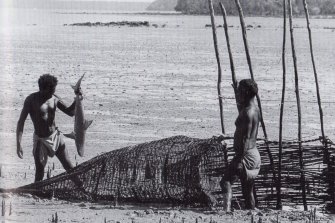
Fish traps in Arnhem Land, 1952.CREDIT:AXEL POIGNANT

In Dark Emu, Pascoe cites the World Heritage-listed Budj Bim eel traps, in western Victoria, and fish traps at Brewarrina, NSW, and the Glyde River, in Arnhem Land, as examples of unappreciated Aboriginal ingenuity. But he fails to mention how rare they were. The eel traps are “unique in the whole country”, Sutton and Walshe write. The Brewarrina fish traps “have no equal on the inland river systems”. The Glyde River fish trap is “even unique in Arnhem Land”. At the same time, while Pascoe views the fish traps as wonders of creativity and invention, Sutton writes that the Old People did not claim them as the ingenious works of human beings, but always “as having been put there in the Dreaming, by Dreamings”.

In Dark Emu, and the children’s version of the book, Young Dark Emu, and a teaching resource, Dark Emu in the Classroom, a photograph shows a large “pointed dome house”, inferred to be Aboriginal. It is not. It is from the Melanesian region of the eastern Torres Strait. Dark Emu in the Classroom also states that both Aboriginal and Torres Strait Islander peoples had “an agricultural economy in which seeds were propagated, irrigated, harvested, stored and traded across regions”, and that Aboriginal people “had systems of agriculture, aquaculture, housing, food storage and land management, inconsistent with hunter-gatherer societies”. Sutton says it should be withdrawn from classrooms and rewritten.

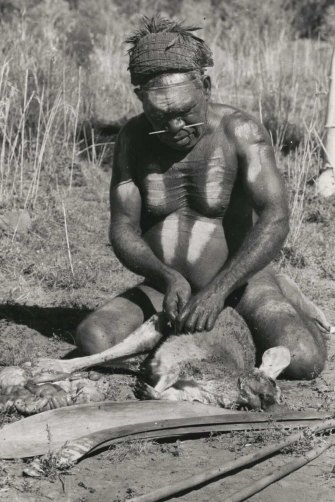
A Warlpiri hunter in 1974.CREDIT: JEFF CARTER/NLA

Sutton is highly critical of Pascoe for the voices that are not heard in Dark Emu, both white and black. He wonders at the absence of anthropologist Norman Tindale, who recorded in 1932 the travels of a young Warlpiri man, Pariparu, who named 332 desert places he had walked to in the previous 11 months; or Athol Chase, who recorded that for the Umpila, Kuuku Ya’u and other peoples of north-east Cape York, agricultural practices were regarded as “a wasteful and illegitimate activity in the landscape”.

He wonders why there is no mention of missionaries Francis Xavier Gsell and Wilbur Chaseling, who each recalled being told that planting food in the ground was a pity and ridiculous. Or the Warlpiri women who have recorded their stories of desert life and the trauma of early European contact, with no mention of agriculture. Or the colonial “castaways” who lived inside traditional Aboriginal communities, including the convict William Buckley, who wrote of a people who “kept up the old fancy of wandering about”, and the castaway Narcisse Pelletier, who lived with Cape York people beyond the frontier for 17 years and was recorded as stating: “No one plants and no one sows”; “They seldom stay long in one place”; and “It would seem that these tribes spend their lives in hunting, fishing, and fighting, and never attempt any kind of cultivation.”

And if Aboriginal people were farmers as Pascoe contends, Sutton asks, where is the evidence for it in Aboriginal languages, as there is evidence in Torres Strait languages? “If, as he says, they traditionally hoed and tilled and ploughed the earth, made gardens, selected and sowed seed or planted tubers, irrigated their crops, reaped the results and stored them, and thus were farmers on farms doing farming, should he not have tried to demonstrate that these categories and terms were present in at least some of the approximately 260 distinct languages of Australia in 1788?”

Aboriginal people knew about farmers, Sutton and Walshe write, from their trading interactions with Torres Strait gardeners and Macassans and Baijini from the Indies, but chose not to emulate them, for reasons that were cultural as well as practical. Economics without religion was “inconceivable” to the Old People, they write. “Gathering and hunting and fishing were not just economics: they were the Law.”

“In contrast to the picture conveyed by Dark Emu, the greater part of Aboriginal traditional methods of reproducing plant and animal species was not through physical cultivation or conservation but through spiritual propagation,” Sutton writes. “This included speaking to the spirits of ancestors at resource sites, carrying out ‘increase rituals’ at special species-related sites, singing resource species songs in ceremonies, maintaining rich systems of totems for various species that were found in the countries of the totem-holders, and handling food resources with reverence … A secularised notion of Aboriginal cultivation, devoid of spiritual dimensions, did not exist in Australia before conquest.”

The decision to not adopt horticulture and agriculture was not a failure of the imagination, Sutton writes, “but an active championing and protection of their own way of life and, when in contact with outsiders, a resistance to an alien economic pattern”.

Pondering why Dark Emu was so well received, Sutton and Walshe write that its success appears to indicate a profound lack of knowledge about Aboriginal people and history, “or an unconcern with facts and truth themselves, or a combination of these things”. Whichever, they say, “the situation is troubling”. Sutton tells Good Weekend he believes reading and accepting Dark Emu has become a search for “moral recovery” for some white Australians of goodwill. Walshe says it has become something like “a pilgrimage”. They also question why no one asked Aboriginal people still connected to traditional practices, or anthropologists, whether Pascoe was right.

“As far as we can tell, no journalist or book reviewer covering the Dark Emu story has interviewed senior Aboriginal people from remote communities where knowledge of the old economy is retained at least by some, and practised in an adapted way by many,” they write. “Nor do members of the media appear to have spoken to any of the anthropological specialists who have learned from Aboriginal authorities and from the vast literature on their traditional ways of life … This journalistic abandonment of the academy, if that is what it is, seems to be symptomatic of a break from the past – a past in which professional knowledge and lay knowledge were more distinct, and the distinction more respected. The authority of the academy has slipped. Much worse than that, the authority of Aboriginal knowledge-holders has been ignored yet again.”

In a foreword to Farmers or Hunter-Gatherers? Wiradjuri archaeologist Kellie Pollard from Charles Darwin University writes that Sutton and Walshe “show that Pascoe tried, and failed, to overturn over a century of anthropological and archaeological study, analysis and documentation, in addition to Aboriginal oral testimony, of the ways of life, governance, socioeconomic behaviour, material, technological and spiritual accomplishments and preferences of Aboriginal people in classical society and on the cusp of colonisation.”

Sutton dedicates Farmers or Hunter-Gatherers? to Enkidu and Gilgamesh – the first, in ancient Mesopotamian legend, a free-roaming man of the hills and forests, the offspring of silence, and the other a cruel king, two-thirds divine – who came, after conflict, to love one another. When Enkidu died, the grief of Gilgamesh knew no bounds. Sutton has returned often to the Epic of Gilgamesh, which was written at a time when Neolithic farmers were displacing, absorbing, and probably in many cases killing, hunter-gatherers. He sees in it, he says, “the birth of reconcilement”.

Stuart Rintoul is an author and journalist. His book Lowitja: The Authorised Biography of Lowitja O’Donoghue, was published last year.

To read more from Good Weekend magazine, visit our page at The Sydney Morning Herald, The Age and Brisbane Times.

The best of Good Weekend delivered to your inbox every Saturday morning. Sign up here.

Dark Emu (book) - Wikipedia

Dark Emu (book) - Wikipedia

Dark Emu (book)

From Wikipedia, the free encyclopedia
Jump to navigationJump to search
Dark Emu: Black Seeds: Agriculture or Accident?
Dark Emu cover.jpg
AuthorBruce Pascoe
CountryAustralia
LanguageEnglish
GenreNon-fiction
History
Publication date
2014
ISBN1921248017

Dark Emu: Black Seeds: Agriculture or Accident? is a 2014 non-fiction book by Bruce Pascoe. It reexamines colonial accounts of Aboriginal people in Australia, and cites evidence of pre-colonial agricultureengineering and building construction by Aboriginal and Torres Strait Islander peoples. A second edition, published under the title Dark Emu: Aboriginal Australia and the Birth of Agriculture was published in mid-2018, and a version of the book for younger readers, entitled Young Dark Emu: A Truer History, was published in 2019. Both the first and the children's editions were shortlisted for major awards, and the former won two awards in the New South Wales Premier's Literary Awards.

Editions

The first edition, entitled Dark Emu: Black seeds: agriculture or accident?, was published by Magabala Books in 2014.[1] A second edition, entitled Dark Emu: Aboriginal Australia and the Birth of Agriculture was published in June 2018,[2] and a version of the book for younger readers, entitled Young Dark Emu: A Truer History, was published in 2019.[3] The 2019 version was shortlisted for the 2020 Adelaide Festival Awards for Literature in the Children's Literature Award section.[4]

Contents

In Dark Emu: Black seeds: agriculture or accident?, Pascoe examines the journals and diaries of early explorers such as Charles Sturt and Thomas Mitchell[5] and early settlers in Australia,[1] finding evidence in their accounts of existing agriculture,[6][7] engineering and building, including stone houses, weirs, sluices and fish traps, and also game management.[8][9] This evidence of occupation[10] challenges the traditional views about pre-colonial Australia[11] and "Terra Nullius".[12] The book also gives a description from Sturt's journal of his 1844 encounter with hundreds of Aboriginal people who were living in an established village in what is now Queensland (then part of New South Wales), in which a welcoming party offered him "water, roast duck, cake and a hut to sleep in".[5]

Pascoe discovered that other historians had pursued the same material; one of these was the independent scholar Rupert Gerritsen, who in 2008 published Australia and the Origins of Agriculture,[13] which argued that Aboriginal people were agriculturalists as much as hunter-gatherers. Gerritsen died in 2013, and Pascoe cites him as a scholar who languished in obscurity because his theories contradicted the mainstream view. He said that Gerritsen "should have got all the credit for Dark Emu”. Pascoe also drew on the work of historian Bill Gammage, author of The Biggest Estate on Earth: How Aborigines Made Australia (2012), which looked at how Aboriginal people used firedams and cropping to support themselves sustainably in their environment.[5][14]

Pascoe also cites the work of Dr Heather Builth and colleague Professor Peter Kershaw, noted palynologist at Monash University,[15][16] with reference to their research into the extensive aquaculture and farming of short-finned eels (kooyang) practised by the Gunditjmara people of western Victoria, dated by Kershaw as 8,000 years BP.[17] (Evidence of the dams, weirs and stone dwellings are now protected under several layers of legislation, including a large area being on the World Heritage List as the Budj Bim Cultural Landscape since 2019.[18][19])

In the last pages of Dark Emu, Pascoe says that Australia could learn from Indigenous culture and landcare, replacing wheat with native grasses and eating kangaroo rather than cattle, a message he continues to drive home in his public appearances.[5]

Pascoe's friend, writer Gregory Day, thinks that the success of the book lies in its ability to connect with "whitefellas", in a sense, translating it for this audience.[5]

Critical reception

The book received critical acclaim, winning two NSW Premier's Literary Awards (Book of the Year and the Indigenous Writers' Prize)[8] and being shortlisted for two other prizes (the History Book Award in the Queensland Literary Awards and Victorian Premier's Award for Indigenous Writing),[1] as well as mainstream recognition.[20][14][5] It was reviewd by three Australian teachers' assocations,[21] earned positive reviews in other media,[22][23] and, with the highest number of nominations by members of the public, was chosen to be the first book discussed in the inaugural meeting of the Parliamentary Book Club.[24][25] By May 2019 it had sold more than 100,000 copies and was in its 28th printing.[5] There is an audiobook and ebook version,[26] and a new edition was published in 2018.[27]

Gammage, whose work was built upon in Dark Emu, praised Pascoe’s storytelling gift of weaving a narrative that challenges many readers' preconceptions, and says that he is a big fan of the book because of its impact, but added that Pascoe sometimes romanticises pre-contact Indigenous society, and says that his claims that Stone Age Indigenous people invented democracy and baking may be "push[ing] these things too far".[5]

Lynette Russell, at Monash University's Indigenous Studies Centre and co-author of Australia's First Naturalists: Indigenous Peoples’ Contribution to Early Zoology,[28] admired Dark Emu's achievement in popularising ideas that challenged European Australians' cultural preconceptions.[5] She said that it had managed to promulgate more widely "information about indigenous land management practices that archaeologists have known for a long time".[29]

Tony Hughes-D'Aeth, a researcher in cultural history at the University of Western Australia and , said that Dark Emu "provides the most concerted attempt [yet] to answer the question about the quality of the country...in the pre-colonial epoch", and that the book's strengths lie in "its ability to bridge archaeology, anthropology, archival history, Indigenous oral tradition and other more esoteric but highly revealing disciplines such as ethnobotany and paleoecology".[14]

The book has also received criticism. One criticism by academics has been of Pascoe's claim that since 1880 there has been an academic suppression of alternative historical accounts about Aboriginal peoples' housing, farming and cultivation practices. Peter Hiscock, chair of archaeology at Sydney University, archaeologist Harry Lourandos, who documented the construction of eel traps in Victoria in the 1970s, and Ian McNiven of Monash University's Indigenous Studies Centre all agree that there is a large body of published work on the topic. However, Lourandos and McNiven are delighted at the book's success in reaching the broader public.[5]

Academic responses

Several academic critiques have specifically addressed the debate surrounding Dark Emu's thesis that Indigenous Australian society was largely built on sedentary agriculture rather than hunting and gathering. Anthropologist Ian Keen argued in Anthropological Forum against Pascoe's thesis that Indigenous Australians practised agriculture. He concluded that "Aboriginal people were indeed hunters, gatherers and fishers at the time of the British colonisation of Australia", although acknowledging "the boundary between foraging and farming is a fuzzy one".[30]

In their 2021 rebuttal Farmers or Hunter-Gatherers? The Dark Emu Debate, anthropologist Peter Sutton and archaeologist Keryn Walshe state that Dark Emu is "littered with unsourced material, is poorly researched, distorts and exaggerates many points, selectively emphasises evidence to suit those opinions, and ignores large bodies of information that do not support the author's opinions".[31] They state Dark Emu is "actualy not, properly considered, a work of scholarship" and that "its success as a narrative has been achieved in spite of its failure as an account of fact".[31][32]

Archaeologist Michael Westaway considers Dark Emu in relation to the archaeological research in the Channel Country in Central Australia which has identified more than 140 sandstone quarry sites including the largest seed grinding quarry site in Australia, the remains of pit dwelling huts known as gunyahs and evidence of trade with other communities as far away as Mount Isa.[33][34] The area is on trade routes used by First Nations people.[35] The Mithaka Aboriginal Corporation, representing the native title owners, has published a framework to support culturally sensitive and ethical research in the area.[36][37]

Awards and accolades

Adaptations

See also

References

  1. Jump up to:a b c d Pascoe, Bruce (2014), Dark emu : black seeds : agriculture or accident?, Magabala Books, ISBN 978-1-922142-43-6
  2. ^ Pascoe, Bruce (1 June 2018). Dark Emu: Aboriginal Australia and the Birth of Agriculture. Magabala Books. ISBN 9781921248016.
  3. ^ Pascoe, Bruce (2019). Young Dark Emu: A Truer HistoryMagabalaISBN 9781925360844. Retrieved 20 December2019.
  4. ^ "Adelaide Festival Awards for Literature"State Library of South Australia. Retrieved 20 December 2019.
  5. Jump up to:a b c d e f g h i j Guilliatt, Richard (25 May 2019). "Turning history on its head"The Australian. Weekend Australian Magazine. Retrieved 26 October 2019.
  6. ^ Hughes-D'Aeth, Tony (15 June 2018). "Friday essay: Dark Emu and the blindness of Australian agriculture"The Conversation. Retrieved 26 October 2019.
  7. ^ Davis, Michael (2014). "Review of Dark Emu, Black Seeds: Agriculture or Accident". Aboriginal History38: 195–198. ISSN 0314-8769JSTOR 43687015.
  8. Jump up to:a b c d Allam, Lorena (23 May 2019). "Dark Emu's infinite potential: 'Our kids have grown up in a fog about the history of the land'"The Guardian. Retrieved 26 October 2019.
  9. ^ "Reading Bruce Pascoe | Tom Griffiths"Inside Story. 26 November 2019. Retrieved 26 November 2019.
  10. ^ Smale, Hilary; Mills, Vanessa (17 March 2014). "Dark Emu argues against 'Hunter Gatherer' history of Indigenous Australians"ABC Kimberley Radio. Retrieved 26 October 2019.
  11. ^ Elliott, David (25 February 2019). "Book Review: Dark Emu"The Socialist. Retrieved 26 October 2019.
  12. ^ Mazengarb, Michael (28 April 2019). "Review: Dark Emu — How do we reckon with Australia's timeless history?"Medium. Retrieved 26 October 2019.
  13. ^ Gerritsen, Rupert (2008). Australia and the Origins of Agriculture. Volume 1874 of British Archaeological Reports British Series; Bar S; BAR international series. Archaeopress. ISBN 9781407303543.
  14. Jump up to:a b c Hughes-D'Aeth, Tony (15 June 2018). "Friday essay: Dark Emu and the blindness of Australian agriculture"The Conversation. Retrieved 17 November 2019[Pascoe's] cards are on the table, but this does not mean that he is not a rigorous and exacting judge of the historical record.
  15. ^ Kershaw, Peter (17 August 2012). "Fifty years of Quaternary palynology in Australia"Ecological Society of Australia. Retrieved 20 March 2020.
  16. ^ "Peter Kershaw"Google Scholar citations. Retrieved 20 March 2020.
  17. ^ Dark Emu: Black Seeds: Agriculture Or Accident?. Magabala Books. 2014. pp. 84–86. ISBN 9781922142436.
  18. ^ "World heritage Places - Budj Bim Cultural Landscape"Australian Government. Dept of the Environment and Energy. 6 July 2019. Retrieved 20 March 2020.
  19. ^ Neal, Matt. "Ancient Indigenous aquaculture site Budj Bim added to UNESCO World Heritage list"ABC News. Australian Broadcasting Corporation. Retrieved 20 March 2020.

  20. ^ McQuire, Amy (25 May 2016). "Recognising Sovereignty: Bruce Pascoe's Latest Book A Dark Horse To Lead Battle Over Unfinished Business"New Matilda. Retrieved 17 November 2019.
  21. ^ Agora, Nov 2014Aboriginal History, Dec 2014Teaching History, Dec 2016Geographical Education (Online), 2017
  22. ^ Shalvey, Kris (7 September 2016). "Book Review – Dark Emu: Black seeds"South Sydney Herald. Retrieved 17 November 2019.
  23. ^ "Dark Emu, by Bruce Pasocoe"Goodreads. Retrieved 20 December 2019.
  24. ^ Morris, Linda (17 September 2019). "Bruce Pascoe's Dark Emu is pollies' pick"Sydney Morning Herald. Retrieved 17 November 2019.
  25. Jump up to:a b "Arts news — Federal politicians tasked with reading Bruce Pascoe's Dark Emu"Radio National: The Book Show. 23 September 2019. Retrieved 26 October 2019.
  26. ^ "[Search result for "dark emu black seeds agriculture or accident"]"Worldcat. Retrieved 20 December 2019.
  27. ^ "Dark Emu: Aboriginal Australia and the Birth of Agriculture, New Edition"New South Books. Retrieved 20 December2019.
  28. ^ Olsen, Penny; Russell, Lynette (May 2019). Australia's First Naturalists: Indigenous Peoples' Contribution to Early ZoologyNational Library of AustraliaISBN 9780642279378.
  29. ^ "Lecture and Book Launch: Australia's first naturalists"Whispering Gums. 13 June 2019. Retrieved 8 November 2019.
  30. ^ Keen, Ian (2021). "Foragers or Farmers: Dark Emu and the Controversy over Aboriginal Agriculture"Anthropological Forum31: 106–128. doi:10.1080/00664677.2020.1861538.[page needed]
  31. Jump up to:a b Rintoul, Stuart (12 June 2021). "Debunking Dark Emu: did the publishing phenomenon get it wrong?"Good Weekend. Melbourne. Retrieved 13 June 2021.
  32. ^ Chung, Frank (12 June 2021). "Author Bruce Pascoe's best-selling Aboriginal history book Dark Emu 'debunked'"News.com.au. Sydney. Retrieved 13 June 2021.
  33. ^ Westaway, Michael; Gorringe, Joshua (18 June 2021). "Friday essay: how our new archaeological research investigates Dark Emu's idea of Aboriginal 'agriculture' and villages"The Conversation. Retrieved 18 June 2021.
  34. ^ Westaway, Michael C.; Williams, Douglas; Lowe, Kelsey; Wright, Nathan J.; Kerkhove, Ray; Silcock, Jennifer; Gorringe, Joshua; Miszkiewicz, Justina; Wood, Rachel; Adams, Richard; Manne, Tiina (16 June 2021). "Hidden in plain sight: the archaeological landscape of Mithaka Country, south-west Queensland"Antiquity. first view. doi:10.15184/aqy.2021.31ISSN 0003-598X. Retrieved 18 June 2021.
  35. ^ Mulvaney, D. J. (1976), The Chain of Connection: the Material Evidence, retrieved 18 June 2021
  36. ^ Mithaka Aboriginal Corporation (2017). "Ngali Wanthi Mithaka Aboriginal Corporation Research Framework" (PDF). Retrieved 18 June 2021.
  37. ^ "Mithaka Cultural Mapping"ArcGIS StoryMaps. 4 August 2020. Retrieved 18 June 2021.
  38. ^ "Lucashenko wins 2014 Vic Prem's Literary Award for Indigenous Writing"Books+Publishing. 4 September 2014. Retrieved 9 December 2020.
  39. ^ "Adelaide Festival Awards for Literature"State Library of South Australia. Retrieved 20 December 2019.
  40. ^ "Dark Emu"Bangarra. Retrieved 26 October 2019.
  41. ^ Pascoe, Bruce (2019). Young Dark Emu: A Truer HistoryMagabalaISBN 9781925360844. Retrieved 20 December2019.
  42. ^ "Dark Emu to be adapted as TV documentary"ArtsHub Australia: ScreenHub. 21 October 2019. Retrieved 26 October 2019.

Further reading