How to Hide an Empire: A History of the Greater United States Paperback – Illustrated, 3 March 2020
"Consistently both startling and absorbing . . . Immerwahr vividly retells the early formation of the [United States], the consolidation of its overseas territory, and the postwar perfection of its 'pointillist' global empire, which extends influence through a vast constellation of tiny footprints." --Harper's
A pathbreaking history of the United States' overseas possessions and the true meaning of its empire
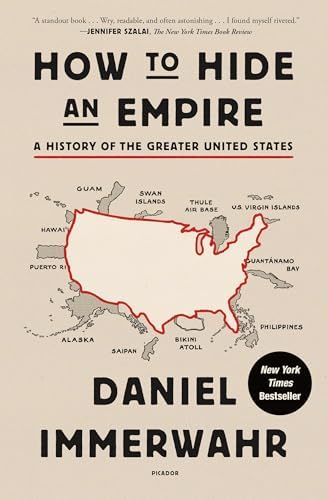
We are familiar with maps that outline all fifty states. And we are also familiar with the idea that the United States is an "empire," exercising power around the world. But what about the actual territories--the islands, atolls, and archipelagos--this country has governed and inhabited?
In How to Hide an Empire, Daniel Immerwahr tells the fascinating story of the United States outside the United States. In crackling, fast-paced prose, he reveals forgotten episodes that cast American history in a new light. We travel to the Guano Islands, where prospectors collected one of the nineteenth century's most valuable commodities, and the Philippines, site of the most destructive event on U.S. soil. In Puerto Rico, Immerwahr shows how U.S. doctors conducted grisly experiments they would never have conducted on the mainland and charts the emergence of independence fighters who would shoot up the U.S. Congress.
In the years after World War II, Immerwahr notes, the United States moved away from colonialism. Instead, it put innovations in electronics, transportation, and culture to use, devising a new sort of influence that did not require the control of colonies. Rich with absorbing vignettes, full of surprises, and driven by an original conception of what empire and globalization mean today, How to Hide an Empire is a major and compulsively readable work of history.
"A richly detailed, thoroughly researched history . . . the author engagingly depicts the nations' conquests . . . Immerwahr animates the narrative with a lively cast of characters . . . A vivid recounting of imperial America's shameful past." --Kirkus Reviews (starred review)
"To call this standout book a corrective would make it sound earnest and dutiful, when in fact it is wry, readable and often astonishing. Immerwahr knows that the material he presents is serious, laden with exploitation and violence, but he also knows how to tell a story, highlighting the often absurd space that opened up between expansionist ambitions and ingenuous self-regard . . . It's a testament to Immerwahr's considerable storytelling skills that I found myself riveted by his sections on Hoover's quest for standardized screw threads, wondering what might happen next." --Jennifer Szalai, The New York Times
224 customer reviews
From Australia
iankh
5.0 out of 5 stars In a word, TIMELY!
Reviewed in Australia on 5 February 2026
Format: PaperbackVerified Purchase
I can't praise this book highly enough. As well as being well-researched and well-written, it is also very timely. The 'empire' takes various forms and I defy any American not to find out some things about their country they never knew. The first part of the book is very interesting, but it is the chapters relating to the period after World War Two that are the most fascinating. In Trump-world, where he talks about seizing Greenland and the Panama Canal, what Immerwahr has to say is so pertinent.
Helpful
Report
Andrew Desmond
5.0 out of 5 stars Wonderful and Compelling History
Reviewed in Australia on 19 September 2024
Format: PaperbackVerified Purchase
I was told about this book, “How to Hide an Empire”, by a good friend. And what a tip! A fascinating and thoroughly readable ride through modern American history and the country’s influence on the wider world.
Ostensibly, Daniel Immerwahr has written a book about America’s 20th century empire. This would include such territories as Hawaii and Alaska (now states) as well as the Philippines and numerous small islands in the Pacific and Caribbean. Much of the information that the author provides would be unknown to the vast bulk of Americans. The book also discusses America’s wider footprint and the way that it has and does use soft power to extend its reach.
Perhaps, some potential readers may be put off by thinking that the book is some sort of political treatise. It’s not. Rather, it’s a wry and very well written account of how America has come to influence the wider world. Immerwahr has no real axe to grind. He’s more the observer than the polemicist. I found the book to be dense with interesting and sometimes amusing anecdotes. It packs quite a punch.
Highly recommended.
Helpful
Report
From other countries
Milan
5.0 out of 5 stars Wonderfully entertaining and educational read.
Reviewed in Japan on 20 June 2021
Format: PaperbackVerified Purchase
Engrossing read.
Report
Ana Carolina Rockert
1.0 out of 5 stars The book's spine was damaged
Reviewed in Brazil on 19 March 2026
Format: PaperbackVerified Purchase
The book's spine was damaged
Customer image
Report
Olive Avocados
5.0 out of 5 stars Great book, I'm learning a lot
Reviewed in the United States on 31 March 2026
Format: PaperbackVerified Purchase
What a great book! I am learning so much and seriously I can't put it down. Lying on the couch reading all this fascinating info is such a treat. The author is a great writer. He has made the history of US imperialism, and then the decline of imperialism and colonialism, not just interesting but readable and understandable for the average reader who may or may not have a good knowledge of US history. Yet it's not dumbed down either. There's nothing dry about this book. In many ways he relates this history to American life and evolution, then and now. For example, he tells us how much the explosion in plastics manufacturing and use was a result of needed supplies during WW2. I wish all writers were this talented.
Report
Dr Eckart Reihlen
5.0 out of 5 stars Unique perspective
Reviewed in Germany on 29 July 2019
Format: HardcoverVerified Purchase
A very good book. Another way of looking at the evolution of the USA, a lot of it unknown to most. By taking the reader to the moon (an American conquest) and to the current era of brawl politics (we have consensus, Barack Obama was born in Hawaii), the author puts history in the context of contemporary sociology - there is no better purpose for a history book.
Report
Muchiri K.
5.0 out of 5 stars Well written
Reviewed in Italy on 21 April 2026
Format: PaperbackVerified Purchase
Very well written and very insightful
Report
Bob Lees
5.0 out of 5 stars History superbly told
Reviewed in Canada on 19 August 2025
Verified Purchase
This is an entirely readable book about an aspect of American history that is generally overlooked. Choc full of interesting “I didn’t know that“ information. Highly recommended.
Report
Arthur G. Yarish
4.0 out of 5 stars Sr.
Reviewed in Mexico on 3 February 2023
Format: PaperbackVerified Purchase
This is an important book because it presents interesting information that is not commonly known among Usamericans who live the myths of Usamerican "Exceptionalism"
Report
Jose I. Fuste
5.0 out of 5 stars Comprehensive yet highly readable. A necessary and highly useful update.
Reviewed in the United States on 25 February 2019
Format: HardcoverVerified Purchase
I'm a professor at the University of California San Diego and I'm assigning this for a graduate class. No other book out there has the level of breadth on the history of US imperialism that this work provides. Even though it packs 400 pages of text (which might seem like a turnoff for non-academic readers), "How to Hide an Empire" is highly readable given Immerwhar's skills as a writer. Also, its length is part of what makes it awesome because it gives it the right amount of detail and scope.
I could not disagree more with the person who gave this book one star. Take it from me: I've taught hundreds of college students who graduate among the best in their high school classes and they know close to nothing about the history of US settler colonialism, overseas imperialism, or US interventionism around the world. If you give University of California college students a quiz on where the US' overseas territories are, most who take it will fail (trust me, I've done it). And this is not their fault. Instead, it's a product of the US education system that fails to give students a nuanced and geographically comprehensive understanding of the oversized effect that their country has around our planet.
Alleging that US imperialism in its long evolution (which this book deciphers with poignancy) has had no bearing on the destinies of its once conquered populations is as fallacious as saying that the US is to blame for every single thing that happens in Native American communities, or in the Philippines, Puerto Rico, Guam, American Samoa, etc. Not everything that happens in these locations and among these populations is directly connected to US expansionism, but a great deal is.
A case in point is Puerto Rico's current fiscal and economic crisis. The island's political class share part of the blame for Puerto Rico's present rut. A lot of it is also due to unnatural (i.e. "natural" but human-exacerbated) disasters such as Hurricane María. However, there is no denying that the evolution of Puerto Rico's territorial status has generated a host of adverse economic conditions that US states (including an island state such as Hawaii) do not have to contend with. An association with the US has undoubtedly raised the floor of material conditions in these places, but it has also imposed an unjust glass ceiling that most people around the US either do not know about or continue to ignore.
To add to those unfair economic limitations, there are political injustices regarding the lack of representation in Congress, and in the case of Am. Samoa, their lack of US citizenship. The fact that the populations in the overseas territories can't make up their mind about what status they prefer is: a) understandable given the way they have been mistreated by the US government, and b) irrelevant because what really matters is what Congress decides to do with the US' far-flung colonies, and there is no indication that Congress wants to either fully annex them or let them go because neither would be convenient to the 50 states and the political parties that run them. Instead, the status quo of modern colonial indeterminacy is what works best for the most potent political and economic groups in the US mainland. Would
This book is about much more than that though. It's also a history of how and why the United States got to control so much of what happens around the world without creating additional formal colonies like the "territories" that exist in this legal limbo. Part of its goal is to show how precisely how US imperialism has been made to be more cost-effective and also more invisible.
Read Immerwhar's book, and don't listen to the apologists of US imperialism which is still an active force that contradicts the US' professed values and that needs to be actively dismantled. Their attempts at discrediting this important reflect a denialism of the US' imperial realities that has endured throughout the history that this book summarizes.
"How to Hide an Empire: A History of the Greater United States" is a great starting point for making the US public aware of the US' contradictions as an "empire of liberty" (a phrase once used by Thomas Jefferson to describe the US as it expanded westward beyond the original 13 colonies). It is also a necessary update to other books on this topic that are already out there, and it is likely to hold the reader's attention more given its crafty narrative prose and structure
Report
Translate all reviews to English
つるちゃん
5.0 out of 5 stars 発送早かったです
Reviewed in Japan on 31 December 2020
Format: PaperbackVerified Purchase
きれいな本が届きました。ありがとうございました。
Report
Translate review to English
Annika
5.0 out of 5 stars Excellent History
Reviewed in Canada on 6 August 2024
Verified Purchase
The best book on recent American history I have read in years. I can’t recommend it highly enough.
Report
Dave the Rave
4.0 out of 5 stars Under a heap of fake news
Reviewed in Canada on 16 December 2019
Verified Purchase
At time witty, but more often quite strident this book offers a quick trip through the intricacies and ironies of America's policies toward the land and countries it has occupied over the centuries. Often not pleasant reading but always thought provoking, it is a worthwhile overview and more scarcely glimpse of the USA's role in the world today.
Report
pumpkinwoman
4.0 out of 5 stars The Entire American Footprint
Reviewed in the United States on 15 September 2019
Format: HardcoverVerified Purchase
Professor Daniel Immerwahr has written a book that seeks to address Americans’ critical lack of knowledge of the country’s overseas territories and military installations, a lack is not surprising since many college students seem severely lacking in knowledge of their own home states, much less distant places. Immerwahr has said that the problem is not geographical, but if a study he cites that indicates that the people who are under thirty are less likely than older respondents to know that Puerto Ricans are American citizens is truly representative, the decline of map reading skills may well be associated with the rise of GPS devices and smart phones, coupled with the tendency to see distances in term of the time it takes to get somewhere rather than miles, may be a strong contributor to the problem. (Immerwahr does not seem to fault teachers and his fellow professors who are including decreasing amounts of content relating to the United States’ own colonial roots in their courses without replacing it with information about the territories, let alone military bases abroad.)
Immerwahr recounts the United States’ acquisition of territories and military bases largely through claim, purchase, and war. He devotes a particularly large amount of text to describing, military operations associated with acquiring and maintaining colonies and employing military bases. While this is important, at times the detail of the descriptions impedes the flow of the narrative and detracts from the subject. A large section on the effects on colonies of post-World War II developments in transportation, communication, and technological standardization seems more relevant to the empires of such colonial powers as Great Britain, France, and the Netherlands, which saw their colonies as being of economic value, than to the United States, which Immerwahr indicates saw its territories as more of a burden than an opportunity, with, perhaps, the exception of the guano islands, which were largely abandoned when guano was no longer needed for American agriculture.
One difficulty with the book is its major focus on the Puerto Rico, the territory about which Americans probably know the most, at the expense of the Pacific territories such as the Commonwealth of the Northern Mariana Islands, of which many are probably unaware. The author might also have devoted more attention to the currently held territories than he does to the former territory of the Philippines.
Immerwahr’s inclusion of U. S. military bases abroad as part of the United State “empire,” will surprise many, but he makes an excellent argument for their inclusion. More information about the justification for the approximately 800 foreign bases, some of which are very close together, and the means by which the U. S. government has convinced countries to allow it to station its troops on their soil might also have been helpful in understanding the large United States footprint on the world.
One cannot criticize the author for omitting something that he did not intend to include in the first place, but if there is another edition of How to Hide and Empire, it might be appropriate to include at least an appendix about Native American communities at least two of which have, by treaty, rights to have non-voting members of the House of Representatives in the same way that the U. S. territories do. Several of these communities also have reservations that are self-governing and often exempt from state laws regarding taxes and/or gaming; one reservation (the Akwesasne in Northern New York) straddles the U.S.-Canadian border, creating concerns about cross-border transportation of both people and goods (especially cigarettes, but also including drugs and alcohol) for both countries.
This work has the potential to be an important book, but many potential readers will find its length daunting (501 pages; 399 pages of text). An easily condensed version would make excellent supplemental reading for classes in such disciplines as United States History, International Relations, Political Science and Constitutional Law. A shorter version might also attract a larger readership among the general public, which the book deserves. The title is highly recommended
Those whose interest in the territories is piqued by How to Hide an Empire might want to read The Not- Quite States of America by Doug Mack, an account of life in the U. S. territories in the twenty-first century, and visit the website www.equalrightsnow.org, which seeks to inform the public about the territories and advocate for the rights of the approximately four million people who live in them.
Report
Glen G Stone
5.0 out of 5 stars Fascinating, eye opening book
Reviewed in Canada on 26 October 2021
Format: PaperbackVerified Purchase
The five star reviews are here for a reason! One of the most interesting books I have ever read, deserving of all of the accolades. If you're a fan of Winchester, Larson, Bryson, etc., you have just found your next great read. Detailed yet entertaining, breathtaking in scope, disturbingly honest, and endlessly fascinating.
Report
Fred Graichen
5.0 out of 5 stars Incredible insights. Fascinating read. You won't think of the United States the same way
Reviewed in the United States on 6 April 2026
Verified Purchase
This should be required reading in High School I was embarrassed by how little I knew about US imperialism. Enjoy!
Report
Roger Cooper
5.0 out of 5 stars Manifest destiny and the quest for bird poop
Reviewed in Canada on 24 August 2020
Verified Purchase
As a Canadian I am more aware of the overt imperialism of the British Empire, and the racism in past and present day Canada.
Daniel Immerwahr examines an often overlooked facet of American History. He takes you into an insightful look at American imperialism and colonialism. This is a look at what territories really make up the Untied States of America. The ones that are not usually thought of as being the US; the rest of the Greater U.S.of A. Corporate imperialism is detailed along with the political story, with emphasis on the undemocratic treatment of US territories and their people. It details the overt racism in early twentieth century US society and politics in general, and specifically concerning territories with large indigenous and non-white populations. This is much worse than I had thought. Especially of interest may be the chapters concerning the involvement of the territories in WWI & WWII, and of course the chapter on how bird guano sparked the acquisition of overseas territory.
Well written, researched and a good read
Report
Alfred Smith
5.0 out of 5 stars Not what I expected
Reviewed in the United States on 19 April 2021
Verified Purchase
Very engaging history of how the U.S. acquired all of it's territories and surprisingly how a lot of peoples in far off places in this world are actually American citizens, something I never knew or expected; these as the result of wars, purchases and including certain acts of Congress. Lots of references and notes and though some interpretations of this book can lean left or right, generally this was not just a bashing of the U.S. like some notable books on the Empires' history, but also a kind of praise for all of the innovations that we enjoy today that were the direct result of many overseas wars and atrocities. Considering just the one subject, language, or popular culture even. Any honest view of history and the definition of empire would have to admit to the truth of the conclusions of the author. From my reading, I would liken this book to an abridged "Tragedy and Hope" by Carroll Quigley. The reading was very easy, due to the excellent style of writing and fast pace of the book. The number of pages should not be a problem for most since almost 100 pages, about 20% is dedicated to notes and references. Just for the educational value, I would recommend this book. Because the "rabbit hole" is deep, I would recommend it twice. :-)
Report
BryonG
5.0 out of 5 stars American Arrogance and Racism
Reviewed in Canada on 19 November 2025
Verified Purchase
Everyone should read this book. How the United States justifies military occupation and control.
Report
Richard Nohe
5.0 out of 5 stars An insightful, enjoyable, and honest look at the US and its territories.
Reviewed in the United States on 2 October 2024
Format: PaperbackVerified Purchase
This is an excellent and much-needed book. My wife is from Puerto Rico, and we currently live there. I was broadly familiar with the Insular Cases and the history of unincorporated territories. However, this book brings that together with the far broader history of all the other territories under US control over many years.
It does so in a manner that is engaging with concise historical context. Prof. Immerwahr presents a compelling story with the right level of detail and a good pace of action that weaves the political, military, economic, and social realities of how the US has evolved its global footprint over the centuries.
It is not part of US history that is taught in schools, but it should be.
Report
Amazon Customer
5.0 out of 5 stars Hiding in plain sight.
Reviewed in Canada on 19 October 2021
Format: PaperbackVerified Purchase
The information is not exactly original (the US built much of its empire by gobbling Pacific islands, which it maintains) but it is cogently presented here in an approachable study.
Report
AYLWIN LEWIS
5.0 out of 5 stars unknown history revealed
Reviewed in the United States on 25 March 2025
Verified Purchase
Must read for US history buffs. So much unknown and untaught details about the US revealed in this book. The hidden wars. How the US won WW2. The number of bases the US has around the globe. The US is an empire in every sense of the word.
Report
Nick
4.0 out of 5 stars Hopefully an accessible intro to Left history
Reviewed in the United States on 9 August 2021
Format: PaperbackVerified Purchase
This is an accessible, entertaining and very informative book with some really wild revelations and connections. I consider myself pretty well read in US history in particular and this book still surprised me. I admit, I was ignorant of many of the stories told here (ex: medical experimentation in Puerto Rico; city planning gone wild in the Philippines; labor law loopholes in Saipan). Possibly because the whole view of American history as being one of empire has been obscured, many historical figures involved with it are obscured as well, even if they became more famous in other contexts. For instance Herbert Hoover comes off pretty well here, all things considered. Immerwahl is also more positive on Douglas MacArthur than most other historians I've read. MacArthur is normally profiled as the sometimes ineffectual diva-like egomaniac that he transparently was, but in the context of US Empire and its stewardship of the Philippines, he seems like a real mensch because he was seemingly the only American of influence who gave a damn about the Philippines at all.
I hope that lots of young people read this book. This is a history that I'd generally categorize as Left, but I think it's accessible enough that it could introduce a lot of readers to these concepts without any perceived (reactionary) stigma as "a Leftist history book."
Report
Ryan
1.0 out of 5 stars Badly bent
Reviewed in Canada on 19 March 2026
Format: PaperbackVerified Purchase
Book arrived very badly bent, not awesome for brand new.
Customer image
Report
Rose DelParto
5.0 out of 5 stars A History that Has a History Within
Reviewed in the United States on 23 December 2024
Verified Purchase
When delving deeper into a history of a region and its greater parts, it is those greater parts that open one’s eyes that the events of the past of a regions interconnects with other regions and their respective events of their past too. After reading Historian Daniel Immerwahr assessment of the history of the United States from its humble beginnings to its most shattering moments that made the nation during the American Revolution period, it was a nation that had always stayed connected with other entities. Whether it was with its former motherland of England or ally with France, or it as a nation of its own that kept interconnected with nations that it also became an ally through the ups and the downs through peace and war Japan and the Philippines. Immerwahr writes a thought-provoking book “How to Hide an Empire: A History of the Greater United States” that spans the timeline of Early America at the cusps of 1776 and the Frontier. When beginning to read the book, keep those two elements of one’s understanding. And the retelling of the Frontier would not be without the mention of Daniel Boone. Questions arise, did one realize before reading the book and after first watching the television show with Fess Parker that Boone was originally from North Carolina and later settled in Kentucky and named his settlement Boonesborough?
Boone’s story is only a piece of the so-called pie or puzzle of understanding the making of the United States as a nation and later an empire, which the book writes of. The book is three-fold, the beginnings, the effects of and more conflicts that rise by the nineteenth century, and the latter half involves parallels of recent history of the past 25-30 years as of the writing of the book. From the country’s separation from England and the series of wars that reshaped the territories of North America, land claimed west of the Appalachians and attempts to fortify relations between Native peoples – nations, tribes, confederacies, and policies that re-mapped forcefully possessions. No doubt, Native lands would be at a cost and by the late nineteenth century, populations dwindled after the Cherokee Removal of 1859, but the frontier grew and symbolized the epitome of westward expansion. Before the century closed, frontiersman and later diplomat and president Theodore Roosevelt claimed expansion in the modern era of the late nineteenth century; moved to Dakota territory and settled at the order of the Badlands and established a life with friends Buffalo Bill Cody and Seth Bullock, the elite of wealth. Roosevelt “TR” would expand beyond the continental U.S. when broke out in Cuba and later in the Philippines with the Spanish American War; the conflict breathed an era of Imperialism that had its advantages and disadvantages that resulted in the supply chain of resources and economy. Immerwahr continues to explain the aftermath of that event and the next that followed with the Philippine American War, the effects of that war and the previous led to annexation and territories that became a part of the greater whole of a growing empire.
After reading "How to Hide an Empire”, one may have a better understanding of the United States as it grew as a nation and empire. The effects of its development continues to show but one must find understanding by learning about its past and its origins. The history is complex if the events that fell in between had not been fully understood from the start.
Report
Bathala Kane
4.0 out of 5 stars Our country, our people haven’t had the purest of intentions
Reviewed in the United States on 6 May 2026
Verified Purchase
I liked the book for its accuracy and frankness. I found it interesting how we’ve transformed from imperialism and colonialism to pointillism in the age of technology.
Report
Rick Harris
5.0 out of 5 stars Got This as a Gift — And My Son Can’t Put It Down
Reviewed in the United States on 28 December 2025
Format: PaperbackVerified Purchase
I bought How to Hide an Empire as a Christmas gift for my son, and he’s been glued to it ever since. I’ll be honest — I haven’t read it myself, so I can’t really speak to the historical depth or accuracy. But when someone gets a book and immediately disappears into it? That’s usually a good sign.
From what he’s told me, it digs into parts of U.S. history that don’t always get talked about, and it does it in a really engaging way. He’s been quoting random facts at me since he started it — so clearly it’s hitting the mark.
If you’re into detailed history or big-picture looks at how the U.S. has shaped the world, it seems like this is right up that alley.
Report
Charlotte
4.0 out of 5 stars Self-published?
Reviewed in the United States on 3 December 2025
Format: PaperbackVerified Purchase
Could have used an editor. Seems self-published, though definitely an academic text in its voice: a photograph is mislabeled and there’s at least one typo. I saw it on C-SPAN BookTV and don’t regret buying it.
Report
PJS
5.0 out of 5 stars Eye opening discussion of the USA
Reviewed in the United States on 27 December 2025
Verified Purchase
Very well written and engaging. Many things you've never heard mentioned in any U.S. history class particularly in names of some of the American icons like Washington, Lincoln and Roosevelt (both).
Thought provoking and disturbing in many areas. Kudos to the author on this work.
Report
Bryan
4.0 out of 5 stars How to hide an empire ... from its own citizens
Reviewed in the United States on 25 January 2023
Format: PaperbackVerified Purchase
This book is informative and engaging. I learned quite a bit about the U.S. history of colonialism and the nation's political strategy toward the same. I will say, that the book occasionally feels a bit one-sided. Far more attention is dedicated to the marginalization of the native populations of these territories (arguing that it's an extension of the U.S. history of oppressing its native American population) with less attention given to the benefits of aligning themselves with the U.S. or even the benefits to America of controlling these areas specifically. This book takes a solidly "Howard Zinn" approach to U.S. colonization. I had hoped that the book would present a slightly more balanced view - presenting pros and cons to being associated with the United States but one gets the impression that the agenda is not to argue that the cons outweigh the pros, but that the benefits simply don't exist.
I also originally thought that the book might highlight U.S. efforts to hide the fact that the nation was, in fact, a colonial power from the world. Instead it focuses on how the U.S. hides the fact that it's a colonial power from its own citizens. This strategy is presented as a means of ensuring further repression.
With all of this said and despite the bias, I still give the book a solid 4 stars for the very fact that it presents a wealth of information that I'd imagine the average U.S. citizen is entirely unaware of. And it presents this information in a light, engaging format.
Report



댓글 없음:
댓글 쓰기