Kindle$21.99
Audiobook$14.95 with 38 percent savings$14.95

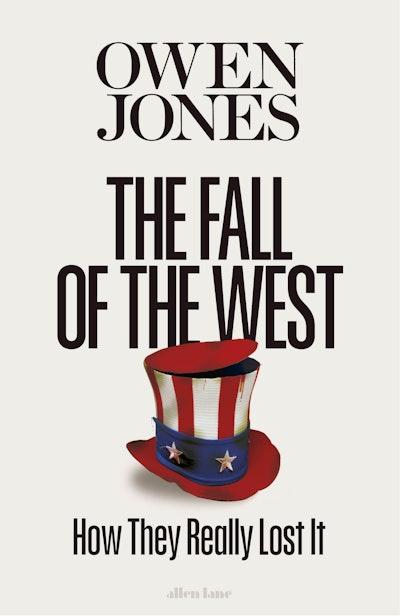
The Fall of the West: How They Really Lost It
Owen Jones (Author, Narrator), Penguin (Publisher) Format: Audible Audiobook
4.5 4.5 out of 5 stars (53)
From the critically acclaimed author of The Establishment, an excoriating take-down of Western hubris – and the book that reveals why we’re really in the state we’re in.
Almost everywhere we turn these days, there’s talk of a West in decline. Our jobs, our values, our past are all under attack, in the face of which we have become immersed in self-loathing, gone weak at the knees: the West needs to be Made Great Again. We know where this toxic narrative comes from: the nationalist, nativist Right. And now it’s gone mainstream.
The thing is, the West is in decline, self-evidently so. But the truth is that it’s not migrants or Muslims or a woke mob which has brought the West to the edge of catastrophe. It’s good, old-fashioned hubris.
In this blistering new book, Owen Jones explores how, amid the triumphalist sugar rush that came with the collapse of the Soviet Union, the West came to believe that its rule, its economic order, its moral values, would endure for ever – and how, over a quarter-century, this brittle self-mythologising narrative collapsed in on itself. From Afghanistan and Iraq, to the economic crash of 2008 and Gaza today, he takes us on a journey to show how the West went from scoring what it believed was its final victory, to being engulfed in an existential crisis of its own making. And how, along the way, it fashioned an ugly new story: that this was the fault of the most vulnerable groups in society, rather than a power-hungry, venal ruling class.
Today, as the Atlantic alliance struggles to hold itself together, The Fall of the West exposes how a generation of Western elites bent on power and self-enrichment at any cost fatally overreached itself, and argues that, if we are to find the solutions to our age of crisis, we must first understand the real reasons for how the West lost it.
'Bold and brilliant... We all need to read this book. If we want to deal with the rise of fascism and dictatorship, if we want to preserve democracy, human rights , peace and social justice, battered and bruised as they are, we cannot look away. This book does not look away' – Irish Times
'Owen Jones is saying it exactly as it is, with no filter, no limits, and not a drop of fear. He is exposing the inconsistencies in the West that, uncorrected, would ultimately cause its precipitous decline and fall' – Nassim Nicholas Taleb
'It is bracing to see what was once the news cycle take its place in the sweep of history, and Jones’s focus on free-market fundamentalism provides a compelling through-line' – Guardian
Owen Jones 2026 (P) Penguin Audio 2026===
Review
Owen Jones delivers a comprehensive deep dive into the state of the dystopian world we inhabit today, with a fascinating, if not perturbing description as to how we got here... Brace yourself for some hard facts from the UK's most supreme political writer, activist and commentator — Annie Lennox
Politics at the turn of the millennium was a story of temporary dispensations mistaken for eternal truths: the definitive triumph of free market ideology; US military supremacy; a rules-based global order. As Jones recounts, these certainties would come crashing down over the next quarter of a century amid a succession of economic failures, foreign policy disasters and political crises... it is bracing to see what was once the news cycle take its place in the sweep of history, and Jones’s focus on free-market fundamentalism provides a compelling through-line. He suggests the second Trump administration, in all its cynical venality, is “the logical endpoint” of that philosophy — Houman Barekat, Guardian
Owen Jones is saying it exactly as it is, with no filter, no limits, and not a drop of fear. He is exposing the inconsistencies in the West that, uncorrected, would ultimately cause its precipitous decline and fall — Nassim Nicholas Taleb
In this fascinating book, with his typical verve, Owen Jones charts the rise and fall of neoliberalism, which has not only led to Western decline but devastated much of the rest of the world since the 1980s. The historical narrative is panoramic in scope but firmly grounded in real human stories, while the analysis is laser-sharp and unflinching. Read this book if you want to know how this bankrupt system can be reformed so that the West can better serve its citizens while interacting with the rest of the world in a decent way — Ha-Joon Chang, economist and author of Kicking Away the Ladder and 23 Things They Don't Tell You About Capitalism
About the Author
Born in Sheffield and raised in Stockport, Owen Jones is one of the UK’s most prominent political thinkers and writers. He is the author of the critically acclaimed No. 1 bestsellers The Establishment: How They Get Away With It and Chavs: The Demonization of the Working Class; his books have been translated into ten languages. He writes regularly for the Guardian, and has two weekly web series, The Owen Jones Show and The Owen Jones Podcast.
Product details
ASIN : B0GTSL1K8V
Publisher : Penguin
Accessibility : Learn more
Publication date : 1 October 2026
==
Reviews
BOOK REVIEW: The Fall of the West: How They Really Lost It
The West won the Cold War, conquered the global economy and emerged as the world's undisputed superpower — only to squander its supremacy through disastrous wars, economic greed and political arrogance
Adnan Khan15th October 2026
The Fall of the West: How They Really Lost It
Owen Jones
1st October 2026
 The West emerged from the Cold War convinced that history had ended, its economic model had triumphed and American supremacy would last indefinitely. Three decades later, its wars have failed, its economies are struggling and its global authority is increasingly contested. In The Fall of the West, Owen Jones argues that the greatest threat to Western dominance was never China, Russia or immigration, but the arrogance and disastrous decisions of its own ruling elites.
The decline of the West has become one of the defining geopolitical questions of our time. Yet explanations often focus on external threats: China’s economic rise, Russia’s military resurgence, immigration or the supposed erosion of Western values.
British journalist Owen Jones offers a fundamentally different explanation. In The Fall of the West: How They Really Lost It, he argues that Western decline is largely self-inflicted. The political and economic elites who celebrated their victory over communism proceeded to undermine the very foundations of their own power.
Jones, best known for Chavs and The Establishment, expands his analysis from British politics to the international order. His central argument is that Western governments pursued an economic ideology that hollowed out their societies while simultaneously embarking on military adventures that destroyed their credibility abroad.
In eight chapters from the graveyard of empires to Russia’s revenge, to the great reverse all the way to a livestreamed genocide, the result is a powerful indictment of Western triumphalism, tracing the journey from the optimism of the 1990s to today’s fractured international order.
The Arrogance of Victory
The book begins with the collapse of the Soviet Union, arguably the greatest geopolitical victory in modern Western history. With communism defeated, Western leaders increasingly believed liberal democracy and free-market capitalism represented the final stage of political development. American military supremacy appeared unchallengeable, while globalisation promised prosperity and stability.
But Jones argues that victory produced intellectual arrogance rather than strategic wisdom. Western governments assumed their economic model could be imposed universally, regardless of local political conditions, historical experiences or social consequences.
Russia provides an important example. The economic transformation following the Soviet collapse produced enormous social disruption, declining living standards and the concentration of wealth among a small oligarchic elite. Jones highlights warnings from officials who recognised that the policies being promoted could destabilise Russia and undermine the possibility of a durable post-Cold War settlement.
Instead, Western policymakers continued to pursue their preferred economic prescriptions, often dismissing dissenting assessments.
The broader lesson is that Western leaders confused their temporary geopolitical dominance with permanent historical superiority.
The Wars That Destroyed Western Credibility
Perhaps the book’s strongest material concerns the consequences of Western military intervention.
The invasions of Afghanistan and Iraq were supposed to demonstrate American power and establish a new international order. Instead, they exposed the limitations of military superiority. Afghanistan ended with the Taliban returning to power in 2021, following two decades of occupation and enormous expenditure.
Iraq proved equally disastrous. The overthrow of Saddam Hussein dismantled existing state institutions, fuelled sectarian conflict and contributed to regional instability.
For Jones, these were not isolated mistakes but consequences of a worldview that assumed Western military power could remake entire societies.
The contradiction between Western rhetoric and Western conduct became increasingly difficult to conceal. Governments that claimed to defend international law repeatedly violated or selectively applied its principles.
Jones extends this criticism to Gaza, where Western support for Israel has severely damaged claims that the international order operates according to universal standards.
The cumulative consequence is a profound loss of legitimacy. Western military power remains formidable, but the ability to persuade others of its moral authority has been substantially weakened.
Neoliberalism and the Destruction From Within
Jones connects these foreign-policy failures with economic developments inside Western societies.
The financial crisis of 2008 exposed fundamental weaknesses in the neoliberal economic model that had dominated Western policymaking since the 1980s. Financial institutions accumulated enormous profits during the boom years, only to require public intervention when their speculative activities threatened the wider economy.
Yet the political response frequently involved austerity, reductions in public expenditure and pressure on ordinary households. Rather than restructuring the economic system responsible for the crisis, governments largely protected its principal institutions.
Jones argues that the resulting inequality, insecurity and deterioration of public services weakened public confidence in democratic institutions.
The political consequences were profound. Communities that had experienced industrial decline, stagnant wages and diminishing economic prospects increasingly rejected established political parties. This created fertile ground for populist movements promising to overturn the existing order.
The Rise of the Right
One of Jones’s central arguments is that the political establishment created the conditions for the very movements it now fears. Rather than acknowledging the consequences of economic mismanagement, political elites increasingly permitted immigrants, minorities and progressive movements to become convenient scapegoats. The rise of Donald Trump, Brexit and European nationalist parties can therefore be understood partly as reactions to economic and political failures.
Jones challenges the argument that Western decline results primarily from cultural liberalism or excessive immigration. Instead, he locates its origins in the decisions of political and economic elites who prioritised private enrichment, market ideology and geopolitical dominance over long-term social stability.
This is an important distinction. The forces claiming to rescue Western civilisation may themselves be symptoms of its deeper crisis.
The book’s greatest strength is its ability to connect developments that are frequently examined separately. Military intervention, financial deregulation, austerity, populism and declining international legitimacy are presented as interconnected consequences of the same governing assumptions. Jones also challenges the tendency to attribute Western decline exclusively to the rise of rival powers.
Jones links ideological arrogance to policy and political decisions made after the Cold war ended. Whilst elites in the west tend to lay the blame to policy decisions or specific governments, Jones places the blame firmly upon the ideology that came to dominate the world after the fall of Communism.
The End of Western Exceptionalism?
The Fall of the West is a compelling account of how a powerful political and economic order undermined its own foundations.
Jones’s central achievement is to challenge the comforting assumption that Western decline must have been caused by hostile outsiders. His argument is that the West’s ruling elites were not merely incapable of preventing decline; their policies actively accelerated it.
The book ends with Jones raising a question: can the West reform its institutions and recover its legitimacy, or have the consequences of three decades of strategic overreach become irreversible?
For readers interested in the changing global balance of power, the book provides an important perspective on the internal contradictions of Western supremacy.
The central lesson is that great powers do not always fall because their enemies become stronger. Sometimes they decline because their elites become convinced that their power has no limits.
==
From other countries
Gideon Anthony
Fascism as a top down distraction needs to be called out and defeated.
Reviewed in Germany on 4 October 2026
Format: Kindle
Verified Purchase
Owen Jones has done the work. He sees it and enables us to feel it in his new book: the fall of the west. Through an array of interviews, covering the UK, US, Palestine and Kenya he shows us that the western establishment is exceptionalist and headed by a consensus that, after the cold war, simply worships finance to the detriment of literally everything else. A feedback loop has been created which will, at best, impoverish the absolute majority (obliterating the middle class)in the west but, in my opinion be much worse ie. War and absolute ecological crisis within a couple of generations.
Impressive for me he delineates that the only approach to tackle this is collective action from below.
For me most impressive was his reading of Aime Cesaire because that directly locates liberalism and Fascism being part of the same ideological tradition. This is why the establishment left fragments into faction struggle. The anti colonial grass roots left simply must be destroyed in order for the establishment to maintain itself. This has been an assault in the making since the end of the second world war with academic marxism acting effectively as ideological bag carriers for the colonial establishment.
This is why we should all understand colonialism and its latest atrocity zombie, Israel and Palestine.
The Palestinian struggle is literally our struggle
The Ukrainian struggle against the west which has forced that state to obliterate up to three million of its population (Owen will find this problematic) against the russians is literally our struggle
Most importantly ecological justice is literally our struggle.
If we are not conscious we cannot struggle.
If do not struggle we can't be free (human), let alone win.
If we don't win the consequences for our culture and the world will make the troubles we have now look like luxuries as the palestinian model will be implemented on more and more of us (as global citizens).
Report
===
Politics books
This article is more than 1 month old
Review
The Fall of the West by Owen Jones review – a bracing history of the changing world order
This article is more than 1 month old
A journalist charts a quarter century of geopolitical hubris and economic overreach
Houman Barekat
Tue 29 Sep 2026 18.00 AEST
Share
Prefer the Guardian on Google
Like many Britons born in the 1980s, the journalist and Guardian columnist Owen Jones came of age with Tony Blair’s platitudes ringing in his ears. Politics at the turn of the millennium was a story of temporary dispensations mistaken for eternal truths: the definitive triumph of free market ideology; US military supremacy; a rules-based global order. As Jones recounts in his new book, these certainties would come crashing down over the next quarter of a century amid a succession of economic failures, foreign policy disasters and political crises.
Indeed, “the west” itself – as a shorthand for the US plus the wealthier western European nations – feels almost quaint today, given the increasing unilateralism of the administration in Washington. But in the 2000s it was part of the lexicon, as if the hemisphere were a political actor in its own right. Revisiting the US-led wars in Afghanistan and Iraq, we are reminded not just of their horrific death tolls (totalling half a million, by conservative estimates) but also their total strategic failure; the 2021 evacuation of Kabul airport, Jones writes, was “among the starkest images of American decline yet broadcast to the world”.
In addition to destabilising the region, these interventions weakened the foundations of the international legal system. As Jones points out, a precedent was set when Nato bombed Yugoslavia without UN security council authorisation in 1999; the 2003 invasion of Iraq, also without authorisation, further undermined the UN. So when Vladimir Putin subsequently invaded Ukraine on his own dubious pretext, western objections could be dismissed as hypocrisy. Perhaps the most ignominious example of western indifference to the international rule of law was Keir Starmer’s limp assertion that Israel had the “right” to cut off water and electricity to 2 million civilians in Gaza – a war crime – in retaliation for Hamas’s attacks on 7 October 2023.
Alongside these geopolitical catastrophes, Jones tells a story of domestic decline, of western economies built on chronic insecurity and precarious employment. In the 2000s, Thatcherite policies pursued by New Labour fleeced the public: “Essential services [were] turned into assets designed to generate returns. Passengers paid more for overcrowded trains. Rivers and seas were fouled while water companies loaded themselves with debt and paid out dividends.” Then came the 2008 financial crisis and the bankers’ bailout, paid for by austerity. In Britain and elsewhere, Jones notes a “correlation between the inability of centrist governments to tackle economic decline in any meaningful way, and the rise of the far right”.
For decades, electorates have been mis-sold a fanatical ideology
The book is interspersed with snippets of interviews with an assortment of eyewitnesses, journalists, scholars and activists. They include the director of Iraq national museum in Baghdad, a former Lehman Brothers employee, a former head of the Afghan Red Crescent, the Greek economist Yanis Varoufakis, and the conservative commentator Andrew Sullivan, a repentant cheerleader for the Iraq war, who admits: “I was wrong on the major issues, on the morality of it and the practicality of it and the reason for it.”
Much of this terrain – Bush and Blair’s wars, the financial crash, the populist surge – has been extensively covered. The average well-informed reader will learn nothing new, but it is bracing to see what was once the news cycle take its place in the sweep of history, and Jones’s focus on free-market fundamentalism provides a compelling through-line. He suggests the second Trump administration, in all its cynical venality, is “the logical endpoint” of that philosophy. And he reminds us that the aggressive privatisation of the Russian economy in the 1990s brought terrible economic hardship which ultimately fuelled Putin’s revanchist nationalism.
For decades, electorates have been mis-sold a fanatical ideology: the prerogatives of the private sector must override the collective interest, and anything less is tantamount to Stalinism. This remains orthodoxy, but the rise to prominence of Zohran Mamdani, the avowedly socialist mayor of New York, offers a glimmer of hope to those who, like Jones, would prefer a society built on “common provision, democratic power, mutual obligation and the recognition that our fates are bound together”.
===
G-Boi
Global awakening
Reviewed in the United Kingdom on 14 November 2026
Format: Hardcover
Verified Purchase
A very well researched book which explains how successive governments and malevolent forces have created a chain reaction of catastrophic errors and false propaganda to continue to support the lame duck of Neo-liberalism and rise of authoritarianism.
Thankfully it’s not all doom and gloom. Owen demonstrates how recent changes in political power have (and will continue) to benefit the people, but only if we continue to take lessons from history, wake up and support these changes, rather than the billionaire class who just want to see society disintegrate in their lust for power and greed.
I highly recommend you read this.
Report
Richard Cohen
A cogent account of the missteps taken by the West
Reviewed in the United Kingdom on 5 November 2026
Format: Kindle
Verified Purchase
A clearsighted and cogent account of the missteps taken by Western leaders over the last 30 years which gives a lucid explanation for the global difficulties faced by the western powers. A compelling read.
Report
Jonathan Edward Evans
A tour de force through the fall of western hegemony
Reviewed in the United Kingdom on 7 October 2026
Format: Kindle
Verified Purchase
Taking as it's premise the "End of History" through the fall of the Soviet Union in 1991, Jones weaves a convincing (at times sobering and hopeful) narrative of how this has led to Western decline. The chapters cover periods from the 'war on terror' - Afghanistan and Iraq - to those within the Western core of the UK and US. Adept at showing where and how this decline is manifesting, also through first hand testimonies, it ends with a call for a newly minted collectively organised society. One opposed to the billionaire atomisation and boltholes in New Zealand. Although covered elsewhere by authors such as Naomi Klein and Gil Duran, the book here could have covered a bit more on generative AI to really solidify the underlying premise. All in all, a five star book that has been some time coming from Jones. Highly recommend to gain insights, knowledge and a modicum of hope as to where we are and to neuter the many myths we have been told about the West.
Report
Mr Anthony Pinnegar
Magnificent
Reviewed in the United Kingdom on 25 October 2026
Format: Kindle
Verified Purchase
Absorbing and totally brings to live the political and economic landscape of the last 50 years. Highly recommend this book.
Report
Jeff lawton
A must read
Reviewed in the United Kingdom on 12 October 2026
Format: Hardcover
Verified Purchase
interesting aspect of testate of the west. must read!
Report
Customer
Informative.
Reviewed in the United Kingdom on 15 November 2026
Format: Hardcover
Verified Purchase
Informative.
Report
Lindsay Talmud
Dead bore
Reviewed in the United Kingdom on 16 October 2026
Format: Kindle
Verified Purchase
I have got more from each of Owen's Guardian articles than I did from this book. It's a real disappointment.
Report
==
==
==
==

댓글 없음:
댓글 쓰기