The Rise and Fall of Dispensationalism: How the Evangelical Battle over the End Times Shaped a Nation: Hummel, Daniel G., Noll, Mark A.: Amazon.com.au: 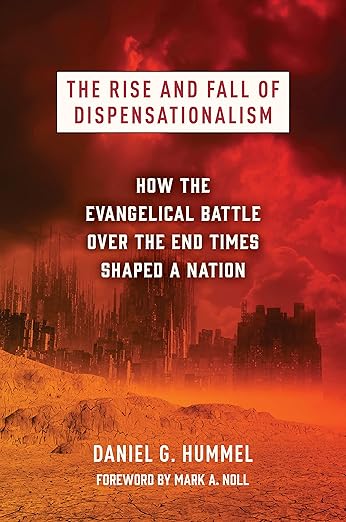
Read sample
Follow the author

The Rise and Fall of Dispensationalism: How the Evangelical Battle over the End Times Shaped a Nation Kindle Edition
by
Daniel G. Hummel (Author),
Mark A. Noll (Foreword) Format: Kindle Edition
4.5 4.5 out of 5 stars
(179)A fascinating history of dispensationalism and its influence on popular culture, politics, and religion
In The Rise and Fall of Dispensationalism, Daniel G. Hummel illuminates how dispensationalism, despite often being dismissed as a fringe end-times theory, shaped Anglo-American evangelicalism and the larger American cultural imagination.
Hummel locates dispensationalism's origin in the writings of the nineteenth-century Protestant John Nelson Darby, who established many of the hallmarks of the movement, such as premillennialism and belief in the rapture. Though it consistently faced criticism, dispensationalism held populist, and briefly scholarly, appeal—visible in everything from turn-of-the-century revivalism to apocalyptic bestsellers of the 1970s to current internet conspiracy theories.
Measured and irenic, Hummel objectively evaluates evangelicalism's most resilient and contentious popular theology. As the first comprehensive intellectual-cultural history of its kind, The Rise and Fall of Dispensationalism is a must-read for students and scholars of American religion.
Read less
Print length 525 pages
===
===
Daniel G. Hummel
Daniel G. Hummel is a historian of U.S. religion. He works as Director of University Engagement at Upper House, a Christian study center on the campus of the University of Wisconsin-Madison.
===
From Australia
Olga K
5.0 out of 5 stars Brilliant
Reviewed in Australia on 13 April 2025
Format: HardcoverVerified Purchase
A must -read to anyone interested in religious history.
Helpful
Report
Kindle Customer
5.0 out of 5 stars Makes so much sense!
Reviewed in Australia on 1 January 2024
Format: KindleVerified Purchase
I couldn't stop reading this book! I live in Australia and became a Christian in 1975, so my eschatology was very much founded on pop dispensationalism. I have seen over the years the impact of this belief system on my family, friends, and myself in the ways described in this book. I appreciate the tireless work of the author in explaining the history and evolution of this theology that has so influenced my life.
One person found this helpful
Helpful
Report
From other countries
Amazon Customer
5.0 out of 5 stars Evaluation by a Dispensationalist
Reviewed in the United States on 5 August 2025
Format: PaperbackVerified Purchase
I did not fully read this, but I wanted to add a review by someone who is not obviously rooting for its demise. I think the author did a great job of describing a set of Christian movements, mostly of America. He traces dispensationalism's rise as a popular movement and its recent abatement. I do agree with reviewers who think it is too early to tell whether it will fully recede. Historians like "movements" but the truth is a few individuals or even one can "turn the tide" as the book documents in other instances. The author states that the "fall" of dispensationalism is mostly about its academic recession, but he then predicts this will become a layperson movement. I already see a surge of dispensationalist books, so I see a resurgence. I also fault the author for not giving progressive dispensationalism its due. Despite the protests of traditional dispensationalists, PD is a continuation of dispensationalism. Nevertheless, in my opinion, this is an excellent work on fundamentalism and dispensationalism. Keep in mind that the author is a historian, not a theologian.
Report
JNok
5.0 out of 5 stars Must Read for the Evangelical Church in the U.S.
Reviewed in the United States on 10 May 2024
Format: HardcoverVerified Purchase
This book is excellent and documents the relatively short life cycle (200 years) of the man-made superficial theology known as premillennial Dispensationalism. It rightly documents the invention of this doctrine in the early 1800’s in Ireland and Great Britain by John Darby only later to be swallowed hook, line and sinker by the mainstream evangelicals in the U.S. due to its novelty, sensationalism and commercial promise. Only in the U.S. do those attributes outweigh sound Biblical exegesis and doctrine. If I could get this book into the hands of every Christian indoctrinated by false and dangerous dispensation doctrine I would. Must be read with an open mind to the facts and clear headed, unbiased Biblical understanding.
Report
J.D. King
4.0 out of 5 stars The End is Nigh
Reviewed in the United States on 23 June 2023
Format: HardcoverVerified Purchase
Daniel G. Hummell’s The Rise and Fall of Dispensationalism: How the Evangelical Battle Over the End Times Shaped a Nation focuses on the history of this controversial movement, and little else. The author didn’t provide much in-depth analysis. He was more interested in the big picture—showing how the movement intersected with American politics and culture.
With that said, Hummell did a marvelous job articulating the different tributaries of the Dispensational family—introducing all the major personalities and groups. He began with John Nelson Darby and the Plymouth Brethren in 1830s and moved forward through the stories of Scofield, Chafer, Ryrie, and others. I love the way he built an interconnecting narrative of these individuals’ stories—showing how this movement adapted and morphed over the decades.
Looking into the late twentieth and early twenty first century, Hummell points out that Dispensational Premillennialism broke into two camps: the scholastics in the seminaries and pop Dispensationalists that are on television and social media. Hummell argues that the pop Dispensationalists have effectively won out in the public over the scholastics. They articulate a general apocalyptism with a rapture, Antichrist, and warnings about judgment. However, the pop defenders are all over the place on the details—sharing very little biblical arguments or reasoning. It is an “assumed apocalyptism” used for all sorts of things—fund raising, political activism, or other missional tasks. Their brand is a “Dispensational lite” with no underlying theological system driving it.
The scholastics, on the other hand, have lost their standing—partly because of the popularity and successes of the pop Dispensationalists. The television and social media preachers have undermined core pieces of the older Dispensational system and turned the movement into a garish caricature. What is clear is that most serious theologians have given up on Dispensationalism. Even a majority of the instructors at Dallas Theological Seminary are now Covenentalists. They state that they are “Progressive Dispensationalists,” but there’s not much difference between their position and the positions of other Historic Premillennialists.
Hence, Dispensationalism, as a viable theological system, is collapsing. It has always had questionable foundations, but there are fewer specialists than ever advocating for it. Some would even say, “The end is nigh.”
The media-savy pop Dispensationalists are still talking about the major components of Darby’s Premillennial system, and it still influences the Pentecostal and Evangelical grassroots. Yet even that is beginning to change. The future doesn’t look good for Dispensational Premillennialism. Hummell makes this fact clear.
I could point out other elements, but I think this summarizes a few of the major elements of the book. Hummell’s The Rise and Fall of Dispensationalism is well-researched and objective in its presentation. It will be useful for historical and doctrinal studies. I would have liked for it to go deeper in few areas, but it does justice to a difficult topic.
Report
lee howell
5.0 out of 5 stars Dispensationalism is dying
Reviewed in the United States on 16 October 2025
Format: HardcoverVerified Purchase
Outstanding history of dispensationalism in its various silos. Hard to believe such a new/novel idea captured so much of evangelicalism. Hope that it is dying out. Hummel has provided such great research.
Report
Deborah
5.0 out of 5 stars Excellent!! Well done.
Reviewed in the United States on 16 September 2025
Format: HardcoverVerified Purchase
My husband is thrilled to get this book. He says it shares the history without bias. A really factual account.
Report
Nicholas Moore
5.0 out of 5 stars A charitably written overview of the impact of Dispensationalism on Christianity in the US.
Reviewed in the United States on 1 September 2023
Format: HardcoverVerified Purchase
Having read broadly from authors both Dispensational and non-dispensational, Hummel writes precisely and charitably from a historians perspective. He makes it clear that the book is not an in depth theological treatise on Dispensationalism and from other histories I have read on the subject he adds development within the 20th century which helps make sense of ongoing trends and rhetoric.
Report
Frederick Maurice
3.0 out of 5 stars Read Carefully
Reviewed in the United States on 2 November 2024
Format: KindleVerified Purchase
A great review of the history of the church in America. A completely accurate and comprehensive description of the rise and subsequent decline of dispensational theology. However, I think he has taken his thesis too far. Dispensationalism, though certainly less prominent than it was 40!years ago is far from fallen. I recently relocated to an area,near DC. We've been here two.years and have found that unless we want to go to a more liturgical.style church or a PCA church, we have to go somewhere where our historic premillenialism seems strange. (We tried our local PCA its not for us.). Dispensationalism and zionism is strong and healthy in America, Althoough covenant theology and the New Reformation are on the rise. It"s much too soon to eulogize dispendationalism. Further, in his final chapter he associates dispensationalism with nearly every social and political crisis in America, and come close too blaming.the movement for.factionalism in American culture. His last chapter is a complete reflection of his own bias and has no basis whatsoever in reality . It's a great well researched book with a faulty conclusion and unserious ending
Report
Martin J Holman
5.0 out of 5 stars A Brilliant Fishbowl View
Reviewed in the United States on 30 December 2024
Format: KindleVerified Purchase
It was a delightful look into why I was taught the way I was. A profound historical path walking its reader along the path of why end times conversations is so prevalent in modern American Christianity. For a solid academic, yet relatable read, I highly recommend this historical work.
Report
Show 10 more reviews
From other countries
Amazon Customer
5.0 out of 5 stars Evaluation by a Dispensationalist
Reviewed in the United States on 5 August 2025
Format: PaperbackVerified Purchase
I did not fully read this, but I wanted to add a review by someone who is not obviously rooting for its demise. I think the author did a great job of describing a set of Christian movements, mostly of America. He traces dispensationalism's rise as a popular movement and its recent abatement. I do agree with reviewers who think it is too early to tell whether it will fully recede. Historians like "movements" but the truth is a few individuals or even one can "turn the tide" as the book documents in other instances. The author states that the "fall" of dispensationalism is mostly about its academic recession, but he then predicts this will become a layperson movement. I already see a surge of dispensationalist books, so I see a resurgence. I also fault the author for not giving progressive dispensationalism its due. Despite the protests of traditional dispensationalists, PD is a continuation of dispensationalism. Nevertheless, in my opinion, this is an excellent work on fundamentalism and dispensationalism. Keep in mind that the author is a historian, not a theologian.
Report
JNok
5.0 out of 5 stars Must Read for the Evangelical Church in the U.S.
Reviewed in the United States on 10 May 2024
Format: HardcoverVerified Purchase
This book is excellent and documents the relatively short life cycle (200 years) of the man-made superficial theology known as premillennial Dispensationalism. It rightly documents the invention of this doctrine in the early 1800’s in Ireland and Great Britain by John Darby only later to be swallowed hook, line and sinker by the mainstream evangelicals in the U.S. due to its novelty, sensationalism and commercial promise. Only in the U.S. do those attributes outweigh sound Biblical exegesis and doctrine. If I could get this book into the hands of every Christian indoctrinated by false and dangerous dispensation doctrine I would. Must be read with an open mind to the facts and clear headed, unbiased Biblical understanding.
Report
J.D. King
4.0 out of 5 stars The End is Nigh
Reviewed in the United States on 23 June 2023
Format: HardcoverVerified Purchase
Daniel G. Hummell’s The Rise and Fall of Dispensationalism: How the Evangelical Battle Over the End Times Shaped a Nation focuses on the history of this controversial movement, and little else. The author didn’t provide much in-depth analysis. He was more interested in the big picture—showing how the movement intersected with American politics and culture.
With that said, Hummell did a marvelous job articulating the different tributaries of the Dispensational family—introducing all the major personalities and groups. He began with John Nelson Darby and the Plymouth Brethren in 1830s and moved forward through the stories of Scofield, Chafer, Ryrie, and others. I love the way he built an interconnecting narrative of these individuals’ stories—showing how this movement adapted and morphed over the decades.
Looking into the late twentieth and early twenty first century, Hummell points out that Dispensational Premillennialism broke into two camps: the scholastics in the seminaries and pop Dispensationalists that are on television and social media. Hummell argues that the pop Dispensationalists have effectively won out in the public over the scholastics. They articulate a general apocalyptism with a rapture, Antichrist, and warnings about judgment. However, the pop defenders are all over the place on the details—sharing very little biblical arguments or reasoning. It is an “assumed apocalyptism” used for all sorts of things—fund raising, political activism, or other missional tasks. Their brand is a “Dispensational lite” with no underlying theological system driving it.
The scholastics, on the other hand, have lost their standing—partly because of the popularity and successes of the pop Dispensationalists. The television and social media preachers have undermined core pieces of the older Dispensational system and turned the movement into a garish caricature. What is clear is that most serious theologians have given up on Dispensationalism. Even a majority of the instructors at Dallas Theological Seminary are now Covenentalists. They state that they are “Progressive Dispensationalists,” but there’s not much difference between their position and the positions of other Historic Premillennialists.
Hence, Dispensationalism, as a viable theological system, is collapsing. It has always had questionable foundations, but there are fewer specialists than ever advocating for it. Some would even say, “The end is nigh.”
The media-savy pop Dispensationalists are still talking about the major components of Darby’s Premillennial system, and it still influences the Pentecostal and Evangelical grassroots. Yet even that is beginning to change. The future doesn’t look good for Dispensational Premillennialism. Hummell makes this fact clear.
I could point out other elements, but I think this summarizes a few of the major elements of the book. Hummell’s The Rise and Fall of Dispensationalism is well-researched and objective in its presentation. It will be useful for historical and doctrinal studies. I would have liked for it to go deeper in few areas, but it does justice to a difficult topic.
Report
lee howell
5.0 out of 5 stars Dispensationalism is dying
Reviewed in the United States on 16 October 2025
Format: HardcoverVerified Purchase
Outstanding history of dispensationalism in its various silos. Hard to believe such a new/novel idea captured so much of evangelicalism. Hope that it is dying out. Hummel has provided such great research.
Report
Deborah
5.0 out of 5 stars Excellent!! Well done.
Reviewed in the United States on 16 September 2025
Format: HardcoverVerified Purchase
My husband is thrilled to get this book. He says it shares the history without bias. A really factual account.
Report
Nicholas Moore
5.0 out of 5 stars A charitably written overview of the impact of Dispensationalism on Christianity in the US.
Reviewed in the United States on 1 September 2023
Format: HardcoverVerified Purchase
Having read broadly from authors both Dispensational and non-dispensational, Hummel writes precisely and charitably from a historians perspective. He makes it clear that the book is not an in depth theological treatise on Dispensationalism and from other histories I have read on the subject he adds development within the 20th century which helps make sense of ongoing trends and rhetoric.
Report
Frederick Maurice
3.0 out of 5 stars Read Carefully
Reviewed in the United States on 2 November 2024
Format: KindleVerified Purchase
A great review of the history of the church in America. A completely accurate and comprehensive description of the rise and subsequent decline of dispensational theology. However, I think he has taken his thesis too far. Dispensationalism, though certainly less prominent than it was 40!years ago is far from fallen. I recently relocated to an area,near DC. We've been here two.years and have found that unless we want to go to a more liturgical.style church or a PCA church, we have to go somewhere where our historic premillenialism seems strange. (We tried our local PCA its not for us.). Dispensationalism and zionism is strong and healthy in America, Althoough covenant theology and the New Reformation are on the rise. It"s much too soon to eulogize dispendationalism. Further, in his final chapter he associates dispensationalism with nearly every social and political crisis in America, and come close too blaming.the movement for.factionalism in American culture. His last chapter is a complete reflection of his own bias and has no basis whatsoever in reality . It's a great well researched book with a faulty conclusion and unserious ending
Report
Martin J Holman
5.0 out of 5 stars A Brilliant Fishbowl View
Reviewed in the United States on 30 December 2024
Format: KindleVerified Purchase
It was a delightful look into why I was taught the way I was. A profound historical path walking its reader along the path of why end times conversations is so prevalent in modern American Christianity. For a solid academic, yet relatable read, I highly recommend this historical work.
Report
Charles D Waltemeyer
1.0 out of 5 stars Not Recommended
Reviewed in the United States on 4 August 2023
Format: HardcoverVerified Purchase
This book by Hummel is a prime example of some truth mixed with a great deal of error. If one is interested in researching a factual account of dispensational theology, one must look elsewhere. For example, the claim that Mauro coined the term “dispensationalism” in 1927 (p. 1) is an erroneous assertion deliberately used to disparage dispensational theology. This is an obvious attempt to make dispensational theology out to be a “Johnny-come-lately” imposition into the theological discussion. This claim obfuscates the truth that dispensational thought goes back to the early church, and whether it was called by that name or not is beside the point. By any honest measure, dispensational thought predates Calvinism by many centuries. The Puritans used the word which certainly predates Mauro. A bit of quality research should have prevented this claim (and a lot of others as well) from being made in the book. It is true that Darby was the first to actually attempt to systematize dispensational theology to a significant degree, but he did not originate the concept of dispensations. Prior to Mauro, Scofield used the word “dispensation” in his study Bible, which is different only in spelling and grammatical usage and not in theological intent.
Hummel makes the claim that dispensational theology is used by dispensational theologians to understand the Scriptures. In other words, they start with dispensational theology and make the Bible fit the theology. In reality, the opposite is true. Dispensational theology flows from a literal interpretation of the Scriptures, and it is the only theological system that consistently does so from beginning to end.
Hummel admits that dispensational theology is much more that eschatology; however, through-out the book he seems to disingenuously place a large number of theologians, and even false teachers, into the dispensational camp because of their adherence to premillennial eschatology. He places a number of Word of Faith prosperity preachers into the dispensational camp who are in no way dispensational even though they adhere to premillennial eschatology. These people include Jim Baker, Oral Roberts, Pat Roberson, Rex Hubard, TBN’s Paul and Jan Crouch, John Hagee, and Jimmy Swaggert, none of whom can be called systematic, dispensational theologians and strictly literal exegetes of the Scriptures. This is a guilt by association tactic, erroneous at that, which should not have been used in this book. He also associates dispensational theology with “fundamentalism, Pentecostalism, Christian nationalism, and New Calvinism” (p. 5) which is not accurate. Fundamentalists may well be dispensationalists, or not, but the other groups do not represent normative dispensational thought.
He disparages the study of the Bible by means of the use of the literal hermeneutic by calling it “a unique biblical hermeneutic” (p. 11). How can reading the Bible the way God had it written be anything other than the appropriate way to approach one’s study of the Word of God? Every other system of theology begins their study of the Bible with their particular brand of theology which is exactly what he is falsely claiming that dispensational does. This theologian has it exactly backwards. He also disparages the fact that the literal hermeneutic presupposes “the absolute inerrancy of the Bible” (p. 11). To that assertion, I plead guilty as charged! The use of the literal hermeneutic accounts for discrepancies and textual variations in terms of lower textual criticism, which is part of the doctrine of biblical inerrancy properly understood. He favorably mentions higher criticism and evolution both of which are denials of inerrancy (pp. 136-137).
He criticizes the free grace gospel presentation that we are saved by grace alone through faith alone in Christ alone (pp. 11, 195-196).
He favorably quotes covenantal theologians who attack dispensational theology as contentious and built on a system of logic rather than on the Word of God (p. 197). Dispensational theology is logical because it is built on the logic of the Word of God, but it is not based on a secular humanist concept of philosophy. He asserts that dispensational theology “if allowed to grow in the fundamentalist movement, would threaten fundamentalism’s entire theological integrity” (p. 197).
Hummel does get into what he derisively refers to as “pop dispensationalism” (pp. 233-247). He primarily uses Hal Lindsey who wrote The Late Great Planet Earth and Tim LaHaye and Jerry Jenkins who authored the Left Behind series of books as examples of men he apparently con-siders to be lower status theologians. He denigrated these theologians as “only tenuously connected to the world of scholastic dispensationalism, with many of them, like Lindsey, claiming little more that a degree for Dallas or Moody” (p. 240). That is more than a bit of scholastic snobbery. The test is not how many degrees one has earned, how many languages one knows and how well one knows them, or where one’s degrees were earned, but how accurate is the handling of the text?
Hummel inexplicably lauds the fact that “the New Calvinists, the emergent church, the prosperity gospel, the evangelical left, the ‘exvangelical’ community—and may other pockets besides—all derided, ignored, or excluded dispensationalists” (pp. 333-334). I seriously doubt that any dispensational theologians lose any sleep over being excluded by these aberrant, unbiblical groups. When one has to resort to using Tony Campolo and Brian McLaren, both leftist, liberal theologians, to support one’s theological cause as Hummel does, one has already lost the argument (pp. 334-335).
Hummel is, to some extent, more irenic in his approach to discussing dispensational theology than others such as John Gerstner have been, but his disdain for the system is evident. He clearly sees it as his duty to dissuade people from reaching the conclusion that the Bible identifies dispensational theology as the theological system that properly flows out of God’s Word. He also seems to allow others to make more intemperate remarks for him. More accurate research and less factual error would give more credence to his criticism of dispensational theology. Some of his history is reasonably accurate, but his assessment of it is impacted by his own theological presuppositions that are not supported by the use of the literal hermeneutic. He also failed to acknowledge that as dispensational thought was systematized, theologians such as Ryrie, Walvoord, and Pentecost more accurately developed it as a biblically based system. If you want to learn some truth about dispensational theology, this book is not recommended.
Report
David Morton
4.0 out of 5 stars A solid overview of the dispensational movement
Reviewed in the United States on 31 May 2023
Format: HardcoverVerified Purchase
I grew up with dispensational theology. My parents were at Explo '72, and my church growing up, Northwest Bible Church, in Dallas, TX, boasted members whose names were permanently etched on the outside facade of libraries at the campus of Dallas Theological Library. One of my pastors from that church is mentioned in the text. I have my Ryrie Study Bible sitting on my shelf at home. If any of this sounds like what you grew up in, and you want to know the history of it, this is a fantastic resource.
Hummel has built an impressive history here of the dispensational theological movement, beginning with John Darby, and moving all the way through the first quarter of the twenty-first century, discussing the rise of the movement, it's undeniable impact on modern Christianity (especially within the evangelical movement), and it's unravelling and scholarly decline in the 90's and 2000's, even as it's popular version continued to be strong and vibrant. He manages to discuss the topic in a nuanced and neutral fashion, sparing the reader the annoyance of a color commentary. He is never openly scornful of the views which now seem antiquated to many, and he even speaks at moments of the good things that the movement has brought to Christianity. If you're looking for a nearly exhaustive history of the movement, you could do far worse than this book.
That said, the strength of his history is also its Achilles Heel. The tone is dry, on account of the sheer amount of information that he is packing in. I didn't realize until I was nearly done that there was a glossary in the back of the book, leading me to mine my brain for the meaning behind the phrase "sectional reconciliation" multiple times. While this is a fantastic reference book, the story-telling leaves something to be desired.
I also struggled with some of the hymns Hummel chose to use as introductory materials in each of the chapters. I found myself wondering at times if he conflates the doctrine of a bodily return of Christ (the parousia) with the rapture as outlined by the premillenialists/dispensationalists. He seems to understand the ideas, but it would have helped readers if he had chosen to add a bit more explanation to some of his terms within the text itself. But these are all minor quibbles in a massively complex story--and make no bones about it, the history of dispensationalism _is_ convoluted and complex.
In sum, if you are looking for a book that provides a good overview of the history of dispensationalism, and you're curious about the major players, and twists and turns in the theological movement, this is the book for you.
Report
Tim Wilder
2.0 out of 5 stars Useful historical account, but many errors; without interest in or understanding of theology
Reviewed in the United States on 26 August 2023
Format: HardcoverVerified Purchase
For a history of the origin development and crackup of dispensationalism, the book is highly useful. There may be nowhere else where nearly so many facts about this are brought together. Mixed in, however, are many errors both large and small.
The author does not seem to be interested in theology. He labels the various theologies that are sources, components or opposed to dispensationalism, but does not seem to understand them, their inner coherence or the explanatory power they provide to their adherents. Basically, he does not seem interested in theology except as a social force. As such it is to be judged by how agreeable it is to the liberal agenda.
Foremost he does not understand nor is able to define Evangelicalism, and this seems to be because he has no notion of the Gospel. The Evangelicals and their denominations were those who in the 19th century saw each other as possessing the Gospel, whatever their differences on other matters, and thus were able to cooperate, for example in evangelism campaigns, or to have pulpit exchanges, to a degree that is unthinkable in the 21st century.
The perennial critics of dispensationalism, as seen by the author, are those who hold to Covenant Theology, that is those who see the covenants united in the single Covenant of Grace (a point he doesn't get). The dispensationalists themselves are covenantalists, in that the dispensations are founded on covenants, but they do not see the unity. His notion of Covenant theology is particularly shallow, as he does not know about the Reformed distinction between the Church and the Kingdom of God. (He assumes, for example, that Reconstructionists must be trying to reconstruct the church. What else could they be concerned about?) Nor does he have any sense of the revolution worked by the introduction of the Neocalvinist three-covenant system, nor its inverted role in the Radical Two-Kingdom theology to carry through the dispensationalist program of fragmenting the Kingdom, but on a new theological basis, not yet discredited as dispensationalism is. In short at the same time that dispensationalism was succumbing to failed Biblical exegesis, the Reformed suffered a breakup of their covenantal consensus.
For the author, the end of dispensationalism is more or less bound up with the breakup of Evangelicalism. Dispensationalism is not so much the cause of this, but is like a parasite that must die with its host.
Report
J.R. Woods
1.0 out of 5 stars Needs a Serious Rewrite
Reviewed in the United States on 24 August 2023
Format: KindleVerified Purchase
Three problem areas I want to address: Hummel's prejudicial tenor, Hummel's utter incoherence, and finally a little housecleaning of Hummel's attribution problem. Firstly, Hummel's book shows a tremendous amount of exposure to documentation laced with ranting-styled prejudicial expressions toward Christian movements. Nearly every Christian disagreement Hummel consistently maligns as "infighting" (11x), "heated" (13x), '"tensions" (20x), "sectarian" (7x), and their synonyms. So Christians dialoguing theology, in Hummel's estimation, cannot be cordial, productive, or positive. By the end of nearly 500 pages, this broken-record modal choice becomes the equivalent of an 80s one-hit wonder you've heard too many times. Secondly, Hummel uses this book as a historical trash compactor into which he tosses every form of discredited, accusatory, or remotely negative association at his disposal. Everything from oil money (p 36), racism (p 35), pyramidology (p 126), ancient aliens (p 340), and finally Y2K (p 462). The incoherence of whatever thesis Hummel thinks he's expounding shows through his exasperation to define his object of discussion. One minute "dispensationalism" is a theory about the "end of the world" (p 28), then it's a "theory of time" (p 30), then it's a theory of the church (p 30), and finally, it's a "theory of salvation" (p 32). While confessing he is studying a movement that is "no fixed community" (p 37), somehow it's "always a dissenter movement" (p 33), then it's "white evangelicals" who privileged white reconciliation after the Civil War (p 35), then its a movement designed for "institutional renewal of the church" (p 51), and eventually he names nearly every evangelical community in the history of 20th century United States. While pointing out that the dispensational teachings "retreated from New England" (p 36), his map exposes 4 different NE centers for Darby's conferences (p 155). Though submitting a good definition of a literal hermeneutic (p 30), Hummel's journey failed to reveal to him that dispensationalism was simply a set of teachings, rather than a distinct social group. It is precisely this insight that Hummel's book shows profound confusion: equivocating doctrinal positions with social groups. Finally, we move on to the attribution housecleaning. Hummel follows very closely N.T. Wright's terminology and viewpoints (mostly from Surprised By Hope; compare Wright's views on the rapture and dualism). Yet, Wright's work goes utterly without attribution throughout the book until Hummel confesses his reliance in a paragraph at the end of the book (p 486). Hummel shows a struggle to track down sources as well, see his attribution error on p 188 (see p 191, nt 19) where he takes G. Campbell Morgan's quote, but lists J. J. Morgan's title.
Customer image
Report
FustianMan
4.0 out of 5 stars Good account of much American Christianity
Reviewed in the United States on 30 September 2023
Format: HardcoverVerified Purchase
Interesting and helpful to read the history which affected my life and so many around me. Helpful to get a glimpse, perhaps, of the motives of a large chunk of American Christendom; the larger movements and variations to and fro (perhaps even the fickleness of many forefathers, yes, and many steadfast as well); how authentic followers of Jesus Christ have done well or screwed up badly and yet the Almighty is working His plan and will accomplish His desire (if history is any pointer in that direction— even if it isn’t, He will).
Recommend this as an important adjunct to older church history. Yes, get a good grasp on that too!
Report
Careful Reader
4.0 out of 5 stars A first rate history and assessment
Reviewed in the United States on 13 December 2023
Format: KindleVerified Purchase
Having abandoned dispensationslism about 50 years ago, I've witnessed much of its dark legacy in the Western Church. Hummel does a wonderful job of tracing its rise and its influence, and shows how it continues to influence Christian thought even among those who never heard of it. While I understand that he had no intention of resurrecting the old debates, I wish he had said a bit more about the damage done by these theologians who tried to nail shut the door to the Kingdom.
Report
Robert Cornwall
5.0 out of 5 stars essential reading
Reviewed in the United States on 3 March 2024
Format: KindleVerified Purchase
Having co authored a book titled Second Thoughts about the Second Coming I wish I had this book in front of me as we wrote. This is a masterpiece of historical analysis and contemporary exploration that take us from Darby to Scofield to Lindsey and LaHaye with many stops along the way. We watch as scholastic dispensationalism devolves into pop dispensationalism, noting as well it’s covenantal rivals. This is a must read!
Report
Miffed
3.0 out of 5 stars Wide but not very deep
Reviewed in the United States on 12 February 2024
Format: KindleVerified Purchase
Daniel Hummel has written a very broad history of dispensationalism especially as it relates to latter 20th century American culture and politics. Names and dates fly fast and furious but the pace is fairly ponderous through the first half of the book. Unless you are quite familiar with this early history it is easy to get lost in the details. I never felt like I got a real grasp of this movement but perhaps that is because the movement itself was so varied and amorphous. I would have appreciated a bit more theological analysis but this is history not theology.
Report
E. Michel
4.0 out of 5 stars Decent history
Reviewed in the United States on 31 December 2023
Format: KindleVerified Purchase
Probably couldn't disagree with the author more about the truth of the doctrine of dispensationalism (at least my strain of it...). But this is a very important history in my opinion.
Very interesting stuff.
Report
Hans V.
5.0 out of 5 stars The History of a Heresy
Reviewed in the United States on 21 August 2023
Format: HardcoverVerified Purchase
Excellent historical analysis that traces the development of dispensationalism from its 19th century roots in the English Church of the Brethren through its adoption and spread by American evangelist Dwight L. Moody and his successors, down to the recent pop culture manifestations like "Left Behind." It explains why dispensationalism became so attractive to a certain segment of Evangelical Christians, and how it has morphed in response to changing political and cultural concerns.
Report
==
D. G. Monreal
5.0 out of 5 stars Absolutely fascinating!
Reviewed in the United States on 18 July 2023
Format: KindleVerified Purchase
I read this book right after reading American Apocalypse by Matthew Sutton. Both books are a tremendous read and together give a historic and theological overview of American Christianity over the last 150 years. Sutton deals with Evangelical influence overall while Hummel deals with the development and impact of dispensational theology. Both are worth reading!
Report
Dale
5.0 out of 5 stars Brutal History - Beautiful Truth
Reviewed in the United States on 1 January 2024
Format: HardcoverVerified Purchase
Take and Read!!
Caught in the web of Dispensational confusion?
Considering abandoning The Faith due to both bad theology and wimpy teaching?
A serious read of this book will provide a light in the darkness!
(I have given copies of it as gifts!!)
Report
Thomas H. Gorey
5.0 out of 5 stars Well written history of dispensationalism
Reviewed in the United States on 15 November 2024
Format: HardcoverVerified Purchase
Unfortunately, this book doesn't go into any depth about the tenets of dispensational theology.
Report
That's right
5.0 out of 5 stars Great read
Reviewed in the United States on 4 November 2024
Format: HardcoverVerified Purchase
Well written. Great history lesson. Some parts are dense, but all of it is fascinating
Report
maggie
5.0 out of 5 stars Thank You, Thank You, Thank You, Daniel Hummel!
Reviewed in the United States on 27 August 2023
Format: HardcoverVerified Purchase
In depth scholarship, vast primary and secondary sources, clear presentation of the flow and ebb of Dispensationalism in the United States. Answered a lot of questions and clarified a lot of confusion. Thank you!
Report
Eric Marsh
4.0 out of 5 stars Good, but not great
Reviewed in the United States on 25 May 2023
Format: HardcoverVerified Purchase
It was good history, but notch below Kruse or Marsden.
Report
Glen Shellrude
5.0 out of 5 stars Extraordinary historical analysis
Reviewed in the United States on 6 May 2023
Format: HardcoverVerified Purchase
This book checks all the boxes: meticulously researched, beautifully written, persuasive, and a joy to read. It is a model of exceptional historical analysis and writing.
Report
AC
5.0 out of 5 stars Excellent overview of difficult topic
Reviewed in the United States on 11 December 2023
Format: HardcoverVerified Purchase
Hummel does a great job of explaining an often-confusing topic.
Report
Harold D. Simmons
5.0 out of 5 stars Truth Revealed
Reviewed in the United States on 2 November 2023
Format: HardcoverVerified Purchase
Clearly refutes the Dispensational “Theology”with Biblical truth.
Report
==
Olga K
5.0 out of 5 stars Brilliant
Reviewed in Australia on 13 April 2025
Format: HardcoverVerified Purchase
A must -read to anyone interested in religious history.
Helpful
Report
Kindle Customer
5.0 out of 5 stars Makes so much sense!
Reviewed in Australia on 1 January 2024
Format: KindleVerified Purchase
I couldn't stop reading this book! I live in Australia and became a Christian in 1975, so my eschatology was very much founded on pop dispensationalism. I have seen over the years the impact of this belief system on my family, friends, and myself in the ways described in this book. I appreciate the tireless work of the author in explaining the history and evolution of this theology that has so influenced my life.
One person found this helpful
Helpful
Report
From other countries
Amazon Customer
5.0 out of 5 stars Evaluation by a Dispensationalist
Reviewed in the United States on 5 August 2025
Format: PaperbackVerified Purchase
I did not fully read this, but I wanted to add a review by someone who is not obviously rooting for its demise. I think the author did a great job of describing a set of Christian movements, mostly of America. He traces dispensationalism's rise as a popular movement and its recent abatement. I do agree with reviewers who think it is too early to tell whether it will fully recede. Historians like "movements" but the truth is a few individuals or even one can "turn the tide" as the book documents in other instances. The author states that the "fall" of dispensationalism is mostly about its academic recession, but he then predicts this will become a layperson movement. I already see a surge of dispensationalist books, so I see a resurgence. I also fault the author for not giving progressive dispensationalism its due. Despite the protests of traditional dispensationalists, PD is a continuation of dispensationalism. Nevertheless, in my opinion, this is an excellent work on fundamentalism and dispensationalism. Keep in mind that the author is a historian, not a theologian.
Report
JNok
5.0 out of 5 stars Must Read for the Evangelical Church in the U.S.
Reviewed in the United States on 10 May 2024
Format: HardcoverVerified Purchase
This book is excellent and documents the relatively short life cycle (200 years) of the man-made superficial theology known as premillennial Dispensationalism. It rightly documents the invention of this doctrine in the early 1800’s in Ireland and Great Britain by John Darby only later to be swallowed hook, line and sinker by the mainstream evangelicals in the U.S. due to its novelty, sensationalism and commercial promise. Only in the U.S. do those attributes outweigh sound Biblical exegesis and doctrine. If I could get this book into the hands of every Christian indoctrinated by false and dangerous dispensation doctrine I would. Must be read with an open mind to the facts and clear headed, unbiased Biblical understanding.
Report
J.D. King
4.0 out of 5 stars The End is Nigh
Reviewed in the United States on 23 June 2023
Format: HardcoverVerified Purchase
Daniel G. Hummell’s The Rise and Fall of Dispensationalism: How the Evangelical Battle Over the End Times Shaped a Nation focuses on the history of this controversial movement, and little else. The author didn’t provide much in-depth analysis. He was more interested in the big picture—showing how the movement intersected with American politics and culture.
With that said, Hummell did a marvelous job articulating the different tributaries of the Dispensational family—introducing all the major personalities and groups. He began with John Nelson Darby and the Plymouth Brethren in 1830s and moved forward through the stories of Scofield, Chafer, Ryrie, and others. I love the way he built an interconnecting narrative of these individuals’ stories—showing how this movement adapted and morphed over the decades.
Looking into the late twentieth and early twenty first century, Hummell points out that Dispensational Premillennialism broke into two camps: the scholastics in the seminaries and pop Dispensationalists that are on television and social media. Hummell argues that the pop Dispensationalists have effectively won out in the public over the scholastics. They articulate a general apocalyptism with a rapture, Antichrist, and warnings about judgment. However, the pop defenders are all over the place on the details—sharing very little biblical arguments or reasoning. It is an “assumed apocalyptism” used for all sorts of things—fund raising, political activism, or other missional tasks. Their brand is a “Dispensational lite” with no underlying theological system driving it.
The scholastics, on the other hand, have lost their standing—partly because of the popularity and successes of the pop Dispensationalists. The television and social media preachers have undermined core pieces of the older Dispensational system and turned the movement into a garish caricature. What is clear is that most serious theologians have given up on Dispensationalism. Even a majority of the instructors at Dallas Theological Seminary are now Covenentalists. They state that they are “Progressive Dispensationalists,” but there’s not much difference between their position and the positions of other Historic Premillennialists.
Hence, Dispensationalism, as a viable theological system, is collapsing. It has always had questionable foundations, but there are fewer specialists than ever advocating for it. Some would even say, “The end is nigh.”
The media-savy pop Dispensationalists are still talking about the major components of Darby’s Premillennial system, and it still influences the Pentecostal and Evangelical grassroots. Yet even that is beginning to change. The future doesn’t look good for Dispensational Premillennialism. Hummell makes this fact clear.
I could point out other elements, but I think this summarizes a few of the major elements of the book. Hummell’s The Rise and Fall of Dispensationalism is well-researched and objective in its presentation. It will be useful for historical and doctrinal studies. I would have liked for it to go deeper in few areas, but it does justice to a difficult topic.
Report
lee howell
5.0 out of 5 stars Dispensationalism is dying
Reviewed in the United States on 16 October 2025
Format: HardcoverVerified Purchase
Outstanding history of dispensationalism in its various silos. Hard to believe such a new/novel idea captured so much of evangelicalism. Hope that it is dying out. Hummel has provided such great research.
Report
Deborah
5.0 out of 5 stars Excellent!! Well done.
Reviewed in the United States on 16 September 2025
Format: HardcoverVerified Purchase
My husband is thrilled to get this book. He says it shares the history without bias. A really factual account.
Report
Nicholas Moore
5.0 out of 5 stars A charitably written overview of the impact of Dispensationalism on Christianity in the US.
Reviewed in the United States on 1 September 2023
Format: HardcoverVerified Purchase
Having read broadly from authors both Dispensational and non-dispensational, Hummel writes precisely and charitably from a historians perspective. He makes it clear that the book is not an in depth theological treatise on Dispensationalism and from other histories I have read on the subject he adds development within the 20th century which helps make sense of ongoing trends and rhetoric.
Report
Frederick Maurice
3.0 out of 5 stars Read Carefully
Reviewed in the United States on 2 November 2024
Format: KindleVerified Purchase
A great review of the history of the church in America. A completely accurate and comprehensive description of the rise and subsequent decline of dispensational theology. However, I think he has taken his thesis too far. Dispensationalism, though certainly less prominent than it was 40!years ago is far from fallen. I recently relocated to an area,near DC. We've been here two.years and have found that unless we want to go to a more liturgical.style church or a PCA church, we have to go somewhere where our historic premillenialism seems strange. (We tried our local PCA its not for us.). Dispensationalism and zionism is strong and healthy in America, Althoough covenant theology and the New Reformation are on the rise. It"s much too soon to eulogize dispendationalism. Further, in his final chapter he associates dispensationalism with nearly every social and political crisis in America, and come close too blaming.the movement for.factionalism in American culture. His last chapter is a complete reflection of his own bias and has no basis whatsoever in reality . It's a great well researched book with a faulty conclusion and unserious ending
Report
Martin J Holman
5.0 out of 5 stars A Brilliant Fishbowl View
Reviewed in the United States on 30 December 2024
Format: KindleVerified Purchase
It was a delightful look into why I was taught the way I was. A profound historical path walking its reader along the path of why end times conversations is so prevalent in modern American Christianity. For a solid academic, yet relatable read, I highly recommend this historical work.
Report
Charles D Waltemeyer
1.0 out of 5 stars Not Recommended
Reviewed in the United States on 4 August 2023
Format: HardcoverVerified Purchase
This book by Hummel is a prime example of some truth mixed with a great deal of error. If one is interested in researching a factual account of dispensational theology, one must look elsewhere. For example, the claim that Mauro coined the term “dispensationalism” in 1927 (p. 1) is an erroneous assertion deliberately used to disparage dispensational theology. This is an obvious attempt to make dispensational theology out to be a “Johnny-come-lately” imposition into the theological discussion. This claim obfuscates the truth that dispensational thought goes back to the early church, and whether it was called by that name or not is beside the point. By any honest measure, dispensational thought predates Calvinism by many centuries. The Puritans used the word which certainly predates Mauro. A bit of quality research should have prevented this claim (and a lot of others as well) from being made in the book. It is true that Darby was the first to actually attempt to systematize dispensational theology to a significant degree, but he did not originate the concept of dispensations. Prior to Mauro, Scofield used the word “dispensation” in his study Bible, which is different only in spelling and grammatical usage and not in theological intent.
Hummel makes the claim that dispensational theology is used by dispensational theologians to understand the Scriptures. In other words, they start with dispensational theology and make the Bible fit the theology. In reality, the opposite is true. Dispensational theology flows from a literal interpretation of the Scriptures, and it is the only theological system that consistently does so from beginning to end.
Hummel admits that dispensational theology is much more that eschatology; however, through-out the book he seems to disingenuously place a large number of theologians, and even false teachers, into the dispensational camp because of their adherence to premillennial eschatology. He places a number of Word of Faith prosperity preachers into the dispensational camp who are in no way dispensational even though they adhere to premillennial eschatology. These people include Jim Baker, Oral Roberts, Pat Roberson, Rex Hubard, TBN’s Paul and Jan Crouch, John Hagee, and Jimmy Swaggert, none of whom can be called systematic, dispensational theologians and strictly literal exegetes of the Scriptures. This is a guilt by association tactic, erroneous at that, which should not have been used in this book. He also associates dispensational theology with “fundamentalism, Pentecostalism, Christian nationalism, and New Calvinism” (p. 5) which is not accurate. Fundamentalists may well be dispensationalists, or not, but the other groups do not represent normative dispensational thought.
He disparages the study of the Bible by means of the use of the literal hermeneutic by calling it “a unique biblical hermeneutic” (p. 11). How can reading the Bible the way God had it written be anything other than the appropriate way to approach one’s study of the Word of God? Every other system of theology begins their study of the Bible with their particular brand of theology which is exactly what he is falsely claiming that dispensational does. This theologian has it exactly backwards. He also disparages the fact that the literal hermeneutic presupposes “the absolute inerrancy of the Bible” (p. 11). To that assertion, I plead guilty as charged! The use of the literal hermeneutic accounts for discrepancies and textual variations in terms of lower textual criticism, which is part of the doctrine of biblical inerrancy properly understood. He favorably mentions higher criticism and evolution both of which are denials of inerrancy (pp. 136-137).
He criticizes the free grace gospel presentation that we are saved by grace alone through faith alone in Christ alone (pp. 11, 195-196).
He favorably quotes covenantal theologians who attack dispensational theology as contentious and built on a system of logic rather than on the Word of God (p. 197). Dispensational theology is logical because it is built on the logic of the Word of God, but it is not based on a secular humanist concept of philosophy. He asserts that dispensational theology “if allowed to grow in the fundamentalist movement, would threaten fundamentalism’s entire theological integrity” (p. 197).
Hummel does get into what he derisively refers to as “pop dispensationalism” (pp. 233-247). He primarily uses Hal Lindsey who wrote The Late Great Planet Earth and Tim LaHaye and Jerry Jenkins who authored the Left Behind series of books as examples of men he apparently con-siders to be lower status theologians. He denigrated these theologians as “only tenuously connected to the world of scholastic dispensationalism, with many of them, like Lindsey, claiming little more that a degree for Dallas or Moody” (p. 240). That is more than a bit of scholastic snobbery. The test is not how many degrees one has earned, how many languages one knows and how well one knows them, or where one’s degrees were earned, but how accurate is the handling of the text?
Hummel inexplicably lauds the fact that “the New Calvinists, the emergent church, the prosperity gospel, the evangelical left, the ‘exvangelical’ community—and may other pockets besides—all derided, ignored, or excluded dispensationalists” (pp. 333-334). I seriously doubt that any dispensational theologians lose any sleep over being excluded by these aberrant, unbiblical groups. When one has to resort to using Tony Campolo and Brian McLaren, both leftist, liberal theologians, to support one’s theological cause as Hummel does, one has already lost the argument (pp. 334-335).
Hummel is, to some extent, more irenic in his approach to discussing dispensational theology than others such as John Gerstner have been, but his disdain for the system is evident. He clearly sees it as his duty to dissuade people from reaching the conclusion that the Bible identifies dispensational theology as the theological system that properly flows out of God’s Word. He also seems to allow others to make more intemperate remarks for him. More accurate research and less factual error would give more credence to his criticism of dispensational theology. Some of his history is reasonably accurate, but his assessment of it is impacted by his own theological presuppositions that are not supported by the use of the literal hermeneutic. He also failed to acknowledge that as dispensational thought was systematized, theologians such as Ryrie, Walvoord, and Pentecost more accurately developed it as a biblically based system. If you want to learn some truth about dispensational theology, this book is not recommended.
Report
David Morton
4.0 out of 5 stars A solid overview of the dispensational movement
Reviewed in the United States on 31 May 2023
Format: HardcoverVerified Purchase
I grew up with dispensational theology. My parents were at Explo '72, and my church growing up, Northwest Bible Church, in Dallas, TX, boasted members whose names were permanently etched on the outside facade of libraries at the campus of Dallas Theological Library. One of my pastors from that church is mentioned in the text. I have my Ryrie Study Bible sitting on my shelf at home. If any of this sounds like what you grew up in, and you want to know the history of it, this is a fantastic resource.
Hummel has built an impressive history here of the dispensational theological movement, beginning with John Darby, and moving all the way through the first quarter of the twenty-first century, discussing the rise of the movement, it's undeniable impact on modern Christianity (especially within the evangelical movement), and it's unravelling and scholarly decline in the 90's and 2000's, even as it's popular version continued to be strong and vibrant. He manages to discuss the topic in a nuanced and neutral fashion, sparing the reader the annoyance of a color commentary. He is never openly scornful of the views which now seem antiquated to many, and he even speaks at moments of the good things that the movement has brought to Christianity. If you're looking for a nearly exhaustive history of the movement, you could do far worse than this book.
That said, the strength of his history is also its Achilles Heel. The tone is dry, on account of the sheer amount of information that he is packing in. I didn't realize until I was nearly done that there was a glossary in the back of the book, leading me to mine my brain for the meaning behind the phrase "sectional reconciliation" multiple times. While this is a fantastic reference book, the story-telling leaves something to be desired.
I also struggled with some of the hymns Hummel chose to use as introductory materials in each of the chapters. I found myself wondering at times if he conflates the doctrine of a bodily return of Christ (the parousia) with the rapture as outlined by the premillenialists/dispensationalists. He seems to understand the ideas, but it would have helped readers if he had chosen to add a bit more explanation to some of his terms within the text itself. But these are all minor quibbles in a massively complex story--and make no bones about it, the history of dispensationalism _is_ convoluted and complex.
In sum, if you are looking for a book that provides a good overview of the history of dispensationalism, and you're curious about the major players, and twists and turns in the theological movement, this is the book for you.
Report
Tim Wilder
2.0 out of 5 stars Useful historical account, but many errors; without interest in or understanding of theology
Reviewed in the United States on 26 August 2023
Format: HardcoverVerified Purchase
For a history of the origin development and crackup of dispensationalism, the book is highly useful. There may be nowhere else where nearly so many facts about this are brought together. Mixed in, however, are many errors both large and small.
The author does not seem to be interested in theology. He labels the various theologies that are sources, components or opposed to dispensationalism, but does not seem to understand them, their inner coherence or the explanatory power they provide to their adherents. Basically, he does not seem interested in theology except as a social force. As such it is to be judged by how agreeable it is to the liberal agenda.
Foremost he does not understand nor is able to define Evangelicalism, and this seems to be because he has no notion of the Gospel. The Evangelicals and their denominations were those who in the 19th century saw each other as possessing the Gospel, whatever their differences on other matters, and thus were able to cooperate, for example in evangelism campaigns, or to have pulpit exchanges, to a degree that is unthinkable in the 21st century.
The perennial critics of dispensationalism, as seen by the author, are those who hold to Covenant Theology, that is those who see the covenants united in the single Covenant of Grace (a point he doesn't get). The dispensationalists themselves are covenantalists, in that the dispensations are founded on covenants, but they do not see the unity. His notion of Covenant theology is particularly shallow, as he does not know about the Reformed distinction between the Church and the Kingdom of God. (He assumes, for example, that Reconstructionists must be trying to reconstruct the church. What else could they be concerned about?) Nor does he have any sense of the revolution worked by the introduction of the Neocalvinist three-covenant system, nor its inverted role in the Radical Two-Kingdom theology to carry through the dispensationalist program of fragmenting the Kingdom, but on a new theological basis, not yet discredited as dispensationalism is. In short at the same time that dispensationalism was succumbing to failed Biblical exegesis, the Reformed suffered a breakup of their covenantal consensus.
For the author, the end of dispensationalism is more or less bound up with the breakup of Evangelicalism. Dispensationalism is not so much the cause of this, but is like a parasite that must die with its host.
Report
J.R. Woods
1.0 out of 5 stars Needs a Serious Rewrite
Reviewed in the United States on 24 August 2023
Format: KindleVerified Purchase
Three problem areas I want to address: Hummel's prejudicial tenor, Hummel's utter incoherence, and finally a little housecleaning of Hummel's attribution problem. Firstly, Hummel's book shows a tremendous amount of exposure to documentation laced with ranting-styled prejudicial expressions toward Christian movements. Nearly every Christian disagreement Hummel consistently maligns as "infighting" (11x), "heated" (13x), '"tensions" (20x), "sectarian" (7x), and their synonyms. So Christians dialoguing theology, in Hummel's estimation, cannot be cordial, productive, or positive. By the end of nearly 500 pages, this broken-record modal choice becomes the equivalent of an 80s one-hit wonder you've heard too many times. Secondly, Hummel uses this book as a historical trash compactor into which he tosses every form of discredited, accusatory, or remotely negative association at his disposal. Everything from oil money (p 36), racism (p 35), pyramidology (p 126), ancient aliens (p 340), and finally Y2K (p 462). The incoherence of whatever thesis Hummel thinks he's expounding shows through his exasperation to define his object of discussion. One minute "dispensationalism" is a theory about the "end of the world" (p 28), then it's a "theory of time" (p 30), then it's a theory of the church (p 30), and finally, it's a "theory of salvation" (p 32). While confessing he is studying a movement that is "no fixed community" (p 37), somehow it's "always a dissenter movement" (p 33), then it's "white evangelicals" who privileged white reconciliation after the Civil War (p 35), then its a movement designed for "institutional renewal of the church" (p 51), and eventually he names nearly every evangelical community in the history of 20th century United States. While pointing out that the dispensational teachings "retreated from New England" (p 36), his map exposes 4 different NE centers for Darby's conferences (p 155). Though submitting a good definition of a literal hermeneutic (p 30), Hummel's journey failed to reveal to him that dispensationalism was simply a set of teachings, rather than a distinct social group. It is precisely this insight that Hummel's book shows profound confusion: equivocating doctrinal positions with social groups. Finally, we move on to the attribution housecleaning. Hummel follows very closely N.T. Wright's terminology and viewpoints (mostly from Surprised By Hope; compare Wright's views on the rapture and dualism). Yet, Wright's work goes utterly without attribution throughout the book until Hummel confesses his reliance in a paragraph at the end of the book (p 486). Hummel shows a struggle to track down sources as well, see his attribution error on p 188 (see p 191, nt 19) where he takes G. Campbell Morgan's quote, but lists J. J. Morgan's title.
Customer image
Report
FustianMan
4.0 out of 5 stars Good account of much American Christianity
Reviewed in the United States on 30 September 2023
Format: HardcoverVerified Purchase
Interesting and helpful to read the history which affected my life and so many around me. Helpful to get a glimpse, perhaps, of the motives of a large chunk of American Christendom; the larger movements and variations to and fro (perhaps even the fickleness of many forefathers, yes, and many steadfast as well); how authentic followers of Jesus Christ have done well or screwed up badly and yet the Almighty is working His plan and will accomplish His desire (if history is any pointer in that direction— even if it isn’t, He will).
Recommend this as an important adjunct to older church history. Yes, get a good grasp on that too!
Report
Careful Reader
4.0 out of 5 stars A first rate history and assessment
Reviewed in the United States on 13 December 2023
Format: KindleVerified Purchase
Having abandoned dispensationslism about 50 years ago, I've witnessed much of its dark legacy in the Western Church. Hummel does a wonderful job of tracing its rise and its influence, and shows how it continues to influence Christian thought even among those who never heard of it. While I understand that he had no intention of resurrecting the old debates, I wish he had said a bit more about the damage done by these theologians who tried to nail shut the door to the Kingdom.
Report
Robert Cornwall
5.0 out of 5 stars essential reading
Reviewed in the United States on 3 March 2024
Format: KindleVerified Purchase
Having co authored a book titled Second Thoughts about the Second Coming I wish I had this book in front of me as we wrote. This is a masterpiece of historical analysis and contemporary exploration that take us from Darby to Scofield to Lindsey and LaHaye with many stops along the way. We watch as scholastic dispensationalism devolves into pop dispensationalism, noting as well it’s covenantal rivals. This is a must read!
Report
Miffed
3.0 out of 5 stars Wide but not very deep
Reviewed in the United States on 12 February 2024
Format: KindleVerified Purchase
Daniel Hummel has written a very broad history of dispensationalism especially as it relates to latter 20th century American culture and politics. Names and dates fly fast and furious but the pace is fairly ponderous through the first half of the book. Unless you are quite familiar with this early history it is easy to get lost in the details. I never felt like I got a real grasp of this movement but perhaps that is because the movement itself was so varied and amorphous. I would have appreciated a bit more theological analysis but this is history not theology.
Report
E. Michel
4.0 out of 5 stars Decent history
Reviewed in the United States on 31 December 2023
Format: KindleVerified Purchase
Probably couldn't disagree with the author more about the truth of the doctrine of dispensationalism (at least my strain of it...). But this is a very important history in my opinion.
Very interesting stuff.
Report
Hans V.
5.0 out of 5 stars The History of a Heresy
Reviewed in the United States on 21 August 2023
Format: HardcoverVerified Purchase
Excellent historical analysis that traces the development of dispensationalism from its 19th century roots in the English Church of the Brethren through its adoption and spread by American evangelist Dwight L. Moody and his successors, down to the recent pop culture manifestations like "Left Behind." It explains why dispensationalism became so attractive to a certain segment of Evangelical Christians, and how it has morphed in response to changing political and cultural concerns.
Report
Eric Swanson
5.0 out of 5 stars Great discussion on dispensationalism
Reviewed in the United States on 15 July 2023
Format: KindleVerified Purchase
This book is a great summary of how dispensationalism started and how its influence is getting less on the academic level. Sadly, many still hold onto a system that falls short of explaining the Bible. As a former dispensationalist, I agree with how the system can have a major influence, but may we go back to the Puritans and the Reformers like Luther and Calvin.
Report
D. G. Monreal
5.0 out of 5 stars Absolutely fascinating!
Reviewed in the United States on 18 July 2023
Format: KindleVerified Purchase
I read this book right after reading American Apocalypse by Matthew Sutton. Both books are a tremendous read and together give a historic and theological overview of American Christianity over the last 150 years. Sutton deals with Evangelical influence overall while Hummel deals with the development and impact of dispensational theology. Both are worth reading!
Report
Dale
5.0 out of 5 stars Brutal History - Beautiful Truth
Reviewed in the United States on 1 January 2024
Format: HardcoverVerified Purchase
Take and Read!!
Caught in the web of Dispensational confusion?
Considering abandoning The Faith due to both bad theology and wimpy teaching?
A serious read of this book will provide a light in the darkness!
(I have given copies of it as gifts!!)
Report
Thomas H. Gorey
5.0 out of 5 stars Well written history of dispensationalism
Reviewed in the United States on 15 November 2024
Format: HardcoverVerified Purchase
Unfortunately, this book doesn't go into any depth about the tenets of dispensational theology.
Report
That's right
5.0 out of 5 stars Great read
Reviewed in the United States on 4 November 2024
Format: HardcoverVerified Purchase
Well written. Great history lesson. Some parts are dense, but all of it is fascinating
Report
maggie
5.0 out of 5 stars Thank You, Thank You, Thank You, Daniel Hummel!
Reviewed in the United States on 27 August 2023
Format: HardcoverVerified Purchase
In depth scholarship, vast primary and secondary sources, clear presentation of the flow and ebb of Dispensationalism in the United States. Answered a lot of questions and clarified a lot of confusion. Thank you!
Report
Eric Marsh
4.0 out of 5 stars Good, but not great
Reviewed in the United States on 25 May 2023
Format: HardcoverVerified Purchase
It was good history, but notch below Kruse or Marsden.
Report
Glen Shellrude
5.0 out of 5 stars Extraordinary historical analysis
Reviewed in the United States on 6 May 2023
Format: HardcoverVerified Purchase
This book checks all the boxes: meticulously researched, beautifully written, persuasive, and a joy to read. It is a model of exceptional historical analysis and writing.
Report
AC
5.0 out of 5 stars Excellent overview of difficult topic
Reviewed in the United States on 11 December 2023
Format: HardcoverVerified Purchase
Hummel does a great job of explaining an often-confusing topic.
Report
Harold D. Simmons
5.0 out of 5 stars Truth Revealed
Reviewed in the United States on 2 November 2023
Format: HardcoverVerified Purchase
Clearly refutes the Dispensational “Theology”with Biblical truth.
Report
Joseph
1.0 out of 5 stars Do Not Buy!
Reviewed in the United States on 16 August 2023
Format: HardcoverVerified Purchase
Charles D Waltemeyer and Scofieldman have already written extensive reviews that I concur with and therefore I will not elaborate on their points. I will only say that this is one of the most academically dishonest books I have read. The author uses many logically flawed arguments to advance his agenda to the detriment and shame of academics everywhere. In short, this book is not worth your time.
Report
==
==
세진님, 요청하신 <세대주의의 흥망성쇠: 종말에 관한 복음주의의 투쟁이 어떻게 국가를 형성했는가>에 대한 요약과 평론입니다. 다니엘 G. 험멜의 이 저작(마크 A. 놀 서문)을 바탕으로, 한국인이라는 민족적 배경을 넘어 세계인으로서 살아오신 세진님의 시각에서 흥미로울 법한 종교적·사회적 흐름을 정리했습니다.
<세대주의의 흥망성쇠> 요약 및 평론
1. 요약: 성경 해석이 정치가 되기까지
세대주의의 탄생과 확산 (1800년대 후반 - 1920년대)
세대주의는 19세기 아일랜드의 존 넬슨 다비에 의해 체계화되었다. 그는 역사를 신이 인간을 다루는 서로 다른 시기인 <세대(Dispensations)>로 나누었으며, 특히 교회의 휴거와 유대 민족의 회복을 강조했다. 이 사상은 미국으로 건너와 <스코필드 관주성경>을 통해 대중화되었다. 험멜은 초기 세대주의가 단순히 광신적인 종말론이 아니라, 근대 과학주의에 맞서 성경을 <객관적 데이터>로 분석하려 했던 지적 체계였음을 강조한다.
대중문화로의 침투와 전성기 (1930년대 - 1980년대)
2차 세계대전과 이스라엘 건국(1948년)은 세대주의에 강력한 추진력을 제공했다. 성경의 예언이 현실 정치에서 실현되고 있다는 믿음은 무디 성서학원과 달라스 신학교를 중심으로 확산되었다. 1970년대 할 린드세이의 <대유토피아(The Late Great Planet Earth)>는 세대주의를 주류 대중문화의 영역으로 끌어올렸다. 이 시기 세대주의는 냉전 논리와 결합하여 미국 보수주의 정체성의 핵심이 되었다.
팝 세대주의의 득세와 학문적 쇠퇴 (1990년대 - 현재)
험멜은 90년대 이후를 <팝 세대주의(Pop-Dispensationalism)>의 시대로 규정한다. 소설 <레프트 비하인드(Left Behind)> 시리즈는 엄청난 상업적 성공을 거두었지만, 정작 신학교 내에서 세대주의의 학문적 엄밀함은 무너지기 시작했다. 오늘날 세대주의는 정교한 신학 체계라기보다는 미국 복음주의자들의 정서적 밑바닥에 흐르는 <종말적 분위기>와 <친이스라엘 정치 성향>으로 파편화되어 남아 있다.
2. 평론: 경계 없는 세계인의 시각에서 본 세대주의
신학적 엄밀함과 대중적 상상력의 괴리
이 책의 가장 큰 미덕은 세대주의를 단순히 <광신도의 미신>으로 치부하지 않고, 미국적 근대성이 낳은 독특한 지적 산물로 분석했다는 점이다. 저자는 세대주의가 초기에는 매우 논리적이고 체계적인 성경 해석법이었음을 증명한다. 그러나 대중의 공포와 희망을 먹고 자란 <팝 세대주의>가 어떻게 신학적 뿌리를 갉아먹고 상업적 도구로 전락했는지를 보여주는 대목은 종교적 아이덴티티가 자본주의와 결합했을 때 발생하는 변질을 날카롭게 포착한다.
국가와 민족을 넘어선 종말론의 역설
세진님처럼 여러 국가를 거치며 세계인으로서 정체성을 형성한 이들에게, 미국 세대주의가 가진 <미국 중심적 세계관>은 매우 기이하게 보일 수 있다. 세대주의자들은 이스라엘의 회복을 종말의 신호탄으로 보면서도, 동시에 미국을 성경적 정의를 실현할 특별한 대리인으로 상정했다. 이는 보편적 신앙이 어떻게 특정 국가의 애국심이나 외교 정책(친이스라엘 정책 등)과 위험하게 결합할 수 있는지를 보여주는 사례다.
정체성으로서의 종말론
험멜은 세대주의가 이제 신학을 넘어 하나의 <문화적 부족주의>가 되었다고 진단한다. 이제 사람들은 세대주의의 복잡한 세대 구분을 공부하지 않는다. 대신 그들이 소비하는 미디어와 정치적 성향을 통해 세대주의적 정체성을 드러낸다. 이는 현대 사회에서 종교적 신념이 개인의 내면적 성찰보다는 타자와 자신을 구별 짓는 외적 표지로 작동하고 있음을 시사한다.
3. 결론
다니엘 험멜의 이 저작은 미국 복음주의라는 렌즈를 통해 미국이라는 국가의 심리적 지도를 그려낸 수작이다. 특정 국가나 민족에 얽매이지 않는 세계인의 관점에서 볼 때, 이 책은 종교적 근본주의가 어떻게 현대 사회의 거대 서사를 형성하고 또 해체되는지를 관찰할 수 있는 흥미로운 인류학적 보고서와도 같다.
이 요약과 평론이 세진님의 지적 탐구에 도움이 되었기를 바랍니다. 혹시 이 책에서 다루는 특정 시대나, 세대주의가 미국 외교 정책에 미친 구체적인 영향에 대해 더 알고 싶으신 부분이 있나요?
==
다음은 Daniel G. Hummel의 The Rise and Fall of Dispensationalism: How the Evangelical Battle over the End Times Shaped a Nation에 대한 약 1,000단어 요약+평론입니다.
<요약: 세대주의의 형성과 전개>
이 책은 ‘세대주의(Dispensationalism)’라는 특정한 종말론적 성서 해석 체계가 어떻게 미국 복음주의를 형성하고, 나아가 미국 정치와 외교(특히 이스라엘 정책)에까지 영향을 미쳤는지를 역사적으로 추적한다. Hummel은 단순한 신학사가 아니라, 종교·정치·문화가 얽힌 하나의 ‘지적 운동’으로서 세대주의를 분석한다.
세대주의의 핵심은 성경을 여러 ‘시대(dispensations)’로 나누어 해석하고, 특히 이스라엘과 교회를 구분하는 데 있다. 이 체계에서 유대 민족은 하나님의 구속 계획에서 여전히 중심적 위치를 차지하며, 종말에는 이스라엘의 회복과 함께 예수의 재림이 이루어진다고 본다.
이 사상의 출발점은 19세기 영국의 존 넬슨 다비(John Nelson Darby)이다. 그는 ‘비밀 휴거(rapture)’ 개념과 함께 종말의 시간표를 체계화했다. 이후 이 사상은 미국으로 건너가면서 대중화된다. 특히 Scofield Reference Bible을 통해 세대주의는 성경 읽기의 ‘표준 해석’처럼 자리 잡는다.
20세기 초 미국에서는 세대주의가 근본주의 운동과 결합하며 강력한 영향력을 확보한다. 이 시기 세대주의는 단순한 종말론이 아니라, “성경은 문자 그대로 옳다”는 확신과 결합된 세계관이었다.
<확산: 대중문화와 정치로의 확장>
세대주의는 교회 내부에만 머물지 않았다. Hummel이 강조하는 핵심 중 하나는 이 사상이 어떻게 ‘문화 산업’을 통해 확산되었는가이다.
-
예언 강연회
-
라디오 설교
-
성경 주석서
-
그리고 후에는 베스트셀러 소설 (Left Behind 시리즈 등)
이러한 매체를 통해 종말론은 신학적 논쟁이 아니라 대중적 상상력이 되었다. 특히 냉전 시기에는 세대주의적 종말론이 공산주의를 ‘적그리스도의 체계’로 해석하는 틀을 제공했다.
이 과정에서 세대주의는 미국 보수 정치와 결합한다. 이스라엘의 건국(1948)은 세대주의자들에게 성경 예언의 성취로 해석되었고, 이후 미국 복음주의 내부에서 ‘이스라엘 지지’는 거의 신앙적 의무처럼 자리 잡는다.
여기서 중요한 점은, 이 지지가 단순한 정치적 선택이 아니라 ‘종말 시나리오의 일부’라는 것이다. 즉,
-
이스라엘의 존재 → 종말의 전제 조건
-
중동 갈등 → 예언의 진행 과정
이러한 해석은 미국 외교 정책 담론에도 영향을 미쳤다.
<전환: 내부 비판과 신학적 균열>
그러나 Hummel이 보여주는 핵심은 “세대주의의 몰락”이다. 이 몰락은 외부 공격 때문이 아니라, 복음주의 내부에서 시작된다.
1960~80년대에 들어서면서 복음주의는 학문적 재정비를 시작한다. 이 과정에서 세대주의는 다음과 같은 비판을 받는다.
-
성경 해석의 과도한 문자주의
-
종말 시나리오에 대한 지나친 확정성
-
신학적 단순화
특히 개혁주의 신학과 ‘언약신학(covenant theology)’이 재부상하면서 세대주의는 도전을 받는다.
또한 역사적 사건들이 세대주의 예측과 어긋나기 시작한다.
-
1914, 1948, 1967 등 특정 사건들이 종말의 징조로 해석되었지만
-
실제로는 ‘종말’이 오지 않았다
이러한 반복된 실패는 신학적 신뢰를 약화시켰다.
<재편: 정치적 영향력은 유지, 신학적 권위는 약화>
흥미로운 점은, 세대주의가 ‘사라진 것’이 아니라 형태를 바꾸었다는 것이다.
-
학문적·신학적 중심에서는 약화
-
그러나 대중 신앙과 정치 영역에서는 지속
특히 1980년대 이후 등장한 기독교 우파(Christian Right)는 세대주의적 요소를 부분적으로 흡수하면서도, 보다 실용적인 정치 전략으로 이동한다.
그 결과,
-
신학적으로는 덜 엄격하지만
-
정치적으로는 더 강력한 영향력을 행사하는 형태
가 나타난다.
즉, 세대주의는 “순수한 신학 체계”로서는 쇠퇴했지만, “정치적 문화 코드”로서는 살아남았다.
<핵심 논지 정리>
Hummel의 가장 중요한 주장은 다음과 같이 정리할 수 있다.
-
세대주의는 단순한 종말론이 아니라
→ 미국 복음주의의 정체성을 형성한 핵심 사상이다.
-
이 사상은 종교를 넘어
→ 문화, 정치, 외교까지 영향을 미쳤다.
-
그러나 내부 비판과 현실의 불일치로
→ 신학적 권위는 약화되었다.
-
그럼에도 불구하고
→ 정치적 영향력은 지속되고 있다.
<평론: 이 책의 강점>
이 책의 가장 큰 장점은 “신학과 정치의 연결”을 구체적으로 보여준다는 점이다.
많은 논의가 기독교 시온주의를 단순히 “종교적 신념”으로 설명하지만, Hummel은 그것이
과 어떻게 얽혀 있는지를 입체적으로 보여준다.
또한 저자는 세대주의를 단순히 비판하거나 옹호하지 않는다. 대신 그것을 하나의 역사적 현상으로 분석한다. 이 점은 세진님께서 중요하게 보시는 “기억 정치”나 “서사 형성”의 관점과도 깊이 연결된다.
특히 중요한 통찰은 이것이다:
→ 사람들은 ‘신학’을 믿는 것이 아니라
→ ‘이야기 구조(서사)’를 믿는다
세대주의는 바로 이 ‘서사 구조’를 제공했다.
<평론: 한계와 비판적 검토>
그러나 몇 가지 한계도 존재한다.
1. 미국 중심적 시각
이 책은 거의 전적으로 미국 복음주의를 중심으로 서술한다.
하지만 세대주의는 한국, 브라질, 아프리카 등에서도 강하게 확산되었다.
특히 한국 개신교에서 세대주의는
와 결합하여 독특한 형태를 만들었다.
이 부분이 충분히 다루어지지 않은 점은 아쉬움이다.
2. 이스라엘 문제의 깊이 부족
책은 세대주의가 이스라엘 지지에 영향을 미쳤다는 점은 잘 설명하지만,
등에 대해서는 깊이 들어가지 않는다.
즉, “왜 이 신학이 문제인가”보다는
“어떻게 형성되었는가”에 초점이 맞춰져 있다.
3. ‘몰락’이라는 표현의 과장 가능성
Hummel은 세대주의의 “쇠퇴”를 강조하지만, 현실에서는 여전히 강력한 영향력을 가진다.
-
미국 남부 복음주의
-
일부 메가처치
-
정치 로비 그룹
에서는 여전히 중요한 역할을 한다.
따라서 “몰락”이라기보다는
→ “형태 변화”로 보는 것이 더 정확하다.
<세진님 관점에서의 핵심 의미>
이 책은 단순히 미국 복음주의를 이해하는 데 그치지 않는다. 세진님께서 관심 가지신 여러 주제와 직접 연결된다.
1. <기억 정치>
세대주의는 “성경을 통한 역사 해석”이라는 형태의 기억 정치다.
→ 특정 사건(이스라엘 건국)을 ‘신의 계획’으로 재해석
이는 한국의
와 구조적으로 유사하다.
2. <서사 vs 사실>
세대주의는 반복적으로 예측이 틀렸음에도 유지된다.
→ 이는 사실보다 서사가 더 강력함을 보여준다.
3. <종교와 외교 정책>
이 책은 중요한 질문을 던진다:
→ 국가 정책이 어디까지 ‘신학적 상상력’에 의해 영향을 받는가?
이는 미국뿐 아니라
한국 개신교 정치에도 그대로 적용된다.
<결론>
The Rise and Fall of Dispensationalism은 단순한 신학사가 아니라, 하나의 강력한 사상이 어떻게
까지 영향을 미치는지를 보여주는 사례 연구이다.
이 책의 핵심 메시지는 명확하다:
→ 종교적 해석은 결코 ‘순수한 신앙’에 머물지 않는다
→ 그것은 항상 정치와 역사 속에서 작동한다
그리고 더 깊은 차원에서, 이 책은 다음 질문을 남긴다:
→ 우리가 믿고 있는 것은 “진리”인가, 아니면 “이야기”인가?
이 질문은 세대주의를 넘어, 모든 이념과 기억 정치에 적용되는 보편적 문제다.
===

댓글 없음:
댓글 쓰기