Jerusalem Post/Diaspora
'Yes! I am Jewish’: How a Jewish Korean princess was ordained as a rabbi - review
In her book Heart of a Stranger, Buchdahl tells the story of her life. She ends each chapter with a homily applying a sacred text to contemporary faith, values, and behavior.
 ANGELA BUCHDAHL in 2013. She was ordained as a cantor in 1999 at the Hebrew Union College-Jewish Institute of Religion before going on to become a rabbi.(photo credit: Wikimedia Commons)ByGLENN C. ALTSCHULEROCTOBER 11, 2025 20:41
A few years ago, Angela Buchdahl was walking on the Upper West Side of Manhattan when a young boy in a black hat and suit, standing near a Chabad Lubavitcher “mitzvah tank,” approached her and asked, “Are you Jewish?”
“Yes!” Angela exclaimed. “I am Jewish.” Surprised perhaps by her exultant response, the boy shrugged, offered her a box of Shabbat candles, and walked off.
The daughter of Fred Warnick, a Jewish American, and Yi Sulija, a Korean Buddhist, Angela Buchdahl, the first Asian American ordained as a rabbi in North America, is the senior rabbi at Central Synagogue in New York City, a Reform congregation and one of the largest Jewish houses of worship in the world.
In her book Heart of a Stranger, Buchdahl tells the story of her life. She ends each chapter with a homily applying a sacred text to contemporary faith, values, and behavior. Her memoir is insightful, passionate, learned, and luminous.
 PROF. LEE SEUNG-JAE (center) at Seoul National University of Science and Technology, South Korea, last year. Buchdahl sang in Hebrew and Korean at the inauguration of the university’s and the nation’s first Israel Education Center. (credit: Kim Soo-hyeon/Reuters)Born in Korea, Buchdahl arrived in Tacoma, Washington, with her parents and her sister in 1977 at the age of five. Related Articles
The family chose Judaism for the girls because Sulija believed that membership in Temple Beth El would connect them to their father’s extended family and the larger community. Nonetheless, “as if to convince himself,” Warnick constantly told his daughters they were 100% Jewish, 100% Korean, and 100% American.
Advertisement
Sulija took Hebrew classes, sang in the synagogue choir, and prepared wontons for Shabbat. She didn’t convert to Judaism because members of the congregation, though friendly, “never quite treated her as one of them.”
Buchdahl viewed herself as a “spiritual mutt.” At her bat mitzvah, she vowed to protect and pass on her religious inheritance. She subsequently learned, from the story of a hassidic rabbi named Zusya, that the root of the Hebrew word for “identity” is zehut (“this”). And as the only version of “this,” each one of us should embrace our identity and not ask why we aren’t “that.”
Painfully aware that, apart from inside “a Reform bubble,” most Jews use matrilineal descent to establish Jewish identity, Buchdahl initially rejected conversion as an insult to someone who had been a Jew for her entire life. While an undergraduate at Yale University, however, she embraced giyur (conversion) as an acknowledgment of the Judaism that had always been inside her.
To become a Jew in the eyes of most Orthodox Jews, she agreed as well to seek the approval of a beit din (a Jewish court of law) and immerse herself in a mikveh (ritual bath).
In 1999, Buchdahl was ordained as a cantor by the Hebrew Union College-Jewish Institute of Religion, and as a rabbi in 2001.
She took a position as assistant rabbi and cantor in the Westchester Reform Temple in 2003, married Jacob Buchdahl in 2005, and moved to Central Synagogue in 2006. In the ensuing years, she felt guilty about not connecting her children to their Korean heritage or to the large Korean community in New York City.
Rediscovering her rootsThat changed in 2012, after Buchdahl appeared on the PBS television program Finding Your Roots, hosted by Harvard professor Henry Louis Gates Jr.
Gates provided information about Buchdahl’s ancestors in Romania, the ship that took them to Ellis Island in 1902, and the antisemitism that had prompted them to leave their homeland. But the “big reveal” came when Gates traced her maternal line back to King Sejong the Great. “The rumor is true,” Buchdahl joked to her mother. “I’m a Jewish Korean princess.”
The connection was reinforced with a family trip to Korea later that year.
Heart of a Stranger supplements Buchdahl ’s personal story with more general observations about identity politics. After noting that seven million American Jews are not white, Buchdahl recommends rethinking “tribal racial notions of Jewish peoplehood.”
She also relates her own experiences with sexism. Congregants, and even the rabbi in Westchester, she reveals, wondered aloud whether she could handle the job at Central Synagogue while raising three children.
Humility, she writes, is especially challenging for female leaders, who are perceived as arrogant, bossy, or excessively ambitious when claiming a place at the table, attempting to change policies, or expecting to be heard.
Citing two Hebrew midwives and Queen Esther as examples, Buchdahl asserts that “false modesty can be irresponsible – or even a betrayal.”
Buchdahl’s homilies contain kernels of wisdom on a wide array of subjects. Often translated as “faith,” the Hebrew word emunah she suggests, is better understood as “trust.” More than faith, a noun, something you can have, trust, a verb, is put into practice by Abraham when he leaves his home, counts the stars (to learn how many offspring he will have), and brings his son Isaac to the mountain.
The Kabbala, she reveals, offers an alternative to the standard creation narrative. Because God is everywhere, He contracts, creates darkness, and pours light into 10 vessels, which shatter in response to the primordial energy.
She points out that God created human beings to “gather the sparks.” Our task, then, is to realize that brokenness, not perfection, is our inheritance. That’s why the shofar call shvarim means “breaks.” And perhaps why the Yiddish word krechtz, “a sigh, groan, or plaintive plea,” is a quintessential Jewish expression of sorrow and the capacity to survive it.
Heart of a Stranger concludes with a dramatically different expression: anguish at the Oct. 7 mega-attack by Hamas terrorists and its aftermath.
Buchdahl cried “over lost lives, children held captive, young soldiers risking their lives to defend their country.” The conflict, she writes, “reduced all nuance to rubble” amid an alarming absence of listening and compassion.
“I don’t have God’s power to see. Or to know,” she told members of her congregation. But when asked what God would want her to do, she knew the answer: Work toward peace, even if doing so seems “unwise, unschooled, naive.” But this is when faith comes in.
“Not a blind faith but trusting in an outcome for which there is no alternative, taking even the smallest steps to bring it about and not losing hope that it is still within reach.”
In a small step to that end, Buchdahl flew to Korea in the summer of 2024 to mark the opening at the Seoul National University of the nation’s first Israel Education Center. She ended her remarks by singing “Yerushalayim Shel Zahav” and “Arirang,” a Korean folk tune: songs of “resilience against all probability, each the requiem of a buffeted people, ringing out into the hall – and, just maybe, into a gentler new day.”
The reviewer is the Thomas and Dorothy Litwin
Emeritus Professor of American Studies at Cornell University.
HEART OF A STRANGERAN UNLIKELY RABBI’S STORYOF FAITH, IDENTITY, AND BELONGING By Angela Buchdahl Viking 352 pages; $32
HEART OF A STRANGERAN UNLIKELY RABBI’S STORYOF FAITH, IDENTITY, AND BELONGING By Angela Buchdahl Viking 352 pages; $32

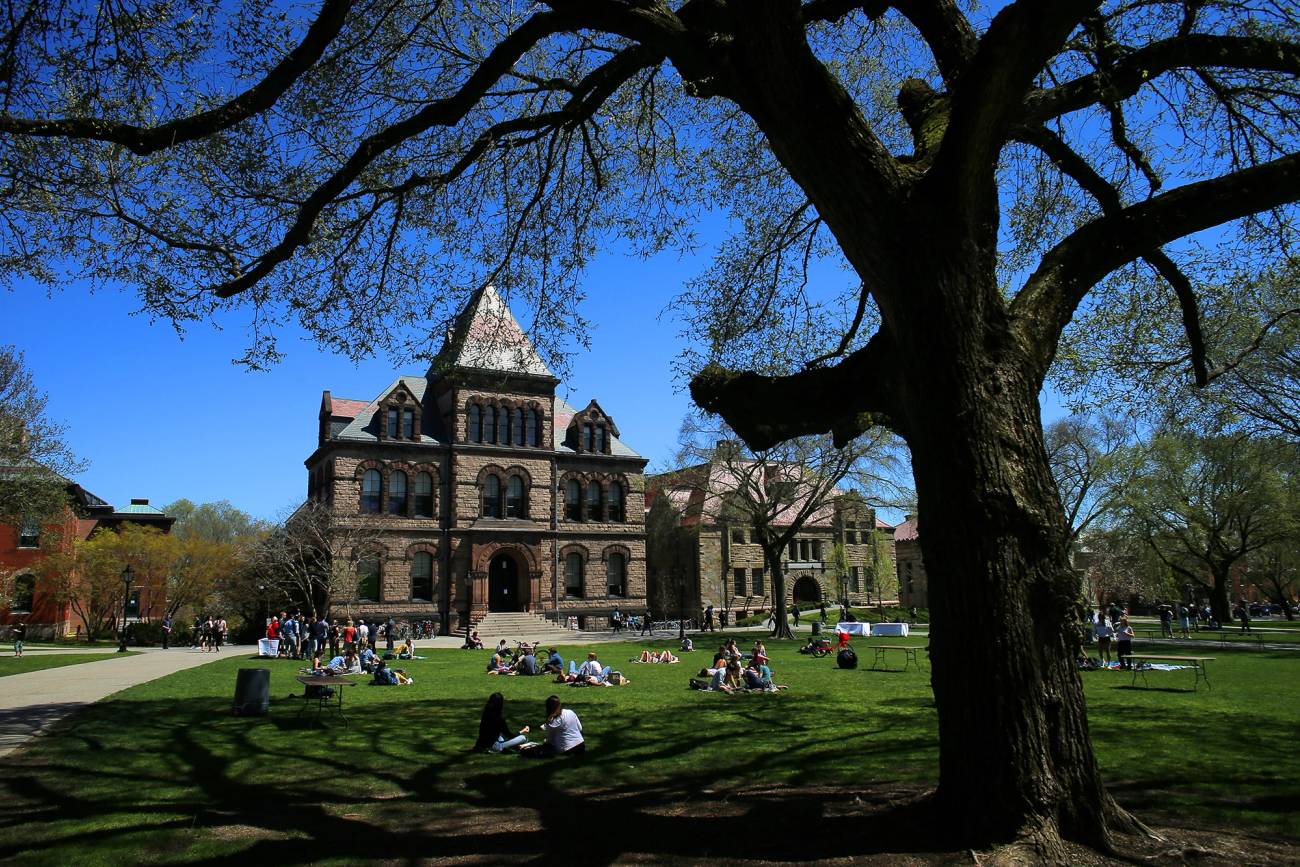 Brown University, Providence, Rhode IslandLane Turner/The Boston Globe via Getty Images


 11
11 11
11 11
11


 11
11 11
11 11
11 11
11 11
11 11
11 11
11 11
11