2019년 9월 12일 목요일

Suicide rate for Native American women up 139%, men up 71% since 1999


Suicide rate for Native American women up 139%, men up 71% since 1999


Suicide rate for Native American women is up 139%
Alia E. Dastagir, USA TODAYPublished 2:26 p.m. ET June 21, 2019 | Updated 10:41 a.m. ET June 22, 2019


Suicide survivor Shelby Rowe hated herself for her struggles with PTSD. By reconnecting with her Native American roots, she's learned to cope with her illness. USA TODAY

CONNECTTWEETLINKEDINCOMMENTEMAILMORE

The US suicide rate is up 33% since 1999, but for Native American women and men, the increase is even greater: 139% and 71%, respectively, according to an analysis out this week from the Centers for Disease Control and Prevention's National Center for Health Statistics.

Suicide disproportionately affects non-Hispanic American Indian and Alaska Natives, according to the CDC. A 2018 CDC report found their suicide rate was more than 3.5 times higher than those among racial and ethnic groups with the lowest rates.

Experts who study Native American suicide blame higher rates of poverty, substance abuse and unemployment as well as geographical isolation, which can make it difficult for people to access mental health care.

Also, American Indian and Alaska Native women experience higher levels of violence than other US women. Nearly 84% experience violence in their lifetime, according to a 2016 report from the National Institute of Justice. This includes 56% who have experienced sexual violence and roughly the same percentage who have experienced physical violence by an intimate partner. Research shows more than a third of women who have been raped have contemplated suicide, and 13% have attempted, according to the National Sexual Violence Resource Center.


Native Americans and Alaska Natives also experience PTSD more than twice as often as the general population, according to SAMHSA.

"You get this historical trauma, and people aren’t able to resolve it. It gets internalized and passed down to future generations," said Karen Hearod, a member of the Choctaw Nation of Oklahoma and regional administrator at the Substance Abuse and Mental Health Services Administration (SAMHSA).


A separate analysis published Tuesday in the Journal of the American Medical Association found the suicide rate for all US teens and young adults increased in 2017 to its highest point since 2000. Of Native American suicide deaths, more than a third were between 10 and 24 years old, according to the CDC.

Shelby Rowe, a member of the Chickasaw Nation, was diagnosed with PTSD after her first husband died in an accidental shooting when she was 19, weeks after she gave birth to their second son. She contemplated suicide, but went through a lot of counseling in an effort to heal.


Shelby Rowe stands in the Aaholiitobli' Honor Garden at the Chickasaw Cultural Center in Sulphur, Oklahoma. Surrounding her are plaques honoring Chickasaw leaders, elders and warriors. Rowe has reconnected with her Chickasaw roots as part of her healing process. (Photo: Jasper Colt, USA TODAY)


She married twice more, had a third son and, drawn to helping people, established a career in public health. In 2007, she became the executive director of the Arkansas Crisis Center, which runs the state's suicide hotline. But three years later, when her third marriage ended suddenly, triggering her PTSD, she attempted suicide.

"I wanted to live, I just didn’t know how to anymore," she said.


After her attempt, Rowe had an emotional conversation with her father that she said helped her feel connected in a way she'd never felt before. Something shifted inside her.

“I just felt like my ancestors reached out and embraced me," she said. She described it as a spiritual scolding, like "a parent who scolds their kid for running out into traffic. It was, ‘why did you do this? Don’t you know who you are? You are all of our hopes and dreams. All of these sacrifices we made over time were so you would be here. Please continue our legacy.’”

Get the News Alerts newsletter in your inbox.

Get alerted to the latest stories to stay on top of the news.
Delivery: Varies

Your Email


Rowe said since her attempt, she has spent a lot of time since reconnecting with her Native heritage, which experts say can help reduce risk.

“Despite all of the things that tribes have endured, we're still here,” Hearod said. “There is strength and resilience we can find in that.”
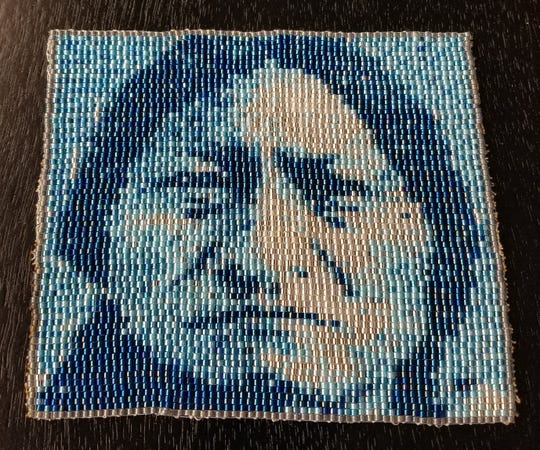

Rowe's beadwork of Sitting Bull. (Photo: Shelby Rowe)


More stories of hope:
Suicide never entered his mind. Then 9/11 happened.
Young, transgender and fighting a years-long battle against suicidal thoughts
Stepping back from the ledge

You may also be interested in:
To connect with suicide survivors and others, join USA TODAY's Facebook group I Survived It
What actually happens when you call the National Suicide Prevention Lifeline
How to help someone who's suicidal

Suicide Lifeline: If you or someone you know may be struggling with suicidal thoughts you can call the U.S. National Suicide Prevention Lifeline at 800-273-TALK (8255) any time of day or night or chat online.

Crisis Text Line provides free, 24/7, confidential support via text message to people in crisis when they dial 741741.
CONNECTTWEETLINKEDINCOMMENTEMAILMORE

2019년 8월 5일 월요일

A Constitution To Be Proud Of: Real Indigenous Recognition Now


A Constitution To Be Proud Of: Real Indigenous Recognition Now


Tessa Morris-Suzuki started this petition to Prime Minister of Australia Scott Morrison and 2 others


Like many Australians, I'm an immigrant. I came to Australia almost 40 years ago, and am hugely grateful for the opportunities this country has given me.

But we have a problem - a huge hole at the heart of our national constitution: no recognition of the history, culture, rights or aspirations of Indigenous Australians. Until the constitution contains meaningful recognition of Indigenous Australians, there will be no true reconciliation.

The Uluru Statement from the Heart contains a roadmap towards meaningful constitutional recognition. Indigenous Australians have worked hard to create that roadmap. Now it is time for all Australians to join in creating a constitution we can be proud of. We, Australians from all backgrounds, call on you as you as our political leaders to engage with the Uluru Statement from the Heart and lead the way towards constitutional recognition, including an Indigenous voice to parliament, whose details can be determined by legislation.

Let's have a constitution with heart!

2019년 7월 18일 목요일

Marlo Morgan | The REAL Story

Marlo Morgan | The REAL Story

A Guardian of Aboriginal Culture?

Imagine if someone spent a few months in Tibet and came back claiming to have been chosen as the “true” Dalai Lama.


Would anyone take it seriously?


Well, meet Marlo Morgan.
03yas1.jpg
After spending a few months in Australia she claimed to be the Spiritual Guardian of the earth’s most ancient living culture, and its messenger to the world.
Ms. Morgan claimed she met the last “true” Aborigines, and that they have decided to voluntarily die out, as their mission on earth is finished.
Her book, Mutant Message Down Under is now the world’s most widely read book about Australian Aborigines. It has been translated into more than 20 languages and sold tens of millions of copies world wide.
Morgan claims to have been contacted by a tribe who carry the last remaining essence of humanity, uncorrupted by civilisation. They kidnapped her and took her with them through the desert, where she learned their spiritual secrets, mastered their culture, mastered life in the desert, and ultimately was chosen to bring this message to the world.
Despite being exposed repeatly as a liar and a fraud, and despite trenchant and unanimous opposition from Aborigines themselves, Morgan continues to promote her deeply racist and damaging lies to a world wide audience.
Fictitious Non-fiction
For anyone who has been in Australia, or in a desert, or had any contact with any indiginenous people, the story is instantly recognisable as a fake, and an extremely poor one at that.
For example, at the start of her desert journey, she suffers horrendous wounds to her feet from walking on spinifex grass. One look at the photo belowreveals the absurdity of such a claim – what was she doing, leaping from clump to clump? But readers unfamiliar with the Australian landscape must simply take Morgan’s word. After days walking “on” this grass, her blistered feet hardened into the kind of “hoof” that members of the tribe have developed – toughened up by years of leaping through the desert, obviously.
Spinifex grass
No one who has been in the desert could make such a mistake, but mistakes as stupid as this appear on nearly every page.
In fact, Morgan’s time in Australia was spent working in a Brisbane pharmacyrun by a certain Leon Brosnan, who kindly confirmed the truth and allowed his name to be used in debunking Morgan’s lies.  She had some fleeting contact with some Aborigines, and may have attended a daytrip for tourists.
It appears that on returning to the US, Morgan invented the story to entertain her family. She was eventually persuaded to write it down, and after it was rejected by a publisher (who couldn’t verify any important details), Morgan published it herself. Her extraordinary “true” story was an immense success. Rupert Murdoch’s Harper Collins Publishing House bought the rights, slapped a “fiction” label on it to avoid prosecution, and turned it into a phenomenal bestseller worth hundreds of millions.
Despite the fiction label, the book included Morgan’s original “Note From the Author” assuring the reader the story is factually true. Now tens of millions of readers around the world believe that Australian Aborigines want to die, and that their culture lives on in Marlo Morgan.

Unfortunately, Morgan’s “message” is deeply racist as well as profoundly ignorant. Aborigines don’t want to die out, and they don’t need any middle class Americans with delusions of grandeur to protect them.

Their continuing survival after more than 200 years of genocide depends largely on international awareness of their plight, and international respect for and interest in their culture. It is this respect and interest which Morgan (and Murdoch) exploit. It’s an extraordinary case of identity theft and cultural assassination, a fraud unparalleled in the publishing world.
Of course, Morgan’s cliches and fantasies are easier to understand than real factual information. Aboriginal culture and spirituality is not a plain-label product for instant consumption. To pretend to have mastered its deepest mysteries in a few short months is beyond absurd.
with-cactuses.jpgnter3502.jpgmarlo_morgan.jpg9788496546974.jpg
Aboriginal Response
During the early 1990s so many people had been approaching the Aboriginal community in Australia and asking about Morgan’s tribe, that Robert Eggington, a Nyungar Elder and director of a cultural support centre for Aborigines, decided to find out exactly what was going on. He traveled in the areas where Morgan claimed to have walked through, to see if anyone had heard of Morgan or her famous tribe.
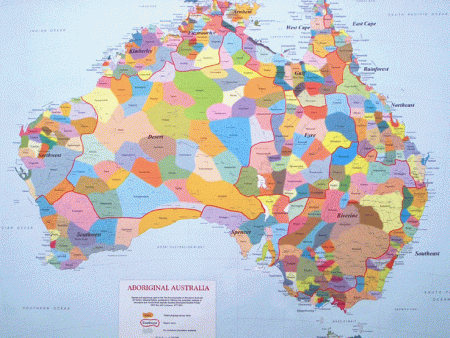
Now, if you look at a map of Australia it looks vast and empty enough for a large group of people to remain undetected for long periods. But the map below, showing Aboriginal territories, offers a very different impression.


Aboriginal Territories
Before entering the territory of another tribe, members of a different tribe ask permission. Morgan’s story takes her tribe over vast distances. Her tribe would have needed to ask many times for permission to enter new territory.
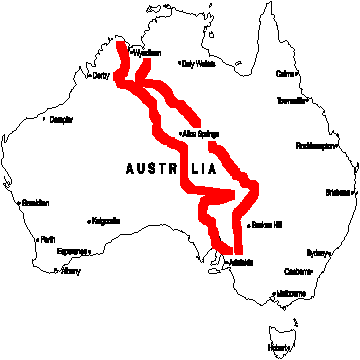
Robert Eggington spent 26 months traveling the areas Morgan claimed (in numerous vague and contradictory statements) to have travelled through. He asked the inhabitants if they had met Morgan or knew anything of the “tribe” she claimed had been living for millenia amongst them. (See map below.)
Map of Robert Eggington’s jouney
No one heard of Morgan or her tribe, and all were horrified by Morgan’s claims of their voluntary extinction. They empowered Robert Eggington to represent all Aborigines in publicly condemning the book.
International Campaign
In 1996  a small group of Aborigines including Eggington, travelled to Hollywood in an effort to persuade film producers not to go ahead with their planned film version of Morgan’s tale. A script had already been written and Meryl Streep was considering the lead role.
Extraordinarily, this small group of unknown Australians succeeded in convincing the filmmakers not to proceed. They also managed to extract a tearful confession from Morgan that the story was a hoax. (She swiftly recanted after her publisher intervened to prevent her signing a statement.)
Morgan then went on an international lecture tour, continuing to promote herself as guardian of the true Aboriginal culture. The same small group confronted her in Japan, interupting her lectures by walking through the hall in full ceremonial paint. After a few minutes of didgeridoo playing, Robert Eggington would then read a statement denouncing Morgan as a fraud and a spiritual thief, and then leaving.
Reactions from the New Age Movement
The Aboriginal campaign has generally been received sympathetically, but was met with open hostility from the New Age movement.
Many members of the New Age movement, instead of realising they’ve been conned and played for fools, continue to defend Morgan’s work (and of course, their own fragile egos). Some argue that the story is “inspirational, even if it is fiction”, and have even criticised Aborigines for being “negative” about Morgan, (unlike Marlo’s tribe who were so peaceful!).
Others, including university lecturers who continue to use the book in their courses, argue that the story is indeed true, and claim that modern physics proves that miracles like the ones Morgan claims, can happen.
One of many such miracles: Morgan’s tribe use their psychic powers to call two crocodiles out of a water hole. Now, while it is true that the Nullarbor Plain (where Morgan claims she was) holds many dangers for the unwary traveler, being eaten by a crocodile is NOT one of them. Any crocodile wanting to visit would need to waddle one or two thousand miles over burning desert sands. Crocs are only found in the wet areas of the far north.
One New Age reviewer sees it like this:
One only needs to read a Quantum Physics textbook to delve into the strange, mystical world of sub-atomic particles. None of the seemingly extra-ordinary events depicted in Mutant Message Down Under can be refuted by modern science…
Sorry, but a crocodile is not a sub-atomic particle. Nor are human beings, nor is the Australian Outback.

marlo_morgan_1.jpg 66255_2.jpg149261.jpeg4db284c60.jpg
In reality, Morgan spent three or four months in Australia in 1985, doing unpaid work in a Brisbane pharmacy. The owner, Leon Brosnan, said, “I knew she wasn’t kidnapped before she worked for me, and after she worked for me she went to Sydney, and then went home to America. There wouldn’t have been four months to go walk about.”

Maybe we can explain Morgan’s miracles without perverting quantum physics. Like, maybe she made the whole thing up?
morgan1.gif
Morgan’s act of cultural assassination (claiming they will soon be extinct) and identity theft (claiming to be their messenger) is totally immoral. It has also damaged international understanding of Aborigines. She has exploited the widespread fascination with Aboriginal culture – something Aborigines have themselves earned through their survival, and replaced with with false information. Now millions of people think they know something about Australian Aboriginal culture; and they believe Morgan is bringing them their last message before they die out.
This world-famous book, deeply racist – even subtly white supremacist, profoundly ignorant of its subject matter and hostile to even the most basic code of ethics, holds a mirror up to the culture that favours it.
The contact address @googlemail.com for this site is:
ifitsellsitsspiritual

2019년 6월 30일 일요일

David Walker’s new book, Stranded Nation


David Walker’s new book, Stranded Nation


David Walker’s latest book is masterfully written and also makes some interesting choices about what it does or doesn’t include.

David Walker’s Anxious Nation (1999) is a richly textured and deeply empirical work dealing with Australian perceptions of Asia up to the 1930s. Its successor, Stranded Nation. White Australia in an Asian Region (2019), which takes the story into the 1970s, is more of an impressionist account, though no less revealing and informative. As with all impressionistic treatments, his choices of episodes and topics may be queried, and there are some parts of the story where details or perspectives may be disputed, but his study is at all points perceptive and, at times, challenging. In brief, Australian approaches to Asia were hesitant, often confused by old stereotypes left over from the fast receding colonial era, and there was much self-deception on the essentially racial basis for the exclusionary immigration policy of the era. Nevertheless, there were some individuals who could see the course ahead, and its navigation was on occasion aided by personal relations of considerable warmth: with the latter most notably depicted in Walker’s stories of a number of exceptional Indian sojourners.

Walker’s story is at its best when he revisits, in lightly revised form, topics on which he has written path-breaking studies. These include on the 1955 Afro-Asian Bandung Conference — and Australia’s exclusion therefrom — and on the contribution of Indian High Commissioner K M Cariappa, who while serving in Canberra (1953-56) was bold enough to point out that the White Australia Policy was a serious affront to his fellow Indians.

As Walker demonstrates, White Australia was the source of many contortions from officials and politicians. It was both vehemently denied while extraordinary efforts were made to exclude the topic from any public exchanges or to divert potential critics. Such contortions are a central theme in Walker’s account of Australian attempts to exert what would now be termed “soft power” in the region, through the programming of Radio Australia, the publication — its funding by External Affairs carefully obscured — of Hemisphere, and the search for suitable Australian books to be distributed in the region.

Such topics as trade and episodes of formal diplomacy — notably the state visit of South Vietnamese President Ngo Dinh Diem in 1957 — are considered, but Walker is more inclined to discuss the ideas of writers and publicists, sometimes entailing curious emphases. More space is devoted to the analysis of the works of Paul McGuire than to Macmahon Ball. Though both were media personalities, Macmahon Ball — his likeness reproduced in the book — was more prominent as well as being vastly better informed on Asia. Moreover, from a very early stage he was convinced that Asia would loom largest in Australia’s future and that Australia’s race-based immigration policies had to change.

The discussion of Frank Clune’s books on Asia occupies a whole chapter. Again, his ideas were often given media attention, but if his orientalising writings deserve close analysis, then the contribution of Percy ‘Inky’ Stephensen would also need to be assessed.

The widely varying estimates in the Australian press concerning the communists in China were undoubtedly a product, as Walker suggests, of the fact that few commentators possessed any first-hand knowledge. Worth a photograph in the book, Michael Lindsay and his wife at the ANU in 1952-59 were the exceptions. When the Lindsays left Yan’an in 1945 — having been with the communist guerrillas since December 1941 — Mao Zedong himself hosted a farewell party. Walker’s discussion of Lindsay’s ideas — by way of ASIO’s conception of them — gives the impression that he emphasised the “psychopathic” nature of the communist regime, whereas his chief point was that there was an internal struggle in the late 1950s between ideologues and more pragmatic elements. In fact, given later events this analysis was exceptionally prescient. Moreover, it is regrettable that the historically important memoir his wife — her name wrongly recorded (p.274) — drafted in 1948 is not mentioned, nor the fact that she and her children were only able to live in Canberra because the White Australia policy had been conveniently waived.

A figure who makes several appearances, and again is accorded a photograph, is Walter Crocker, the Australian ambassador to India in 1952-55 and 1958-62. Walker captures Crocker’s irascible approach in the discussion of his reaction to Cariappa’s undiplomatic remarks on immigration policy, but, given the structural argument of the book, the reader might be misled as to his principal ideas. As an individual who had a personal acquaintance with the third world — he had been a colonial administrator not a “diplomat” (p.346) in Africa in the 1930s — Crocker had concluded by the later 1940s that the Australian policy of racial exclusion was doomed. In fact, he produced a book manuscript developing this argument which he attempted to publish, though unsuccessfully, in 1948. He had become convinced that the Third World moment in global politics had arrived, and was consistent in his advice that without conceding Indonesia’s claims to West New Guinea — the main issue raised by Foreign Minister Subandrio in his visit in 1959, the subject of a chapter — bilateral relations with Jakarta would remain frosty.

The material in this work is deftly handled, the prose always engaging and the insights many. However, its assessment must confront an issue raised by the author himself who, in the very first sentence of his introduction, states that he became “legally blind” in 2004. To this reviewer’s perception, it is thus no accident that it resembles the later works of Lloyd Rees, no less evidently the product of a master though inevitably a work of outlines, forms and colours rather than of minutely executed detail.

James Cotton is Emeritus Professor, University of NSW, Australian Defence Force Academy. He is a Fellow of the Royal Asiatic Society (London) and a Fellow of the Australian Institute of International Affairs.

Source from the Australian Institute for International Affairs: https://www.internationalaffairs.org.au/australianoutlook/reading-room-stranded-nation/

     Top


Anxious Nation: Australia and the Rise and Fall of Asia 1850-1939 by David Walker | Goodreads

Anxious Nation: Australia and the Rise and Fall of Asia 1850-1939 by David Walker | Goodreads


Anxious Nation: Australia and the Rise and Fall of Asia 1850-1939

 3.60  ·   Rating details ·  5 ratings  ·  0 reviews
From the late nineteenth century the Asianisation of Australia has sparked anxious comment. The great catchcries of the day . . the awakening East., . the yellow peril., . populate or perish. . had a direct bearing on how Australians viewed their future. Anxious Nation provides a full and fascinating account of Australia's complex engagement with Asia.
Published by the University of Queensland Press in association with the Australian Studies Centre at the University of Queensland and the Journal of Australian Studies.
"A thorough and entertaining summation of the discourse between Australia and Asia and an excellent primer, a sweeping but considered overview of the cultural influences that continue to dictate many aspects of that discourse." --John Shaumer, "The Age" "Was Australia destined to be European, Asian or Aboriginal? This book impressively combines the personal and the political; it makes sense of spatial and racial anxieties by exploring Australians' broader sense of their region. Drawing on history, science and literature, David Walker tells of Australia's real and imagined encounters with Asia. He provides us with a deep perspective on our current debates overpopulation, environmental limits, multiculturalism and the legitimacy of Australian settlement. This is a searching history of ideas and intrigue that probes the political and literary dimensions of blood, heat, sun, nerves, sex and dreams. Feverish fears and imaginings are reviewed with sensitivity and cool eloquence." --Tom Griffiths, Research School of Social Sciences, ANU
 

2019년 6월 1일 토요일

New Zealand’s next liberal milestone: A budget guided by ‘well-being’


New Zealand’s next liberal milestone: A budget guided by ‘well-being’


New Zealand’s next liberal milestone: A budget guided by ‘well-being’


00:02 / 01:00


Prime Minister Jacinda Ardern's government is moving away from more traditional metrics and has released a national budget whose spending is dictated by what best encourages the well-being of citizens.
UPDATEDUPDATED 2 DAYS AGO
BY CHARLOTTE GRAHAM-MCLAY © 2019 THE NEW YORK TIMES
SHARE
Share on Facebook
Share on Twitter

Preview: Dateline’s special episode 'New Zealand’s Darkest Day'. Watch the full story now at SBS On Demand.

It’s being called the next big move by a New Zealand government seen by progressives around the world as a beacon in increasingly populist times: a national budget whose spending is dictated by what best encourages the well-being of citizens.

That means that as the centre-left government of Prime Minister Jacinda Ardern sets its priorities in the budget that will be unveiled May 30, it is moving away from more traditional bottom-line measures like productivity and economic growth, and instead focusing on goals like community and cultural connection and equity in well-being across generations.

“This budget is a game-changing event,” said Richard Layard, a professor at the London School of Economics who is an expert on life satisfaction across populations.


New Zealand is not the only country that is starting to rethink whether blunt economic measurements like gross domestic product are the best gauge of a nation’s success. But, Layard said, there has been “no other major country that has so explicitly adopted well-being as its objective.”

As a major example of what that new framework will produce, Ardern unveiled Sunday the biggest spending proposal to date in her coming budget: more than $200 million to bolster services for victims of domestic and sexual violence.

It is “the biggest single investment ever” by a New Zealand government on the issue, Ardern said at an event showcasing the initiative, and will tackle one of the nation’s “most disturbing, most shameful” problems.

Under New Zealand’s revised policy, all new spending must advance one of five government priorities: improving mental health, reducing child poverty, addressing the inequalities faced by indigenous Maori and Pacific islands people, thriving in a digital age, and transitioning to a low-emission, sustainable economy.

The government is promoting the new framework as bringing much-needed clarity to the budgeting process. In the past, individual government ministers vied for the new money available in each year’s budget, and “relatively arbitrary” decisions were made about who got what, the country’s finance minister, Grant Robertson, said in an interview.

This year, those ministers have to collaborate on funding proposals with their colleagues, and the proposals must fit the new criteria.


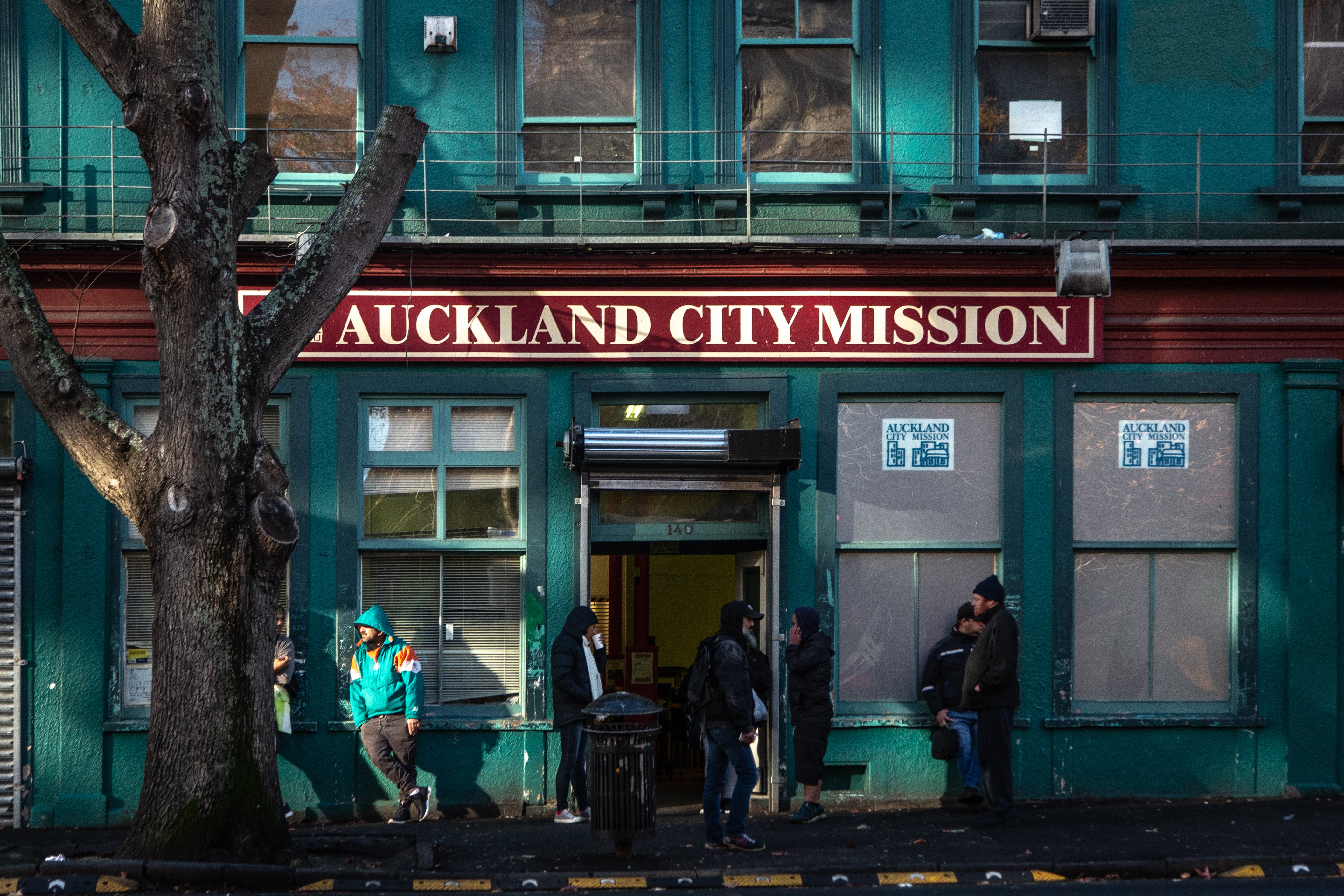
The Auckland City Mission, which provides social services for the homeless and poor.
NYTNS


“Governments are notorious for their silos, and so we’re actually saying, no, there’s an outcome there that we want you all working together on,” Robertson said.

To the centre-right political opposition, however, all this talk is nothing more than “slick branding” of long-standing shared policy goals. New Zealand governments of all political stripes, the opposition argues, have always tried to improve people’s lives through taxpayer spending.

“New Zealanders won’t benefit from a government that is ignoring the slowing economy and focusing instead on branding,” Amy Adams, a lawmaker in the opposition National Party, said in a statement. “We’re facing significant economic risks over coming years, but this government is focusing on a marketing campaign.”

While the country may indeed be facing some economic headwinds, New Zealanders have been among the most contented people on the planet, according to the World Happiness Report, which is produced by the United Nations Sustainable Development Solutions Network. The study ranked New Zealand in eighth place on its 2018 list of the world’s happiest countries, after the Nordic nations — led by Finland — Switzerland and the Netherlands.

And it remains to be seen just how different the budget will look this year. Liberals across the globe may have swooned this year when Ardern moved to ban semi-automatic weapons within days of the Christchurch terrorist attacks, but in reality her government is not a radically progressive one, said Arthur Grimes, an economics professor at Victoria University of Wellington and a former chairman of New Zealand’s central bank.

Grimes said that outside the budget, Ardern’s party had passed up opportunities to enact measures that might have significantly reduced economic and social disparities — including implementing a capital-gains tax or overhauling welfare — in favor of policies that benefited those less in need, like older people and students.

There is no denying that Ardern has secured a string of progressive victories, banning plastic bags, bolstering action on climate change and instituting paid time off for domestic violence victims. But in her less than two years in power, she has also been criticized as sometimes relying more on gauzy promises of “kinder” government policies than concrete proposals.

“I’m sure they will do something meaningful in this budget, but they could do more,” Grimes said.


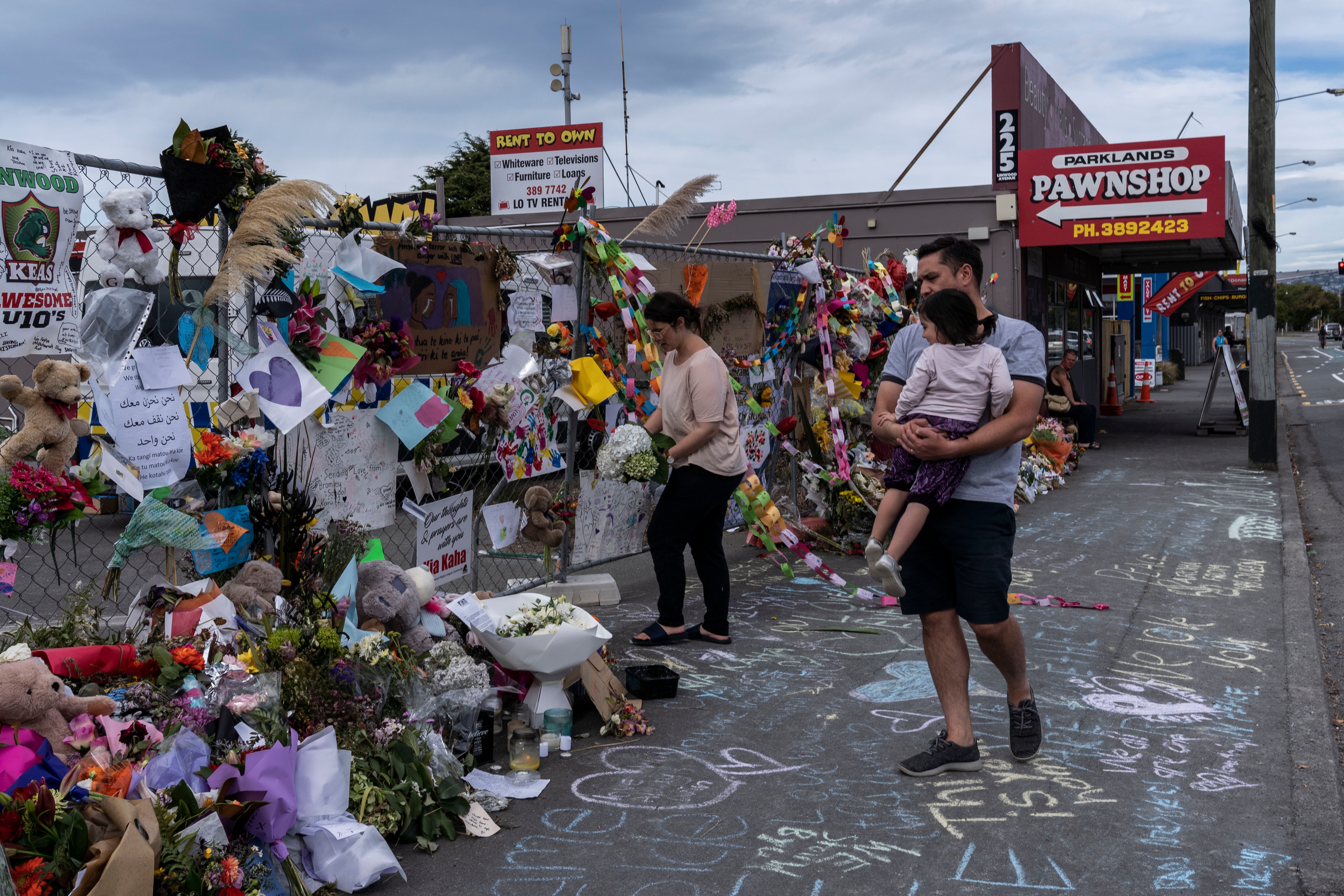
A makeshift memorial to victims of the mass shooting outside the Linwood Mosque in Christchurch.
NYTNS


Still, he said he was optimistic that the new budget approach would be a success, at least as an organizing principle. Budget planning often lacked focus in the past, he said, but officials in government agencies have told him that is not the case this year.

“If you’re not addressing one of those five priorities, you’ve got almost no hope of a budget bid being successful,” he said.

The package of help for domestic and sexual violence survivors announced by Ardern was the result of a joint bid among seven agencies and New Zealand’s attorney general. The goal is to take pressure off the police as the primary responders to such matters, Robertson, the finance minister, said.

Along with that package, other pre-budget announcements have promised housing for the homeless population and an effort to reduce the number of Maori in prisons, where they are overrepresented.

As New Zealand pursues its “well-being budget,” it is heeding a call from the Organization for Economic Cooperation and Development, a group of the world’s most advanced economies, Layard, the British economist, said. While several other countries — including France, Britain and the United Arab Emirates — have adopted language or measurements related to well-being, he said, none have tied the prioritizing and evaluation of policies as closely to people’s welfare as New Zealand has.

But not all of the budget is covered by the well-being framework. Core spending — on schools, hospitals and roads, for example — will be allocated in the usual way.


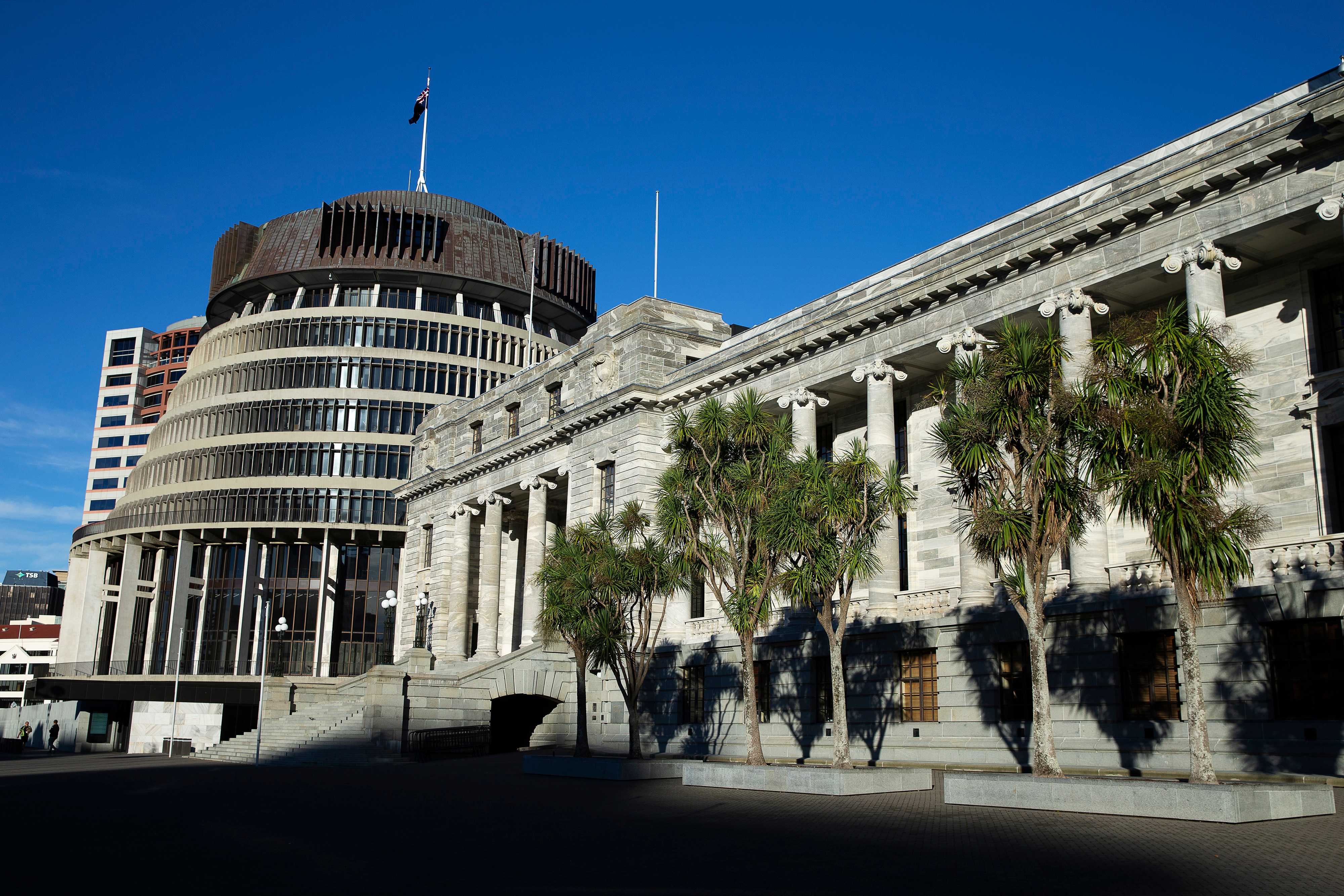
The seat New Zealand’s executive branch, commonly known as "the Beehive," in Wellington.
NYTNS


Robertson said the well-being model would cover more of the budget each year — for as long as his Labour-led government is in power to continue it.

In New Zealand’s fast-paced, three-year electoral cycle, Robertson said he was keenly aware that much of the change his government wants — reducing inequality, increasing life satisfaction — would not be enacted in time for the next election in 2020.

But he said he believed that voters might be willing to bear with him. Despite a strong global economy, he said, people have grown distrustful of government and institutions, and want progress to be measured differently.

“It’s some of that gap between rhetoric and reality that’s been exploited by populist movements and people around the world,” he said.

“If we’re going to rebuild trust and faith in our politics and our political system, we have to be talking about the things that matter to people.”
SOURCE THE NEW YORK TIMES

How a group of passionate locals are helping refugees find their 'home among the gum trees' - ABC News (Australian Broadcasting Corporation)


How a group of passionate locals are helping refugees find their 'home among the gum trees' - ABC News (Australian Broadcasting Corporation)


How a group of passionate locals are helping refugees find their 'home among the gum trees'
ABC Mid North Coast By Wiriya Sati

Updated Sat at 6:38am
PHOTO: Cooks at the Tamil feast, Jack and Hemily are classed as refugees on a Safe Haven Enterprise visa. (ABC Mid North Coast: Wiriya Sati)
RELATED STORY: TPVs to encourage asylum seekers to enter regional workforce
RELATED STORY: Apple's done her best to contribute to her city, now she has to leave
RELATED STORY: PM to reduce permanent migration cap to 160,000, introduce new regional visas for skilled workers

Port Macquarie, a coastal town popular with holiday-makers and retirees, is home to a group of ordinary people who have made it their mission to make refugees and asylum-seekers feel welcome.

Key points:
A group of volunteers in the NSW coastal town of Port Macquarie has set up a support group, which receives no government funding, to welcome refugees to the area
Although Safe Haven Enterprise Visasencourage migrants to move out of cities and into regional areas for five years, there are often no support systems in place to help them find work, homes and settle in
The group aims to bridge that gap by welcoming migrants to the area, hosting them with local families and assisting them with settlement as part of a program called Home Among the Gum Trees


The Mid-North Coast Refugee Support Group has nothing to do with government resettlement areas and does not receive any funding, but group member Beth Flynn said they want refugees to know that they are welcome and have support.

"There is an obligation as citizens to support people fleeing persecution," Ms Flynn said.

Nikshan Sharma is one of seven Tamil people to arrive in the community after fleeing Sri Lanka in 2012, after horrific war crimes and torture by the Sri Lankan military.

"In Port Macquarie there was a refugee support group who were more helpful, caring, visiting me every day," he said.
Bridging the gaps in the system
PHOTO: Support group member Kathryn Parle worked for nine years as a torture and trauma counsellor with hundreds of Tamil asylum seekers in detention centres offshore and on the mainland. (ABC Port Macquarie: Wiriya Sati)


The group's Kathryn Parle said people were encouraged to get out of cities and move to rural areas on their Safe Haven Enterprise Visas for five years, and one of the conditions of that visa was to work and be self-supporting for three of the five years.

But regional areas do not have the normal support systems.

"There's no case management, there's no torture trauma-counselling service here, no translator, they have to do that by phone," Ms Parle said.

"It's the support group of volunteers who are doing enormous work to accommodate them and what their particular needs might be."


Mr Sharma was living in Sydney where there was already a Tamil community and plenty of support both culturally and financially, including counselling services, Tamil schools and study opportunities.

He worked in a residential care facility for two years in Sydney before going to Port Macquarie where he now works in aged care, a job he secured before he arrived at the town six months ago.

"The first time I visited some other regional areas because it's a condition of my visa, I didn't feel comfortable and I came back to Sydney," Mr Sharma said.

However in Port Macquarie, he said he felt more welcome, because of the support group, but his biggest struggle had been finding work.

Mr Sharma has a casual contract for 18 hours a fortnight, sometimes more, but he needed to be on full-time work for his visa conditions.

He did not earn enough money to survive and struggled with petrol and bills.
The locals who make it possible

The Refugee Support Group has more than 100 hundred people on its distribution list.

It runs a program called Home Among the Gum Trees, where refugees from the city can go for a holiday and a look at Port Macquarie as a possible place to live.

It has a list of host families and about 30 refugees came on a bus for a weekend to look around the community.
PHOTO: The Mid North Coast Refugee Support group takes part in Home Among The Gum Trees, sponsoring, in their homes, a holiday for city refugees. (Supplied: Kathryn Parle)


Out of the people who came, there were five adults and two children who decided to live here.

They are now being accommodated with host families as they look for work and housing.

The support group members do not act as counsellors, rather they can provide welcome and the warmth of friendships.

Ms Parle said the group promoted a sense of belonging by assisting with aspects of settlement.

She said they might facilitate access to systems of care, accompany a person to an initial appointment, or provide social contact and links to other community groups — or opportunities to practice English conversation.

Ms Parle said that group members attended sessions in cross-cultural awareness training and in aspects of vicarious trauma.

"[This training was] to give them confidence to offer support with sensitivity to the impact of trauma and to have realistic expectations," she said.
Dance as storytelling therapy

The group has also held several events in the form of a Tamil feast and dance performance, inviting the community to attend the dinner which will raise money for the cooks, showcase their cooking to help them find further work in catering and raise their presence in the community.
Mr Sharma is a classical Indian dancer, of both the Bollywood and Tamil cultural styles.

"I am a classical dancer, as a teen I learnt street drama for telling stories and inciting strong emotions," he said.
PHOTO: Nikshan Sharma, who performed at a Tamil feast, arrived in the community after fleeing Sri Lanka in 2012. (ABC Mid North Coast: Wiriya Sati)


Mr Sharma does not accept money for his performances.

He said this was because he used dance as a platform to share his story without relying on language, and said he used dance as a form of narrative exposure therapy.

Ms Parle worked for nine years as a torture and trauma counsellor with hundreds of Tamil asylum seekers in detention centres offshore and on the mainland.

She said narrative therapy was a counselling method involving storytelling in some way, which could help to externalise the story, and perhaps find meaning or some healing in the process.

"Nikshan through his dance, allows himself to feel his way through his memories of trauma, and express his experiences safely, under his control," Ms Parle said.

"It can be frightening to tell the story — a person needs to feel safe and ready.


"If you watch Nikshan dance, you'll see it in his face, and his expression is profound, he knows exactly what it was like over there."
A very painful history

Mr Sharma said it was a very painful history.


"Still every day the thoughts are coming, every day is remembrance day, for my friends, family and neighbours I've lost. I just recently lost three friends and my uncle," he said.

Mr Sharma was well-educated, with a degree in psychology and several diplomas in social work and counselling.

He had ambitions, but like many Tamils in Sri Lanka, his career was interrupted by the civil war between the Sri Lankan military and the Tamil Tigers.

As his home town became a battleground, his skills as a social worker saw Mr Sharma employed by the Red Cross for several years through the conflict, including what is described as a mass genocide of Tamils by the Sri Lankan military.
PHOTO: "Every day, parents are crying in the street, missing people, sons, daughters, husbands," Nikshan Sharma said, telling his story through dance. (ABC Port Macquarie: Wiriya Sati)


Mr Sharma tried to help the injured and dying after attacks on innocent civilians in schools, hospitals, churches and homes within a government-designated 'No Fire Zone'.

"Every day in 2009 thousands were killed and I was seeing all the bodies, counting the bodies," Mr Sharma said.

He ran groups for torture survivors, trauma groups, missing people groups, gathering people together to talk in counselling sessions.

The military came in asking him questions about his clients and whether he was a Tamil Tiger.

"Five times I was arrested, taken by military for inquiries and released," Mr Sharma said.

They questioned him about the photos and articles he had published under different pseudonyms, showing the war crimes that the Sri Lankan government wanted to keep secret, still largely unrecognised around the world today.

On the fifth time, he was not officially arrested.

He was picked up riding his bike home from work and was taken to a military check point in a white van. He was blindfolded, stripped, beaten and tortured.


"I knew I had to go — next time I would be killed," he said.

"I was 18 days in that boat to Australia. I landed in the Cocos Islands, then Christmas Island and then Darwin."
The community

While many in Port Macquarie had been welcoming, the Tamil people who settled there had made friends and were all working, there had been some racism and discrimination when finding employment.

Mr Sharma has a house and two jobs and has opportunities to perform his dance and tell his story.

He said he would not say he was happy, but just going along every day.
PHOTO: Mr Sharma uses dance as a way to share his story with his new community without words. (ABC Mid North Coast: Wiriya Sati)


"There are still issues in Sri Lanka, my family are still in danger, my brother was taken arrested and tortured two or three times," Mr Sharma said.


"But the biggest issue is language and people not understanding my culture.

"In Sydney, there are a lot of Tamil groups and cultural activities.

"I have no future plans, like when I will be married, have kids, I am now 37.

"The last election I was hopeful for new opportunities, waiting with fingers crossed for the changes to refugee policies. But nothing happened.

"In Sri Lanka the government does physical and sexual torture, the Australian government does mental torture, with the unknown times for uncertain visa status."

Ms Parle said that all asylum seekers wanted the same thing as anyone.


"People who have fled persecution in other countries, want freedom, they want to be safe and they want dignity and respect. Like all of us," she said.

Topics: refugees, immigration, community-and-society, immigration-policy, com