2021년 4월 9일 금요일

질병과 아시안 증오 150년 역사...그들은 '각본'을 재탕하고 있다

질병과 아시안 증오 150년 역사...그들은 '각본'을 재탕하고 있다:


질병과 아시안 증오 150년 역사...그들은 '각본'을 재탕하고 있다

[아시아 증오범죄, 과거-현재-미래] 미국의 오래된 역사, 인종화된 질병 담론 ①
전홍기혜 특파원 | 기사입력 2021.04.05. 10:36:35 최종수정 2021.04.05. 21:57:25


지난 3월 30일 미국 노스캐롤라이나주 샬럿에서 한국계 미국인이 운영하는 슈퍼마켓에 20대 남성이 쇠막대기를 들고 들어와 "이 빌어먹을 중국인들아, 너희 나라로 돌아가라"고 욕하면서 냉장고와 선반 등 기물을 부수는 등 난동을 부렸다. 같은 날 뉴욕 지하철에서는 50대 남성이 40대 아시안 여성과 자녀들에게 큰 소리로 아시아인 비하 발언을 하며 침을 뱉고, 여성이 든 휴대전화를 바닥에 떨어뜨린 뒤 도망갔다고 한다.


전날엔 뉴욕 맨해튼 한복판에서 거구의 흑인 남성이 맞은 편에서 걸어오던 65세의 아시아계 여성을 발로 차서 넘어뜨리고 쓰러진 여성에게 다시 발길질을 하는 충격적인 장면이 영상으로 보도되기도 했다. 폭행이 일어나던 당시 빌딩 안에 보안요원이 있었지만 전혀 말리지 않았고 오히려 건물 문을 닫고 피해 여성을 방치해 비난이 일었다.


지난 3월 16일 조지아주 애틀랜타 총기 난사 사건으로 미국 사회의 '아시안 증오범죄'의 심각성이 드러났다. 그러나 이 사건 이후에도 연일 크고 작은 '아시안 증오범죄'가 발생하고 보도되고 있다.


'아시안 증오범죄'의 뿌리는 미국사회의 '인종차별'에 있다는 점에서 매일매일 발생하는 '증오범죄'에 분노하고 더 강도 높은 처벌을 요구하는 것만으로는 근원적인 해결이 어렵다. 또 미국의 인종문제는 사회경제적인 문제와 겹쳐지기 때문에 더 풀기 어려운 '고차 방정식'이기도 하다. '아시아 증오범죄'가 왜 신종 코로나바이러스 감염증(코로나19) 사태 이후 급증했으며, 어떤 양상을 보이며, 해결 방안은 무엇인지 등에 대해 전문가들의 의견을 들어보았다. 필자 주


"전혀 새로운 일이 아니다."


지난 3월 16일 조지아주 애틀랜타 총기 난사 사건이 발생했다. 용의자인 21세 백인 남성 로버트 애런 롱은 애틀랜타 인근의 아시안 마사지숍과 스파 3곳을 습격해 총격을 퍼부었고, 8명의 사망자 중 6명이 아시안 여성이었다. 범행 장소를 볼 때 당연한 일이었다.


지난해 3월부터 신종 코로나바이러스 감염증(코로나19) 사태가 본격화 되고, 미국에서 대통령(도널드 트럼프)까지 나서서 이를 "중국 바이러스(China virus)", "쿵 플루(Kung Flu)"라고 부를 때부터 2021년 현재 미국의 사회적 이슈로 떠오른 '아시안 증오범죄'는 예견됐다. 아시아-태평양계 미국인들((Asian Americans and Pacific Islanders, 줄여서 AAPI)을 대상으로 한 증오범죄에 대한 반대 운동을 벌이고 있는 '스탑 AAPI 헤이트(Stop AAPI Hate)'에 따르면, 지난해 3월부터 올해 2월말까지 미국 전역에서 살해, 폭행, 폭언 등 3715건의 인종적 폭력 사건이 보고됐다.


애틀랜타에서 나고 자란 가수 에릭 남은 지난 3월 19일 시사주간지 <타임>에 기고한 글에서 “어떤 사람들은 여전히 '왜 아무런 말도 하지 않았느냐’고 묻는다. 분명히 하고 싶은 건 우리는 지난 1년 동안 그 어느 때보다도 도움을 간청해왔지만 당신들이 듣지 않았다"고 강조했다.


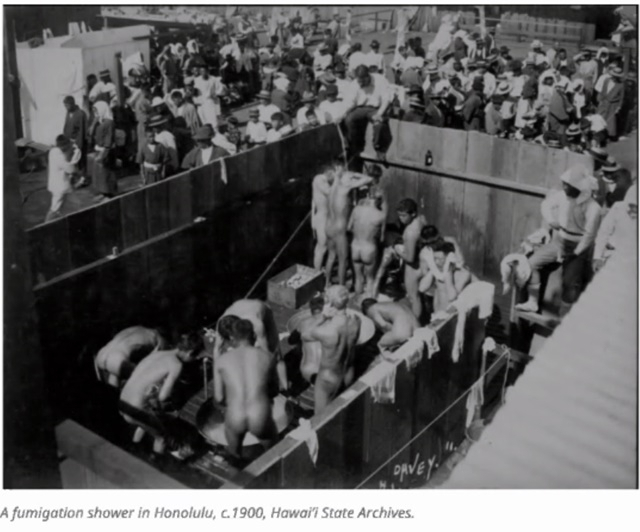
미국, 감염병 사태 때마다 이민자들에게 '책임 전가'...중국인들은 공개된 장소에서 전라로 강제로 집단 샤워


안소현 케네소 스테이트대 교수(사회교육학)는 훨씬 더 큰 의미로 "전혀 새롭지 않다"고 말한다.


안 교수는 지난 3월 31일 먼모스대가 주최한 온라인 강연('질병의 인종화에 대한 긴 역사 : 코로나19 펜데믹 하에서의 반 아시아 폭력과 교육적 영향')에서 미국 역사에서 대규모 감염병 사태를 다루는 인종화된 방식에 대해 설명했다.


"트럼프 전 대통령만이 아니다."


안 교수는 아시안이 전염병의 원인으로 지목당하고 이로 인해 차별과 증오의 대상이 되는 일은 1876년 천연두(Small Pox) 사태로 거슬러 올라간다고 말했다. 미국 주류 사회는 당시 유행한 '천연두'의 원인으로 중국 이민자들을 지적했다. 당시 미국 사회에서 중국 이민자들은 "불치병을 일으키고 이를 백인들에게 전파시킨 불결하고 더러운 인종"으로 인식됐다. 감염병에 대한 인종화된 인식은 중국인들이 미국으로 들어오는 것을 막아야 한다는 요구를 급증하게 만들었고 결국 1882년 연방의회에서 중국인의 이민을 금지하는 '중국인 배척법(Chinese Exclusion Act)'을 통과시켰다. 이 법은 1943년에야 폐지됐다.


중국인을 '전염병의 원인'으로 지목하는 일은 1899년 선페스트(Bubonic Plague) 사태 때도 똑같이 반복됐다. 1899년 하와이에서 선페스트가 확산되자 정부는 차이나타운을 진원지로 지목하고 감염자가 발생한 건물 등을 소각했다. 이 과정에서 바람으로 인해 불길이 번져 화재가 17일 동안 지속됐고 차이나타운이 사실상 붕괴됐으며 4000명 이상 노숙자가 발생했다. 당연히 피해자의 절대 다수는 중국계 미국인들이었다.


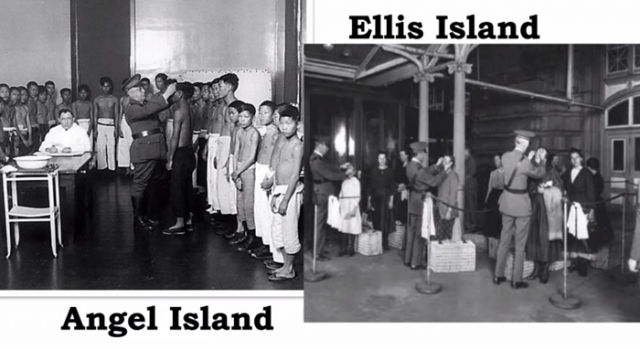
▲1900년 하와이에서 중국인, 일본인, 하와이 원주민 중 선페스트 감염이 의심되는 이들은 이처럼 공개적인 장소에서 전라로 샤워를 한 뒤 정밀 신체검사를 받고 격리 조치에 취해졌다. ⓒslate.com

하와이 주정부는 중국인, 일본인, 하와이 원주민 출신 주민들 중 감염이 의심되는 이들을 소독 장소로 보냈고, 이 곳에서 남녀노소를 가리지 않고 모두 벌거벗고 살균 샤워를 한 뒤 정밀 신체검사를 받게 했다. 위의 사진처럼 공개된 장소에서 전라로 소독을 하게 한 것에 대해 안 교수는 "동등한 인간으로 존중했다면 일어나기 힘든 일"이라고 안타까워했다.


1900년 샌프란시스코에서도 선페스트가 발생했을 때 캘리포니아 주정부는 백인 주민들과 접촉을 막기 위해 1만4000명이 거주하는 차이나타운 주변에 밧줄로 저지선을 설치했다. 하수도와 거주지 주변을 이산화황과 수은 등 현재는 독성물질로 알려진 약품들로 소독했고, 안전성이 확보되지 않은 상태의 백신을 아시안들에게 강제로 주사했다고 한다.


당시 아시안들을 '더러운 인종'으로 인식했다는 사실은 이민자들이 미국으로 입국하는 '검문소' 역할을 했던 엘리스 섬(Ellis Island)과 엔젤 섬(Angel Island)의 검역 풍경에서도 확인된다. 유럽 국가의 이민자들이 입국하는 통로인 뉴욕 인근의 엘리스 섬에서는 입국자들이 옷을 모두 입고 검문검색을 받았다. 반면 1882년 '중국인 배척법' 제정 이후 이민자 수용소가 만들어진 캘리포니아주 샌프란시스코 인근의 엔젤 섬에서는 윗옷을 벗고 검문검색을 받았다.


▲중국 출신 이민자들과 유럽 출신 이민자들의 대조적인 검문 검색 장면. ⓒ안소현 제공


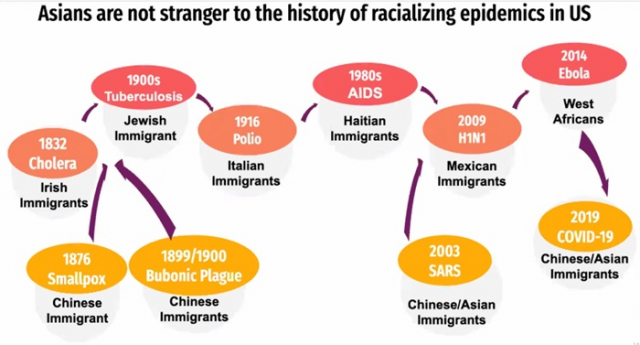
질병을 인종화하는 담론은 과학이 충분히 발달한 21세기에도 지속되고 있다. 미국에서 사망자가 한명도 발생하지 않았던 2003년 사스 때도 아시안 혐오 레토릭은 발생했고, 이로 인해 중국 음식점들이 타격을 입었다. 이어 2020년 중국 우한에서 첫 발생해 전 세계로 확산된 코로나19 사태로 최근까지 아시안을 상대로한 증오범죄가 급증하고 있다.


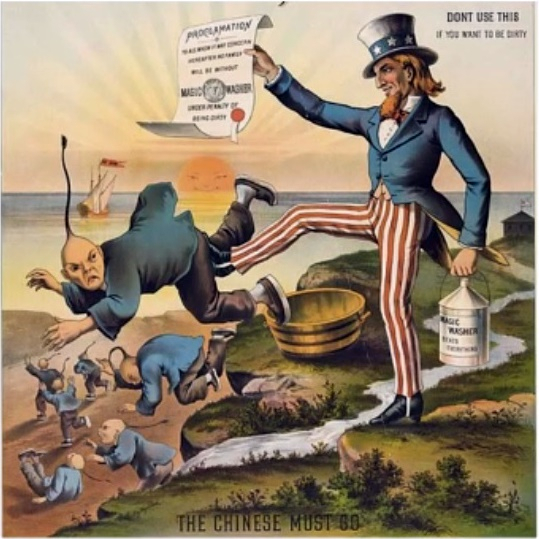
▲"중국인들은 돌아가야 한다." 한 손에 추방명령서, 다른 손에 소독약 병을 든 성조기 문양이 그려진 옷을 입은 백인 남성이 중국인들을 발로 차서 내쫓는 그림. 20세기 초반 중국 이민자들에 대한 미국 사회의 인식을 잘 보여준다. ⓒ안소현 제공

안 교수는 이처럼 감염병 확산기에 아시아계 미국인들을 '위험한 외국인'으로 인종화하는 담론은 1870년대 이후부터 지금까지 여전히 유효하다고 강조했다. 아시아계 미국인들이 유색인종의 모범격인 "모델 마이너리티(Model Minority)"로 자주 언급되는 것과 상반되게 인종화된 아시안들을 외래의 위협으로 여기는 오래된 편견(황색 공포 Yellow Peril, 19세기 초반 중국 이민자들이 들어오자 이들을 미국을 위협하는 존재로 여겨진 현상을 지칭하는 용어)은 여전히 강력하게 작동하고 있다고 안 교수는 지적했다.


▲미국에서 감염병을 인종화하는 방식. 감염병 사태 때마다 '이민자'들에게 책임을 돌리는 담론이 강력하게 작동해왔다는 역사적 사실을 보여준다. ⓒ안소현 제공


▲안소현 교수

중국인 배척법, 일본인 강제 수용, LA폭동...수없이 반복된 아시안 대상 폭력


이처럼 질병과 직접적으로 연관되지 않더라도 미국에서 아시아계를 대상으로한 인종적 폭력의 역사도 유규하다. 정청세 뉴욕 빙햄턴대학 한국학 연구소 선임연구원은 "미국 내에서 아시안 커뮤니티는 사회적, 정치적, 경제적 갈등과 위기가 불거졌을 때 쉽게 폭력의 대상이 된다"고 지난 3월 27일 시민참여센터(KACE)가 주최한 온라인 강연에서 말했다. 이를 보여주는 역사적 사건들은 다음과 같다.


*1871년 LA '중국인 대학살' : 백인과 중국인 폭력조직 사이의 갈등이 비화돼 수백명의 백인과 히스패닉이 LA 차이나타운을 습격해 20명 이상의 중국인들이 사망한 사건


* 2차 세계대전 당시 일본계 미국인에 대한 강제 수용소 수용 : 진주만 공습 뒤 행정명령에 의해 일본계 거주자 20여만 명이 강제 수용되고 재산도 몰수당했다. 이들 중 80% 가량이 미국 시민이었다고 한다.


* 1885년 록 스프링스 중국인 대학살 : 와이오밍주의 광산에서 백인 광부들이 중국인 광부들을 공격해 28명이 숨진 사건.


* 1982년 빈센트 친 살해 사건 : 디트로이트 외곽에서 중국계 청년 빈센트 친(Vincent Chin)이 일본인으로 오해 받아 '일본이 미국의 자동차 산업을 침식하고 우리의 일자리를 뺏는다'는 이유로 폭행당해 사망한 사건.


* 1992년 LA 폭동: 흑인 로드니 킹을 무자비하게 폭행한 경찰관들의 무죄 판결로 분노한 흑인들이 한인타운을 습격해 6일 동안 무차별 공격을 감행했던 사건.


미국 사회에서 아시안에 대한 폭력은 물리적인 차원에 그치는 것만이 아니라 법과 제도를 통해 제도화되어 있다.


* 귀화법 (1790년) : 미국에서 2년 이상 거주한 이민자 중 좋은 평판을 가진 자유 신분의 백인 이민자에게만 귀화 자격 부여.


* 페이지법(1875년) : "부도덕한 목적"을 가진 여성들의 미국 입국을 금지하기 위한 법. 이는 아시안 여성들에 대한 성적 편견을 드러내는 법인데, 주로 중국 여성들의 입국을 막는 용도로 활용됐다.


* 중국인 배척법 (1882년): 중국 출신 노동자들의 미국 입국을 제한하고 시민권 부여 대상에서 제외하는 내용을 담은 법안. 단일 출신 국가를 상대로 한 입국금지 조치는 이 법이 유일하다.


* 이민법 개정(1917년) : 일본과 필리핀을 제외한 모든 아시아 국가에서 이민을 금지


* 이민법 개정(1924년) : 미국 이민 비자 발급 건수를 국가별로 할당했는데 이는 유럽 출신 이민자들을 더 많이 수용하기 위한 목적이었다. 당시 중국인에겐 연간 105건이 할당됐음. 비자 할당제는 1965년에 폐지됐다.


* 인종간 결혼금지 정책 (1931년) : 아시아인 비율이 가장 높았던 캘리포니아주에서는 백인과 유색인종간의 결혼을 금지했다. 하와이 사탕수수 농장 취업 등을 통해 미국으로 건너왔던 한국인들도 당시 '단신' 이민만 가능했고, 인종간 결혼을 금지했기 때문에 평생 독신으로 살았던 이들도 많았다고 한다. 기자가 2005년 하와이를 방문했을 때 현지 한인들로부터 후손이 없어 버려진 초기 한인 이민자들의 묘를 돌보는 일들을 하고 있다는 이야기를 듣기도 했다. 한인들은 이후 중매인을 통해 사진을 주고 받는 '우편 주문 신부(mail order bride)' 형태로 한국에서 결혼 상대를 구해야 했다.


2020년 급증하기 시작해 2021년 총기 난사 사건으로까지 비화된 미국 내 '아시안 증오 범죄'는 이런 역사적 사건들의 연속성에 놓고 봐야 한다. 장성관 미주한인유권자연대(KAGC) 사무차장은 <프레시안>과 인터뷰에서 "현재 아시아-태평양계(AAPI) 대상 폭력사건의 문제를 증오 범죄의 문제로만 봐서는 안된다"며 "이 사태의 본질은 증오 '범죄'가 아니라 '증오'이자 뿌리 깊은 AAPI 대상 인종주의"라고 지적했다. (계속)

출처: https://www.pressian.com/pages/articles/2021040208472447728?fbclid=IwAR2zLBfnFV88ytetPn8dDNUCugRHGukopQmI0RCIYb_eUgozo7CkiXdXXCc#0DKU 프레시안(http://www.pressian.com)

2021년 4월 4일 일요일

Caste (Oprah's Book Club): The Origins of Our Discontents: Wilkerson, Isabel: 9780593230251: Amazon.com: Books

Caste (Oprah's Book Club): The Origins of Our Discontents: Wilkerson, Isabel: 9780593230251: Amazon.com: Books


Caste (Oprah's Book Club): The Origins of Our Discontents Hardcover – August 4, 2020
by Isabel Wilkerson  (Author)
4.8 out of 5 stars    25,622 ratings
496 pages
---
#1 NEW YORK TIMES BESTSELLER • OPRAH’S BOOK CLUB PICK • NATIONAL BOOK AWARD LONGLIST • “An instant American classic and almost certainly the keynote nonfiction book of the American century thus far.”—Dwight Garner, The New York Times

The Pulitzer Prize–winning, bestselling author of The Warmth of Other Suns examines the unspoken caste system that has shaped America and shows how our lives today are still defined by a hierarchy of human divisions.

NAMED THE #1 NONFICTION BOOK OF THE YEAR BY TIME, ONE OF THE TEN BEST BOOKS OF THE YEAR BY People • The Washington Post • Publishers Weekly AND ONE OF THE BEST BOOKS OF THE YEAR BY The New York Times Book Review • O: The Oprah Magazine • NPR • Bloomberg • Christian Science Monitor • New York Post • The New York Public Library • Fortune • Smithsonian Magazine • Marie Claire • Town & Country • Slate • Library Journal • Kirkus Reviews • LibraryReads • PopMatters

Los Angeles Times Book Prize Finalist • National Book Critics Circle Award Finalist • PEN/John Kenneth Galbraith Award for Nonfiction Finalist • PEN/Jean Stein Book Award Longlist

“As we go about our daily lives, caste is the wordless usher in a darkened theater, flashlight cast down in the aisles, guiding us to our assigned seats for a performance. The hierarchy of caste is not about feelings or morality. It is about power—which groups have it and which do not.”
 
In this brilliant book, Isabel Wilkerson gives us a masterful portrait of an unseen phenomenon in America as she explores, through an immersive, deeply researched narrative and stories about real people, how America today and throughout its history has been shaped by a hidden caste system, a rigid hierarchy of human rankings.
 
Beyond race, class, or other factors, there is a powerful caste system that influences people’s lives and behavior and the nation’s fate. Linking the caste systems of America, India, and Nazi Germany, Wilkerson explores eight pillars that underlie caste systems across civilizations, including divine will, bloodlines, stigma, and more. Using riveting stories about people—including Martin Luther King, Jr., baseball’s Satchel Paige, a single father and his toddler son, Wilkerson herself, and many others—she shows the ways that the insidious undertow of caste is experienced every day. She documents how the Nazis studied the racial systems in America to plan their out-cast of the Jews; she discusses why the cruel logic of caste requires that there be a bottom rung for those in the middle to measure themselves against; she writes about the surprising health costs of caste, in depression and life expectancy, and the effects of this hierarchy on our culture and politics. Finally, she points forward to ways America can move beyond the artificial and destructive separations of human divisions, toward hope in our common humanity.

Beautifully written, original, and revealing, Caste: The Origins of Our Discontents is an eye-opening story of people and history, and a reexamination of what lies under the surface of ordinary lives and of American life today.

---

Editorial Reviews
Amazon.com Review
An Amazon Best Book of August 2020: It has been ten years since Wilkerson’s award-winning The Warmth of Other Suns was published. While that book pointed to the great migration of Black people to the north as an “unrecognized migration,” this new book points to our entire social structure as an unrecognized caste system. Most people see America as racist, and Wilkerson agrees that it is indeed racist. She points out that we tend to refer to slavery as a “sad, dark chapter” in America when in fact it lasted for hundreds of years—but in order to maintain a social order and an “economy whose bottom gear was torture” (as Wilkerson quotes the historian Edward Baptist), it was necessary to give blacks the lowest possible status. Whites in turn got top status. In between came the middle castes of “Asians, Latinos, indigenous people, and immigrants of African descent” to fill out the originally bipolar hierarchy. Such a caste system allowed generations of whites to live under the same assumptions of inequality—these “distorted rules of engagement”—whether their ancestors were slave owners or abolitionists. And the unspoken caste system encouraged all to accept their roles. As Wilkerson develops her argument, she brings in historical figures like Martin Luther King, Jr. and Satchel Paige. She even looks at the Nazis, who turned to us when they were seeking ways to institutionalize racism in the Third Reich. As I read this book, I finally had to consciously stop myself from highlighting passages. Because I was highlighting most of the book. --Chris Schluep
Review
“Magnificent . . . a trailblazing work on the birth of inequality . . . Caste offers a forward-facing vision. Bursting with insight and love, this book may well help save us.”—O: The Oprah Magazine

“This book has the reverberating and patriotic slap of the best American prose writing. . . . Wilkerson has written a closely argued book that largely avoids the word ‘racism,’ yet stares it down with more humanity and rigor than nearly all but a few books in our literature. . . . It’s a book that changes the weather inside a reader.”—Dwight Garner, The New York Times

“A surprising and arresting wide-angle reframing . . . Her epilogue feels like a prayer for a country in pain, offering new directions through prophetic language.”—Bilal Qureshi, The Washington Post

“A transformative new framework through which to understand identity and injustice in America.”—Justin Worland, Time

“Magisterial . . . Her reporting is nimble and her sentences exquisite. But the real power of Caste lies tucked within the stories she strings together like pearls. . . . Caste roams wide and deep, lives and deaths vividly captured, haloed with piercing cultural critique. . . . Caste is a luminous read, bearing its own torch of righteous wrath in a diamond-hard prose that will be admired and studied by future generations of journalists.”—Hamilton Cain, Minneapolis Star Tribune

“Brave, clear and shatteringly honest in both approach and delivery . . . Extrapolating Wilkerson’s ideas to contemporary America becomes an unsettling exercise that proves how right she is and how profoundly embedded into society the caste system is. . . . Her quest for answers frames everything and acts as the perfect delivery method for every explanation.”—Gabino Iglesias, San Francisco Chronicle

“Caste draws heavily on the powerful mingling of narrative, research, and visionary, sweeping insight that made Wilkerson’s The Warmth of Other Suns the definitive contemporary study of African Americans’ twentieth-century Great Migration from the Jim Crow South to northern, midwestern, and western cities. It deepens the resonance of that book (a seemingly impossible feat) by digging more explicitly into the pervasive racial hierarchy that transcends region and time.”—Steve Nathans-Kelly, New York Journal of Books

“Caste will spur readers to think and to feel in equal measure.”—Kwame Anthony Appiah, The New York Times Book Review

“Wilkerson’s book is a powerful, illuminating and heartfelt account of how hierarchy reproduces itself, as well as a call to action for the difficult work of undoing it.”—Kenneth W. Mack, The Washington Post

“Should be required reading for generations to come . . . A significant work of social science, journalism, and history, Caste removes the tenuous language of racial animus and replaces it with a sturdier lexicon based on power relationships.”—Joshunda Sanders, The Boston Globe

“[Caste] should be at the top of every American’s reading list.”—Jennifer Day, Chicago Tribune

“An expansive interrogation of racism, institutionalised inequality and injustice . . . This is an American reckoning and so it should be. . . . It is a painfully resonant book and could not have come at a more urgent time.”—Fatima Bhutto, The Guardian

“Full of uncovered stories and persuasive writing . . . Opening up a new bank of language in a time of emboldened white supremacism may provide her readers with a new way of thinking and talking about social injustice. . . . A useful reminder to India’s many upper-caste cosmopolitans . . . that dreams of resistance are just one part of the shared inheritance of the world’s oldest democracy, and the world’s largest.”—Supriya Nair, Mumbai Mirror

“It is bracing to be reminded with such precision that our country was built through genocide and slavery. But Ms. Wilkerson has also provided a renewed way of understanding America’s longest, fiercest trouble in all its complexity. Her book leaves me both grateful and hopeful. I gulped it down.”—Tracy Kidder, Pulitzer Prize–winning author of Mountains Beyond Mountains 

“Like Martin Luther King, Jr. before her, Isabel Wilkerson has traveled the world to study the caste system and has returned to show us more clearly than ever before how caste is permanently embedded in the foundation and unseen structural beams of this old house called America. Isabel Wilkerson tells this story in prose that is so beautiful, the only reason to pause your reading is to catch your breath. You cannot understand America today without this book.”—Lawrence O’Donnell

“This enthralling exposé deserves a wide and impassioned readership.”—Publishers Weekly (starred review)
 
“Similar to her previous book, the latest by Wilkerson is destined to become a classic, and is urgent, essential reading for all.”—Library Journal (starred review)
 
“This is a brilliant book, well timed in the face of a pandemic and police brutality that cleave along the lines of a caste system.”—Booklist (starred review)
Read more
Product details
Publisher : Random House; First Edition (August 4, 2020)
Language : English
Hardcover : 496 pages
ISBN-10 : 0593230256
ISBN-13 : 978-0593230251
Item Weight : 1.65 pounds
Dimensions : 6.4 x 1.25 x 9.5 inches
Best Sellers Rank: #54 in Books (See Top 100 in Books)
#1 in Slavery & Emancipation History
#2 in U.S. State & Local History
#2 in Sociology of Class
Customer Reviews: 4.8 out of 5 stars    25,622 ratings
VideosPage 1 of 2Page 1 of 2
Previous page
Videos for this product
3:14
Customer Review: This book should be required text! Great read!
Customer Video
0:58
Caste: The Origins of Our Discontents Short Reads
Urban Survivor
3:14
This book should be required text!
Customer Video
0:45
Love in the Time of Cholera Oprah's Book Club Close Up Look
Carl Newberry
Next page
Upload your video
More about the author
› Visit Amazon's Isabel Wilkerson Page
Isabel Wilkerson
 Follow
Biography
Isabel Wilkerson, winner of the Pulitzer Prize and the National Humanities Medal, is the author the critically acclaimed New York Times bestsellers The Warmth of Other Suns, and Caste: The Origins of Our Discontents.

Her first book, The Warmth of Other Suns, tells the story of the Great Migration, a watershed in American history. It won the National Book Critics Circle Award for Nonfiction, the Heartland Prize for Nonfiction, the Anisfield-Wolf Award for Nonfiction, the Lynton History Prize from Harvard and Columbia universities, the Stephen Ambrose Oral History Prize and was shortlisted for both the Pen-Galbraith Literary Award and the Dayton Literary Peace Prize.

WARMTH was named to more than 30 Best of the Year lists, including The New York Times' 10 Best Books of the Year, Amazon's 5 Best Books of the Year and Best of the Year lists in The New Yorker, Los Angeles Times, The Washington Post and The Economist, among others. In 2019, TIME Magazine named Warmth to its list of the10 best books of the decade.

Her second book, CASTE: The Origins of Our Discontents, explores the unrecognized hierarchy in America, its history and its consequences. Caste became a No. 1 New York Times bestseller, was the 2020 summer/fall selection for Oprah’s Book Club and was longlisted for the National Book Award. It was named to more best of the year lists than any other work of nonfiction and was named the No. 1 book of 2020 across all genres by the industry arbiter, Publishers Marketplace.

Wilkerson won the Pulitzer Prize for her work as Chicago Bureau Chief of The New York Times in 1994, making her the first black woman in the history of American journalism to win a Pulitzer and the first African-American to win for individual reporting. In 2016, President Barack Obama awarded her the National Humanities Medal for "championing the stories of an unsung history."

She has appeared on national programs such as "Fresh Air with Terry Gross," CBS's "60 Minutes," NBC's "Nightly News," "The PBS News Hour," MSNBC's "The Last Word with Lawrence O'Donnell," “The Daily Show with Trevor Noah,” NPR's "On Being with Krista Tippett," the BBC and others. She has taught at Princeton, Emory and Boston universities and has lectured at more than 200 other colleges and universities across the U.S. and in Europe and Asia.

Follow @isabelwilkerson on Instagram and Twitter. Follow her on Facebook at http://www.facebook.com/IsabelWilkersonWriter/
 Show More


How would you rate your experience shopping for books on Amazon today


Very poor Neutral Great
Customer reviews
4.8 out of 5 stars
4.8 out of 5
25,622 global ratings
5 star
 86%
4 star
 9%
3 star
 3%
2 star
 1%
1 star
 2%
How are ratings calculated?
Review this product
Share your thoughts with other customers
Write a customer review
Reviews with images
Customer image Customer image Customer image Customer image
See all customer images
Read reviews that mention
united states must read isabel wilkerson required reading nazi germany well written warmth of other suns eye opening high school jim crow caste systems dominant caste well researched african americans highly recommend black people beautifully written thought provoking third reich ever read

Top reviews
Top reviews
Top reviews from the United States
Liz Wright
VINE VOICE
5.0 out of 5 stars A must read!
Reviewed in the United States on August 4, 2020
The Warmth of Other Suns was one of the most important books I’ve read. So, I was really looking forward to Caste. When I previously thought of castes, I thought only of India. Wilkerson posits that the Third Reich was also a caste system. And, of course, the US. In fact, the Nazis used American race laws to design their own system. Unlike the Indian caste system, which had hundreds if not hundreds of separate castes, we basically have two. White and Black, as the poorest white is still above a Black person.
Wilkerson uses the first section to set out her premise. By Part Two, she gets down to the history, spelling out how it came to be and evolved through time. From 1619 until 1865, the slaves were the obvious lowest caste. But even after Emancipation, the country found ways to keep the Blacks in the lowest segment of society. The surprise is how current this book is. She not only covers the Obama presidency, but also the Trump election and his first three years. Even the corona virus is covered.
One of the most important points she makes is that racism is not just the personal hatred by one person, but a systematic abuse, often so deeply ingrained in society as to be oblivious to those in the upper caste. And that the upper caste will do everything to keep their privilege intact.
Wilkerson uses a blend of historical research, individual examples and even personal history to flesh out her theory. Some of the stories are gruesome in the extreme. It’s a hard truth to realize that there’s scant difference between a Nazi labor camp and a southern plantation, both using multiple means to dehumanize the targeted segment . And she rightly points out that brutality actually worsened after the Civil War, as the whites no longer had a monetary investment in the black population. By 1933, there was a black person lynched every four days in the south.
Wilkerson is not shy about talking about current US affairs, post 2016. She makes an important point about the narcissism of a group. “A group whipped into narcissistic fervor is eager to have a leader with whom it can identify...The right kind of leader can inspire a symbiotic connection that supplants logic. The susceptible group sees itself in the narcissistic leader, becomes one with the leader, sees his fortunes and his fate as their own.”
This isn’t an easy book, but it’s extremely important, especially in light of current times. It’s one of my best of 2020. Towards the end of the book, Taylor Branch is quoted as asking, “So the real question would be, if people were given the choice between democracy and whiteness, how many would choose whiteness?”
My thanks to netgalley and Random House for an advance copy of this book.
Read less
1,374 people found this helpful
Helpful
Report abuse
Lori
1.0 out of 5 stars political bias at it's best
Reviewed in the United States on August 4, 2020
Verified Purchase
Wow!! I really loved her first book but I cannot say that about Caste. The first chapter is so biased towards the left it's laughable and I'm libertarian. I cannot recommend this book to anyone and if I could give it negative stars I would. How can we mend our country when you only see the speck in someone else's eye and not the log in your own. So sad.
1,212 people found this helpful
Helpful
Report abuse
Kabron
5.0 out of 5 stars Tough Read for Some
Reviewed in the United States on August 5, 2020
Verified Purchase
Part One, Chapter One will be a tough read for half of the American audience. If this is you, push through - you may learn something.
876 people found this helpful
Helpful
Report abuse
J. Dunham
1.0 out of 5 stars You lost me at: "Most people see America as racist,...." - A Sad Lie If True; I Doubt It
Reviewed in the United States on August 5, 2020
I had an open mind until I read this opening description which posits as self-evident the proposition that: "Most people see America as racist,,,,,". Now that it is obvious there is zero objectivity in this thesis, there is no point in reading it.. It is anti-American SJW trash. I feel sad for anyone that is this brainwashed.
1,018 people found this helpful
Helpful
Report abuse
Stetson Thacker
1.0 out of 5 stars An Unfortunately Reckless, Inaccurate Portrayal of Contemporary America
Reviewed in the United States on August 7, 2020
Caste: The Origins of Our Discontents by Isabel Wilkerson, the Pulitzer Prize winning journalist, makes the case that America is a caste system analogous to that of India's but organized on the basis of race. She strongly implies that the 2016 Presidential Election was somehow evidence for this claim and then outlines what she posits are the features of the American caste system (8 pillars of caste):

Wilkerson's 8 Pillars of Caste:
1) Divine Will and The Laws of Nature
2) Heritability
3) Endogamy and the control of marriage and mating
4) Purity vs pollution
5) Occupational hierarchy
6) Dehumanization and Stigma
7) Terror as enforcement, cruelty as a means of control
8) Inherent superiority vs inherent inferiority

Wilkerson's thesis is ostensibly ridiculous as a description of contemporary America, which is actually organized as a hierarchy of competence where competence is roughly determined by free market forces (any serious discussion of political economy is strikingly absent from Caste), a meritocracy in other words. Wilkerson's claims are also reckless, especially given the media attention given to her work (i.e. Oprah's recommendation). This is not a work that is seeking to achieve the racial reconciliation and harmony of a post-racial America where all races and creeds can cash the promissory note of the American founding and the American dream. It wallows in the racial sins and misery of America's past (slavery, lynching, and Jim Crow) and labels those evils as America's essence rather than the chronic disease that America has always aspired to eliminate.

I would be more inclined to take her arguments seriously if she didn't assiduously avoid all the aspects of American life that plainly contradict her or at least mitigate against such a stark perspective. For instance, Wilkerson completely ignores Asian American minorities in her books. She fails to address why in a caste system organized by race with "whiteness" as the dominant identity that Asian Americans are the most educated, wealthiest ethnic group. Of course black/African Americans historically suffered much deeper, more severe iniquities than Asian Americans, but her thesis is predicated on the claim that society is systemically organized to ensure dominant status for white Americans. It's just sloppy to have such a glaring omission, a white elephant of sorts that lurks behind every lines. Moreover, Wilkerson's seeming aversion to sociological and economic data is evidence as she opts for the telling of emotive anecdotes of racial iniquities. Wilkerson is a moving writer; however, the lack of rigor, specificity, data, and analysis belie her true intentions, which are those of an activist rather than a scholar (activists don't have time for pesky facts or to dissect a delicate, hot-button topic in a balanced, dispassionate fashion).

There were some aspects of Wilkerson's discussions of race that I thought were accurate. For instance, she does point out that there is no biological (i.e. genetic) definition of race, making it decidedly a social invention. I think this is an important insight, but Wilkerson does not follow this understanding through to its conclusion. Given the harm caused by the arbitrary use of skin color as a historical system of oppression and disenfranchisement, we should aim for a future where skin color is no longer a meaningful measure (a color-blind egalitarian society where one's merit determines their place in the social hierarchy). Despite Wilkerson's vagueness on how this supposed American racial caste system can be remedied, it is clear that this is not the vision she has for America's future or even believes that such a future is possible.

I could belabor my critique endlessly, but I think a recommendation to readers interested in this topic would be better. Political Tribes by Amy Chua, although not as directly engaged on the issue of race, is still far superior in its discussion of similar issues, a balanced, reasonable analysis of the tribalism in contemporary American society.
Read less
761 people found this helpful
Helpful
Report abuse
GeorgeK
1.0 out of 5 stars a very skewed perspective of facts. completely falls in line with new woke narrative
Reviewed in the United States on August 4, 2020
"Unless one reaches for those foundations and tears them out, she warns, caste is likely to remain with us long after our current moment of racial reckoning is done." Hmm, what happens when you tear out the foundation?
for almost as long as humanity exists, there has been a divide. black vs white, christian vs muslim, muslim vs jewish, tutsi vs hutu, the list goes on.
776 people found this helpful
Helpful
Report abuse
See all reviews
Top reviews from other countries
Madan Jadhav
5.0 out of 5 stars One of the best books on "Caste". Not only for Americans, for Indians too.
Reviewed in India on September 24, 2020
Verified Purchase
I got to know about this book through social media which invoked a curiosity of mine. So I Pre-ordered it. Contrary to the routine, the kindle edition price was also comparable to hardbound editiom. So reluctantly though, I ordered the hardbound one. The binding, paper quality and the font size, all are really worth of the price. About reading experience, I must say this book is at par. Right from the 1st line, this 400-odd pages book gets over you. The writer has written this book simply keeping the american sociology and psychology at prime focus. While doing this, she has compared it with the racism during Nazi Germany and Caste system in India. Though it is a non-fiction, the writer has intermittently narrated some real stories and experiences in such a manner that the reading never gets dull. From Indian perspective, whatever she has mentioned about Indian caste system, they are pure facts and not exaggeration as some of the users have said in their respective reviews here. That's all for now. I am going to write a detailed review on goodreads.
Customer image
51 people found this helpful
Report abuse
David
1.0 out of 5 stars Dangerous Sophistry
Reviewed in the United Kingdom on September 24, 2020
Verified Purchase
Nobody can dispute that race relations in the US have some distance to go before reaching an acceptable parity. Equally nobody, looking at US history since the civil war, could deny there has been huge progress.

To repeatedly compare the modern US, to Nazi Germany, is not only historical nonsense it is deeply offensive. If the case is being made that black people in the US are treated like Jewish people in Nazi germany, then it must be possible to imagine a Jewish Reichs Chancellor, Jewish people represented throughout the upper echelons of the legal profession and Jewish intellectuals, such as this lady, making a lucrative career of trotting round the world in the 1930’s criticising the German government. That is obscene.

This book’s entire premise is built on quicksand and will only exacerbate the growing racial tension being fomented by critical race theory. Real progress on race relations will be made in boring committee rooms where policy decisions are taken and laws tweaked. Those processes are set back hugely by this kind of grotesque exaggeration, which only increases polarisation.

If you want to understand the philosophy underlying this kind of tripe try Cynical Theory.
Read less
25 people found this helpful
Report abuse
bettyparry
5.0 out of 5 stars WHY AFRICAN-AMERICANS' HEALTH IS SO POOR.
Reviewed in the United Kingdom on September 19, 2020
Verified Purchase
IW uses a house as an analogy throughout the book to develop her case of the structure of American society. The substructure of the house holds everything up and the layer of the African-American at the bottom and the wealthy and powerful white race layer at the top floor is a caste system. She compares it to the Indian caste system and the Nazi system in Germany, ie. black people and untouchables and Jews respectively all at the bottom. IW says we need to look at society over time to understand it today, just as we look at a family which may have alcoholism in the family. Anecdotes are mixed with data and statistics to clarify matters and confirm how people feel suffering at the bottom of a caste system. The hidden problems in an old house/society sooner or later come out in strange ways which become massive problems as they’ve not been treated until it’s discovered.
Horrendous examples of racist killings throughout its history are detailed and taken for granted by white people and white made law. The selling postcards of the hanging or burning of black people was so common and natural that the sending of them eventually had to be banned. They got around this by sending them in envelopes. It reminds me today of the black jogger who was killed by a father and son filmed by a friend of theirs. Because of the caste system created each individual is crow-barred into a role which each has to adhere to. Many examples are given of this including the class exercise made of the superior blue eyes and the inferior brown eyes kids in a school. This showed how they all fell into their roles and totally transformed the ways they related to each other. Africans who came to the States identified themselves as their tribe eg. Igbo, Akan etc.; however they were all lumped together as blacks. The same with Europeans who emigrated to the US as Italians or French, they were lumped together as whites. The roles becomes the norm and it looks to be the natural order of things.
IW goes into detail in India, and Germany of the 30s and 40s and compares their castes and how it functions to the US one. This shows the similarities and the end results being virtually the same. The wealthy, powerful white elite assume their dominant role in US society, as does the African-American subordinate role at the bottom to ensure their attitudes. The hierarchical structure becomes an enormous obstacle for all to move from. The Jim Crow laws ensured that this was maintained and led to crimes against humanity which were viewed as totally normal and natural. The author says that there are 8 Pillars of Caste and goes into all of them in detail which make up the Foundation of Caste. She talks of wolf packs and how hierarchical that is and that when the lowest wolf dies the pack grieves and are totally lost for a period. They have lost their substructure which was the glue which held them all up. With the 60s civil rights acts and a black president this caused a feeling of, “this equality feels like a demotion” to the lowest layer of white people in the structure.”
“History has shown that nations and groups will conquer, colonize, enslave, and kill to maintain their illusion of primacy”. She then goes on to talk of Erich Fromm and his theory of fascism and the narcissistic self. The white working class may feel, “even though I am poor and uncultured I am somebody important because I belong to the most admirable group in the world….Caste is more than rank, it is a state of mind that holds everyone captive, the dominant imprisoned in an illusion of their own entitlement….the ancient code for the subordinate caste calls upon them to see the world not with their own eyes but as the dominant caste sees it..the message of inferiority comes at you in whispers and billboards, it burrows into your identity”. She gives several examples of people keeping silent when racism is overt and puts forward Don Lemon’s argument that silence is not an option.
The premature aging of cells leads to the early onset of disease due to chronic exposure to such stressors as discrimination, job loss or obesity. African-Americans lead such a stressful life under the dominant caste that they suffer greatly which leads to all sorts of ill-health and the explanation of why they suffer more under such things as Covid 19. In 2012 Obama won 39% of white American votes, in Mississippi only 10% voted for him, in other words, he won despite the bulk of the white electorate. Census projections state that the white majority will end in 2042 which is frightening to many white people. Researchers, “the belief that undeserving groups are getting ahead while your group is left behind”. She compares Germany to US and how they treat their appalling histories totally differently. Germany feels guilt and shame whereas Confederate flags and statues are the norm in the southern states.
She looks at the data of things, such as infant mortality, and maths and reading, and the richest country comes out poorly. IW brings the book up to date with Covid 19 and the total shambles of the USA. She talks about Einstein who came to US and stood up against racism and wished more white people would. “the bottom caste, though it bears much of the burden of the hierarchy, did not create the system, and the bottom caste alone cannot fix it….caste is a disease and none of us is immune..for most of American history, the country was closed off from the talents of the bulk of its people of all colours, genders, and nationalities…a world without caste would set everyone free”
Today as I write this (19 Sept. 2020) Trump is trying to change the school curriculum to make it whiter than white. Also Alicia Keys says in an interview, “I am that person, she says, the one that wasn’t supposed to make it out of Hell’s Kitchen, who was supposed to end up being a prostitute, a young mother at 16, or addicted to drugs. I am the one who was supposed to be in the wrong place at the wrong time and get injured or killed”.
Read less
17 people found this helpful
Report abuse
Shopaholic
2.0 out of 5 stars Parochial, devoid of originality, pretentious and overstated. Misleading publisher's promotion
Reviewed in the United Kingdom on October 14, 2020
Verified Purchase
Readers lead by the publisher's notes to expect a scholarly study of the various forms in which caste divisions appear in societies, and their effects, will not find what they are looking for in this book.
Early in the introductory chapter it is made clear that "Us" in the title means Americans only. In a style irritatingly familiar to others, the author clearly assumes that should be the approach to any form of reportage, without actually stating it. So this book describes only the American caste system, something familiar to educated observers from outside the US of A, but which much of American society has a tradition of denying. There is no mention of the peculiarities of caste in Britain, and the caste conflict of Rwanda and Burundi is mentioned en passant, misrepresented as it usually is as an inter-ethnic conflict.
The author makes attempts at comparison of the American caste system, with its obsession with skin colour and ancestry, with the traditions of India, and the doctrines of the short-lived Nazi regime in Germany. She makes multiple claims to having carried out a volume of research into the subject, recounting her multiple eureka moments, yet at the same time describes how previous writers have made the same comparisons generations ago. This was more than a century in the case of comparison with Indian caste conventions, and of course it is well known that the pseudo-science beloved of the Nazi regime has had a widespread following in the USA long before the world heard of Hitler, and long after his fall. This of course is not limited to the USA.
A verbose, overly decorative and repetitive writing style, with frequent literary digressions, is something of a tradition in American reportage, but to the majority of the anglophone world these things are a pretentious distraction, which frequently disguise superficial content.
One wonders what readership this author is writing for. That she is addressing only her fellow Americans is clear enough, but educated Americans, able to look dispassionately at their society, will be familiar with this material - they have seen and heard it before - , and will likely also be offended and alienated by the extravagant and sententious overstatement. Those wedded to their tradition of denial will reject it. It might be of value to some who are less convinced that caste cannot exist in American society and are open to persuasion that it does and needs to be addressed. The book is of no conceivable interest to anyone outside this very specific demographic. Although such a heavily padded tome is unlikely to be an effective tool for this purpose, it is impossible not to wish her some success in this endeavour, and this is the reason for the second star, which comes with more than a suspicion that that may be over-generous.
Read less
11 people found this helpful
Report abuse
Shopper21
5.0 out of 5 stars A life changing narrative beautifully written
Reviewed in the United Kingdom on November 22, 2020
Verified Purchase
I am not even sure if this review can do this book justice. It is not an exaggeration to say that Caste is life changing. Isabel Wilkerson somehow manages to crystallise the complex roots and branches of systemic discrimination into a book. It can only be her supreme intelligence that has allowed her to see connections I missed, bring together works across the spectrum of the sciences, to knead together the issue across the continents. Utterly compelling, beautifully written; you will savour it. I cannot recommend this book highly enough; if Amazon allowed for ‘infinity’ stars I would give it that. This should feature on every school curriculum in every country across the world.
9 people found this helpful
Report abuse
See all reviews
2021년 4월 3일 토요일

What Happens to All the Asian-American Overachievers When the Test-Taking Ends? -- New York Magazine - Nymag

What Happens to All the Asian-American Overachievers When the Test-Taking Ends? -- New York Magazine - Nymag
https://nymag.com/news/features/asian-americans-2011-5/


MAY 6, 2011

Paper Tigers
By Wesley Yang

Wesley YangPhoto: Marco Grob. Grooming by Reneé Majour for Orlando Pita T3/Jump.
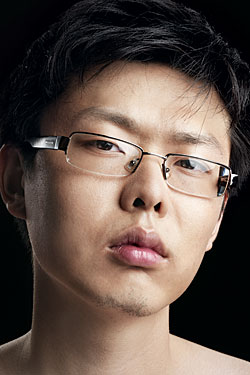
Sometimes I’ll glimpse my reflection in a window and feel astonished by what I see. Jet-black hair. Slanted eyes. A pancake-flat surface of yellow-and-green-toned skin. An expression that is nearly reptilian in its impassivity. I’ve contrived to think of this face as the equal in beauty to any other. But what I feel in these moments is its strangeness to me. It’s my face. I can’t disclaim it. But what does it have to do with me?

Millions of Americans must feel estranged from their own faces. But every self-estranged individual is estranged in his own way. I, for instance, am the child of Korean immigrants, but I do not speak my parents’ native tongue. I have never called my elders by the proper honorific, “big brother” or “big sister.” I have never dated a Korean woman. I don’t have a Korean friend. Though I am an immigrant, I have never wanted to strive like one.

You could say that I am, in the gently derisive parlance of Asian-Americans, a banana or a Twinkie (yellow on the outside, white on the inside). But while I don’t believe our roots necessarily define us, I do believe there are racially inflected assumptions wired into our neural circuitry that we use to sort through the sea of faces we confront. And although I am in most respects devoid of Asian characteristics, I do have an Asian face.

Here is what I sometimes suspect my face signifies to other Americans: an invisible person, barely distinguishable from a mass of faces that resemble it. A conspicuous person standing apart from the crowd and yet devoid of any individuality. An icon of so much that the culture pretends to honor but that it in fact patronizes and exploits. Not just people “who are good at math” and play the violin, but a mass of stifled, repressed, abused, conformist quasi-robots who simply do not matter, socially or culturally.

I’ve always been of two minds about this sequence of stereotypes. On the one hand, it offends me greatly that anyone would think to apply them to me, or to anyone else, simply on the basis of facial characteristics. On the other hand, it also seems to me that there are a lot of Asian people to whom they apply.

Let me summarize my feelings toward Asian values: Fuck filial piety. Fuck grade-grubbing. Fuck Ivy League mania. Fuck deference to authority. Fuck humility and hard work. Fuck harmonious relations. Fuck sacrificing for the future. Fuck earnest, striving middle-class servility.

I understand the reasons Asian parents have raised a generation of children this way. Doctor, lawyer, accountant, engineer: These are good jobs open to whoever works hard enough. What could be wrong with that pursuit? Asians graduate from college at a rate higher than any other ethnic group in America, including whites. They earn a higher median family income than any other ethnic group in America, including whites. This is a stage in a triumphal narrative, and it is a narrative that is much shorter than many remember. Two thirds of the roughly 14 million Asian-Americans are foreign-born. There were less than 39,000 people of Korean descent living in America in 1970, when my elder brother was born. There are around 1 million today.

Asian-American success is typically taken to ratify the American Dream and to prove that minorities can make it in this country without handouts. Still, an undercurrent of racial panic always accompanies the consideration of Asians, and all the more so as China becomes the destination for our industrial base and the banker controlling our burgeoning debt. But if the armies of Chinese factory workers who make our fast fashion and iPads terrify us, and if the collective mass of high-­achieving Asian-American students arouse an anxiety about the laxity of American parenting, what of the Asian-American who obeyed everything his parents told him? Does this person really scare anyone?

Earlier this year, the publication of Amy Chua’s Battle Hymn of the Tiger Mother incited a collective airing out of many varieties of race-based hysteria. But absent from the millions of words written in response to the book was any serious consideration of whether Asian-Americans were in fact taking over this country. If it is true that they are collectively dominating in elite high schools and universities, is it also true that Asian-Americans are dominating in the real world? My strong suspicion was that this was not so, and that the reasons would not be hard to find. If we are a collective juggernaut that inspires such awe and fear, why does it seem that so many Asians are so readily perceived to be, as I myself have felt most of my life, the products of a timid culture, easily pushed around by more assertive people, and thus basically invisible?
Jefferson MaoPhoto: Marco Grob. Grooming by Reneé Majour for Orlando Pita T3/Jump.
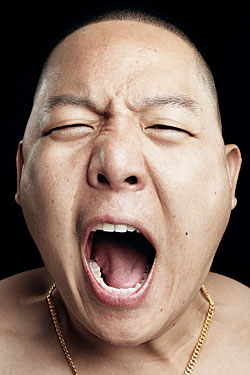
A few months ago, I received an e-mail from a young man named Jefferson Mao, who after attending Stuyvesant High School had recently graduated from the University of Chicago. He wanted my advice about “being an Asian writer.” This is how he described himself: “I got good grades and I love literature and I want to be a writer and an intellectual; at the same time, I’m the first person in my family to go to college, my parents don’t speak English very well, and we don’t own the apartment in Flushing that we live in. I mean, I’m proud of my parents and my neighborhood and what I perceive to be my artistic potential or whatever, but sometimes I feel like I’m jumping the gun a generation or two too early.”

One bright, cold Sunday afternoon, I ride the 7 train to its last stop in Flushing, where the storefront signs are all written in Chinese and the sidewalks are a slow-moving river of impassive faces. Mao is waiting for me at the entrance of the Main Street subway station, and together we walk to a nearby Vietnamese restaurant.

Mao has a round face, with eyes behind rectangular wire-frame glasses. Since graduating, he has been living with his parents, who emigrated from China when Mao was 8 years old. His mother is a manicurist; his father is a physical therapist’s aide. Lately, Mao has been making the familiar hour-and-a-half ride from Flushing to downtown Manhattan to tutor a white Stuyvesant freshman who lives in Tribeca. And what he feels, sometimes, in the presence of that amiable young man is a pang of regret. Now he understands better what he ought to have done back when he was a Stuyvesant freshman: “Worked half as hard and been twenty times more successful.”

Entrance to Stuyvesant, one of the most competitive public high schools in the country, is determined solely by performance on a test: The top 3.7 percent of all New York City students who take the Specialized High Schools Admissions Test hoping to go to Stuyvesant are accepted. There are no set-asides for the underprivileged or, conversely, for alumni or other privileged groups. There is no formula to encourage “diversity” or any nebulous concept of “well-­roundedness” or “character.” Here we have something like pure meritocracy. This is what it looks like: Asian-­Americans, who make up 12.6 percent of New York City, make up 72 percent of the high school.

This year, 569 Asian-Americans scored high enough to earn a slot at Stuyvesant, along with 179 whites, 13 Hispanics, and 12 blacks. Such dramatic overrepresentation, and what it may be read to imply about the intelligence of different groups of New Yorkers, has a way of making people uneasy. But intrinsic intelligence, of course, is precisely what Asians don’t believe in. They believe—and have ­proved—that the constant practice of test-taking will improve the scores of whoever commits to it. All throughout Flushing, as well as in Bayside, one can find “cram schools,” or storefront academies, that drill students in test preparation after school, on weekends, and during summer break. “Learning math is not about learning math,” an instructor at one called Ivy Prep was quoted in the New York Times as saying. “It’s about weightlifting. You are pumping the iron of math.” Mao puts it more specifically: “You learn quite simply to nail any standardized test you take.”

And so there is an additional concern accompanying the rise of the Tiger Children, one focused more on the narrowness of the educational experience a non-Asian child might receive in the company of fanatically preprofessional Asian students. Jenny Tsai, a student who was elected president of her class at the equally competitive New York public school Hunter College High School, remembers frequently hearing that “the school was becoming too Asian, that they would be the downfall of our school.” A couple of years ago, she revisited this issue in her senior thesis at Harvard, where she interviewed graduates of elite public schools and found that the white students regarded the Asians students with wariness. (She quotes a music teacher at Stuyvesant describing the dominance of Asians: “They were mediocre kids, but they got in because they were coached.”) In 2005, The Wall Street Journal reported on “white flight” from a high school in Cupertino, California, that began soon after the children of Asian software engineers had made the place so brutally competitive that a B average could place you in the bottom third of the class.

Colleges have a way of correcting for this imbalance: The Princeton sociologist Thomas Espenshade has calculated that an Asian applicant must, in practice, score 140 points higher on the SAT than a comparable white applicant to have the same chance of admission. This is obviously unfair to the many qualified Asian individuals who are punished for the success of others with similar faces. Upper-middle-class white kids, after all, have their own elite private schools, and their own private tutors, far more expensive than the cram schools, to help them game the education system.
Eddie HuangPhoto: Marco Grob. Grooming by Jane Choi for Clairisonic at Stockland Martel.
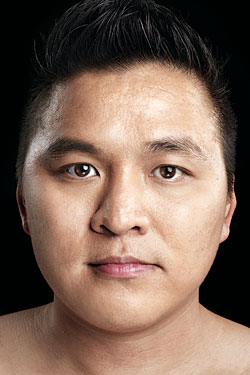
You could frame it, as some aggrieved Asian-Americans do, as a simple issue of equality and press for race-blind quantitative admissions standards. In 2006, a decade after California passed a voter initiative outlawing any racial engineering at the public universities, Asians composed 46 percent of UC-Berkeley’s entering class; one could imagine a similar demographic reshuffling in the Ivy League, where Asian-Americans currently make up about 17 percent of undergraduates. But the Ivies, as we all know, have their own private institutional interests at stake in their admissions choices, including some that are arguably defensible. Who can seriously claim that a Harvard University that was 72 percent Asian would deliver the same grooming for elite status its students had gone there to receive?

Somewhere near the middle of his time at Stuyvesant, a vague sense of discontent started to emerge within Mao. He had always felt himself a part of a mob of “nameless, faceless Asian kids,” who were “like a part of the décor of the place.” He had been content to keep his head down and work toward the goal shared by everyone at Stuyvesant: Harvard. But around the beginning of his senior year, he began to wonder whether this march toward academic success was the only, or best, path.

“You can’t help but feel like there must be another way,” he explains over a bowl of phô. “It’s like, we’re being pitted against each other while there are kids out there in the Midwest who can do way less work and be in a garage band or something—and if they’re decently intelligent and work decently hard in school …”

Mao began to study the racially inflected social hierarchies at Stuyvesant, where, in a survey undertaken by the student newspaper this year, slightly more than half of the respondents reported that their friends came from within their own ethnic group. His attention focused on the mostly white (and Manhattan-dwelling) group whose members seemed able to manage the crushing workload while still remaining socially active. “The general gist of most high-school movies is that the pretty cheerleader gets with the big dumb jock, and the nerd is left to bide his time in loneliness. But at some point in the future,” he says, “the nerd is going to rule the world, and the dumb jock is going to work in a carwash.

“At Stuy, it’s completely different: If you looked at the pinnacle, the girls and the guys are not only good-looking and socially affable, they also get the best grades and star in the school plays and win election to student government. It all converges at the top. It’s like training for high society. It was jarring for us Chinese kids. You got the sense that you had to study hard, but it wasn’t enough.”

Mao was becoming clued in to the fact that there was another hierarchy behind the official one that explained why others were getting what he never had—“a high-school sweetheart” figured prominently on this list—and that this mysterious hierarchy was going to determine what happened to him in life. “You realize there are things you really don’t understand about courtship or just acting in a certain way. Things that somehow come naturally to people who go to school in the suburbs and have parents who are culturally assimilated.” I pressed him for specifics, and he mentioned that he had visited his white girlfriend’s parents’ house the past Christmas, where the family had “sat around cooking together and playing Scrabble.” This ordinary vision of suburban-American domesticity lingered with Mao: Here, at last, was the setting in which all that implicit knowledge “about social norms and propriety” had been transmitted. There was no cram school that taught these lessons.

Before having heard from Mao, I had considered myself at worst lightly singed by the last embers of Asian alienation. Indeed, given all the incredibly hip Asian artists and fashion designers and so forth you can find in New York, it seemed that this feeling was destined to die out altogether. And yet here it was in a New Yorker more than a dozen years my junior. While it may be true that sections of the Asian-American world are devoid of alienation, there are large swaths where it is as alive as it has ever been.

A few weeks after we meet, Mao puts me in touch with Daniel Chu, his close friend from Stuyvesant. Chu graduated from Williams College last year, having won a ­creative-writing award for his poetry. He had spent a portion of the $18,000 prize on a trip to China, but now he is back living with his parents in Brooklyn Chinatown.
J.T. TranPhoto: Marco Grob. Grooming by Jane Choi for Clairisonic at Stockland Martel.

Chu remembers that during his first semester at Williams, his junior adviser would periodically take him aside. Was he feeling all right? Was something the matter? “I was acclimating myself to the place,” he says. “I wasn’t totally happy, but I wasn’t depressed.” But then his new white friends made similar remarks. “They would say, ‘Dan, it’s kind of hard, sometimes, to tell what you’re thinking.’ ”

Chu has a pleasant face, but it would not be wrong to characterize his demeanor as reserved. He speaks in a quiet, unemphatic voice. He doesn’t move his features much. He attributes these traits to the atmosphere in his household. “When you grow up in a Chinese home,” he says, “you don’t talk. You shut up and listen to what your parents tell you to do.”

At Stuyvesant, he had hung out in an exclusively Asian world in which friends were determined by which subway lines you traveled. But when he arrived at Williams, Chu slowly became aware of something strange: The white people in the New England wilderness walked around smiling at each other. “When you’re in a place like that, everyone is friendly.”

He made a point to start smiling more. “It was something that I had to actively practice,” he says. “Like, when you have a transaction at a business, you hand over the money—and then you smile.” He says that he’s made some progress but that there’s still plenty of work that remains. “I’m trying to undo eighteen years of a Chinese upbringing. Four years at Williams helps, but only so much.” He is conscious of how his father, an IT manager, is treated at work. “He’s the best programmer at his office,” he says, “but because he doesn’t speak English well, he is always passed over.”

Though Chu is not merely fluent in En­glish but is officially the most distinguished poet of his class at Williams, he still worries that other aspects of his demeanor might attract the same kind of treatment his father received. “I’m really glad we’re having this conversation,” he says at one point—it is helpful to be remembering these lessons in self-presentation just as he prepares for job interviews.
It is a part of the bitter undercurrent of Asian-American life thatmeritocracycomes to an abrupt end aftergraduation.

“I guess what I would like is to become so good at something that my social deficiencies no longer matter,” he tells me. Chu is a bright, diligent, impeccably credentialed young man born in the United States. He is optimistic about his ability to earn respect in the world. But he doubts he will ever feel the same comfort in his skin that he glimpsed in the people he met at Williams. That kind of comfort, he says—“I think it’s generations away.”

While he was still an electrical-­engineering student at Berkeley in the nineties, James Hong visited the IBM campus for a series of interviews. An older Asian researcher looked over Hong’s résumé and asked him some standard questions. Then he got up without saying a word and closed the door to his office.

“Listen,” he told Hong, “I’m going to be honest with you. My generation came to this country because we wanted better for you kids. We did the best we could, leaving our homes and going to graduate school not speaking much English. If you take this job, you are just going to hit the same ceiling we did. They just see me as an Asian Ph.D., never management potential. You are going to get a job offer, but don’t take it. Your generation has to go farther than we did, otherwise we did everything for nothing.”

The researcher was talking about what some refer to as the “Bamboo Ceiling”—an invisible barrier that maintains a pyramidal racial structure throughout corporate America, with lots of Asians at junior levels, quite a few in middle management, and virtually none in the higher reaches of leadership.

The failure of Asian-Americans to become leaders in the white-collar workplace does not qualify as one of the burning social issues of our time. But it is a part of the bitter undercurrent of Asian-American life that so many Asian graduates of elite universities find that meritocracy as they have understood it comes to an abrupt end after graduation. If between 15 and 20 percent of every Ivy League class is Asian, and if the Ivy Leagues are incubators for the country’s leaders, it would stand to reason that Asians would make up some corresponding portion of the leadership class.

And yet the numbers tell a different story. According to a recent study, Asian-­Americans represent roughly 5 percent of the population but only 0.3 percent of corporate officers, less than 1 percent of corporate board members, and around 2 percent of college presidents. There are nine Asian-American CEOs in the Fortune 500. In specific fields where Asian-Americans are heavily represented, there is a similar asymmetry. A third of all software engineers in Silicon Valley are Asian, and yet they make up only 6 percent of board members and about 10 percent of corporate officers of the Bay Area’s 25 largest companies. At the National Institutes of Health, where 21.5 percent of tenure-track scientists are Asians, only 4.7 percent of the lab or branch directors are, according to a study conducted in 2005. One succinct evocation of the situation appeared in the comments section of a website called Yellowworld: “If you’re East Asian, you need to attend a top-tier university to land a good high-paying gig. Even if you land that good high-paying gig, the white guy with the pedigree from a mediocre state university will somehow move ahead of you in the ranks simply because he’s white.”

Jennifer W. Allyn, a managing director for diversity at PricewaterhouseCoopers, works to ensure that “all of the groups feel welcomed and supported and able to thrive and to go as far as their talents will take them.” I posed to her the following definition of parity in the corporate workforce: If the current crop of associates is 17 percent Asian, then in fourteen years, when they have all been up for partner review, 17 percent of those who are offered partner will be Asian. Allyn conceded that PricewaterhouseCoopers was not close to reaching that benchmark anytime soon—and that “nobody else is either.”

Part of the insidious nature of the Bamboo Ceiling is that it does not seem to be caused by overt racism. A survey of Asian-Pacific-American employees of Fortune 500 companies found that 80 percent reported they were judged not as Asians but as individuals. But only 51 percent reported the existence of Asians in key positions, and only 55 percent agreed that their firms were fully capitalizing on the talents and perspectives of Asians.

More likely, the discrepancy in these numbers is a matter of unconscious bias. Nobody would affirm the proposition that tall men are intrinsically better leaders, for instance. And yet while only 15 percent of the male population is at least six feet tall, 58 percent of all corporate CEOs are. Similarly, nobody would say that Asian people are unfit to be leaders. But subjects in a recently published psychological experiment consistently rated hypothetical employees with Caucasian-sounding names higher in leadership potential than identical ones with Asian names.

Maybe it is simply the case that a traditionally Asian upbringing is the problem. As Allyn points out, in order to be a leader, you must have followers. Associates at Pricewaterhouse­Coopers are initially judged on how well they do the work they are assigned. “You have to be a doer,” as she puts it. They are expected to distinguish themselves with their diligence, at which point they become “super-doers.” But being a leader requires different skill sets. “The traits that got you to where you are won’t necessarily take you to the next level,” says the diversity consultant Jane Hyun, who wrote a book called Breaking the Bamboo Ceiling. To become a leader requires taking personal initiative and thinking about how an organization can work differently. It also requires networking, self-promotion, and self-assertion. It’s racist to think that any given Asian individual is unlikely to be creative or risk-taking. It’s simple cultural observation to say that a group whose education has historically focused on rote memorization and “pumping the iron of math” is, on aggregate, unlikely to yield many people inclined to challenge authority or break with inherited ways of doing things.

Sach Takayasu had been one of the ­fastest-rising members of her cohort in the marketing department at IBM in New York. But about seven years ago, she felt her progress begin to slow. “I had gotten to the point where I was overdelivering, working really long hours, and where doing more of the same wasn’t getting me anywhere,” she says. It was around this time that she attended a seminar being offered by an organization called Leadership Education for Asian Pacifics.

LEAP has parsed the complicated social dynamics responsible for the dearth of Asian-American leaders and has designed training programs that flatter Asian people even as it teaches them to change their behavior to suit white-American expectations. Asians who enter a LEAP program are constantly assured that they will be able to “keep your values, while acquiring new skills,” along the way to becoming “culturally competent leaders.”

In a presentation to 1,500 Asian-American employees of Microsoft, LEAP president and CEO J. D. Hokoyama laid out his grand synthesis of the Asian predicament in the workplace. “Sometimes people have perceptions about us and our communities which may or may not be true,” Hokoyama told the audience. “But they put those perceptions onto us, and then they do something that can be very devastating: They make decisions about us not based on the truth but based on those perceptions.” Hokoyama argued that it was not sufficient to rail at these unjust perceptions. In the end, Asian people themselves would have to assume responsibility for unmaking them. This was both a practical matter, he argued, and, in its own way, fair.

Aspiring Asian leaders had to become aware of “the relationship between values, behaviors, and perceptions.” He offered the example of Asians who don’t speak up at meetings. “So let’s say I go to meetings with you and I notice you never say anything. And I ask myself, ‘Hmm, I wonder why you’re not saying anything. Maybe it’s because you don’t know what we’re talking about. That would be a good reason for not saying anything. Or maybe it’s because you’re not even interested in the subject matter. Or maybe you think the conversation is beneath you.’ So here I’m thinking, because you never say anything at meetings, that you’re either dumb, you don’t care, or you’re arrogant. When maybe it’s because you were taught when you were growing up that when the boss is talking, what are you supposed to be doing? Listening.”

Takayasu took the weeklong course in 2006. One of the first exercises she encountered involved the group instructor asking for a list of some qualities that they identify with Asians. The students responded: upholding family honor, filial piety, self-­restraint. Then the instructor solicited a list of the qualities the members identify with leadership, and invited the students to notice how little overlap there is between the two lists.

At first, Takayasu didn’t relate to the others in attendance, who were listing typical Asian values their parents had taught them. “They were all saying things like ‘Study hard,’ ‘Become a doctor or lawyer,’ blah, blah, blah. That’s not how my parents were. They would worry if they saw me working too hard.” Takayasu had spent her childhood shuttling between New York and Tokyo. Her father was an executive at Mitsubishi; her mother was a concert pianist. She was highly assimilated into American culture, fluent in English, poised and confident. “But the more we got into it, as we moved away from the obvious things to the deeper, more fundamental values, I began to see that my upbringing had been very Asian after all. My parents would say, ‘Don’t create problems. Don’t trouble other people.’ How Asian is that? It helped to explain why I don’t reach out to other people for help.” It occurred to Takayasu that she was a little bit “heads down” after all. She was willing to take on difficult assignments without seeking credit for herself. She was reluctant to “toot her own horn.”

Takayasu has put her new self-awareness to work at IBM, and she now exhibits a newfound ability for horn tooting. “The things I could write on my résumé as my team’s accomplishments: They’re really impressive,” she says.

The law professor and writer Tim Wu grew up in Canada with a white mother and a Taiwanese father, which allows him an interesting perspective on how whites and Asians perceive each other. After graduating from law school, he took a series of clerkships, and he remembers the subtle ways in which hierarchies were developed among the other young lawyers. “There is this automatic assumption in any legal environment that Asians will have a particular talent for bitter labor,” he says, and then goes on to define the word coolie,a Chinese term for “bitter labor.” “There was this weird self-selection where the Asians would migrate toward the most brutal part of the labor.”

By contrast, the white lawyers he encountered had a knack for portraying themselves as above all that. “White people have this instinct that is really important: to give off the impression that they’re only going to do the really important work. You’re a quarterback. It’s a kind of arrogance that Asians are trained not to have. Someone told me not long after I moved to New York that in order to succeed, you have to understand which rules you’re supposed to break. If you break the wrong rules, you’re finished. And so the easiest thing to do is follow all the rules. But then you consign yourself to a lower status. The real trick is understanding what rules are not meant for you.”

This idea of a kind of rule-governed rule-breaking—where the rule book was unwritten but passed along in an innate cultural sense—is perhaps the best explanation I have heard of how the Bamboo Ceiling functions in practice. LEAP appears to be very good at helping Asian workers who are already culturally competent become more self-aware of how their culture and appearance impose barriers to advancement. But I am not sure that a LEAP course is going to be enough to get Jefferson Mao or Daniel Chu the respect and success they crave. The issue is more fundamental, the social dynamics at work more deeply embedded, and the remedial work required may be at a more basic level of comportment.

What if you missed out on the lessons in masculinity taught in the gyms and locker rooms of America’s high schools? What if life has failed to make you a socially dominant alpha male who runs the American boardroom and prevails in the American bedroom? What if no one ever taught you how to greet white people and make them comfortable? What if, despite these deficiencies, you no longer possess an immigrant’s dutiful forbearance for a secondary position in the American narrative and want to be a player in the scrimmage of American appetite right now, in the present?

How do you undo eighteen years of a Chinese upbringing?

This is the implicit question that J. T. Tran has posed to a roomful of Yale undergraduates at a master’s tea at Silliman College. His answer is typically Asian: practice. Tran is a pickup artist who goes by the handle Asian Playboy. He travels the globe running “boot camps,” mostly for Asian male students, in the art of attraction. Today, he has been invited to Yale by the Asian-American Students Alliance.

“Creepy can be fixed,” Tran explains to the standing-room-only crowd. “Many guys just don’t realize how to project themselves.” These are the people whom Tran spends his days with, a new batch in a new city every week: nice guys, intelligent guys, motivated guys, who never figured out how to be successful with women. Their mothers had kept them at home to study rather than let them date or socialize. Now Tran’s company, ABCs of Attraction, offers a remedial education that consists of three four-hour seminars, followed by a supervised night out “in the field,” in which J. T., his assistant Gareth Jones, and a tall blonde wing-girl named Sarah force them to approach women. Tuition costs $1,450.

“One of the big things I see with Asian students is what I call the Asian poker face—the lack of range when it comes to facial expressions,” Tran says. “How many times has this happened to you?” he asks the crowd. “You’ll be out at a party with your white friends, and they will be like—‘Dude, are you angry?’ ” Laughter fills the room. Part of it is psychological, he explains. He recalls one Korean-American student he was teaching. The student was a very dedicated schoolteacher who cared a lot about his students. But none of this was visible. “Sarah was trying to help him, and she was like, ‘C’mon, smile, smile,’ and he was like …” And here Tran mimes the unbearable tension of a face trying to contort itself into a simulacrum of mirth. “He was so completely unpracticed at smiling that he literally could not do it.” Eventually, though, the student fought through it, “and when he finally got to smiling he was, like, really cool.”

Tran continues to lay out a story of Asian-American male distress that must be relevant to the lives of at least some of those who have packed Master Krauss’s living room. The story he tells is one of Asian-American disadvantage in the sexual marketplace, a disadvantage that he has devoted his life to overturning. Yes, it is about picking up women. Yes, it is about picking up white women. Yes, it is about attracting those women whose hair is the color of the midday sun and eyes are the color of the ocean, and it is about having sex with them. He is not going to apologize for the images of blonde women plastered all over his website. This is what he prefers, what he stands for, and what he is selling: the courage to pursue anyone you want, and the skills to make the person you desire desire you back. White guys do what they want; he is going to do the same.

But it is about much more than this, too. It is about altering the perceptions of Asian men—perceptions that are rooted in the way they behave, which are in turn rooted in the way they were raised—through a course of behavior modification intended to teach them how to be the socially dominant figures that they are not perceived to be. It is a program of, as he puts it to me later, “social change through pickup.”

Tran offers his own story as an exemplary Asian underdog. Short, not good-looking, socially inept, sexually null. “If I got a B, I would be whipped,” he remembers of his childhood. After college, he worked as an aerospace engineer at Boeing and Raytheon, but internal politics disfavored him. Five years into his career, his entire white cohort had been promoted above him. “I knew I needed to learn about social dynamics, because just working hard wasn’t cutting it.”

His efforts at dating were likewise “a miserable failure.” It was then that he turned to “the seduction community,” a group of men on Internet message boards like alt.seduction.fast. It began as a “support group for losers” and later turned into a program of self-improvement. Was charisma something you could teach? Could confidence be reduced to a formula? Was it merely something that you either possessed or did not possess, as a function of the experiences you had been through in life, or did it emerge from specific forms of behavior? The members of the group turned their computer-science and engineering brains to the question. They wrote long accounts of their dates and subjected them to collective scrutiny. They searched for patterns in the raw material and filtered these experiences through social-psychological research. They eventually built a model.

This past Valentine’s Day, during a weekend boot camp in New York City sponsored by ABCs of Attraction, the model is being played out. Tran and Jones are teaching their students how an alpha male stands (shoulders thrown back, neck fully extended, legs planted slightly wider than the shoulders). “This is going to feel very strange to you if you’re used to slouching, but this is actually right,” Jones says. They explain how an alpha male walks (no shuffling; pick your feet up entirely off the ground; a slight sway in the shoulders). They identify the proper distance to stand from “targets” (a slightly bent arm’s length). They explain the importance of “kino escalation.” (You must touch her. You must not be afraid to do this.) They are teaching the importance of sub-­communication: what you convey about yourself before a single word has been spoken. They explain the importance of intonation. They explain what intonation is. “Your voice moves up and down in pitch to convey a variety of different emotions.”

All of this is taught through a series of exercises. “This is going to feel completely artificial,” says Jones on the first day of training. “But I need you to do the biggest shit-eating grin you’ve ever made in your life.” Sarah is standing in the corner with her back to the students—three Indian guys, including one in a turban, three Chinese guys, and one Cambodian. The students have to cross the room, walking as an alpha male walks, and then place their hands on her shoulder—firmly but gently—and turn her around. Big smile. Bigger than you’ve ever smiled before. Raise your glass in a toast. Make eye contact and hold it. Speak loudly and clearly. Take up space without apology. This is what an alpha male does.

Before each student crosses the floor of that bare white cubicle in midtown, Tran asks him a question. “What is good in life?” Tran shouts.

The student then replies, in the loudest, most emphatic voice he can muster: “To crush my enemies, see them driven before me, and to hear the lamentation of their women—in my bed!”

For the intonation exercise, students repeat the phrase “I do what I want” with a variety of different moods.

“Say it like you’re happy!” Jones shouts. (“I do what I want.”) Say it like you’re sad! (“I do what I want.” The intonation utterly unchanged.) Like you’re sad! (“I … do what I want.”) Say it like you’ve just won $5 million! (“I do what I want.”)
“She was tryingto help him.‘C’mon, smile,smile, and he was like …” And here Tranmimes the unbearable tension of a face trying to contortitself into a simulacrum of mirth.

Raj, a 26-year-old Indian virgin, can barely get his voice to alter during intonation exercise. But on Sunday night, on the last evening of the boot camp, I watch him cold-approach a set of women at the Hotel Gansevoort and engage them in conversation for a half-hour. He does not manage to “number close” or “kiss close.” But he had done something that not very many people can do.

Of the dozens of Asian-­Americans I spoke with for this story, many were successful artists and scientists; or good-looking and socially integrated leaders; or tough, brassy, risk-taking, street-smart entrepreneurs. Of course, there are lots of such people around—do I even have to point that out? They are no more morally worthy than any other kind of Asian person. But they have figured out some useful things.

The lesson about the Bamboo Ceiling that James Hong learned from his interviewer at IBM stuck, and after working for a few years at Hewlett-Packard, he decided to strike off on his own. His first attempts at entrepreneurialism failed, but he finally struck pay dirt with a simple, not terribly refined idea that had a strong primal appeal: hotornot.com. Hong and his co-founder eventually sold the site for roughly $20 million.

Hong ran hotornot.com partly as a kind of incubator to seed in his employees the habits that had served him well. “We used to hire engineers from Berkeley—almost all Asian—who were on the cusp of being entrepreneurial but were instead headed toward jobs at big companies,” he says. “We would train them in how to take risk, how to run things themselves. I remember encouraging one employee to read The Game”—the infamous pickup-artist textbook—“because I figured growing the cojones to take risk was applicable to being an entrepreneur.”

If the Bamboo Ceiling is ever going to break, it’s probably going to have less to do with any form of behavior assimilation than with the emergence of risk-­takers whose success obviates the need for Asians to meet someone else’s behavioral standard. People like Steve Chen, who was one of the creators of YouTube, or Kai and Charles Huang, who created Guitar Hero. Or Tony Hsieh, the founder of Zappos.com, the online shoe retailer that he sold to Amazon for about a billion dollars in 2009. Hsieh is a short Asian man who speaks tersely and is devoid of obvious charisma. One cannot imagine him being promoted in an American corporation. And yet he has proved that an awkward Asian guy can be a formidable CEO and the unlikeliest of management gurus.

Hsieh didn’t have to conform to Western standards of comportment because he adopted early on the Western value of risk-taking. Growing up, he would play recordings of himself in the morning practicing the violin, in lieu of actually practicing. He credits the experience he had running a pizza business at Harvard as more important than anything he learned in class. He had an instinctive sense of what the real world would require of him, and he knew that nothing his parents were teaching him would get him there.

You don’t, by the way, have to be a Silicon Valley hotshot to break through the Bamboo Ceiling. You can also be a chef like Eddie Huang, whose little restaurant on the Lower East Side, BaoHaus, sells delicious pork buns. Huang grew up in Orlando with a hard-core Tiger Mom and a disciplinarian father. “As a kid, psychologically, my day was all about not getting my ass kicked,” he says. He gravitated toward the black kids at school, who also knew something about corporal punishment. He was the smallest member of his football team, but his coach named him MVP in the seventh grade. “I was defensive tackle and right guard because I was just mean. I was nasty. I had this mentality where I was like, ‘You’re going to accept me or I’m going to fuck you up.’ ”

Huang had a rough twenties, bumping repeatedly against the Bamboo Ceiling. In college, editors at the Orlando Sentinel invited him to write about sports for the paper. But when he visited the offices, “the editor came in and goes, ‘Oh, no.’ And his exact words: ‘You can’t write with that face.’ ” Later, in film class at Columbia, he wrote a script about an Asian-American hot-dog vendor obsessed with his small penis. “The screenwriting teacher was like, ‘I love this. You have a lot of Woody Allen in you. But do you think you could change it to Jewish characters?’ ” Still later, after graduating from Cardozo School of Law, he took a corporate job, where other associates would frequently say, “You have a lot of opinions for an Asian guy.”

Finally, Huang decided to open a restaurant. Selling food was precisely the fate his parents wanted their son to avoid, and they didn’t talk to him for months after he quit lawyering. But Huang understood instinctively that he couldn’t make it work in the professional world his parents wanted him to join. “I’ve realized that food is one of the only places in America where we are the top dogs,” he says. “Guys like David Chang or me—we can hang. There’s a younger generation that grew up eating Chinese fast food. They respect our food. They may not respect anything else, but they respect our food.”

Rather than strive to make himself acceptable to the world, Huang has chosen to buy his way back in, on his own terms. “What I’ve learned is that America is about money, and if you can make your culture commodifiable, then you’re relevant,” he says. “I don’t believe anybody agrees with what I say or supports what I do because they truly want to love Asian people. They like my fucking pork buns, and I don’t get it twisted.”

Sometime during the hundreds of hours he spent among the mostly untouched English-language novels at the Flushing branch of the public library, Jefferson Mao discovered literature’s special power of transcendence, a freedom of imagination that can send you beyond the world’s hierarchies. He had written to me seeking permission to swerve off the traditional path of professional striving—to devote himself to becoming an artist—but he was unsure of what risks he was willing to take. My answer was highly ambivalent. I recognized in him something of my own youthful ambition. And I knew where that had taken me.

Unlike Mao, I was not a poor, first-­generation immigrant. I finished school alienated both from Asian culture (which, in my hometown, was barely visible) and the manners and mores of my white peers. But like Mao, I wanted to be an individual. I had refused both cultures as an act of self-­assertion. An education spent dutifully acquiring credentials through relentless drilling seemed to me an obscenity. So did adopting the manipulative cheeriness that seemed to secure the popularity of white Americans.

Instead, I set about contriving to live beyond both poles. I wanted what James Baldwin sought as a ­writer—“a power which outlasts kingdoms.” Anything short of that seemed a humiliating compromise. I would become an aristocrat of the spirit, who prides himself on his incompetence in the middling tasks that are the world’s business. Who does not seek after material gain. Who is his own law.

This, of course, was madness. A child of Asian immigrants born into the suburbs of New Jersey and educated at Rutgers cannot be a law unto himself. The only way to approximate this is to refuse employment, because you will not be bossed around by people beneath you, and shave your expenses to the bone, because you cannot afford more, and move into a decaying Victorian mansion in Jersey City, so that your sense of eccentric distinction can be preserved in the midst of poverty, and cut yourself free of every form of bourgeois discipline, because these are precisely the habits that will keep you chained to the mediocre fate you consider worse than death.

Throughout my twenties, I proudly turned away from one institution of American life after another (for instance, a steady job), though they had already long since turned away from me. Academe seemed another kind of death—but then again, I had a transcript marred by as many F’s as A’s. I had come from a culture that was the middle path incarnate. And yet for some people, there can be no middle path, only transcendence or descent into the abyss.

I was descending into the abyss.

All this was well deserved. No one had any reason to think I was anything or anyone. And yet I felt entitled to demand this recognition. I knew this was wrong and impermissible; therefore I had to double down on it. The world brings low such people. It brought me low. I haven’t had health insurance in ten years. I didn’t earn more than $12,000 for eight consecutive years. I went three years in the prime of my adulthood without touching a woman. I did not produce a masterpiece.

I recall one of the strangest conversations I had in the city. A woman came up to me at a party and said she had been moved by a piece of writing I had published. She confessed that prior to reading it, she had never wanted to talk to me, and had always been sure, on the basis of what she could see from across the room, that I was nobody worth talking to, that I was in fact someone to avoid.

But she had been wrong about this, she told me: It was now plain to her that I was a person with great reserves of feeling and insight. She did not ask my forgiveness for this brutal misjudgment. Instead, what she wanted to know was—why had I kept that person she had glimpsed in my essay so well hidden? She confessed something of her own hidden sorrow: She had never been beautiful and had decided, early on, that it therefore fell to her to “love the world twice as hard.” Why hadn’t I done that?

Here was a drunk white lady speaking what so many others over the years must have been insufficiently drunk to tell me. It was the key to many things that had, and had not, happened. I understood this encounter better after learning about LEAP, and visiting Asian Playboy’s boot camp. If you are a woman who isn’t beautiful, it is a social reality that you will have to work twice as hard to hold anyone’s attention. You can either linger on the unfairness of this or you can get with the program. If you are an Asian person who holds himself proudly aloof, nobody will respect that, or find it intriguing, or wonder if that challenging façade hides someone worth getting to know. They will simply write you off as someone not worth the trouble of talking to.

Having glimpsed just how unacceptable the world judges my demeanor, could I too strive to make up for my shortcomings? Practice a shit-eating grin until it becomes natural? Love the world twice as hard?

I see the appeal of getting with the program. But this is not my choice. Striving to meet others’ expectations may be a necessary cost of assimilation, but I am not going to do it.

Often I think my defiance is just delusional, self-glorifying bullshit that artists have always told themselves to compensate for their poverty and powerlessness. But sometimes I think it’s the only thing that has preserved me intact, and that what has been preserved is not just haughty caprice but in fact the meaning of my life. So this is what I told Mao: In lieu of loving the world twice as hard, I care, in the end, about expressing my obdurate singularity at any cost. I love this hard and unyielding part of myself more than any other reward the world has to offer a newly brightened and ingratiating demeanor, and I will bear any costs associated with it.

The first step toward self-reform is to admit your deficiencies. Though my early adulthood has been a protracted education in them, I do not admit mine. I’m fine. It’s the rest of you who have a problem. Fuck all y’all.

Amy Chua returned to Yale from a long, exhausting book tour in which one television interviewer had led off by noting that Internet commenters were calling her a monster. By that point, she had become practiced at the special kind of self-presentation required of a person under public siege. “I do not think that Chinese parents are superior,” she declared at the annual gathering of the Asian-American Students Alliance. “I think there are many ways to be a good parent.”

Much of her talk to the students, and indeed much of the conversation surrounding the book, was focused on her own parenting decisions. But just as interesting is how her parents parented her. Chua was plainly the product of a brute-force Chinese education. Battle Hymn of the Tiger Mother includes many lessons she was taught by her parents—lessons any LEAP student would recognize. “Be modest, be humble, be simple,” her mother told her. “Never complain or make excuses,” her father instructed. “If something seems unfair at school, just prove yourself by working twice as hard and being twice as good.”

In the book, Chua portrays her distaste for corporate law, which she practiced before going into academe. “My entire three years at the firm, I always felt like I was playacting, ridiculous in my suit,” she writes. This malaise extended even earlier, to her time as a student. “I didn’t care about the rights of criminals the way others did, and I froze whenever a professor called on me. I also wasn’t naturally skeptical and questioning; I just wanted to write down everything the professor said and memorize it.”

At the AASA gathering at Yale, Chua made the connection between her upbringing and her adult dissatisfaction. “My parents didn’t sit around talking about politics and philosophy at the dinner table,” she told the students. Even after she had escaped from corporate law and made it onto a law faculty, “I was kind of lost. I just didn’t feel the passion.” Eventually, she made a name for herself as the author of popular books about foreign policy and became an award-winning teacher. But it’s plain that she was no better prepared for legal scholarship than she had been for corporate law. “It took me a long, long time,” she said. “And I went through lots and lots of rejection.” She recalled her extended search for an academic post, in which she was “just not able to do a good interview, just not able to present myself well.”

In other words, Battle Hymn provides all the material needed to refute the very cultural polemic for which it was made to stand. Chua’s Chinese education had gotten her through an elite schooling, but it left her unprepared for the real world. She does not hide any of this. She had set out, she explained, to write a memoir that was “defiantly self-incriminating”—and the result was a messy jumble of conflicting impulses, part provocation, part self-critique. Western readers rode roughshod over this paradox and made of Chua a kind of Asian minstrel figure. But more than anything else, Battle Hymn is a very American project—one no traditional Chinese person would think to undertake. “Even if you hate the book,” Chua pointed out, “the one thing it is not is meek.”

“The loudest duck gets shot” is a Chinese proverb. “The nail that sticks out gets hammered down” is a Japanese one. Its Western correlative: “The squeaky wheel gets the grease.” Chua had told her story and been hammered down. Yet here she was, fresh from her hammering, completely unbowed.

There is something salutary in that proud defiance. And though the debate she sparked about Asian-American life has been of questionable value, we will need more people with the same kind of defiance, willing to push themselves into the spotlight and to make some noise, to beat people up, to seduce women, to make mistakes, to become entrepreneurs, to stop doggedly pursuing official paper emblems attesting to their worthiness, to stop thinking those scraps of paper will secure anyone’s happiness, and to dare to be interesting.