Kindle$12.99, Audiobook
https://archive.org/details/pavilionofwomen0000buck_s9q7

Read sample
 Audible sample
Follow the author

Pearl S. BuckPearl S. Buck
Follow
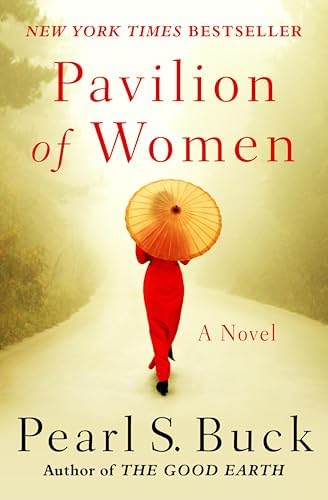
Pavilion of Women: A Novel of Life in the Women's Quarters Kindle Edition
by Pearl S. Buck (Author) Format: Kindle Edition
4.5 4.5 out of 5 stars (4,090)
4.2 on Goodreads
15,263 ratings
===
A "vivid and extremely interesting" novel of an upper-class Chinese wife's quest for freedom, from the Nobel Prize–winning author of The Good Earth (The New Yorker).
At forty, Madame Wu is beautiful and much respected as the wife of one of China's oldest upper-class houses. Her birthday wish is to find a young concubine for her husband and to move to separate quarters, starting a new chapter of her life. When her wish is granted, she finds herself at leisure, no longer consumed by running a sixty-person household. Now she's free to read books previously forbidden her, to learn English, and to discover her own mind. The family in the compound are shocked at the results, especially when she begins learning from a progressive, excommunicated Catholic priest.
In its depiction of life in the compound, Pavilion of Women includes some of Buck's most enchanting writing about the seasons, daily rhythms, and customs of women in China. It is a delightful parable about the sexes, and of the profound and transformative effects of free thought.
This ebook features an illustrated biography of Pearl S. Buck including rare images from the author's estate.
Next slide of product details
See all details
Due to its large file size, this book may take longer to download
Report an issue with this product or seller
This title is only available on select devices and the latest version of the Kindle app. Please refer to the supported device list before purchase. Available on these devices
Similar books
 by Pearl S. Buck
China
Cultural Heritage
Page 1 of 8
Previous page
 Imperial Woman: The Story of the Last Empress of China
3,616
Kindle Edition
 East Wind: West Wind: The Saga of a Chinese Family (Oriental Novels of Pearl S. Buck Book 8)East Wind: West Wind: The Saga of a Chinese Family (Oriental Nov…
1,646
Kindle Edition
 Dragon Seed: A Novel of China at War (Oriental Novels of Pearl S. Buck)Dragon Seed: A Novel of China at War (Oriental Novels of P…
884
Kindle Edition
 The Mother: A NovelThe Mother: A Novel
1,973
Kindle Edition











Next page
From the Publisher


Editorial Reviews
Review
“Beautifully written . . . a fine, full flavorsome novel.” —Newsweek
“Vivid and extremely interesting.” —The New Yorker
“Pavilion of Women is Miss Buck at her best, the dedicated storyteller. Beneath the deceptive simplicity of the narrative flows the clear, swift tide of human life—the small commonplaces of daily living, the clashes of personality, the episodes mean and magnificent.” —The Saturday Review of Literature
From the Publisher
Madame Wu was to retire from married life and had planned to select a concubine for her husband. When the revered House of Wu is upturned by her decision, Madame Wu elegantly manages the situation and is granted private time she never had before. Yet, with all this new freedom, and the arrival of her son's English teacher, how will Madame Wu change?
"Pavilion of Women is Miss Buck at her best, the dedicated storyteller. Beneath the deceptive simplicity of the narrative flows the clear, swift tide of human life--the small commonplaces of daily living, the clashes of personality, the episodes mean and magnificent."
--Saturday Review of Literature
Read more
Publication date : August 21, 2012
Print length : 233 pages
Best Sellers Rank: #115,439 in Kindle Store (See Top 100 in Kindle Store)#23 in Historical Chinese Fiction
#55 in Historical Asian Fiction
#417 in Cultural Heritage Fiction
Customer Reviews:
4.5 4.5 out of 5 stars (4,090)

TopAbout this itemSimilarFrom the BrandFrom the AuthorQuestionsReviews
 Pavilion of Women: A Novel of Life in the Women's Quarters
Videos
Help others learn more about this product by uploading a video!Upload your video
About the author
Follow authors to get new release updates, plus improved recommendations.
===
From the United States
Deb Oestreicher
5.0 out of 5 stars
Absorbing story of a spiritual quest in domestic surroundings
Reviewed in the United States on August 29, 2013
Format: KindleVerified Purchase
This is the totally absorbing story of the mistress of a privileged Chinese household, Madame Wu. The book takes place in early 20th century China and Madame Wu decides on her 40th birthday to retire from her marriage, allow her husband to take a second wife, and concentrate on herself for a change. She's been a consummate wife, mother, and businesswoman (she's managed the family's estates and business interests for twenty-two years), and she's tired of ministering to others. Partly, the book reads as a sort of spiritual King Lear story, because she is like the king of this family (Mr. Wu has long since handed over all the important decisions to her) and she abdicates, leaving her family at sixes and sevens. She finds herself consumed by fixing small and large disasters that occur as a result of her withdrawal instead of liberated to nourish her spirit. Then an encounter with a foreign priest/scholar transforms her understanding of herself,not by religious conversion, but by demonstrating a different way of being.
It is an old-fashioned kind of novel, full of descriptive detail and at least a dozen memorable characters; socially astute; and fascinating in its depictions of a Chinese culture that no longer exists. Above all, the character of Madame Wu is most compelling, because--as admirable as she appears to be at the novel's start--cool; self-possessed; understanding who she is, what she wants, and how to get it--she changes, in a very convincing way. This book, with its preoccupation with the soul and the transformation of its protagonist, reminded me of Dostoevsky more than anything else.
This book was on sale cheap, or I doubt I would have picked it up--I have bad memories of slogging through The Good Earth in high school. But while I didn't enjoy reading that book, certain images have stayed with me through the decades since, and I imagine this book, which I enjoyed thoroughly, will stick with me also.
34 people found this helpful
Helpful
Report
KB
4.0 out of 5 stars Thought Provoking
Reviewed in the United States on August 5, 2024
Format: KindleVerified Purchase
All my life I had heard of Pearl S. Buck, yet never thought her writing would appeal to me until about ten years ago. I happened upon an offer for an ebook, which I decided to take advantage
of thinking if I didn't like it, I would now be familiar with her style. I loved that book and now have read nearly all her books. I find myself immersed in her narrative, characters and cultures. Seemingly plainly written, yet, deftly written to invoke inner-self dialogue with regard to relationships, personal beliefs and how amazing this wide world of individuals are. Highly recommend!
2 people found this helpful
Helpful
Report
Bookaddict
5.0 out of 5 stars Still relevant today
Reviewed in the United States on September 2, 2013
Format: PaperbackVerified Purchase
This wonderful book by Pearl S. Buck was originally published in 1946. That date is annoyingly absent from the Kindle edition; in fact, the original publication date is very difficult to ascertain in most Amazon descriptions of Kindle books. I, for one, value this book more because it was published in 1946. Buck's protagonist, Madame Wu, and other characters struggle with issues of personal freedom versus family duty and with expectations of women, issues that still are timely and that must have been quite thought provoking for women readers in 1946. Biographers confirm that Buck had intimate knowledge of Chinese society and class differences of the time. Not only did she win Pulitzer and Nobel Prizes for the quality of her writing, her novels in the 1930s and 1940s increased understanding in this country of Chinese culture. This novel describes the complexities of a wealthy Chinese household, mostly through Madame Wu's perspective, as modern and traditional expectations collide right before WWII. Choices that seem right under one set of assumptions are later questioned and re-worked. Dramatic events occur, but most of the book deals with conversations and daily life in the family compound. Finely drawn characters strive to understand themselves and their relationships with others as they age and as society changes around them. I found myself highlighting many passages having to do with the differences between men and women, the meaning of love, freedom to define oneself, and the importance of having a purpose in life. Having read this book, I was not surprised to learn that Buck was an activist who became an early advocate for the rights of women, minority groups, and Asian orphans. Overall, this is a moving tale that is still relevant today.
47 people found this helpful
Helpful
Report
P. Carson
5.0 out of 5 stars A lesser-known gem by Pearl Buck
Reviewed in the United States on September 20, 2013
Format: KindleVerified Purchase
In Pavilion of Women, Pearl Buck follows the consequences that flow from a woman’s decision to stop sleeping with her husband after celebrating her fortieth birthday – and to select a concubine to fill that role in his life. Madame Wu’s logic is flawless – she does not want to bear any additional children in the second half of her life and she wants to live her own life, free of her duty to raise children, serve her husband, and live for the others in her vast household.
"I will spend the rest of my life assembling my own mind and my own soul. I will take care of my body carefully, not that it may any more please a man, but because it houses me and therefore I am dependent upon it."
Her husband, her sons, her close friend, and even her servants do not understand Madame Wu’s decision, however, and much of the novel relates how she acts to carry out her plan – selecting a young woman to be her husband’s concubine; selecting a tutor for her third son, so that he can attract a wife who has been educated in Shanghai; sending her youngest son to live in the countryside with rural cousins; and, then, trying to solve the problems that arise. Madame Wu is steadfast in her decision to live in her late father-in-law’s quarters in the household and living her own life.
"In this city the Wu family was only one house. It was pleasant to think that there were all these others where men and women lived together and brought forth their children and children’s children. And in this nation there were many more such cities, and around the world many other nations where in different ways men and women lived the same life. She liked to dwell upon such thoughts. Her own life took its proportion. What was one grief among so many like it, or what was one joy in a world of such joys?"
The chance hiring of the tutor, a foreign priest from Venice, for her son’s education, changes the placid life that Madame Wu imagined for herself. Brother Andre, as he calls himself, is a very tall, very large man with very unusual ideas that attract both her son’s desire for personal freedom and her own. Both her son and Madame Wu come to love this man, his high degree of learning, his lack of fear, and his venturing mind. No romantic attachment colors Madame Wu’s attraction to Brother Andre but, before he dies, he becomes the only man she has ever fully loved. It is the flowering of the relationship and the effect it has on Madame Wu’s actions that makes Pavilion of Women and engaging and powerful book – as powerful as the author’s best known work The Good Earth.
A few quotes may illustrate the effect of Brother Andre upon Madame Wu:
Brother Andre’s advice about her third son, “You can be as free within these walls as you could be in the whole world. And how could you be free if, however far you wander, you still carry inside yourself the constant thought of him? See where you belong in the stream of life. Let it flow through you, cool and strong. Do not dam it with your two hands, lest he break the dam and so escape you. Let him go free, and you will be free.”
Madame’s view of her readiness for Brother Andre’s words, “It was so pellucid a soul, so wise and yet so young. She had lived in this house and had learned so much through her own living that she was ripe with understanding. Her mind was a crystal cup, the workmanship complete, the cup only waiting to be filled.”
Madame’s thoughts about Brother Andre at the time of his death, “He was neither foreign nor a priest to her now. He was the only being she had ever met whom she worshiped. Old Gentleman had taught her much. But Old Gentleman had feared many things. Brother André feared no one. He feared neither life nor death. She had never thought of him as a man when he was alive, but now that he was dead she saw him as a man lying dead … She was skeptic to the soul. Not in years had she entered a temple or burned incense before a god. Her father had cleansed her of the superstition common to women, and Old Gentleman had finished the work. She did not now believe in an unseen God, but she knew certainly that this man continued.”
Brother Andre’s influence on her son, “Madame Wu now saw. Indeed, she perceived what she had never seen before, that Fengmo was not at all like his father, but he was very like his grandfather. The same sternness sat on his features, the same gravity shone in his eyes. He was handsome, but grave … When she had asked André to be his teacher she had asked blindly, seeing only a shallow step ahead. She had touched a lock, half turned the key, but a wide gate had opened under her hand, and her son had gone through to that new world.”
Madame’s faith in her own immortality, “Yes, she now believed that when her body died, her soul would go on. Gods she did not worship, and faith she had none, but love she had and forever. Love alone had awakened her sleeping soul and had made it deathless. She knew she was immortal.”
14 people found this helpful
Helpful
Report
J W
5.0 out of 5 stars Excellent read
Reviewed in the United States on December 9, 2019
Format: KindleVerified Purchase
Pearl S. Buck is primarily known for her novel, The Good Earth. It has been years since I read Good Earth, so I cannot make comparisons, but this novel is beautifully and sensitively written. Buck's parents were missionaries in China, and the influence of the Christian gospel is obvious in the Christ-like figure of Andre in the story. Her love and deep respect for Chinese culture is also apparent. Madame Wu is written with such depth, the character given such growth, wisdom and insight, that the reader craves an hour in her presence. Pearl Buck may seem out of date to some, but great writing like this is never dated.
One person found this helpful
Helpful
Report
Eddie Lew
3.0 out of 5 stars In my opinion, and from a fan, a rambling and unfocused Pearl Buck novel.
Reviewed in the United States on January 13, 2017
Format: KindleVerified Purchase
I love Pearl Buck’s books. She is always a deeply satisfying novelist and sometimes, as in the Good Earth, Dragon Seed, The Mother, and Letter from Peking, she soars towards greatness.
I just finished Pavilion of Women and found it curiously unfocused and rambling. It starts off with a gripping premise: Madam Wu, the matriarch of an aristocratic family – the time is always vague in her novels, it this must be about the Sino-Japanese War and the very beginning of Communism, at the age of forty, decides to “retire” from her wifely duty. She purchases a concubine for her husband, and ministers to her very wealthy, privileged extended family from her rooms as a kind of benevolent distant force. Her main goal is to keep the traditional Chinese family fixed in its aim to continue the procreation of children to assure everyone’s role in its journey toward a stable society; thus, its members are assured “immortality” by continued procreation, especially by producing sons. Madam Wu is unusually wise, especially, seeing the value of girls. Her fierce, dogged grip on tradition, however, comes into conflict with her three sons, each having been touched by modernism from abroad.
I won’t go further into the plot, but let me say to anyone who new to Mrs. Buck’s writing, that this, as most of her books, moves glacially. Having said this, I just want to assure the new reader that this is a deliberate device to reflect the almost eternal, pre-Communist, Chinese culture, which was impervious to change, slowly moving toward the future with unusual stability and deliberateness. Once the reader adjusts, and succumbs to her world, there are great rewards.
For me the book takes strange turns and ends unsatisfactorily. Mrs. Buck ignored the Sino-Japanese war and the arrival of Communism, a factor that I can’t believe would not fatally affect the old Chinese order and the Wu family. The remoteness she portrays of the family’s existence – in an unnamed town and unspecified time - doesn’t reflect reality. There are enough hints of war and chaos to make me believe this is during a specific period. In my opinion, the “remoteness” of the family is a contrived device that just does not work.
Madam Wu probably reflects Chinese stability, albeit an imperfect person – she is human, after all – but one jarring note, the one that stood out above everything, was her treatment of her husband; he was a wonderfully, vulnerable man who adored his wife, yet she was curiously calloused to his very poignant reaction of her “divorce.”
While there are wonderful observations that made me continue reading – ultimately, Mrs. Buck is a wonderful write and observer - I must say I became impatient about three-quarters into the story. This is certainly an interesting book, I suggest any newcomer to Mrs. Buck’s fabulous books, however, start with the Good Earth or Dragon Seed.
14 people found this helpful
Helpful
Report
L. Adams
4.0 out of 5 stars Sympathetic depiction of life in rural China
Reviewed in the United States on November 10, 2013
Format: KindleVerified Purchase
I*ve known of Pearl Buck*s work my whole life but this is the first book I have read. I was first drawn to it by the price and stayed for the great read. It is the story of a wealthy merchant family in rural China that would be the equivalent of an English country squire. It is told through the eyes of the female head of the house who retires from being a wife at age 40 and finds a concubine for her husband so she can have the rest of her life to learn and read. As the years go on she has an increasing influence in the village around her.
The writing is almost soothing in its flow and I literally felt peaceful reading it. I don't think I have ever felt that way about a book before and I have been an avid reader more than 60 years. The influence of her missionary parents is clear and in the last third of the book became so strong I almost stopped reading it but it returned to its original flow and peaceful conclusion. A great read and a peek into rural Chinese life on the eve of the communist revolution.
2 people found this helpful
Helpful
Report
A Lady
5.0 out of 5 stars Pursuit of Perfection
Reviewed in the United States on February 7, 2011
Format: PaperbackVerified Purchase
A novel chronicling a Chinese woman's life at the time of Chinese nationalism. This novel begins when Madame Wu decides to get her husband a concubine on her 40th birthday and thus free herself from duty. Madame Wu (M. Wu), the novel's protagonist, is a woman that has been bound by duty for many years, and has striven for perfection in all of her life's choices. In choosing a concubine for her husband, she intends to free herself from her duty to her husband, and yet continue the rest of her familial responsibilities.
As the novel progresses, the reader discovers that in order to allow her husband to flourish, Madame Wu, a wiser and more intelligent person than her husband, has given up pursuit of her own pleasures in order to build up the esteem of her husband and create a thriving home for the entire family. After all, as Old Gentleman, M. Wu's father-in-law, once said, "Intelligence, more than poverty and riches, divides human beings and makes them friends or enemies." M. Wu's intelligence in a threat to her husband, and so she must abandon it. In choosing a concubine for her husband, thus horrifying both her friends and family, M. Wu's trapped spirit sees only freedom within its grasp.
However, once the concubine, dubbed "Ch'iuming" by M. Wu, enters their life, things get complicated. Even Mr. Wu cannot understand why his wife, formally so loving, has now become so "monstrous cold." From unrequited loves, to forbidden loves, to unequal marriages--Pavilion of Women is not quite a love story, and more of a literary exposition on the pursuit of perfection and the costs of selfish-love over unselfish-love.
In an effort to marry off one of her sons, M. Wu asks a foreign tutor, named Brother Andre, to tutor her son in English and make him more "eligible" for the woman she has chosen for him. M. Wu is manipulative in nearly all that she does, flattering to obtain her own means, but there is instilled in the reader a sense of sympathy for the woman who had no choice in her marriage, and is making the most out of the duties handed to her. With Bother Andre, however, M. Wu finds a kindred spirit that she never expected to find in the priest-without-a-church. Brother Andre, a man who refuses to acknowledge one true religion, and believes that all gods are "God," is still a man of great worth. He believes that "religion is better without money" and refuses M. Wu's payment for tutoring her son. Brother Andre traverses the city and takes in abandoned girls, teaching them with his vast wisdom in languages, astronomy, etc., and, at the age of 16, finds them husbands.
When M. Wu's son leaves the house, his marriage to the woman of M. Wu's choice all but crumbling, M. Wu soon enlists Brother Andre to tutor her son's wife, in hopes that it will improve their relationship. But the son's wife is no scholar. Soon, M. Wu becomes Brother Andre's best student, and from that point in the novel, M. Wu becomes a much more sympathetic character, changing so that even her servants do not recognize her.
Pavilion of Women was a book that I fully intended to dislike, having read The Good Earth by Pearl S. Buck prior to this, and not having liked it. However, by a third of the way through, I had to know how M. Wu's story would end. It is not action packed, but slow moving and thought provoking, so if you're looking for a quick read or an action-packed thriller, look elsewhere. If you want to meditate on some interesting thoughts and characters, pick up Pavilion of Women and enjoy a luxurious read through Chinese culture and history, where the characters are richly described and become well known to you.
9 people found this helpful
Helpful
Report
Shalanna Collins
5.0 out of 5 stars This book is a revelation
Reviewed in the United States on September 13, 2013
Format: KindleVerified Purchase
This is a work of genius. It is literature. It puts to shame so much crap that is written today, popcorn reads and explorations of porn and so forth. I am ashamed to have ever put pen to paper when I see what can be written by genius. This book shows you--immerses you into--a culture that modern minds can never fully comprehend, but teaches you that there is nothing to rail against in it, for they can't understand our modern ways either and are content in their "primitive" ways. I understood the minds of these people several continents and centuries away. This book made me cry.
Madame Wu discovers that "freedom's just another word for nothin' left to lose" after she frees herself from many of her family responsibilities that have taken up her life, and not until after she begins studying with a progressive (excommunicated) priest does she finally figure out that to serve others can be a kind of freedom, and that the freedom of the mind doesn't depend on your standing in society. She used to mock the nun who came as a missionary to their area, but soon she begins to understand the soul and how she herself has heretofore been merely a manipulator like her sons as they play Western chess. If you are interested in pre-Communist, pre-Western-opening China, this book will illuminate for you so much about their customs and beliefs. It is also a parable of sorts that teaches how freedom of thought is truly freeing.
One person found this helpful
Helpful
Report
Gardener58
5.0 out of 5 stars Leisurely, Thought-Provoking Classic
Reviewed in the United States on January 5, 2015
Format: KindleVerified Purchase
Buck's language is as lovely and many-layered as an opening rose. Her pace and character development are leisurely, which fit the setting and time of the novel perfectly. This might well be too slow a read for the modern reader, but the novel is a beautiful example of why I like to steep in the older classics. They reflect a time when even American society did not clamor for instant gratification, but could take the time to savor words and think deeply about them. This novel is set in China during a time when, at least for the elite, duty to family heavily outweighed duty to self, but the main character is just beginning to think that the rights of the individual should also count for something. Such a major change in one's world view would be a slow evolution, so again the slower pacing meshes perfectly with the plot and themes. The idea that one's soul counts, and counts greatly, is a topic worth savoring slowly, with the changing seasons, over many years of one woman's lifetime. Add to this the ruminations about relationships between men and women, insights about the sameness and differences of the sexes, and the fact that the novel begins with the protagonist's decision to encourage her husband to take a concubine, and you do indeed have a novel with MUCH to keep your brain in motion, all while the protagonist sits perfectly still contemplating her gray orchids.
3 people found this helpful
Helpful
Report
===
From the United States
Amazon Customer
4.0 out of 5 stars Copy of book , strange condition
Reviewed in the United States on January 27, 2023
Verified Purchase
The book I received was not as shown in order picture, in fact, it is pretty beaten up & appears to be a book printed in 1946! Perhaps an original book, w/ rough-cut pages, yellow, kind of scuffed-up. Because this is a Pearl Buck book, I'll consider it an unexpected treasure; another book of hers I ordered, received recently was in better shape, but also a treasure of a story. Wish I didn't get charged the price of a new book, but won't ask for adjustment this time.
2 people found this helpful
Helpful
Report
Kindle Customer
4.0 out of 5 stars a smart woman rules this dynsty
Reviewed in the United States on September 27, 2013
Format: KindleVerified Purchase
i like Pearl Buck. Her stories are well written and I usually learn something about that culture. This story's mother planned out the events of her husband, kids and household purchases. She found the mates for the kids, not all successful, but tolerable. At 50, she decided she was done with husband, so found a concubine to take her place. The story led the reader to believe this was a large property so all could have their own space with a door, thus the new concubine was less afraid. A priest comes to teach one of the boys a new language. Yup, he moves to America.
Heartfelt story of the love that continued between husband wife, but no longer able to create kids, time to move and bring in another breeder. .the long standing family traditions are difficult to break down, but slowly they do as modernization comes closer to their compound.
M s Buck always puts me right in the center of the family with her words. I have read all she has written. great legacy
One person found this helpful
Helpful
Report
EKS
5.0 out of 5 stars Fascinating
Reviewed in the United States on December 29, 2013
Format: KindleVerified Purchase
This is a hard review for me because I mistakenly read Pavilion without prior research into the author, Pear S. Buck, who I was unfamiliar with. It was only afterward, as a new admirer, that I realized what a great mind and contributor to the arts and society she was. I’m a fan of historical and period works centered in Asia and became deeply interested in Madame Wu from the beginning of her story. In an effort to understand her, all the while aware of our vast time and cultural differences, I came to feel quite close to Made Wu; rejoicing inwardly at her little self-triumphs and gifts to herself that seem harmless against the fortress of ancient strength she’s inherited and continues to build around herself. But at some point, Madame Wu becomes tragic and I, perhaps as she did, come to regret it all. Because her existence was so much like looking in on a pretty little Chinese doll house, being mesmerized by all her goings about, I fell all the harder when her concepts of what’s right and wrong crumbled in on us. It was both wonderful and painful, and that can make for a novel one feels good about having read, or a novel that leaves little room for the feeling of goodness.
Helpful
Report
Linore Rose Burkard
3.0 out of 5 stars Fictional Treatise on Secular Humanism
Reviewed in the United States on January 22, 2020
Format: KindleVerified Purchase
Buck is always an entertaining writer with deftly drawn characters. And she's an expert on Chinese culture in pre-Revolutionary China. This book is no exception and we are drawn into the protagonist's (Madame Wu's) very Chinese conundrums and decisions in such a way that we can identify with her even while her issues are utterly foreign. Her grappling with life reflects ours: we are all Madame Wu at times. My problem with the book is how the author uses the setting to slowly aggrandize a watered down secular humanism. She hobbles back and forth between the greatness of seeking what one most wants versus living self-sacrificially for family and society. In the end, Madame Wu discovers that the soul is eternal, but with no faith in any God (Buck doubles down to reassure us of this) or in anything except the eternal nature of the soul. We are supposed to conclude with her, that she has reached ultimate enlightenment. Meanwhile, a Catholic priest is the means of her education, the way she discovers not only love, but this supposed wisdom of the soul. In my opinion, (as a Christian) this is a disappointing philosophy and empty conclusion. Give the book another star if you don't mind getting a treastise on secular humanism in your fiction.
21 people found this helpful
Helpful
Report
JLee
5.0 out of 5 stars A beautiful and thoughtful book. Loved it.
Reviewed in the United States on August 9, 2013
Format: KindleVerified Purchase
This is an amazingly beautiful, touching book. I savored every line. Pearl Buck so skillfully builds this story, beginning with the "perfect" Madame Wu's 40th birthday and her monumental decision to live separately (in the same house, but a different court) from her husband. Outwardly, she is being generous, seeking only her husband's happiness, but in reality, she also longs for freedom from being crushed under the burden of constant duty. She relishes her new freedom, but she has no intention of giving up her power. She is in charge of a huge, extremely wealthy household, and she has several sons whose futures she needs to determine. Along the way, she comes to understand, through the gentle words and selfless dedication of a foreign priest, her true nature, the meaning of love, and what is important in life.
The story gently and smoothly unfolds and is never preachy. I was completely enthralled by the characters and couldn't stop reading. It is the first book I have ever read by Pearl Buck, and I can't wait to read another.
4 people found this helpful
Helpful
Report
Joanne
5.0 out of 5 stars Another thought inspiring book!
Reviewed in the United States on September 27, 2024
Format: KindleVerified Purchase
It is so late in my life that I've have found Pearl S. Buck's books. They are beautifully written. Read them now and enjoy!
Helpful
Report
Michael Swart
5.0 out of 5 stars a wonderful book of love and passion.
Reviewed in the United States on July 4, 2023
Format: KindleVerified Purchase
What a wonderful incisive story of love and death, and family and loneliness. Buck certainly has a turn of phrase and easily discusses such complex feelings and emotions. It coulc be a good book for those thinking of a relationship, to consider the pros and cons and plusses and minuses of a truly loving relationship, and how to nourish such a love. Highly recommend for anyone interested in the human condition and its examinaton
Helpful
Report
Bear One
5.0 out of 5 stars Choices Can Have Unforeseen Consequences
Reviewed in the United States on May 5, 2008
Format: PaperbackVerified Purchase
I love Pearl Buck's books. She is so adept at taking the reader right into a foreign world and making it understandable. One begins to see how we are all really the same underneath our outward appearances and social customs. In this book, wealtlhy Madame Wu changes the course of her entire family's lives because of her strong desires to ultimately satisfy self. At first, her actions appear to be somewhat self-sacrificing in a certain way. Some readers may find her attitudes and actions quite modern, but there are far-reaching consequences to those actions and one wonders how selfless those actions really are in the end. I found the surprise turn in Madame Wu's relationship/feelings for the exiled priest to be a bit far-fetched for a wealthy Chinese woman of her time, but life can take odd twists and turns. To me this book is a moral tale of actions and consequences. I do not belive she or her family were better off in the end in spite of her taking over the care of the priest's orphans. Very interesting reading...food for thought.
6 people found this helpful
Helpful
Report
Bernee Mancuso
5.0 out of 5 stars Thought provoking
Reviewed in the United States on November 22, 2023
Format: KindleVerified Purchase
The writing style and stories of Pearl Buck hold many pearls of wisdom about life and the human condition
Her protaganist of Mother Wu in this book continues to evolve throughout her life in many ways
and there is much to think about as she evolves
Anyone interested in eastern culture would enjoy this book
One person found this helpful
Helpful
Report
Tina
4.0 out of 5 stars An excellent Read
Reviewed in the United States on November 5, 2013
Format: KindleVerified Purchase
This book was a joy to read. The life of the well to do in China at this time is fascinating to read about, and probably more so now we are so much more tolerant and appreciative of other cultures. Madame Wu is a wonderful character as is every character in this story that is woven so cleverly and neatly until the end. From the English spinster missionery, to the Venetian Priest wonderful insights are slowly developed until you feel you really know that character. There is still much to learn here today from the wise and thoughtful decisions made by Madame Wu. There is an added bonus at the end of a synopsis of Pearl S. Buck's life which I appreciated, as after reading this I wanted to know about this author, although famous, I had not read any of her books. This won't be the last.
One person found this helpful
Helpful
Report
==
From the United States
A. L. Wright
3.0 out of 5 stars Pavilion of Women a Satisfactory Period Piece
Reviewed in the United States on September 20, 2013
Format: KindleVerified Purchase
This is not Buck's best work, although very well constructed and displaying her deep, personal knowledge of Asia, in this case, pre-communist China. Buck attempts to profile the transition of traditional upper-class Chinese society to incipient westernization by focusing on the vital but largely unknown role of aristocratic Chinese women, especially her heroine, a middle-age and impossibly wise family matriarch. Buck's characterizations, typical of 1940's writers, are generally too idealized for modern readers, who expect more insight about women's lives than what they wear and what's for supper (exceptions are the finely done scene of a difficult birth, and a too-quixotic and platonic east-west romance). Descriptions, Buck's forte in all her works, are extensive and vivid, allowing you to feel a robe's silkiness and savor a soup's rich broth. But unlike the great transitional novels by 19th century western women --Austin, the Brontes, Burney, Chopin, Eliot,Edgeworth, etc. -- "Pavilion" is too delicate and satiny, lacking the bite of satire and irony, and blunting insight into this major shift in China's culture. One cannot escape the perception that Buck is handcuffed here by her Edwardian, missionary upbringing. On the plus side, "Pavilion" is worth reading for that very silkiness, which transports readers into a fantasy of elegant dignity and heroism--this is escapist literature, and can be enjoyed as such.
6 people found this helpful
Helpful
Report
Lady VJ
5.0 out of 5 stars Better Than the Film
Reviewed in the United States on November 4, 2020
Format: KindleVerified Purchase
In the midst of reading the story of Madame Wu I saw a film was available for viewing. Of course, the film is an adaptation of the novel, but it is not the same story at all. Madame Wu would never have done what she is depicted doing on screen. The film is a significant disappointment if you hope to understand anything about Chinese culture of the time, the function and purpose of marriage and family life, and the relationship between women and men based upon rational thinking rather than love. Madame Wu is a deeply intriguing, engaging character. We are allowed entry into the depths of her mind. We know how she thinks and why. Her navigation of her world in the women's quarters is enlightening.
4 people found this helpful
Helpful
Report
Paula L. Schneider
5.0 out of 5 stars Pearl S. Buck was a genius and this beautiful book proves it.
Reviewed in the United States on June 20, 2024
Format: KindleVerified Purchase
Buck was an expert storyteller who excelled at character development. I have recommended this book to my few friends who like to read the classics. Marvelous story with strong moral values. I loved it!
Helpful
Report
LC Wolff
4.0 out of 5 stars Strength of a Woman
Reviewed in the United States on May 29, 2020
Format: KindleVerified Purchase
I was recommended this novel by a friend a while back. Having lots of extra time I finally decided to read it. I liked the characters especially Madame Wu. She at first just wanted a quiet existence after turning forty. So, she decided to get her husband a concubine. Her character evolved from at first being selfish to being the true matriarch and figure head of the family. Her personal journey changed as the book continues.
Good novel and highly recommended.
Helpful
Report
Kay L. Campbell
4.0 out of 5 stars Undated intellectual courage
Reviewed in the United States on September 23, 2013
Verified Purchase
Pearl Buck draws back the curtain on the secret life of a powerful, wealthy rural woman as she determines for herself what her life will be. The heroine discovers the limits of her self-determination, its costs to the family that orbits around her direction, and the surprising joys of obligation. Beautifully written and surprisingly (to me) humanistic in philosophy, the only weak part of the book are the last few chapters when the narrative shifts into a faster pace to pack in a few more decades and tie up loose ends. Fascinating look at pre-war, pre-Revolutionary China -- this probably didn't get bigger play on the Pearl Buck required reading lists because it is relatively explicit about sexual details (mostly admitting there ARE sexual details; there's nothing prurient here).
Helpful
Report
Diana Brown
4.0 out of 5 stars Madam Wu,A Woman Ahead of Her Time
Reviewed in the United States on February 21, 2015
Format: KindleVerified Purchase
As usual Pearl Buck provides and good story combined with interesting historic and political comments of life in China at a time when the old ancestral ways began to give way to more modern thinking and Easterners began coming into China. The main character. Madam Wu, is a strong intelligent Chinese woman, who decides to select a second wife for her husband when she reaches age forty. She is brave enough to put aside her families traditions to allow herself time for person growth. She expands her knowledge by allowing her son's tutor, a foreign monk, to teach her about life beyond her small world. There are many lessons about life and love.Buck draws the reader in by sharing the secrets of the characters. A very good read.
Helpful
Report
Rebecca Jessup
5.0 out of 5 stars Beautiful book!
Reviewed in the United States on December 2, 2021
Format: KindleVerified Purchase
Pavilion of Women is very easy to just keep reading and reading until you reach the last page. The author, Pearl Buck, won a Nobel Prize for her earlier book, The Good Earth. Her father was a devout Presbyterian missionary in China, where Pearl Buck spent her childhood. She writes about China with deep familiarity and empathy. Her characters are well drawn and well developed, and they mature and change in meaningful, recognizable ways. I have heard that Shakespeare loved all his characters; I believe the same can be said of Pearl Buck.
Helpful
Report
Zippy
4.0 out of 5 stars Still worth reading
Reviewed in the United States on December 26, 2013
Format: KindleVerified Purchase
This is an interesting book and reflects Buck's deep knowledge of Chinese life and thinking around the time that she lived there. I had wondered if the novel would seem dated, given that we are as Americans (I think) somewhat less smug than we were when she was writing. I was annoyed that, in the story, enlightenment comes from a Westerner, and a Christian missionary at that, but the author made this character a loner and outsider which appeased me somewhat. Buck is an excellent storyteller and in this book explores what it is like to be an intelligent, wealthy woman in a patriarchal and misogynistic society. I certainly think that most women would find this book worth reading and would enjoy its strong plot and skillful writing.
One person found this helpful
Helpful
Report
browniemama
5.0 out of 5 stars AMAZING
Reviewed in the United States on January 30, 2021
Format: KindleVerified Purchase
A multigenerational saga that teaches us all to be patient and willing to be open to self introspection and improvement. Whether as a woman, wife, daughter,sister, employee or employer, we all need to grow and “Let go”, of things that hold us back in life from being the best self we can be. This book takes one individual, from selfish, to seeing herself and her world in a much different way, for the better. Sometimes how we see ourselves is not 1) how we really are, 2) as good as we think we are or 3) for the best.
Helpful
Report
Kindle Customer
5.0 out of 5 stars Brilliantly written
Reviewed in the United States on September 23, 2013
Format: KindleVerified Purchase
I thoroughly enjoyed reading this novel. It was written with such great insight that I felt it wasn't just something that applied to a certain time and place, but could be easily connected with today. Granted some of the more specific events would cause many raised eyebrows and more than a few "I'd never do that" s, but I don't want to spoil any of the story by telling too much. I can say I felt a real connection with this woman in how she felt about her life within the all important family structure and was sorry to see the novel come to an end. This is probably one of the very few books that I will read again and I highly recommend it to those not only interested in historic Chinese family life styles, but those looking for a book in which they can really immerse themselves.
Helpful
Report
From the United States
- Reviewed in the United States on August 25, 2023Delicately written, a wonderful portrait of the quintessential classic Chinese woman = embodiment of fluid grace, iron will, intending sense of honor, laser focus on aims, goals, in failing in assumption and execution of responsibilities. L o bed this family's story.
- Reviewed in the United States on May 11, 2010Pavilion of Women tells the story of a privileged upper class woman, Madame Wu. Having reached middle age, she decides to retire from her responsibilities to her husband and family. She believes that by separating herself from these responsibilities, she will finally achieve happiness and freedom. Her life changes when she meet brother Andre, who is hired to tutor one of the sons of Madame Wu. An unusual relationship develops between these two characters. The reader expects this to turn into a typcial forbidden love affair. That is not the case. I don't want to give the story away. What I gained from the book is that true freedom is not dependent on our circumstances in life but it is a state of mind. Happiness can be found not by fulfulling selfish needs but by serving others and by taking the focus away from ourselves.
- Reviewed in the United States on August 6, 2017I am more than a little embarrassed to say I had never known of Buck before happening across this work a few days ago, though I now have absolutely no doubt that all her praise, including the Nobel Prize, is completely deserved .
The author possesses an almost supernatural ability to bring distant people , ideas, and culture to the forefront of the reader's mind, drawing upon color and feeling that could easily compel the reader to believe the work is something of their own memory.
As with any protagonist, Madam Wu is is impossible to fully love or fully hate, but remains impossible to ignore. Her expressions of grief , love, and self-examination offer insight to all who are enchanted by her words. - Reviewed in the United States on September 21, 2013With the deftly painted portrait of a time and place virtually unknown by anyone younger than 60, Pearl Buck's novel of rural China is a vivid recreation of mindset and manners. She establishes the human face to pre Mao China
Withe great sensitivity. The novel focuses on Madame Wu and her puzzled and puzzling children. The narrative style could be off putting in its almost Biblical storytelling, but for this reader it was all the more fascinating. It becomes a morality tale that helps the characters find themselves within a changing world transitioning from ancient to modern. Pavillion Is a good epilogue to a wonderful biography of this once famous woman by Hillary Sperling. - Reviewed in the United States on October 2, 2021I buy so few books in physical existence these days but I think that this is one book that I will return to again. I want to have it by me. Like many authors that I grew up reading, I fear it will be impossible to find a physical text in the coming years. I thought I had read this before. I read a great many of Buck’s novels many years ago, but not this one. I’m glad I found it.
- Reviewed in the United States on March 20, 2013I love Pearl Buck because I enjoy reading as a calming escape. Her work is always interesting, and keeps you turing pages without pulling you to the egde of your seat. The characters and plots are real and well written. Buck has a way of allowing you to care and invest yourself in her stories without crushing you under the weight of their context. But you never fail to come away from these reads with a little more insight than you started.
Pavillion of Women is no exception. Very interesting and plausible story; at times enlightening. Sympathetic characters. Like many of her stories, set in old China, but the human truths revealed are universal.
But there is something extra special about this book - its just a beautiful story. Definitely Pearl Buck's best work (in my opinion). - Reviewed in the United States on April 1, 2016Our Book Club really enjoyed this book ... maybe not 'loved' it, but we were all surprised that we all liked it a lot! Characterization was excellent. One major "soap opera" incident to tie up loose ends re Second Wife at the end of the story was our biggest complaint. The book made several of us want to understand the culture of the Chinese in the 20's and 30's. It seemed a little strange to me that First Wife was in charge of the money, the running of the business, etc., in that culture and at that time. But, Pearl S. Buck should know!
- Reviewed in the United States on May 5, 2014To be honest, the first book I read by Pearl S. Buck was the Good Earth, which I enjoyed. So, this one caught my eye. I had just started the second book of the Good Earth trilogy (Sons), and did not enjoy it as much as the first, so I was looking for something else. With Pavilion of Women, I really enjoyed the look into the women's lives, after reading about men's lives, and the changes that happen through modernization with each generation, especially from a woman's perspective. So, I actually enjoyed this one much more. Further, the interplay with philosophy (and a hint of religion) also made the book much more enjoyable. This was not a love story, but more of a philosophical look at life, with some family drama, without the sex.
- Reviewed in the United States on September 17, 2015Pearl Buck never disappoints! This is a fascinating and lovely book. Very hard to put down. It gives an insight into the matriarch of a wealthy Chinese family in the early 1900s (I think) and how she rules her family with wisdom. It is a large household since all the wives of her sons and all their children plus all the servants live in the same household under her rule. When she turns 40 she decides that her sexual life is finished (no explicit sex - everything is simply hinted at) and she decides to bring in a concubine for her husband. But even she with all her wisdom cannot contain the forces of life, and big changes come into the family. Fascinating. Don't miss it!


==
From the United States
Anna Amp
5.0 out of 5 stars Wonderful Tour of Asian Life.
Reviewed in the United States on November 17, 2013
Format: PaperbackVerified Purchase
There is a reason that Pearl S. Buck is so revered. Her stories take you wherever she wants you to go. In this book, I have been living in an Asian Estate. I have met a powerful and wise woman named Madam Wu. Like me, she is a wife,mother, and grandmother. She guides her household as well as any of us could hope to. I have tasted the cuisine and worn the silk robes, witnessing life on the other side of the world. Through their eyes, I have looked back at America.
I am partial to stories of our Eastern civilizations, mainly because of their adherence to disciplne and grace. Ms. Buck writes from personal experience, having lived in this place. Her observance of their lives is remarkable. This book will captivate you.
Helpful
Report
Karen W.
5.0 out of 5 stars A book worthy of more attention, the equal of Buck's better-known works
Reviewed in the United States on December 19, 2016
Format: PaperbackVerified Purchase
I'm rounding up about half a star.
I had never heard of this book before I stumbled on it through some list of daily bargains. It should be better known. Those who like (or love) Buck's better-known works are likely to enjoy this book just as much.
Like The Good Earth, this book deals with the changes in China brought by world events and Western influence, and the way different generations respond to them. It also confronts the constraints placed by Chinese tradition on a woman's role, and -- more than The Good Earth -- the ways women could at times surmount them.
We see the POV character, Madame Wu, go through several transitions and transformations, and I found it an inspiring and moving journey.
49 people found this helpful
Helpful
Report
Amazon Customer
5.0 out of 5 stars Excellent
Reviewed in the United States on January 28, 2024
Format: KindleVerified Purchase
Another excellent read. Going through them all. I never get tired of these. These are good reads even for classes.
Helpful
Report
Jgranjan
5.0 out of 5 stars Another Buck hit
Reviewed in the United States on January 16, 2014
Format: KindleVerified Purchase
I read The Good Earth about 60 years ago and then reread it 4-5 times more times. Pavillion of Women didn't strike the same chord, but it was well worth the time spent. Madame Wu is a strong woman who lives her life in a very narrow fashion, believing that as the leader of her family she is obligated to behave in a certain way. Her 40th birthday brings about many lifestyle changes. In her desire to always learn more she begins lessons with Andre, the white priest in her village. Her contact with him, and his subsequent death lead her to question every part of her life and how she has lived it.
The author was a strong advocate for women long before the feminist movement.
Helpful
Report
Ricia S
4.0 out of 5 stars Moving Book
Reviewed in the United States on May 31, 2022
Format: KindleVerified Purchase
I found this book very moving! I realize it is quite old but the issues Madam Wu faced were quite modern. At first I hated her but I came to care for her.
2 people found this helpful
Helpful
Report
pearl lou
5.0 out of 5 stars When mama's not happy, no one is happy!
Reviewed in the United States on January 3, 2017
Format: KindleVerified Purchase
Pearl Buck at her best. A great story about the wealthy Wu family. Madame Wu reaches her 40th birthday with a major dicision that changes the lives of all within the Dynasty. A shocking choice that stunned the very stability of the family. She dreams of life outside the four huge confining walls in which they live. She is intelligent, reads books which is unheard of for a chinese woman in anchiet times. When her son's rebellion leads her to seek the help of a priest, a foreigner, to teach the son English , her life begins to change also. Finally a story woth depth and words that touch your heart. Good writing is rare these days.
Helpful
Report
Amazon Customer Katja Krull
5.0 out of 5 stars Fascinating read
Reviewed in the United States on January 17, 2021
Format: KindleVerified Purchase
The story of an upper class woman. Madam Wuthering starts telling her story on the evening prior to her 40 birthday. She decides than from her 40 year on she will no longer share the bedroom with her husband and starts looking for a concubine. The house is thrown in turmoil and has growing pains alongside it's mistress. From new daughter in laws to English teacher/former priest. A very descriptive story of rural China and it's family dynamic.
Helpful
Report
DustyMom
4.0 out of 5 stars Good historical story of China from the perspective of a concubine
Reviewed in the United States on February 14, 2017
Format: KindleVerified Purchase
I've read other books by this author and this one was interesting from a historical perspective. I enjoyed reading about the living situation in the Forbidden City and the separation of women from men. However, it was somewhat disturbing to read about the way the main character turned from a caring well-meaning person as she is portrayed in her youth to a ruthless woman as she rises through the ranks of concubines to mother of the heir. I realize that she did this to survive, but it was disturbing nonetheless.
Helpful
Report
marcia riley
4.0 out of 5 stars Something very different from Ms. Buck
Reviewed in the United States on February 21, 2016
Format: KindleVerified Purchase
jMore than a novel, an allegory. Through Madam Wu, Ms. Buck reveals the secret of life:
“To lift a soul above its natural level is a dangerous act. Souls, like springs, have their natural sources, and to force them beyond is against nature and therefore a dangerous act. For when the soul is forced, it seeks its own level again and disintegrates, being torn between upper and lower levels, and this is also dangerous.True wisdom it is to weigh and judge the measure of a soul and let it live where it belongs.”
Helpful
Report
K. Whitgrove
4.0 out of 5 stars Glimpse Into The Past
Reviewed in the United States on August 10, 2013
Format: KindleVerified Purchase
This book was written in the 30's so it gives a historical and sociological glimpse into China in the years before World War II. As Buck lived in China for many years she can give an inside look at that culture. This book explores the changing world that was China in those years as some of the young people in the story leave their country and way of life to be educated in the West. There is tension between age and youth, tradition and modernity, men and women. A good read even today.
2 people found this helpful
Helpful
Report
==
==
===
===

댓글 없음:
댓글 쓰기