Thomas Jefferson


Thomas Jefferson | |
|---|---|
.jpg) Portrait, c. 1800 | |
| 3rd President of the United States | |
| In office March 4, 1801 – March 4, 1809 | |
| Vice President |
|
| Preceded by | John Adams |
| Succeeded by | James Madison |
| 2nd Vice President of the United States | |
| In office March 4, 1797 – March 4, 1801 | |
| President | John Adams |
| Preceded by | John Adams |
| Succeeded by | Aaron Burr |
| 1st United States Secretary of State | |
| In office March 22, 1790 – December 31, 1793 | |
| President | George Washington |
| Preceded by | John Jay (acting) |
| Succeeded by | Edmund Randolph |
| 2nd United States Minister to France | |
| In office May 17, 1785 – September 26, 1789 | |
| Appointed by | Congress of the Confederation |
| Preceded by | Benjamin Franklin |
| Succeeded by | William Short |
| Minister Plenipotentiary for Negotiating Treaties of Amity and Commerce | |
| In office May 7, 1784 – May 11, 1786 | |
| Appointed by | Congress of the Confederation |
| Preceded by | Office established |
| Succeeded by | Office abolished |
| Delegate from Virginia to the Congress of the Confederation | |
| In office June 6, 1782 – May 7, 1784 | |
| Preceded by | James Madison |
| Succeeded by | Richard Henry Lee |
| 2nd Governor of Virginia | |
| In office June 1, 1779 – June 3, 1781 | |
| Preceded by | Patrick Henry |
| Succeeded by | William Fleming |
| Member of the Virginia House of Delegates from Albemarle County, Virginia[1] | |
| In office October 7, 1776 – May 30, 1779 | |
| Preceded by | Charles Lewis |
| Succeeded by | George Gilmer, Jr. |
| In office December 10–22, 1781 | |
| Preceded by | Isaac Davis |
| Succeeded by | James Marks |
| Delegate from Virginia to the Second Continental Congress | |
| In office June 20, 1775 – September 26, 1776 | |
| Preceded by | George Washington |
| Succeeded by | John Harvie |
| Member of the Virginia House of Burgesses from Albemarle County, Virginia | |
| In office May 11, 1769[2] – June 1, 1775[3] | |
| Preceded by | Edward Carter[3] |
| Succeeded by | Office abolished |
| Personal details | |
| Born | April 13, 1743 Shadwell Plantation, Colony of Virginia, British America |
| Died | July 4, 1826 (aged 83) Monticello, Virginia, U.S. |
| Resting place | Monticello, Virginia, U.S. |
| Political party | Democratic-Republican |
| Spouse | |
| Children |
|
| Parents | |
| Alma mater | College of William & Mary |
| Occupation |
|
| Signature |  |
| Military service | |
| Allegiance | United States |
| Branch/service | Virginia militia |
| Years of service | 1775–1776 |
| Rank | Colonel |
| Unit | Albemarle County Militia |
| Battles/wars | American Revolutionary War |
| Philosophical work | |
| Era | Age of Enlightenment |
| Region | |
| School | |
| Institutions | American Philosophical Society |
| Main interests | |
| Notable works |
|
| Notable ideas | See list |
Thomas Jefferson (April 13 [O.S. April 2], 1743 – July 4, 1826) was an American Founding Father and the third president of the United States from 1801 to 1809.[6] He was the primary author of the Declaration of Independence. Jefferson was the nation's first U.S. secretary of state under George Washington and then the nation's second vice president under John Adams. Jefferson was a leading proponent of democracy, republicanism, and natural rights, and he produced formative documents and decisions at the state, national, and international levels.
Jefferson was born into the Colony of Virginia's planter class, dependent on slave labor. During the American Revolution, Jefferson represented Virginia in the Second Continental Congress, which unanimously adopted the Declaration of Independence. Jefferson's advocacy for individual rights, including freedom of thought, speech, and religion, helped shape the ideological foundations of the revolution and inspired the Thirteen Colonies in their revolutionary fight for independence, which culminated in the establishment of the United States as a free and sovereign nation.[7][8]
Jefferson served as the second governor of revolutionary Virginia from 1779 to 1781. In 1785, Congress appointed Jefferson U.S. minister to France, where he served from 1785 to 1789. President Washington then appointed Jefferson the nation's first secretary of state, where he served from 1790 to 1793. In 1792, Jefferson and political ally James Madison organized the Democratic-Republican Party to oppose the Federalist Party during the formation of the nation's First Party System. Jefferson and Federalist John Adams became both personal friends and political rivals. In the 1796 U.S. presidential election between the two, Jefferson came in second, which made him Adams' vice president under the electoral laws of the time. Four years later, in the 1800 presidential election, Jefferson again challenged Adams and won the presidency. In 1804, Jefferson was reelected overwhelmingly to a second term.
Jefferson's presidency assertively defended the nation's shipping and trade interests against Barbary pirates and aggressive British trade policies, promoted a western expansionist policy with the Louisiana Purchase, which doubled the nation's geographic size, and reduced military forces and expenditures following successful negotiations with France. In his second presidential term, Jefferson was beset by difficulties at home, including the trial of his former vice president Aaron Burr. In 1807, Jefferson implemented the Embargo Act to defend the nation's industries from British threats to U.S. shipping, limit foreign trade, and stimulate the birth of the American manufacturing.
Jefferson is ranked among the upper tier of U.S. presidents both by scholars and in public opinion. Presidential scholars and historians have praised Jefferson's advocacy of religious freedom and tolerance, his peaceful acquisition of the Louisiana Territory from France, and his leadership in supporting the Lewis and Clark Expedition. They acknowledge his lifelong ownership of large numbers of slaves, but offer varying interpretations of his views on and relationship with slavery.[9]
Early life and education

| ||
|---|---|---|
Personal 2nd Vice President of the United States 3rd President of the United States Tenure Electoral history Legacy  | ||

Jefferson was born on April 13, 1743 (April 2, 1743, Old Style, Julian calendar), at the family's Shadwell Plantation in the Colony of Virginia, then one of the Thirteen Colonies of British America. He was the third of ten children.[10] His father, Peter Jefferson, was a planter and surveyor; his mother was Jane Randolph.[b] Peter Jefferson moved his family to Tuckahoe Plantation in 1745 following the death of William Randolph III, the plantation's owner and Jefferson's friend, who in his will had named Peter guardian of Randolph's children. The Jeffersons returned to Shadwell before October 1753.[13]
Jefferson began his education together with the Randolph children at Tuckahoe under tutors.[14] Thomas' father Peter, who was self-taught and regretted not having a formal education, entered Thomas into an English school at age five. In 1752, at age nine, he attended a local school run by a Presbyterian minister and also began studying the natural world, which he grew to love. He studied Latin, Greek, and French, and began learning to ride horses. Thomas read books from his father's modest library.[15] He was taught from 1758 to 1760 by the Reverend James Maury near Gordonsville, Virginia, where he studied history, science, and the classics while boarding with Maury's family.[15][16] Jefferson came to know various American Indians, including Cherokee chief Ostenaco, who often stopped at Shadwell to visit on their way to Williamsburg to trade.[17][18] In Williamsburg, the young Jefferson met and came to admire Patrick Henry.[19]
Thomas's father died in 1757, and his estate was divided between his sons, Thomas and Randolph.[20] John Harvie Sr. became 14-year-old Thomas' guardian.[21] Thomas inherited approximately 5,000 acres (7.8 sq mi; 20.2 km2), which included the land on which he later built Monticello in 1772.[22]
In 1761, at the age of eighteen, Jefferson entered the College of William & Mary in Williamsburg, where he studied mathematics and philosophy with William Small. Under Small's tutelage, Jefferson encountered the ideas of British empiricists, including John Locke, Francis Bacon, and Isaac Newton. Small also introduced Jefferson to George Wythe and Francis Fauquier. Small, Wythe, and Fauquier recognized Jefferson as a man of exceptional ability and included him in their inner circle, where he became a regular member of their Friday dinner parties. Jefferson later wrote that, while there, he "heard more common good sense, more rational & philosophical conversations than in all the rest of my life".[23]
During his first year in college, Jefferson spent considerable time attending parties and dancing and was not very frugal with his expenditures; in his second year, regretting that he had squandered away time and money in his first year, he committed to studying fifteen hours a day.[24] While at William & Mary, Jefferson became a member of the Flat Hat Club, the nation's oldest secret society, a small group whose members included St. George Tucker, Edmund Randolph, and James Innes.[25][26]
Jefferson concluded his formal studies in April 1762.[27] He read the law under Wythe's tutelage while working as a law clerk in his office.[28] Jefferson was well-read in a broad variety of subjects, including law, philosophy, history, natural law, natural religion, ethics, and several areas of science, including agriculture.
Jefferson kept two commonplace books: from about age 15 to 30, he compiled a book of sayings and quotations, published in the 20th century as Jefferson's Literary Commonplace Book.[29] During his years of legal study under Wythe, Jefferson began recording his notes on law, history, and philosophy, and continued to do so until the end of his life; his Legal Commonplace Book was also published in the 20th century.[30]
On July 20, 1765, Jefferson's sister Martha married his close friend and college companion Dabney Carr, which greatly pleased Jefferson. In October of that year, however, Jefferson mourned his sister Jane's unexpected death at age 25.[31]
Jefferson treasured his books and amassed three sizable libraries in his lifetime. He began assembling his first library, which grew to 200 volumes, in his youth.[32] Wythe was so impressed with Jefferson that he later bequeathed his entire library to him.[33] In 1770, however, Jefferson's first library was destroyed in a fire at his Shadwell home. His second library, which replenished the first, grew to nearly 6,500 volumes by 1814.[34] Jefferson organized his books into three broad categories of the human mind: memory, reason, and imagination.[35] After British forces set the Library of Congress on fire in the Burning of Washington in 1814, Jefferson sold his second library to the U.S. government for $23,950, hoping to help jumpstart the Library of Congress's rebuilding. Jefferson used a portion of the proceeds to pay off some of his large debt. Jefferson soon resumed collecting his third personal library. In a letter to John Adams, Jefferson wrote, "I cannot live without books."[36][37] By the time of Jefferson's death a decade later, his third and final library had grown to nearly 2,000 volumes.[38]
Career
Lawyer and House of Burgesses
In 1767, Jefferson was granted admission to the Virginia bar, and lived with his mother at Shadwell.[39] Between 1769 and 1775, he represented Albemarle County in Virginia's House of Burgesses.[40] While serving in the House of Burgesses, Jefferson pursued reforms to slavery, including writing and sponsoring legislation in 1769 to strip power from the royal governor and courts, instead providing masters of slaves with the discretion to emancipate them. Jefferson persuaded his cousin Richard Bland to spearhead the legislation's passage, but it faced strong opposition in a state whose economy was largely agrarian.[41]
As a lawyer, Jefferson took on seven freedom-seeking enslaved people as clients[42] and waived his fee for one he claimed should be freed before the minimum statutory age for emancipation.[43] Jefferson invoked natural law, arguing "everyone comes into the world with a right to his own person and using it at his own will ... This is what is called personal liberty, and is given him by the author of nature, because it is necessary for his own sustenance." The judge cut him off and ruled against his client. As a consolation, Jefferson gave his client some money, which was conceivably used to aid his escape shortly thereafter.[43] Jefferson's underlying intellectual argument that all people were entitled by their creator to what he labeled a "natural right" to liberty is a theme that he later prominently incorporated into the Declaration of Independence.[44] In 1767, Jefferson took on 68 cases for the General Court of Virginia and was counsel in three notable cases of that era, Howell v. Netherland (1770), Bolling v. Bolling (1771), and Blair v. Blair (1772).[45]
In 1774, Jefferson authored a resolution calling for a boycott of all British goods in protest of the British Parliament's passing of the Intolerable Acts. Jefferson's resolution was later expanded into A Summary View of the Rights of British America, published that year in which he argued that people have the right to govern themselves.[46]
Monticello, marriage, and family

In 1768, Jefferson began constructing his primary residence, Monticello near present-day Charlottesville, Virginia. Its Italian name means "Little Mountain" in English. Monticello is located on a hilltop overlooking his 5,000-acre (20 km2; 7.8 sq mi) plantation.[c] He spent most of his adult life designing Monticello as an architect and was quoted as saying, "Architecture is my delight, and putting up, and pulling down, one of my favorite amusements."[48] Construction was done mostly by local masons and carpenters, assisted by Jefferson's slaves.[49] He moved into the South Pavilion in 1770. Turning Monticello into a neoclassical masterpiece in the Palladian style became Jefferson's lifelong project.[50]
On January 1, 1772, Jefferson married his third cousin,[51] Martha Wayles Skelton, a 23-year-old widow of Bathurst Skelton.[52][53] She was a frequent hostess for Jefferson, and managed the large household. Historian Dumas Malone described the marriage as the happiest period of Jefferson's life.[54] Martha was a skilled pianist; Jefferson often accompanied her on the violin or cello.[55] During their ten-year marriage, Martha bore six children: Martha "Patsy" (1772–1836); Jane Randolph (1774–1775); an unnamed son who lived for only a few weeks in 1777; Mary "Polly" (1778–1804); Lucy Elizabeth (1780–1781); and another Lucy Elizabeth (1782–1784).[56][d] Only Martha and Mary survived to adulthood.[59] Martha's father, John Wayles, died in 1773, and the couple inherited 135 enslaved people, 11,000 acres (45 km2; 17 sq mi), and the estate's debts. The debts took Jefferson years to satisfy, contributing to his financial problems.[52]
Martha later suffered from ill health, including diabetes, and frequent childbirth weakened her. A few months after the birth of her last child, she died on September 6, 1782, with Jefferson at her bedside. Shortly before her death, Martha made Jefferson promise never to marry again, telling him that she could not bear to have another mother raise her children.[60] Jefferson was grief-stricken by her death, relentlessly pacing back and forth for roughly three weeks, and finally emerging to take long rambling rides on secluded roads with his daughter, Martha, who said she was "a solitary witness to many a violent burst of grief".[59][61]
Revolutionary War
Declaration of Independence

Jefferson was the primary author of the Declaration of Independence.[63] At age 33, he was one of the youngest delegates to the Second Continental Congress, which convened in the colonial capital of Philadelphia following the Battles of Lexington and Concord, which launched the American Revolutionary War in 1775. Delegates to the Congress overwhelmingly favored authoring, ratifying, and issuing a formal declaration of independence from Britain.[64] Jefferson was inspired by the Enlightenment ideals of the sanctity of the individual, and the writings of Locke and Montesquieu.[65]
Jefferson sought out John Adams, a Continental Congress delegate from Massachusetts and an emerging leader in the Congress.[66] They became close friends, and Adams supported Jefferson's appointment to the Committee of Five, which the Congress charged with authoring the Declaration: Adams, Jefferson, Benjamin Franklin, Robert R. Livingston, and Roger Sherman. The committee initially thought that Adams should write the document, but Adams persuaded the committee to choose Jefferson due to Jefferson being a Virginian, popular, and a good writer by Adams.[e]
Jefferson consulted with his fellow committee members, but mostly wrote the Declaration of Independence in isolation between June 11 and 28, 1776.[62] Jefferson drew considerably on his proposed draft of the Virginia Constitution, George Mason's draft of the Virginia Declaration of Rights, and other sources.[68] Other committee members made some changes, and a final draft was presented to Congress on June 28, 1776.[69] Congress began debate over its contents on Monday, July 1,[69] resulting in the removal of roughly a fourth of Jefferson's original draft.[70][71] Jefferson resented the changes, but he did not speak publicly about them.[f] On July 4, 1776, the Congress voted unanimously to ratify the Declaration, and delegates signed it on August 2. Jefferson and the other delegates knew they were committing high treason against the Crown, which was punishable by torture and death.[73]
Following its ratification, the Declaration was released publicly. Two days after its ratification, on July 6, The Pennsylvania Evening Post, was the first newspaper to publish it. On July 8 at noon, it was read publicly and simultaneously for the first time at three designated locations: Trenton, New Jersey; Easton, Pennsylvania; and Philadelphia.[74]
Contemporary historians generally view the Declaration of Independence as one of the most significant and influential written documents in world history, and Jefferson's preamble is regarded as an enduring statement on individual and human rights. Jefferson's phrase "all men are created equal" has been called "one of the best-known sentences in the English language". Harvard University history chairman David Armitage has written that, "No American document has had a greater global impact than the Declaration of Independence",[75] and historian Joseph Ellis has written that the Declaration includes "the most potent and consequential words in American history".[71][76]
Virginia state legislator and governor
_September_2012.jpg)
At the start of the American Revolution, Colonel Jefferson was named commander of the Albemarle County Militia on September 26, 1775.[77] He was then elected to the Virginia House of Delegates for Albemarle County in September 1776, when finalizing the state constitution was a priority.[78][79] For nearly three years, Jefferson assisted with the constitution and was especially proud of his Bill for Establishing Religious Freedom, which prohibited state support of religious institutions or enforcement of religious doctrine.[80] The bill failed to pass, as did his legislation to disestablish the Anglican Church, but both were later revived by James Madison.[81]
In 1778, Jefferson was given the task of revising the state's laws. He drafted 126 bills in three years, including laws to streamline the judicial system. He proposed statutes that provided for general education, which he considered the basis of "republican government".[78] Jefferson also was concerned that Virginia's powerful landed gentry were becoming a hereditary aristocracy and took the lead in abolishing what he called "feudal and unnatural distinctions."[82] He targeted laws such as entail and primogeniture by which a deceased landowner's oldest son was vested with all land ownership and power.[82][g]
Jefferson was elected governor for one-year terms in 1779 and 1780.[84] He transferred the state capital from Williamsburg to Richmond, and introduced additional measures for public education, religious freedom, and inheritance.[85]
During General Benedict Arnold's 1781 invasion of Virginia, Jefferson escaped Richmond just ahead of the British forces, which razed the city.[86][87] He sent emergency dispatches to Colonel Sampson Mathews and other commanders in an attempt to repel Arnold's efforts.[88][89] General Charles Cornwallis that spring dispatched a cavalry force led by Banastre Tarleton to capture Jefferson and members of the Assembly at Monticello, but Jack Jouett of the Virginia militia thwarted the British plan.[h] Jefferson escaped to Poplar Forest, his plantation to the west.[92] When the General Assembly reconvened in June 1781, it conducted an inquiry into Jefferson's actions which eventually concluded that Jefferson had acted with honor, but Jefferson was not reelected.[93]
In April of the same year, his daughter Lucy died at age one. A second daughter of that name was born the following year, but she died at age two.[94]
In 1782, Jefferson refused a partnership offer by North Carolina Governor Abner Nash, in a profiteering scheme involving the sale of confiscated Loyalist lands.[95] Unlike some Founders, Jefferson was content with his Monticello estate and the land he owned in the vicinity of Virginia's Shenandoah Valley. Jefferson thought of Monticello as an intellectual gathering place for James Madison, James Monroe, and other friends.[96]
Notes on the State of Virginia
In 1780, Jefferson received a letter of inquiry from French diplomat François Barbé-Marbois into the geography, history, and government of Virginia, as part of a study of the United States. Jefferson organized his responses in a book, Notes on the State of Virginia (1785).[97] The book explores what constitutes a good society, using Virginia as an exemplar. Jefferson included extensive data about the state's natural resources and economy and wrote at length about slavery and miscegenation; he articulated his belief that blacks and whites could not live together as free people in one society because of justified resentments of the enslaved.[98] He also wrote of his views on the American Indians, equating them to European settlers.[99][100]
Notes was first published in 1785 in French and appeared in English in 1787.[101] Biographer George Tucker considered the work "surprising in the extent of the information which a single individual had been thus far able to acquire, as to the physical features of the state";[102] University of Virginia historian Merrill D. Peterson described it as an accomplishment for which all Americans should be grateful.[103]
Member of Congress

Jefferson was appointed a Virginia delegate to the Congress of the Confederation organized following the peace treaty with Great Britain in 1783. He was a member of the committee setting foreign exchange rates and recommended an American currency based on the decimal system that was adopted.[104] He advised the formation of the Committee of the States to fill the power vacuum when Congress was in recess.[105] The committee met when Congress adjourned, but disagreements rendered it dysfunctional.[106]
Jefferson sent a letter (revealed in 2025) to Virginia Governor Benjamin Harrison, dated December 31, 1783, in which he relates the wave of enthusiasm of Europeans for taking up arms against their leaders. Jefferson was sharing the affirmation of his own promotion of the right to bear arms that brought about the American Revolution. The letter also conveys Jefferson's anxiety over the final ratification of the Treaty of Paris formally ending the revolutionary war. Signed initially by the parties in September, the still-outstanding consent of two colonies was required in London (then a two-month journey) by the following March. The deadline was ultimately but barely met, with the required signatures made in mid-January.[107]
In the Congress's 1783–1784 session, Jefferson acted as chairman of committees to establish a viable system of government for the new Republic and to propose a policy for settlement of the western territories. He was the principal author of the Land Ordinance of 1784, whereby Virginia ceded to the national government the vast area that it claimed northwest of the Ohio River. He insisted that this territory should not be used as colonial territory by any of the thirteen states, but that it should be divided into sections that could become states. He plotted borders for nine new states in their initial stages and wrote an ordinance banning slavery in all the nation's territories. Congress made extensive revisions and rejected the ban on slavery.[108][109] The provisions banning slavery, known as the "Jefferson Proviso", were modified and implemented three years later in the Northwest Ordinance of 1787 and became the law for the entire Northwest Territory.[108]
Minister to France

On May 7, 1784, Jefferson was appointed by the Congress of the Confederation[i] to join Benjamin Franklin and John Adams in Paris as Minister Plenipotentiary for Negotiating Treaties of Amity and Commerce with Great Britain and other countries.[110][j] With his young daughter Patsy and two servants, he departed in July 1784, arriving in Paris the next month.[112][113] Jefferson had Patsy educated at Pentemont Abbey. Less than a year later, he was assigned the additional duty of succeeding Franklin as Minister to France. French foreign minister Count de Vergennes commented, "You replace Monsieur Franklin, I hear." Jefferson replied, "I succeed. No man can replace him."[114] During his five years in Paris, Jefferson played a leading role in shaping U.S. foreign policy.[115]
In 1786, he met and fell in love with Maria Cosway, a married 27-year-old Italian-English musician. She returned to Great Britain after six weeks, but she and Jefferson maintained a lifelong correspondence.[116]

During the summer of 1786, Jefferson arrived in London to meet with John Adams, who was then serving as the nation's first US Ambassador to Britain. Adams had official access to George III and arranged a meeting between Jefferson and the king. Jefferson later described the king's reception of the men as "ungracious." According to Adams's grandson, George III turned his back on both in a gesture of public insult. Jefferson returned to France in August.[117]
Jefferson sent for his youngest surviving child, nine-year-old Polly, in June 1787. She was accompanied by a young slave from Monticello, Sally Hemings. Jefferson had taken her older brother, James Hemings, to Paris as part of his domestic staff and had him trained in French cuisine.[118] According to Sally's son, Madison Hemings, 16-year-old Sally and Jefferson began a sexual relationship in Paris, where she became pregnant.[119] The son indicated Hemings agreed to return to the United States only after Jefferson promised to free her children when they came of age.[119]
While in France, Jefferson became a regular companion of the Marquis de Lafayette, a French hero of the American Revolution, and Jefferson used his influence with Lafayette to procure trade agreements with France.[120][121] As the French Revolution began, Jefferson agreed to allow his Paris residence at Hôtel de Langeac to be used for meetings by Lafayette and other republicans. He was in Paris during the storming of the Bastille on July 14, 1789, and he consulted with Lafayette as Lafayette drafted the Declaration of the Rights of Man and of the Citizen.[122] Jefferson often found his mail opened by postmasters, so he invented his own enciphering device, the "Wheel Cipher"; he wrote important communications in code for the rest of his career.[123][k] Unable to attend the 1787 Constitution Convention, Jefferson supported the Constitution but desired the addition of the promised Bill of Rights.[124] Jefferson left Paris for America in September 1789.[125] He remained a firm supporter of the French Revolution while opposing its more violent elements.[126]
Secretary of State

Soon after returning from France, Jefferson accepted President Washington's invitation to serve as Secretary of State.[127] Pressing issues at the time, the national debt and where the new national capital should be placed following its planned relocation from Philadelphia in 1800, placed him at odds with Secretary of the Treasury Alexander Hamilton, who favored a capital close to major commercial centers in the Northeast, while Washington, Jefferson, and other agrarians wanted it further south.[128] After lengthy deadlock, the Compromise of 1790 was struck, permanently locating the capital on the Potomac River, and the federal government assumed the war debts of all original 13 states.[128]
Jefferson opposed a national debt, preferring that each state retire its own, which contrasted with Hamilton's vision of the federal government consolidating state debts[129] and establishing national credit and a national bank. Jefferson strenuously opposed both polices and attempted to undermine Hamilton's agenda, which nearly led Washington to dismiss him from the cabinet. He later left the cabinet voluntarily.[130]
Jefferson's goals were to decrease American dependence on British commerce and to expand commercial trade with France. He sought to weaken Spanish colonialism of the Trans-Appalachia and British control in the North, believing this would aid in the pacification of Native Americans.[131]
Along with political protegé James Madison, then a U.S. Representative, and author Philip Freneau, Jefferson co-founded the National Gazette in Philadelphia in 1791, which sought to counter the policies of the Federalist Party, which Hamilton was promoting through the Gazette of the United States, an influential Federalist newspaper. The National Gazette criticized the policies promoted by Hamilton, often in anonymous essays signed by the pen name Brutus at Jefferson's urging and written by Madison.[132] In Spring 1791, Jefferson was suffering from migraines and tiring of the in-fighting with Hamilton, and he and Madison departed for a vacation in Vermont.[133]
In May 1792, Jefferson's concern about emerging political rivalries in the young nation was escalating, and he wrote Washington, imploring him to run for reelection for a second term that year as a unifying influence.[134] He urged the president to rally the citizenry to a party that would defend democracy against the corrupting influence of banks and financial-focused interests, which the Federalists were embracing and espousing. Historians recognize Jefferson's letter to Washington as one of the first delineations of Democratic-Republican Party principles.[135] Jefferson, Madison, and other Democratic-Republican organizers favored states' rights and local control and opposed the federal concentration of power. Hamilton, conversely, sought more power vested in the federal government.[136]
Jefferson supported France against Britain when the two nations fought in 1793, though his arguments in Washington's Cabinet were undercut by French Revolutionary envoy Edmond-Charles Genêt's open scorn for Washington.[137] In discussions with British Minister George Hammond, Jefferson tried in vain to persuade the British to vacate their posts in the Northwest and to compensate the U.S. for enslaved people freed by the British at the end of the Revolutionary War. Jefferson also sought to return to private life, and resigned from the cabinet in December 1793; he may also have wanted to bolster his political influence from outside the administration.[138]
After the Washington administration negotiated the Jay Treaty with Britain in 1794, Jefferson saw a cause around which he could rally the Democratic-Republican Party. He organized national opposition to the treaty from Monticello.[139] The treaty, designed by Hamilton, aimed to reduce tensions and increase trade. Jefferson warned that it would increase British influence and subvert republicanism, calling it "the boldest act [Hamilton and Jay] ever ventured on to undermine the government".[140] The Treaty passed, but it expired in 1805 during Jefferson's presidential administration, and then President Jefferson did not renew it. Jefferson continued his pro-France stance; during the violence of the Reign of Terror, he declined to disavow the revolution. "To back away from France would be to undermine the cause of republicanism in America", he wrote.[141]
Election of 1796 and vice presidency

In the presidential campaign of 1796, Jefferson lost the electoral college vote to Federalist John Adams 71–68. He did, however, receive the second-highest number of votes and, under the electoral laws at the time, was elected as vice president. As presiding officer of the United States Senate, Jefferson assumed a more passive role than his predecessor, John Adams. He allowed the Senate to freely conduct debates and confined his participation to procedural issues, which he called an "honorable and easy" role.[142] Jefferson previously studied parliamentary law and procedure for 40 years, making him qualified to serve as presiding officer. In 1800, he published his assembled notes on Senate procedure as A Manual of Parliamentary Practice.[143] He cast only three tie-breaking votes in the Senate.
In four confidential talks with French consul Joseph Létombe in the spring of 1797, Jefferson attacked Adams, predicting that his rival would only serve one term. He also encouraged France to invade England, and advised Létombe to stall any American envoys sent to Paris.[144] This toughened the tone that the French government adopted toward the Adams administration. After Adams's initial peace envoys were rebuffed, Jefferson and his supporters lobbied for the release of papers related to the incident, called the XYZ Affair after the letters used to disguise the identities of the French officials involved.[145] But the tactic backfired when it was revealed that French officials had demanded bribes, rallying public support against France. The U.S. began an undeclared naval war with France known as the Quasi-War.[146]
During the Adams presidency, the Federalists rebuilt the military, levied new taxes, and enacted the Alien and Sedition Acts. Jefferson believed these laws were intended to suppress Democratic-Republicans, rather than prosecute enemy aliens, and considered them unconstitutional.[147] To rally opposition, he and James Madison anonymously wrote the Kentucky and Virginia Resolutions, asserting that the federal government had no right to exercise powers not specifically delegated to it by the states.[148] The resolutions followed the "interposition" approach of Madison, that states may shield their citizens from federal laws that they deem unconstitutional. Jefferson advocated nullification, allowing states to entirely invalidate federal laws.[149][l] He warned that, "unless arrested at the threshold", the Alien and Sedition Acts would "drive these states into revolution and blood".[151]
Biographer Ron Chernow contends that "the theoretical damage of the Kentucky and Virginia Resolutions was deep and lasting, and was a recipe for disunion", and contributed to the outbreak of the American Civil War and later events.[152] Washington was so appalled by the resolutions that he told Patrick Henry that, if "systematically and pertinaciously pursued", the resolutions would "dissolve the union or produce coercion."[153] Jefferson had always admired Washington's leadership skills but felt that his Federalist party was leading the country in the wrong direction. He decided not to attend Washington's funeral in 1799 because of acute differences with him while serving as secretary of state.[154]
Election of 1800

Jefferson ran for president against John Adams again in 1800. Adams' campaign was weakened by unpopular taxes and vicious Federalist infighting over his actions in the Quasi-War.[155] Democratic-Republicans pointed to the Alien and Sedition Acts and accused the Federalists of being secret pro-Britain monarchists. Federalists, in turn, charged that Jefferson was a godless libertine beholden to the French.[156] UCLA history professor Joyce Appleby described the 1800 presidential election as "one of the most acrimonious in the annals of American history".[157]
The Democratic-Republicans ultimately won more electoral college votes, due in part to the electors that resulted from the addition of three-fifths of the South's slaves to the population calculation under the Three-Fifths Compromise.[158] Jefferson and his vice presidential candidate Aaron Burr unexpectedly received an equal total. Because of the tie, the election was decided by the Federalist-dominated U.S. House of Representatives.[159][m] Hamilton lobbied Federalist representatives on Jefferson's behalf, believing him a lesser political evil than Burr. On February 17, 1801, after thirty-six ballots, the House elected Jefferson president and Burr vice president.[160]
The win led to Democratic-Republican celebrations throughout the country.[161] Some of Jefferson's opponents argued that he owed his victory to the South's inflated number of electors.[162] Others alleged that Jefferson secured James Asheton Bayard's tie-breaking electoral vote by promising to retain various Federalist posts in the government.[160] Jefferson disputed the allegation, and the historical record is inconclusive.[163]
The transition proceeded smoothly, marking a watershed in American history. Historian Gordon S. Wood writes that, "it was one of the first popular elections in modern history that resulted in the peaceful transfer of power from one 'party' to another."[160]
Presidency (1801–1809)

Jefferson was sworn in as president by Chief Justice John Marshall at the new Capitol in Washington, D.C., on March 4, 1801. His inauguration was not attended by outgoing President Adams. In contrast to his two predecessors, Jefferson exhibited a dislike of formal etiquette. Plainly dressed, he chose to walk alongside friends to the Capitol from his nearby boardinghouse instead of arriving by carriage.[164] His inaugural address struck a note of reconciliation and commitment to democratic ideology, declaring, "We have been called by different names brethren of the same principle. We are all Republicans, we are all Federalists."[165][166] Ideologically, he stressed "equal and exact justice to all men", minority rights, and freedom of speech, religion, and press.[167] He said that a free and republican government was "the strongest government on earth."[167] He nominated moderate Republicans to his cabinet: James Madison as secretary of state, Henry Dearborn as secretary of war, Levi Lincoln as attorney general, and Robert Smith as secretary of the navy.[166]
Widowed since 1782, Jefferson first relied on his two daughters to serve as his official hostesses.[168] In late May 1801, he asked Dolley Madison, wife of his long-time friend James Madison, to be the permanent White House hostess. She was also in charge of the completion of the White House mansion. Dolley served as White House hostess for the rest of Jefferson's two terms and then for another eight years as First Lady while her husband was president.[168]
Financial affairs
.jpg)
Jefferson's first challenge as president was shrinking the $83 million national debt.[169] He began dismantling Hamilton's Federalist fiscal system with help from the secretary of the treasury, Albert Gallatin.[166] Gallatin devised a plan to eliminate the national debt in sixteen years by extensive annual appropriations and reduction in taxes.[170] The administration eliminated the whiskey excise and other taxes after closing "unnecessary offices" and cutting "useless establishments and expenses".[171][172]
Jefferson believed that the First Bank of the United States represented a "most deadly hostility" to republican government.[170] He wanted to dismantle the bank before its charter expired in 1811, but was dissuaded by Gallatin.[173] Gallatin argued that the national bank was a useful financial institution and set out to expand its operations.[174] Jefferson looked to other corners to address the growing national debt.[174] He shrank the Navy, for example, deeming it unnecessary in peacetime, and incorporated a fleet of inexpensive gunboats intended only for local defense to avoid provocation against foreign powers.[171] After two terms, he had lowered the national debt from $83 million to $57 million.[175]
Domestic affairs
Jefferson pardoned several of those imprisoned under the Alien and Sedition Acts.[176] Congressional Republicans repealed the Judiciary Act of 1801, which removed nearly all of Adams's "midnight judges". A subsequent appointment battle led to the Supreme Court's landmark decision in Marbury v. Madison, asserting judicial review over executive branch actions.[177] Jefferson appointed three Supreme Court justices: William Johnson (1804), Henry Brockholst Livingston (1807), and Thomas Todd (1807).[178]
Jefferson strongly felt the need for a national military university, producing an officer engineering corps for a national defense based on the advancement of the sciences, rather than having to rely on foreign sources.[179] He signed the Military Peace Establishment Act on March 16, 1802, founding the United States Military Academy at West Point. The act documented a new set of laws and limits for the military. Jefferson was also hoping to bring reform to the Executive branch, replacing Federalists and active opponents throughout the officer corps to promote Republican values.[180]
Jefferson took great interest in the Library of Congress, which had been established in 1800. He often recommended books to acquire. In 1802, Congress authorized Jefferson to name the first Librarian of Congress, and formed a committee to establish library regulations. Congress also granted both the president and vice president the right to use the library.[181]
Foreign affairs (1801–1805)
First Barbary War

American merchant ships had been protected from Barbary Coast pirates by the Royal Navy when the states were British colonies.[182] After independence, however, pirates often captured U.S. merchant ships, pillaged cargoes, and enslaved or held crew members for ransom. Jefferson had opposed paying tribute to the Barbary States since 1785. In 1801, he authorized a U.S. Navy fleet under Commodore Richard Dale to make a show of force in the Mediterranean, the first American naval squadron to cross the Atlantic.[183] Following the fleet's first engagement, he successfully asked Congress for a declaration of war.[183] The "First Barbary War" was the first foreign war fought by the U.S.[184]
Pasha of Tripoli Yusuf Karamanli captured the USS Philadelphia, so Jefferson authorized William Eaton, the U.S. Consul to Tunis, to lead a force to restore the pasha's older brother to the throne.[185] The American navy forced Tunis and Algiers into breaking their alliance with Tripoli. Jefferson ordered five separate naval bombardments of Tripoli, leading the pasha to sign a treaty that restored peace in the Mediterranean.[186] This victory proved only temporary, but according to Wood, "many Americans celebrated it as a vindication of their policy of spreading free trade around the world and as a great victory for liberty over tyranny."[187]
Louisiana Purchase

Spain ceded ownership of the Louisiana territory in 1800 to France. Jefferson was concerned that Napoleon's interests in the vast territory would threaten the security of the continent and Mississippi River shipping. He wrote that the cession "works most sorely on the U.S. It completely reverses all the political relations of the U.S."[188] In 1802, he instructed James Monroe and Robert R. Livingston to negotiate the purchase of New Orleans and adjacent coastal areas.[189] In early 1803, Jefferson offered Napoleon nearly $10 million for 40,000 square miles (100,000 square kilometres) of tropical territory.[190]
Napoleon realized that French military control was impractical over such a vast remote territory, and he was in dire need of funds for his wars on the home front. In early April 1803, he unexpectedly made negotiators a counter-offer to sell 827,987 square miles (2,144,480 square kilometres) of French territory for $15 million (~$371 million in 2023), doubling the size of the United States.[190] U.S. negotiators accepted the offer and signed the treaty on April 30, 1803.[175] Word of the unexpected purchase did not reach Jefferson until July 3, 1803.[175] He unknowingly acquired the most fertile tract of land of its size on Earth, making the new country self-sufficient in food and other resources. The sale also significantly curtailed European presence in North America, removing obstacles to U.S. westward expansion.[191]
Most thought that this was an exceptional opportunity, despite Republican reservations about the Constitutional authority of the federal government to acquire land.[192] Jefferson initially thought that a Constitutional amendment was necessary to purchase and govern the new territory; but he later changed his mind, fearing that this would give cause to oppose the purchase, and urged a speedy debate and ratification.[193] On October 20, 1803, the Senate ratified the purchase treaty by a vote of 24–7.[194] Jefferson personally was humble about acquiring the Louisiana Territory, but he resented complainers who called the vast domain a "howling wilderness".[195]
After the purchase, Jefferson preserved the region's Spanish legal code and instituted a gradual approach to integrating settlers into American democracy. He believed that a period of the federal rule would be necessary while Louisianans adjusted to their new nation.[196][n] Historians have differed in their assessments regarding the constitutional implications of the sale,[198] but they typically hail the Louisiana acquisition as a major accomplishment. Frederick Jackson Turner called the purchase the most formative event in American history.[191]
Expeditions

Jefferson anticipated further westward settlements due to the Louisiana Purchase and arranged for the exploration and mapping of the uncharted territory. He sought to establish a U.S. claim ahead of competing European interests and to find the rumored Northwest Passage.[199] Jefferson and others were influenced by exploration accounts of Le Page du Pratz in Louisiana (1763) and James Cook in the Pacific (1784),[200] and they persuaded Congress in 1804 to fund an expedition to explore and map the newly acquired territory to the Pacific Ocean.[201]
Jefferson appointed secretary Meriwether Lewis and acquaintance William Clark to lead the Corps of Discovery (1803–1806).[202] In the months leading up to the expedition, Jefferson tutored Lewis in the sciences of mapping, botany, natural history, mineralogy, and astronomy and navigation, giving him unlimited access to his library at Monticello, which included the largest collection of books in the world on the subject of the geography and natural history of the North American continent, along with an impressive collection of maps.[203] The expedition lasted from May 1804 to September 1806 and obtained a wealth of scientific and geographic knowledge, including knowledge of many Indian tribes.[204]
Jefferson organized three other western expeditions: the William Dunbar and George Hunter Expedition on the Ouachita River (1804–1805), the Thomas Freeman and Peter Custis Expedition (1806) on the Red River, and the Zebulon Pike Expedition (1806–1807) into the Rocky Mountains and the Southwest. All three produced valuable information about the American frontier.[205] This interest also motivated Jefferson to meet the Prussian explorer Alexander von Humboldt several times in June 1804, inquiring into Humboldt's knowledge of New Spain's natural resources, economic prospects, and demographic development.[206]
Native American affairs

Jefferson refuted the contemporary notion that Indians were inferior and maintained that they were equal in body and mind to people of European descent,[207] although he believed them to be inferior in terms of culture and technology.[208] As governor of Virginia during the Revolutionary War, Jefferson recommended moving the Cherokee and Shawnee tribes, who had allied with the British, to west of the Mississippi River. But when he took office as president, he quickly took measures to avert another major conflict, as American and Indian societies were in collision and the British were inciting Indian tribes from Canada.[209][210] In Georgia, he stipulated that the state would release its legal claims for lands to its west in exchange for military support in expelling the Cherokee from Georgia. This facilitated his policy of western expansion, to "advance compactly as we multiply".[211]
In keeping with his Enlightenment thinking, President Jefferson adopted an assimilation policy toward American Indians known as his "civilization program" which included securing peaceful U.S.–Indian treaty alliances and encouraging agriculture. Jefferson advocated that Indian tribes should make federal purchases by credit holding their lands as collateral. Various tribes accepted Jefferson's policies, including the Shawnees led by Black Hoof, the Muscogee, and the Cherokee. However, some Shawnees, led by Tecumseh, broke off from Black Hoof, and opposed Jefferson's assimilation policies.[212]
Historian Bernard Sheehan argues that Jefferson believed that assimilation was best for American Indians, and next-best was removal to the west; he felt that the worst outcome of the conflict would be their attacking the whites.[210] Jefferson told U.S. Secretary of War Henry Dearborn, who then oversaw Indian affairs, "If we are constrained to lift the hatchet against any tribe, we will never lay it down until that tribe is exterminated or driven beyond the Mississippi."[213] Miller agrees that Jefferson believed that Indians should assimilate to American customs and agriculture. Historians such as Peter S. Onuf and Merrill D. Peterson argue that Jefferson's actual Indian policies did little to promote assimilation and were a pretext to seize lands.[214]
Re-election in 1804 and second term

Jefferson was nominated for reelection by the Democratic-Republican Party, with George Clinton replacing Burr as his running mate.[215] The Federalist Party ran Charles Cotesworth Pinckney of South Carolina, John Adams's vice presidential candidate in the 1800 election. The Jefferson-Clinton ticket won overwhelmingly in the electoral college vote, by 162 to 14, promoting their achievement of a strong economy, lower taxes, and the Louisiana Purchase.[215]
In March 1806, a split developed in the Democratic-Republican Party, led by fellow Virginian and former Republican ally John Randolph, who viciously accused President Jefferson on the floor of the House of moving too far in the Federalist direction, permanently setting Randolph apart politically from Jefferson. Jefferson and Madison backed resolutions to limit or ban British imports in retaliation for British seizures of American shipping. Also, in 1808, Jefferson was the first president to propose a broad federal plan to build roads and canals across several states, asking for $20 million, further alarming Randolph and believers of limited government.[216]
Jefferson's popularity suffered further in his second term as a result of his response to wars in Europe. Relations with Britain deteriorated, due partly to the antipathy between Jefferson and British diplomat Anthony Merry. After Napoleon's decisive victory at the Battle of Austerlitz in 1805, Napoleon became more aggressive in his negotiations with Jefferson and the U.S. over trading rights, which the U.S. proved unsuccessful in countering. Jefferson then led the enactment of the Embargo Act of 1807, directed at both France and Britain, which triggered economic chaos in the U.S. and was strongly criticized, leading Jefferson to abandon the policy a year later.[217]
During the American Revolution, colonial states abolished the international slave trade, but South Carolina reopened it. In his annual message of December 1806, Jefferson denounced the international slave trade as "violations of human rights" and called on the new Congress to immediately criminalize it. The following year, in 1807, Congress passed the Act Prohibiting Importation of Slaves, which Jefferson signed.[218][219] The act established severe punishment against the international slave trade, although it did not address the issue domestically.[220]
In Haiti, Jefferson's neutrality allowed arms to flow to the slave independence movement during the Haitian Revolution, and Jefferson blocked attempts to assist Napoleon, who was defeated militarily in Haiti in 1803.[221] But Jefferson's administration refused official recognition of Haiti during his second term, in deference to southern complaints about racial violence against slave holders. Recognition was not extended to Haiti until 1862.[222]
Controversies
Burr conspiracy and trial

Following the 1801 electoral deadlock, Jefferson's relationship with his vice president, Aaron Burr, rapidly eroded. Jefferson suspected Burr of seeking the presidency for himself, while Burr was angered by Jefferson's refusal to appoint some of his supporters to federal office. Burr was dropped from the Democratic-Republican ticket in 1804 in favor of charismatic George Clinton.
The same year, Burr was soundly defeated in his bid to be elected New York governor. During the campaign, Alexander Hamilton made publicly callous remarks regarding Burr's moral character.[223] Burr challenged Hamilton to a duel, held on July 11, 1804. In the duel, Burr mortally wounded Hamilton, who died the following day. Burr was subsequently indicted for Hamilton's murder, causing him to flee to Georgia, even though he remained president of the U.S. Senate during Supreme Court Justice Samuel Chase's impeachment trial.[224] Both indictments quietly died and Burr was not prosecuted.[225]
In August 1804, Burr contacted British Minister Anthony Merry offering to cede U.S. western territory in return for money and British ships.[226] After leaving office in April 1805, Burr traveled west and conspired with Louisiana Territory governor James Wilkinson, beginning a large-scale recruitment for a military expedition.[227] Burr discussed seizing control of Mexico or Spanish Florida, or forming a secessionist state in New Orleans or the Western U.S.; historians remain unclear as to his true goal.[228][o] In the fall of 1806, Burr launched a military flotilla carrying about 60 men down the Ohio River. Wilkinson renounced the plot and reported Burr's expedition to Jefferson, who ordered Burr's arrest.[227][230][231] On February 13, 1807, Burr was captured in Louisiana and sent to Virginia to be tried for treason.[226] Burr's 1807 conspiracy trial became a national issue.[232] Jefferson attempted to preemptively influence the verdict by telling Congress that Burr's guilt was "beyond question", but the case came before his longtime political foe, and distant cousin, John Marshall, who dismissed the treason charge. Burr's legal team subpoenaed Jefferson, but Jefferson refused to testify, making the first argument for executive privilege.[233] Instead, Jefferson provided relevant legal documents.[234] After a three-month trial, the jury found Burr not guilty, while Jefferson denounced his acquittal.[231][235][p][236] Jefferson subsequently removed Wilkinson as territorial governor but retained him in the U.S. military. Historian James N. Banner criticized Jefferson for continuing to trust Wilkinson, a "faithless plotter".[231]
Wilkinson's misconduct
Commanding General James Wilkinson was a holdover of the Washington and Adams administrations. In 1804, Wilkinson received 12,000 pesos from the Spanish for information on American boundary plans.[237] Wilkinson also received advances on his salary and payments on claims submitted to Secretary of War Henry Dearborn. This damaging information apparently was unknown to Jefferson. In 1805, Jefferson trusted Wilkinson and appointed him Louisiana Territory governor, admiring Wilkinson's work ethic.
In January 1806, Jefferson received information from Kentucky U.S. Attorney Joseph Davies that Wilkinson was on the Spanish payroll. Jefferson took no action against Wilkinson, since there was not then significant evidence against him.[238] An investigation by the U.S. House of Representatives in December 1807 exonerated Wilkinson.[239] In 1808, a military court looked into the allegations against Wilkinson but also found a lack of evidence. Jefferson retained Wilkinson in the U.S. Army.[240] Evidence found in Spanish archives in the 20th century proved Wilkinson was on the Spanish payroll.[237]
Foreign affairs (1805–1809)
Attempted annexation of Florida
In the aftermath of the Louisiana Purchase, Jefferson attempted to annex West Florida from Spain. In his annual message to Congress, on December 3, 1805, Jefferson railed against Spain over Florida border depredations.[241][242] A few days later Jefferson secretly requested a two-million-dollar expenditure to purchase Florida. Floor leader John Randolph opposed annexation, was upset over Jefferson's secrecy on the matter, and believed the money would end up going to Napoleon.[242][243] The Two Million Dollar bill passed only after Jefferson successfully maneuvered to replace Randolph with Barnabas Bidwell as floor leader.[242][243] This aroused suspicion of Jefferson and charges of undue executive influence over Congress. Jefferson signed the bill into law in February 1806. Six weeks later the law was made public. The two million dollars was to be given to France as payment, in turn, to put pressure on Spain to permit the annexation of Florida by the United States. France, however, refused the offer and Florida remained under Spanish control.[244][242] The failed venture damaged Jefferson's reputation among his supporters.[245][242]
Chesapeake–Leopard affair

Starting in 1806, the Royal Navy began stopping American merchantmen to search for deserters from the British navy; approximately 6,000 sailors were impressed into the Royal Navy this way, leading to deep anger and resentment among the U.S. public. In 1806, Jefferson issued a call for a boycott of British goods; on April 18, Congress passed the Non-Importation Acts, but they were never enforced. Later that year, Jefferson asked James Monroe and William Pinkney to negotiate an end to foreign interference with American merchant shipping, though relations with Britain showed no signs of improving. The Monroe–Pinkney Treaty was finalized but lacked any provisions regarding the issue of impressment, and Jefferson refused to submit it to the Senate for ratification.[246]
The British warship HMS Leopard encountered the USS Chesapeake off the Virginia coast in June 1807; Leopard fired at Chesapeake after the latter refused to allow for a search for deserters before removing four deserters from the ship.[247] Jefferson issued a proclamation banning British warships from U.S. waters. He presumed unilateral authority to call on the states to prepare 100,000 militia and ordered the purchase of arms, ammunition, and supplies, writing, "The laws of necessity, of self-preservation, of saving our country when in danger, are of higher obligation [than strict observance of written laws]". The USS Revenge was dispatched to demand an explanation from the British government, and Jefferson called for a special session of Congress in October to enact an embargo or alternatively to consider war.[248]
Embargo (1807–1809)

In December 1807, news arrived that Napoleon had extended the Berlin Decree, globally banning British imports. The Royal Navy, meanwhile continued to impress sailors from American merchant ships. However, Congress had no appetite to prepare the U.S. for war; Jefferson asked for and received the Embargo Act, an alternative that allowed the U.S. more time to build up defensive works, militias, and naval forces. Meacham argued that the Embargo Act was a projection of power that surpassed the Alien and Sedition Acts, and R. B. Bernstein said that Jefferson "was pursuing policies resembling those he had cited in 1776 as grounds for independence and revolution".[249]
In November 1807, Jefferson, for several days, met with his cabinet to discuss the deteriorating foreign situation.[250] Secretary of State James Madison supported the embargo,[251] while Treasury Secretary Gallatin opposed it, due to its indefinite time frame and the risk to the policy of American neutrality.[252] The U.S. economy suffered, criticism grew, and opponents began evading the embargo. Instead of retreating, Jefferson sent federal agents to secretly track down smugglers and violators.[253] Three acts were passed in Congress during 1807 and 1808, called the Supplementary, the Additional, and the Enforcement acts.[247] The government could not prevent American vessels from trading with the European belligerents once they had left American ports, although the embargo triggered a devastating decline in exports.[247]
In December 1807, Jefferson announced his intention not to seek a third term. He turned his attention increasingly to Monticello during the last year of his presidency, giving Madison and Gallatin almost total control of affairs.[254] Shortly before leaving office in March 1809, Jefferson signed the repeal of the Embargo. In its place, the Non-Intercourse Act was passed, but it proved no more effective.[247] The day before Madison was inaugurated as his successor, Jefferson said that he felt like "a prisoner, released from his chains".[255]
Cabinet
| Jefferson cabinet | ||
|---|---|---|
| Office | Name | Term |
| President | Thomas Jefferson | 1801–1809 |
| Vice President | Aaron Burr | 1801–1805 |
| George Clinton | 1805–1809 | |
| Secretary of State | James Madison | 1801–1809 |
| Secretary of the Treasury | Samuel Dexter | 1801 |
| Albert Gallatin | 1801–1809 | |
| Secretary of War | Henry Dearborn | 1801–1809 |
| Attorney General | Levi Lincoln Sr. | 1801–1805 |
| John Breckinridge | 1805–1806 | |
| Caesar Augustus Rodney | 1807–1809 | |
| Secretary of the Navy | Benjamin Stoddert | 1801 |
| Robert Smith | 1801–1809 | |
Post-presidency (1809–1826)
After his presidency, Jefferson remained influential and continued to correspond with many of the country's leaders (including his two protégées, Madison and Monroe, who succeeded him as president); the Monroe Doctrine strongly resembles solicited advice that Jefferson gave to Monroe in 1823.[256][257]
University of Virginia

Jefferson envisioned a university free of church influences where students could specialize in new areas not offered at other colleges. He believed that education engendered a stable society, which should provide publicly funded schools accessible based solely on ability.[258] He initially proposed his university in a letter to Joseph Priestley in 1800[259] and, in 1819, founded the University of Virginia. He organized the state legislative campaign for its charter and, with the assistance of Edmund Bacon, purchased the location. He was the principal designer of the buildings, planned the university's curriculum, and served as the first rector upon its opening in 1825.[260]
Jefferson was a strong disciple of Greek and Roman architectural styles, which he believed to be most representative of American democracy. Each academic unit, called a pavilion, was designed with a two-story temple front, while the library "Rotunda" was modeled on the Roman Pantheon. Jefferson referred to the university's grounds as the "Academical Village", and he reflected his educational ideas in its layout. The ten pavilions included classrooms and faculty residences; they formed a quadrangle and were connected by colonnades, behind which stood the student rooms. Gardens and vegetable plots were placed behind the pavilions and were surrounded by serpentine walls, affirming the importance of the agrarian lifestyle.[261] The university had a library rather than a church at its center, emphasizing its secular nature—controversial at the time.[262]
When Jefferson died in 1826, James Madison replaced him as rector.[263] Jefferson bequeathed most of his reconstructed library of almost 2,000 volumes to the university.[264] Only one other ex-president has founded a university; Millard Fillmore founded the University at Buffalo in 1846.[265]
Reconciliation with Adams
,_1800-1815,_NGA_42934.jpg)
Jefferson and John Adams became good friends in the first decades of their political careers, serving together in the Continental Congress in the 1770s and in Europe in the 1780s. The Federalist/Republican split of the 1790s divided them, however, and Adams felt betrayed by Jefferson's sponsorship of partisan attacks, such as those of James Callender. Jefferson was angered by Adams' appointment of "midnight judges".[266] The two men did not communicate directly for more than a decade after Jefferson succeeded Adams as president.[267] A brief correspondence took place between Abigail Adams and Jefferson after Jefferson's daughter Polly died in 1804, in an attempt at reconciliation unknown to Adams. However, an exchange of letters resumed open hostilities between Adams and Jefferson.[266]
As early as 1809, Benjamin Rush began to prod the two through correspondence to re-establish contact.[266] In 1812, Adams wrote a short New Year's greeting to Jefferson, prompted earlier by Rush, to which Jefferson warmly responded. This initial correspondence began what historian David McCullough calls "one of the most extraordinary correspondences in American history".[268] Over the next 14 years, Jefferson and Adams exchanged 158 letters discussing their political differences, justifying their respective roles in events, and debating the revolution's import to the world.[269]
When Adams died on July 4, 1826, the 50th anniversary of the Declaration of Independence, his last words were an acknowledgment of his longtime friend and rival. "Thomas Jefferson survives", Adams said, unaware that Jefferson had died a few hours earlier.[270][271][272]
Autobiography
In 1821, at the age of 77, Jefferson began writing his Autobiography of Thomas Jefferson: 1743–1790, in which he said he sought to "state some recollections of dates and facts concerning myself".[273] He focused on the struggles and achievements he experienced until July 29, 1790, where the narrative stopped short.[274] He excluded his youth, emphasizing the revolutionary era. He related that his ancestors came from Wales to America in the early 17th century and settled in the western frontier of the Virginia colony, which influenced his zeal for individual and state rights. Jefferson described his father as uneducated, but with a "strong mind and sound judgement". He also addressed his enrollment in the College of William & Mary and his election to the Continental Congress in Philadelphia in 1775.[273]
He expressed opposition to the idea of a privileged aristocracy made up of large landowning families partial to the King, and instead promoted "the aristocracy of virtue and talent, which nature has wisely provided for the direction of the interests of society, & scattered with equal hand through all its conditions, was deemed essential to a well-ordered republic".[273] The work is primarily concerned with the Declaration and reforming the government of Virginia. He used notes, letters, and documents to tell many of the stories. He suggested that this history was so rich that his personal affairs were better overlooked, but he incorporated a self-analysis using the Declaration and other patriotism.[275]
Greek War of Independence
Thomas Jefferson was a philhellene, lover of Greek culture, who sympathized with the Greek War of Independence.[276][277] He has been described as the most influential of the Founding Fathers who supported the Greek cause,[277][278] viewing it as similar to the American Revolution.[279] By 1823, Jefferson was exchanging ideas with Greek scholar Adamantios Korais.[277] Jefferson advised Korais on building the political system of Greece by using classical liberalism and examples from the American governmental system, ultimately prescribing a government akin to that of a U.S. state.[280] He also suggested the application of a classical education system for the newly founded First Hellenic Republic.[281] Jefferson's philosophical instructions were welcomed by the Greek people.[281] Korais became one of the designers of the Greek constitution and urged his associates to study Jefferson's works and other literature from the American Revolution.[281]
Lafayette's visit

In the summer of 1824, the Marquis de Lafayette accepted an invitation from President James Monroe to visit the country. Jefferson and Lafayette had not seen each other since 1789. After visits to New York, New England, and Washington, Lafayette arrived at Monticello on November 4.[260]
Jefferson's grandson Randolph was present and recorded the reunion: "As they approached each other, their uncertain gait quickened itself into a shuffling run, and exclaiming, 'Ah Jefferson!' 'Ah Lafayette!', they burst into tears as they fell into each other's arms." Jefferson and Lafayette then retired to the house to reminisce.[282] The next morning Jefferson, Lafayette, and James Madison attended a tour and banquet at the University of Virginia. Jefferson had someone else read a speech he had prepared for Lafayette, as his voice was weak and could not carry. This was his last public presentation. After an 11-day visit, Lafayette bid Jefferson goodbye and departed Monticello.[283]
Final days, death, and burial

Jefferson's approximately $100,000 of debt weighed heavily on his mind in his final months, as it became increasingly clear that he would have little to leave to his heirs.[284][285] In February 1826, he successfully applied to the General Assembly to hold a public lottery as a fundraiser.[286] His health began to deteriorate in July 1825, due to a combination of rheumatism from arm and wrist injuries, and intestinal and urinary disorders.[260] By June 1826, he was confined to bed.[286] On July 3, overcome by fever, Jefferson declined an invitation to attend an anniversary celebration of the Declaration in Washington.[287]
During his last hours, he was accompanied by family members and friends. Jefferson died on July 4, 1826, at 12:50 p.m. at age 83, on the 50th anniversary of the adoption of the Declaration of Independence. In the moments prior to his death, Jefferson instructed his treating physician, "No, doctor, nothing more", refusing laudanum. But his final significant words were, "Is it the Fourth?" or "This is the Fourth".[288] When John Adams died later that same day, his last words were "Thomas Jefferson survives", though Adams was unaware that Jefferson had died several hours before.[289][290][291][292] The sitting president was Adams's son, John Quincy Adams, and he called the coincidence of their deaths on the nation's anniversary "visible and palpable remarks of Divine Favor".[293]
Shortly after Jefferson died, attendants found a gold locket on a chain around his neck, containing a small faded blue ribbon around a lock of his wife Martha's hair.[294]
Jefferson was interred at Monticello, under an epitaph that he wrote:
In his advanced years, Jefferson became increasingly concerned that people would understand the principles in the Declaration of Independence, and the people responsible for writing it, and he continually defended himself as its author. He considered the document one of his greatest life achievements, in addition to authoring the Statute of Virginia for Religious Freedom and founding the University of Virginia. Absent from his epitaph were his political roles, including his presidency.[296]
Jefferson died deeply in debt, and was unable to pass on his estate freely to his heirs.[297] He gave instructions in his will for disposal of his assets,[298] including the freeing of Sally Hemings's children;[299] but his estate, possessions, and slaves were sold at public auctions starting in 1827.[300] In 1831, Monticello was sold by Martha Jefferson Randolph and the other heirs.[301]
Political, social, and religious views
| Part of the Politics series on |
| Republicanism |
|---|
 Politics portal Politics portal |
Jefferson subscribed to the political ideals expounded by John Locke, Francis Bacon, and Isaac Newton, whom he considered the three greatest men who ever lived.[302][303] He was also influenced by the writings of Gibbon, Hume, Robertson, Bolingbroke, Montesquieu, and Voltaire.[304] Jefferson thought that the independent yeoman and agrarian life were ideals of republican virtues. He distrusted cities and financiers, favored decentralized government power, and believed that the tyranny that had plagued the common man in Europe was due to corrupt political establishments and monarchies. He supported efforts to disestablish the Church of England,[305] wrote the Virginia Statute for Religious Freedom, and he pressed for a wall of separation between church and state.[306] The Republicans under Jefferson were strongly influenced by the 18th-century British Whig Party, which believed in limited government.[307] His Democratic-Republican Party became dominant in early American politics, and his views became known as Jeffersonian democracy.[308][309]
Philosophy, society, and government
Jefferson wrote letters and speeches prolifically; these show him to be well-read in the philosophical literature of his day and of antiquity. Nevertheless, some scholars do not take Jefferson seriously as a philosopher mainly because he did not produce a formal work on philosophy. However, he has been described as one of the most outstanding philosophical figures of his time because his work provided the theoretical background to, and the substance of, the social and political events of the revolutionary years and the development of the American Constitution in the 1770s and 1780s.[310] Jefferson continued to attend to more theoretical questions of natural philosophy and subsequently left behind a rich philosophical legacy in the form of presidential messages, letters, and public papers.[311]
Jefferson described himself as an Epicurean and agreed with Epictetus' works.[312][313] Jefferson knew Epicurean philosophy from original sources, but also mentioned Pierre Gassendi's Syntagma philosophicum as influencing his ideas on Epicureanism.[314]
According to Jefferson's philosophy, citizens have "certain inalienable rights" and "rightful liberty is unobstructed action according to our will, within limits drawn around us by the equal rights of others."[315][316] A staunch advocate of the jury system, he proclaimed in 1801, "I consider [trial by jury] as the only anchor yet imagined by man, by which a government can be held to the principles of its constitution."[317] Jeffersonian government not only prohibited individuals in society from infringing on the liberty of others, but also restrained itself from diminishing individual liberty as a protection against tyranny of the majority.[318] Initially, Jefferson favored restricted voting to those who could actually have the free exercise of their reason by escaping any corrupting dependence on others. He advocated enfranchising a majority of Virginians, seeking to expand suffrage to include "yeoman farmers" who owned their own land while excluding tenant farmers, city day laborers, vagrants, most American Indians, and women.[319]
He was convinced that individual liberties were the fruit of political equality, which was threatened by the arbitrary government.[320] Excesses of democracy in his view were caused by institutional corruption rather than human nature. He was less suspicious of a working democracy than many contemporaries.[319] As president, Jefferson feared that the federal system enacted by Washington and Adams had encouraged corrupting patronage and dependence. He tried to restore a balance between the state and federal governments more nearly reflecting the Articles of Confederation, seeking to reinforce state prerogatives where his party was in the majority.[319]
According to Stanford Scholar Jack Rakove, "[w]hen Jefferson wrote 'all men are created equal' in the preamble to the Declaration, he was not talking about individual equality. What he really meant was that the American colonists, as a people, had the same rights of self-government as other peoples, and hence could declare independence, create new governments and assume their 'separate and equal station' among other nations."[316] Jefferson's famous mantra later became a statement "of individual equality that everyone and every member of a deprived group could claim for himself or herself."[316] Historian Henry Wiencek has noted Jefferson included slaves when he penned "all men are created equal" in the Declaration. As early as 1774, Jefferson had supported ending domestic slavery, and making slaves citizens.[321] Later, writing in Notes (1781), Jefferson supported gradual emancipation of slaves, to be sent away from the U.S. to an unspecified place. The former slaves would be replaced by white immigrant workers.[322] In 1792, Jefferson calculated that he was making a 4 percent profit every year on the birth of black children. After this he wrote that slavery presented an investment strategy for the future. Historian Brion Davis writes that Jefferson's emancipation efforts virtually ceased.[323]
Jefferson was steeped in the Whig tradition of the oppressed majority set against a repeatedly unresponsive court party in the Parliament. He justified small outbreaks of rebellion as necessary to get monarchial regimes to amend oppressive measures compromising popular liberties. In a republican regime ruled by the majority, he acknowledged "it will often be exercised when wrong".[324] But "the remedy is to set them right as to facts, pardon and pacify them."[325] As Jefferson saw his party triumph in two terms of his presidency and launch into a third term under James Madison, his view of the U.S. as a continental republic and an "empire of liberty" grew more upbeat. On departing the presidency, he described America as "trusted with the destines of this solitary republic of the world, the only monument of human rights, and the sole depository of the sacred fire of freedom and self-government".[326]
Jefferson was a supporter of American expansionism, writing in 1801 that "it is impossible not to look forward to distant times when our rapid multiplication will expand itself beyond those limits, and cover the whole northern, if not the southern continent."[327]
Democracy

Jefferson considered democracy to be the expression of society and promoted national self-determination, cultural uniformity, and education of all males of the commonwealth.[328] He supported public education and a free press as essential components of a democratic nation.[329]
After resigning as secretary of state in 1795, Jefferson focused on the electoral bases of the Republicans and Federalists. The "Republican" classification for which he advocated included "the entire body of landholders" everywhere and "the body of laborers" without land.[330] Republicans united behind Jefferson as vice president, with the election of 1796 expanding democracy nationwide at grassroots levels.[331] Jefferson promoted Republican candidates for local offices.[332]
Beginning with Jefferson's electioneering for the "revolution of 1800", his political efforts were based on egalitarian appeals.[333] In his later years, he referred to the 1800 election "as real a revolution in the principles of our government as that of '76 was in its form", one "not effected indeed by the sword ... but by the ... suffrage of the people".[334] Voter participation grew during Jefferson's presidency, increasing to "unimaginable levels" compared to the Federalist Era, with turnout of about 67,000 in 1800 rising to about 143,000 in 1804.[335]
At the onset of the American Revolution, Jefferson accepted William Blackstone's argument that property ownership would sufficiently empower voters' independent judgement, but he sought to further expand suffrage by land distribution to the poor.[336] In the heat of the Revolutionary Era and afterward, several states expanded voter eligibility from landed gentry to all propertied male, tax-paying citizens with Jefferson's support.[337] In retirement, he gradually became critical of his home state for violating "the principle of equal political rights"—the social right of universal male suffrage.[338] He sought a "general suffrage" of all taxpayers and militia-men, and equal representation by population in the General Assembly to correct preferential treatment of the slave-holding regions.[339]
Religion

Christianity
Baptized in his youth, Jefferson became a governing member of his local Episcopal Church in Charlottesville, which he later attended with his daughters.[340] Jefferson, however, spurned Biblical views of Christianity.[341] Influenced by Deist authors during his college years, Jefferson abandoned orthodox Christianity after his review of New Testament teachings.[342][343] Jefferson has sometimes been portrayed as a follower of the liberal religious strand of Deism that values reason over revelation.[344] Nonetheless, in 1803, Jefferson asserted, "I am Christian, in the only sense in which [Jesus] wished any one to be".[219]
Jefferson later defined being a Christian as one who followed the simple teachings of Jesus. Influenced by Joseph Priestley,[344] Jefferson selected New Testament passages of Jesus' teachings into a private work he called The Life and Morals of Jesus of Nazareth, known today as the Jefferson Bible, which was never published during his lifetime.[345][346] Jefferson believed that Jesus' message had been obscured and corrupted by Paul the Apostle, the Gospel writers and Protestant reformers.[344] Peterson states that Jefferson was a theist "whose God was the Creator of the universe ... all the evidences of nature testified to His perfection; and man could rely on the harmony and beneficence of His work".[347] In a letter to John Adams, Jefferson wrote that what he believed was genuinely Christ's, found in the Gospels, was "as easily distinguishable as diamonds in a dunghill".[341] By omitting miracles and the resurrection, Jefferson made the figure of Jesus more compatible with a worldview based on reason.[341]
Jefferson was firmly anticlerical, writing in "every age, the priest has been hostile to liberty ... they have perverted the purest religion ever preached to man into mystery and jargon."[348] The full letter to Horatio Spatford can be read at the National Archives.[349] Jefferson once supported banning clergy from public office but later relented.[350] In 1777, he drafted the Virginia Statute for Religious Freedom. Ratified in 1786, it made compelling attendance or contributions to any state-sanctioned religious establishment illegal and declared that men "shall be free to profess ... their opinions in matters of religion".[351] The Statute is one of only three accomplishments he chose for his epitaph.[352][353] Early in 1802, Jefferson wrote to the Danbury Connecticut Baptist Association that "religion is a matter which lies solely between Man and his God". He interpreted the First Amendment as having built "a wall of separation between Church and State".[354] The phrase 'Separation of Church and State' has been cited several times by the Supreme Court in its interpretation of the Establishment Clause.[355]
Jefferson donated to the American Bible Society, saying the Four Evangelists delivered a "pure and sublime system of morality" to humanity. He thought Americans would rationally create "Apiarian" religion, extracting the best traditions of every denomination.[356] He contributed generously to several local denominations near Monticello.[357] Acknowledging organized religion would always be factored into political life, he encouraged reason over supernatural revelation to make inquiries into religion. He believed in a creator god, an afterlife, and the sum of religion as loving God and neighbors. But he also controversially rejected fundamental Christian beliefs, denying the conventional Christian Trinity, Jesus's divinity as the Son of God and miracles, the Resurrection of Christ, atonement from sin, and original sin.[346][358][359] Jefferson believed that original sin was a gross injustice.[346]
Jefferson's unorthodox religious beliefs became an important issue in the 1800 presidential election.[360] Federalists attacked him as an atheist. As president, Jefferson countered the accusations by praising religion in his inaugural address and attending services at the Capitol.[360]
Islam
In October 1765, while Jefferson was still a law student he bought a copy of the Quran from the year 1734.[361] He had the Quran shipped from England to Williamsburg, Virginia.[362]
Banks

Jefferson distrusted government banks and opposed public borrowing, which he thought created long-term debt, bred monopolies, and invited dangerous speculation as opposed to productive labor.[363] In one letter to Madison, he argued each generation should curtail all debt within 19 years, and not impose a long-term debt on subsequent generations.[364]
In 1791, President Washington asked Jefferson, then secretary of state, and Hamilton, the secretary of the treasury, if the Congress had the authority to create a national bank. While Hamilton believed so, Jefferson and Madison thought a national bank would ignore the needs of individuals and farmers, and would violate the Tenth Amendment by assuming powers not granted to the federal government by the states.[365] Hamilton successfully argued that the implied powers given to the federal government in the Constitution supported the creation of a national bank, among other federal actions.
Jefferson used agrarian resistance to banks and speculators as the first defining principle of an opposition party, recruiting candidates for Congress on the issue as early as 1792.[366] As president, Jefferson was persuaded by Secretary of the Treasury Albert Gallatin to leave the bank intact but sought to restrain its influence.[367][q]
Slavery

Scholars give radically differing interpretations on Jefferson's views and relationship with slavery.[9] Opinions range from "emancipationists" who view him as an early proto-abolitionist, who subsequently made pragmatic compromises with the slave power to preserve the union; to "revisionists", who argue that he in fact entrenched the institution in American society; with people also having more nuanced opinions, who either argue that Jefferson held inconsistent views on the institution throughout his lifetime or that both interpretations are too overly simplistic.[9]
Jefferson lived in a planter economy largely dependent upon slavery, and as a wealthy landholder, used slave labor for his household, plantation, and workshops. He first recorded his slaveholding in 1774, when he counted 41 enslaved people.[369] Over his lifetime he enslaved about 600 people; he inherited about 175 people while most of the remainder were people born on his plantations.[370] Jefferson purchased some slaves in order to reunite their families. He sold approximately 110 people for economic reasons, primarily slaves from his outlying farms.[370][371] In 1784, when the number of people he enslaved likely was approximately 200, he began to divest himself of many slaves, and by 1794 he had divested himself of 161 individuals.[372][r]
Approximately 100 slaves lived at Monticello at any given time. In 1817, the plantation recorded its largest slave population of 140 individuals.[373]
Jefferson once said, "My first wish is that the labourers may be well treated".[370] Jefferson did not work his slaves on Sundays and Christmas and he allowed them more personal time during the winter months.[374] Some scholars doubt Jefferson's benevolence,[375] noting cases of excessive slave whippings in his absence. His nail factory was staffed only by enslaved children. Many of the enslaved boys became tradesmen. Burwell Colbert, who started his working life as a child in Monticello's Nailery, was later promoted to the supervisory position of butler.[376]
Jefferson felt slavery was harmful to both slave and master but had reservations about releasing slaves from captivity, and advocated for gradual emancipation.[377][378][379] In 1779, he proposed gradual voluntary training and resettlement to the Virginia legislature, and three years later drafted legislation allowing slaveholders to free their own slaves.[69] In his draft of the Declaration of Independence, he included a section, stricken by other Southern delegates, criticizing King George III for supposedly forcing slavery onto the colonies.[380] In 1784, Jefferson proposed the abolition of slavery in all western U.S. territories, limiting slave importation to 15 years.[381] Congress, however, failed to pass his proposal by one vote.[381] In 1787, Congress passed the Northwest Ordinance, a partial victory for Jefferson that terminated slavery in the Northwest Territory. Jefferson freed his slave Robert Hemings in 1794 and he freed his cook slave James Hemings in 1796.[382] Jefferson freed his runaway slave Harriet Hemings in 1822. Upon his death in 1826, Jefferson freed five male Hemings slaves in his will.[383]
During his presidency, Jefferson allowed the diffusion of slavery into the Louisiana Territory hoping to prevent slave uprisings in Virginia and to prevent South Carolina secession.[384] In 1804, in a compromise, Jefferson and Congress banned domestic slave trafficking for one year into the Louisiana Territory.[385] In 1806 he officially called for anti-slavery legislation terminating the import or export of slaves. Congress passed the law in 1807.[377][386][387]
In 1819, Jefferson strongly opposed a Missouri statehood application amendment, which banned domestic slave importation and freed slaves at the age of 25 on grounds that it would destroy the union.[388] In Notes on the State of Virginia, he created controversy by calling slavery a moral evil for which the nation would ultimately have to account to God.[389] Jefferson wrote of his "suspicion" that Black people were mentally and physically inferior to Whites, but argued that they nonetheless had innate human rights.[377][390][391] He therefore supported colonization plans that would transport freed slaves to another country, such as Liberia or Sierra Leone, though he recognized the impracticability of such proposals.[392] According to Eric Foner, "In 1824 Jefferson proposed that the federal government purchase and deport 'the increase of each year' (that is, children), so that the slave population would age and eventually disappear."[393]
During his presidency, Jefferson was for the most part publicly silent on the issue of slavery and emancipation,[394] as the Congressional debate over slavery and its extension caused a dangerous north–south rift among the states, with talk of a northern confederacy in New England.[395][s] The violent attacks on white slave owners during the Haitian Revolution due to injustices under slavery supported Jefferson's fears of a race war, increasing his reservations about promoting emancipation.[377][396] After numerous attempts and failures to bring about emancipation,[397] Jefferson wrote privately in an 1805 letter to William A. Burwell, "I have long since given up the expectation of any early provision for the extinguishment of slavery among us." That same year he also related this idea to George Logan, writing, "I have most carefully avoided every public act or manifestation on that subject."[398]
Jefferson–Hemings controversy

Claims that Jefferson fathered children with his slave Sally Hemings after his wife's death have been debated since 1802. In that year James T. Callender, after being denied a position as postmaster, alleged Jefferson had taken Hemings as a concubine and fathered several children with her.[399] In 1998, a panel of researchers conducted a Y-DNA study of living descendants of Jefferson's uncle, Field, and of a descendant of Hemings's son, Eston Hemings. The results showed a match with the male Jefferson line.[400][401] Subsequently, the Thomas Jefferson Foundation (TJF) formed a nine-member research team of historians to assess the matter.[401] The TJF report concluded that "the DNA study ... indicates a high probability that Thomas Jefferson fathered Eston Hemings".[401][402][t] The TJF also concluded that Jefferson likely fathered all of Hemings's children listed at Monticello.[401][u]
In July 2017, the TJF announced that archeological excavations at Monticello had revealed what they believe to have been Sally Hemings's quarters, adjacent to Jefferson's bedroom.[404][405] Since the results of the DNA tests were made public, the consensus among most historians has been that Jefferson had a sexual relationship with Sally Hemings and that he was the father of her son Eston Hemings.[406]
A minority of scholars maintain the evidence is insufficient to prove Jefferson's paternity conclusively. Based on DNA and other evidence, they note the possibility that additional Jefferson males, including his brother Randolph Jefferson and any one of Randolph's four sons, or his cousin, could have fathered Sally Hemings's children.[407] In 2002, historian Merrill Peterson said: "in the absence of direct documentary evidence either proving or refuting the allegation, nothing conclusive can be said about Jefferson's relations with Sally Hemings."[408] Concerning the 1998 DNA study, Peterson said that "the results of the DNA testing of Jefferson and Hemings descendants provided support for the idea that Jefferson was the father of at least one of Sally Hemings's children".[408]
After Jefferson's death in 1826, although not formally manumitted, Sally Hemings was allowed by Jefferson's daughter Martha to live in Charlottesville as a free woman with her two sons until her death in 1835.[409][v] The Monticello Association refused to allow Sally Hemings' descendants the right of burial at Monticello.[411]
Interests and activities

Jefferson was a farmer, obsessed with new crops, soil conditions, garden designs, and scientific agricultural techniques. His main cash crop was tobacco, but its price was usually low and it was rarely profitable. He tried to achieve self-sufficiency with wheat, vegetables, flax, corn, hogs, sheep, poultry, and cattle to supply his family, slaves, and employees, but he lived perpetually beyond his means[412] and was always in debt.[413] Jefferson also planted two vineyards at Monticello and hoped to grow Vitis vinifera, the European wine grape species, to make wine, but the crop failed. His efforts were nonetheless an important contribution to the development of American viticulture.[414]
Jefferson mastered architecture through self-study. His primary authority was Andrea Palladio's 1570 The Four Books of Architecture, which outlines the principles of classical design.[415] Jefferson helped popularize the Neo-Palladian style in the United States, utilizing designs for the Virginia State Capitol, the University of Virginia, Monticello, and others.[416] It has been speculated that he was inspired by the Château de Rastignac in southwest France. Jefferson viewed the plans during his service as ambassador to France, and may have convinced the architect of the White House to modify the South Portico to resemble the château.[417]
In archaeology in 1784, Jefferson, using the trench method, started excavating several Native American burial mounds in Virginia. His excavations were prompted by the "Moundbuilders" question and his careful methods allowed him to witness the stratigraphic layout, the various human remains and other artifacts inside the mound. The evidence present at the site granted him enough insight to admit that he saw no reason why the ancestors of the present-day Native Americans could not have raised those mounds.[418]
He was interested in birds and wine, and was a noted gourmet.[419] As a naturalist, he was fascinated by the Natural Bridge geological formation, and in 1774 successfully acquired the Bridge by a grant from George III.[420]
As an advocate of Enlightenment ideals, Jefferson studied many aspects of the natural sciences and frequently corresponded, and even hosted on multiple occasions, with Prussian explorer, Alexander von Humboldt. These two figures regularly shared ideas and knowledge with one another with letters spanning multiple years.[421]
American Philosophical Society
Jefferson was a member of the American Philosophical Society for 35 years, beginning in 1780. Through the society he advanced the sciences and Enlightenment ideals, emphasizing that knowledge of science reinforced and extended freedom.[422] His Notes on the State of Virginia was written in part as a contribution to the society.[423] He became the society's third president on March 3, 1797, a few months after he was elected Vice President of the United States.[423][424] In accepting, Jefferson stated: "I feel no qualification for this distinguished post but a sincere zeal for all the objects of our institution and an ardent desire to see knowledge so disseminated through the mass of mankind that it may at length reach even the extremes of society, beggars and kings."[422]
On March 10, 1797, Jefferson gave a lecture, later published as a paper in 1799, which reported on the skeletal remains of an extinct large sloth, which he named Megalonyx, unearthed by saltpeter workers from a cave in what is now Monroe County, West Virginia.[425][426] Jefferson is considered to be a pioneer of scientific paleontology research in North America.[427]
Jefferson served as APS president for the next eighteen years, including through both terms of his presidency.[423] He introduced Meriwether Lewis to the society, where various scientists tutored him in preparation for the Lewis and Clark Expedition.[423][428] He resigned on January 20, 1815, but remained active through correspondence.[429]
Linguistics
Jefferson had a lifelong interest in linguistics, and could speak, read, and write in a number of languages, including French, Greek, Italian, and German. In his early years, he excelled in classical languages.[430][431] Jefferson later came to regard Greek as the "perfect language" as expressed in its laws and philosophy.[432] While attending the College of William & Mary, he taught himself Italian.[433] Here Jefferson first became familiar with the Anglo-Saxon language, studying it in a linguistic and philosophical capacity. He owned 17 volumes of Anglo-Saxon texts and grammar and later wrote an essay on the Anglo-Saxon language.[430] Jefferson claimed to have taught himself Spanish during his nineteen-day journey to France, using only a grammar guide and a copy of Don Quixote.[434]
Linguistics played a significant role in how Jefferson modeled and expressed political and philosophical ideas. He believed that the study of ancient languages was essential in understanding the roots of modern language.[435] Jefferson criticized language purists and supported the introduction of neologisms to English, foreseeing the emergence of "an American dialect". He described the Académie Française, a body designated to regulate the French language, as an "endeavor to arrest the progress of their language".[436]
He collected and understood a number of American Indian vocabularies and instructed Lewis and Clark to record and collect various Indian languages during their Expedition.[437] When Jefferson moved from Washington after his presidency, he took 50 Native American vocabulary lists back to Monticello along with the rest of his possessions. Somewhere along the journey, a thief stole the heavy chest, thinking it was full of valuables, but its contents were dumped into the James River when the thief discovered it was only filled with papers. Thirty years of collecting were lost, with only a few fragments rescued from the muddy banks of the river.[438]
Jefferson was not an outstanding orator and preferred to communicate through writing or remain silent if possible. Instead of delivering his State of the Union addresses himself, Jefferson wrote the annual messages and sent a representative to read them aloud in Congress, which started a tradition that continued until 1913, when President Woodrow Wilson chose to deliver his State of the Union address to Congress verbally and in person.[439]
Inventions
Jefferson invented many small practical devices and improved contemporary inventions, including a revolving book-stand and a "Great Clock" powered by the gravitational pull on cannonballs. He improved the pedometer, the polygraph (a device for duplicating writing),[440] and the moldboard plow, an idea he never patented and gave to posterity.[441] Jefferson can also be credited as the creator of the swivel chair, the first of which he created and used to write much of the Declaration of Independence.[442] He first opposed patents but later supported them. From 1790 to 1793, as Secretary of State, he was the ex officio head of the three-person patent review board. He drafted reforms of US patent law which led to him being relieved of this duty in 1793, and also drastically changed the patent system.[443]
As Minister to France, Jefferson was impressed by the military standardization program known as the Système Gribeauval, and initiated a program as president to develop interchangeable parts for firearms. For his inventiveness and ingenuity, Jefferson was awarded an honorary Doctor of Law degree from Harvard University in 1787.[444]
Legacy
Historical reputation
Jefferson is seen as an icon of individual liberty, democracy, and republicanism, hailed as the author of the Declaration of Independence, an architect of the American Revolution, and a renaissance man who promoted science and scholarship.[445] The participatory democracy and expanded suffrage he championed defined his era and became a standard for later generations.[446] Jon Meacham opined that Jefferson was the most influential figure of the democratic republic in its first half-century, succeeded by presidential adherents James Madison, James Monroe, Andrew Jackson, and Martin Van Buren.[447] A Siena Research Institute poll of presidential scholars, which began in 1982, has consistently ranked Jefferson as one of the five best U.S. presidents,[448] and a 2015 Brookings Institution poll of American Political Science Association members ranked him as the fifth-greatest president.[449]
Memorials and honors
Jefferson has been memorialized with buildings, sculptures, postage, and currency. In the 1920s, Jefferson, together with George Washington, Theodore Roosevelt, and Abraham Lincoln, was chosen by sculptor Gutzon Borglum and approved by President Calvin Coolidge to be depicted in a stone national memorial at Mount Rushmore in the Black Hills in South Dakota.[450]
The Jefferson Memorial was dedicated in Washington, D.C., in 1943, on the 200th anniversary of Jefferson's birth. The interior of the memorial includes a 19-foot (6 m) statue of Jefferson by Rudulph Evans and engravings of passages from Jefferson's writings. Most prominent among these passages are the words inscribed around the Jefferson Memorial: "I have sworn upon the altar of God eternal hostility against every form of tyranny over the mind of man", a quote from Jefferson's September 23, 1800, letter to Benjamin Rush.[451]
In October 2021, in response to lobbying, the New York City Public Design Commission voted unanimously to remove the plaster model of the statue of Jefferson that currently stands in the United States Capitol rotunda from the chamber of the New York City Council, where it had been for more than a century, due to him fathering children with people he enslaved.[452] The statue was taken down the next month.[453]


-3_new.jpg)


Writings
- A Summary View of the Rights of British America (1774)
- Declaration of the Causes and Necessity of Taking Up Arms (1775)
- Declaration of Independence (1776)
- Memorandums taken on a journey from Paris into the southern parts of France and Northern Italy, in the year 1787
- Notes on the State of Virginia (1781)
- Plan for Establishing Uniformity in the Coinage, Weights, and Measures of the United States A report submitted to Congress (1790)
- "An Essay Towards Facilitating Instruction in the Anglo-Saxon and Modern Dialects of the English Language" (1796)
- Manual of Parliamentary Practice for the Use of the Senate of the United States (1801)
- Autobiography (1821)[454]
- Jefferson Bible, or The Life and Morals of Jesus of Nazareth
See also
Notes
- A number of historians and geneticists argue that while DNA testing of Hemings' descendants reveals a genetic connection with a male ancestor in the Jefferson family, it does not conclusively prove that it was Jefferson himself who sired these children, see Jefferson-Hemings controversy.[4][5]
- Jefferson personally showed little interest in his ancestry; on his father's side, he only knew of the existence of his grandfather.[11][12] Malone writes that Jefferson vaguely knew that his grandfather "had a place on the Fluvanna River which he called Snowden after a mountain in Wales near which the Jeffersons were supposed to have once lived".[11] See also Peter Jefferson#Ancestry.
- His other properties included Shadwell, Tufton, Lego, Pantops, and his retreat, Poplar Forest. He also owned the unimproved mountaintop Montalto, and the Natural Bridge.[47]
- While the news from Francis Eppes, with whom Lucy was staying, did not reach Jefferson until 1785, in an undated letter,[57] it is clear that the year of her death was 1784 from another letter to Jefferson from James Currie dated November 20, 1784.[58]
- Adams recorded his exchange with Jefferson on the question. Jefferson asked, "Why will you not? You ought to do it." To which Adams responded, "I will not—reasons enough." Jefferson replied, "What can be your reasons?" and Adams responded, "Reason first, you are a Virginian, and a Virginian ought to appear at the head of this business. Reason second, I am obnoxious, suspected, and unpopular. You are very much otherwise. Reason third, you can write ten times better than I can." "Well," said Jefferson, "if you are decided, I will do as well as I can." Adams concluded, "Very well. When you have drawn it up, we will have a meeting."[67]
- Franklin, seated beside the author, observed him "writhing a little under the acrimonious criticisms on some of its parts."[72]
- The entail laws made it perpetual: the one who inherited the land could not sell it, but had to bequeath it to his oldest son. As a result, increasingly large plantations, worked by white tenant farmers and by black slaves, gained in size, wealth, and political power in the eastern ("Tidewater") tobacco areas.[82] During the Revolutionary era, all such laws were repealed by the states that had them.[83]
- Anthony M. Hance, writing in Tarleton's Fox Hunt, quotes a letter from a Bradley S. Johnson that claims an unnamed girl did the ride. "When Tarleton got to 'Castle Hill,' about twenty miles from Charlottesville, its owner, Colonel Rives, ... detained him with a Virginia break¬ fast — ... while his daughter rode at speed to warn Jefferson and the other rebels."[90] but at the time Castle Hill was not owned by a Colonel Rives but was instead owned by its builder Thomas Walker, though the house did later pass on by inheritance into the Rives family.[91]
- the immediate successor to the Second Continental Congress
- These included Russia, Austria, Prussia, Denmark, Saxony, Hamburg, Spain, Portugal, Naples, Sardinia, The Papal States, Venice, Genoa, Tuscany, the Sublime Porte, Morocco, Algiers, Tunis, and Tripoli.[111]
- An example can be seen at the Library of Congress website.
- Jefferson's Kentucky draft said: "where powers are assumed which have not been delegated, a nullification of the act is the rightful remedy: that every State has a natural right in cases not within the compact, (casus non fœderis) to nullify of their own authority all assumptions of power by others within their limits."[150]
- This electoral process problem was addressed by the Twelfth Amendment to the United States Constitution in 1804, which provided separate votes for presidential and vice-presidential candidates.[160]
- Louisiana nevertheless gained statehood nine years later in 1812.[197]
- Further complicating matters, Wilkinson was posthumously revealed to have been in the simultaneous pay of the British, French, and Spanish.[229]
- Burr then left for Europe and eventually returned to practicing law.
- The First Bank of the U.S. was eventually abolished in 1811 by a heavily Republican Congress.[368]
- The 135 slaves, which included Betty Hemings and her ten children, that Jefferson acquired from Wayles's estate made him the second-largest slave owner in Albemarle County with a total of 187 slaves. The number fluctuated from around 200 slaves until 1784 when he began to give away or sell slaves. By 1794 he had gotten rid of 161 individuals.[372]
- Aaron Burr was offered help in obtaining the governorship of New York by Timothy Pickering if he could persuade New York to go along, but the secession effort failed when Burr lost the election.
- The minority report authored by White Wallenborn concluded "the historical evidence is not substantial enough to confirm nor for that matter to refute his paternity of any of the children of Sally Hemings. The DNA studies certainly enhance the possibility but ... do not prove Thomas Jefferson's paternity".[403]
- Sally Heming's children recorded at Monticello included: "Harriet (born 1795; died in infancy); Beverly (born 1798); an unnamed daughter (born 1799; died in infancy); Harriet (born 1801); Madison (born 1805); and Eston (born 1808)".[401]
- Annette Gordon-Reed notes that it would have been legally challenging to free Sally Hemings, due to Virginia laws mandating the support of older slaves and requiring special permission for freed slaves to remain within the state.[410]
References
- "Burgesses and Delegates". Virginia House of Delegates. Retrieved May 9, 2023.
- McDonnell, Michael. "Jefferson, Thomas as Governor of Virginia". Encyclopedia Virginia. Retrieved October 13, 2022.
- Virginia Historical Society (April 1897). "House of Burgesses, 1766 to 1775". Virginia Magazine of History and Biography. 4 (4): 380–86. JSTOR 4241983. Retrieved October 13, 2022.
- "The Jefferson-Hemings Controversy Report of the Scholars Commission" (PDF). 2000–2001. p. 70.
The DNA tests could not discriminate among the more than two dozen adult male Jeffersons in Virginia at the time Eston Hemings was conceived, and there is reasonable evidence to suggest that at least seven of those men (including Thomas Jefferson) may well have been at Monticello when Sally became pregnant with Eston.
- "The Jefferson-Hemings Controversy | C-SPAN.org". c-span.org.
- Morris, Richard B. (1973). Seven Who Shaped Our Destiny: The Founding Fathers as Revolutionaries. Harper & Row. p. 1. ISBN 978-0060904548.
- Bowers, Claude G. (January 1, 1953). "Jefferson and Civil Liberties". The Atlantic. ISSN 2151-9463. Retrieved February 4, 2025.
- Neem, Johann N. (April 2, 2013). "Developing Freedom: Thomas Jefferson, the State, and Human Capability". Studies in American Political Development. 27 (1): 36–50. doi:10.1017/S0898588X13000023. ISSN 0898-588X.
- Cogliano, Francis (2008). "Slavery". Thomas Jefferson: Reputation and Legacy. University of Virginia Press. pp. 217–219. ISBN 978-0813927336.
- Tucker, 1837, v. 1, p. 18.
- Malone, 1948, pp. 5–6.
- Brodie, 1974, pp. 33–34.
- Kern, Susan A. (2010). The Jefferson's at Shadwell. Yale University Press. ISBN 978-0195169119. OCLC 51854624.[page needed]
- Tucker, 1837, v. 1, p. 19.
- Bowers, 1945, pp. 12–13.
- Peterson, 1970, pp. 7–9.
- Bowers, 1945, p. 13
- Meacham, 2012, p. 36
- Bowers, 1945, pp. 14–15
- Malone, 1948, pp. 31–33.
- Woods, Edgar (1901). Albemarle County in Virginia. The Michie Company, printers. p. 225.
- Malone, 1948, pp. 437–440.
- Bowers, 1945, p. 25; Boles, 2017, p. 17
- Bowers, 1945, pp. 22–23; Boles, 2017, p. 18
- Millfeld, Becca (November 2, 2004). "Shhh! The Secret Side to the College's Lesser Known Societies". The DoG Street Journal. Archived from the original on September 28, 2011. Retrieved November 11, 2011.
- "F.H.C. Society (Flat Hat Club)". Special Collections Knowledgebase. College of William & Mary Libraries. September 9, 2019. Retrieved July 11, 2025.
- Wilson, Gaye. "Jefferson's Formal Education". Monticello. Thomas Jefferson Foundation. Retrieved May 5, 2024.
- Meacham, 2012, pp. 29, 39.
- "Overview of Jefferson's Literary Commonplace Book". Princeton University Press. Princeton University. April 19, 2016. Retrieved April 6, 2025.
- "Overview of Jefferson's Legal Commonplace Book". Princeton University Press. Princeton University. April 23, 2019. Retrieved April 6, 2025.
- Meacham, 2012, p. 37
- Tucker, 1837, v. 1, p. 42.
- Bowers, 1945, pp. 32–34; Boles, 2017, p. 19
- Ferling, 2000, p. 43.
- Murray, S. (2009). The library: An illustrated history. Skyhorse Publishing. p. 163.
- Library of Congress
- Boles, 2017, p. 458
- Root, Daniel (October 12, 2015). "I cannot live without books". UWIRE Text.
- Meacham, 2012, pp. 11, 49.
- Tucker, 1837, v. 1, p. 40.
- Meacham, 2012, pp. 47–49.
- Gordon-Reed, 2008, p. 348.
- Gordon-Reed, 2008, pp. 99–100.
- Meacham, 2012, p. 49.
- Konig, David T., Encyclopedia Virginia
- Meacham, 2012, pp. 71–73.
- Bear, 1967, p. 51.
- "Building Monticello". Retrieved April 21, 2020.
- TJF: Monticello (House) FAQ – "Who built the house?"
- Ellis, 1996, pp. 142–144.
- "They Did What? 15 Famous People Who Actually Married Their Cousins". Retrieved August 24, 2019.
- Tucker, 1837, v. 1, p. 47.
- Roberts, 1993
- Malone, 1948, p. 53.
- Malone, 1948, pp. 47, 158.
- "Lucy Jefferson (1782–1784)". Thomas Jefferson's Monticello. Retrieved February 17, 2020.
- Boyd, Julian P., ed. (1953). "To Thomas Jefferson from Francis Eppes [14 October 1784]". The Papers of Thomas Jefferson, vol. 7, March 2, 1784 – February 25, 1785. Princeton University Press. pp. 441–442. Retrieved September 29, 2019 – via Founders Online, National Archives.
- Boyd, Julian P., ed. (1953). "To Thomas Jefferson from James Currie, 20 November 1784". The Papers of Thomas Jefferson, vol. 7, March 2, 1784 – February 25, 1785. Princeton University Press. pp. 538–539. Retrieved September 29, 2019 – via Founders Online, National Archives.
- White House Archives
- Gordon-Reed, 2008, p. 145; Meacham, 2012, p. 53.
- Halliday, 2009, pp. 48–53.
- "The Declaration House Through Time", National Park Service
- Bowers, 1945, p. v
- Tucker, 1837, v. 1, p. 77.
- Meacham, 2012, pp. 103–104.
- Peterson, 1970, p. 87.
- Meacham, 2012, p. 102.
- Maier, 1997, p. 104.
- Meacham, 2012, p. 105.
- Shipler, David K., The Paragraph Missing From The Declaration of Independence, The Shipler Report, July 4, 2020
- Ellis, 1996, p. 50.
- Tucker, 1837, p. 90.
- Meacham, 2012, p. 110.
- "The Declaration of Independence in Easton", Historical Marker Datatbase
- "The Declaration of Independence in Global Perspective", Gilder Lehrman Institute of American History
- Ellis, 2008, pp. 55–56.
- Brodie, 1974, p. 112.
- Peterson, 1970, pp. 101–102, 114, 140.
- Ferling, 2004, p. 26.
- Tucker, 1837, v. 1, p. 102; Bernstein, 2003, p. 42.
- Peterson, 1970, pp. 134, 142; Bernstein, 2003, pp. 68–69.
- Brewer, Holly (1997). "Entailing Aristocracy in Colonial Virginia: 'Ancient Feudal Restraints' and Revolutionary Reform". William and Mary Quarterly. 54 (2): 307–346. doi:10.2307/2953276. ISSN 0043-5597. JSTOR 2953276.
- Morris, Richard B. (1927). "Primogeniture and Entailed Estates in America". Columbia Law Review. 27 (1): 24–51. doi:10.2307/1113540. JSTOR 1113540.
- Tucker, 1837, v. 1, p. 134.
- Tucker, 1837, v. 1, p. 137.
- Peterson, 1970, pp. 234–238.
- Ellis, 1996, p. 66; Gordon-Reed, 2008, pp. 136–137; Meacham, 2012, pp. 133–135.
- Boyd, Julian P., ed. (1951). "From Thomas Jefferson to Sampson Mathews, 12 January 1781". The Papers of Thomas Jefferson, vol. 4, October 1, 1780 – February 24, 1781. Princeton University Press. p. 343. Retrieved July 10, 2019 – via Founders Online, National Archives.
- Bryan, Charles (October 25, 2014). "Richmond's Benedict Arnold". Richmond Times Dispatch. Retrieved July 11, 2019.
- Hance, Anthony M. (1910). Tarleton's Fox Hunt. Retrieved July 10, 2025.
- "Castle Hill". Virginia Department of Historic Resources. November 16, 1971. Retrieved July 10, 2025.
Here in 1781 Walker's wife delayed the British colonel Banastre Tarleton to give the patriot Jack Jouett time to warn Thomas Jefferson and the Virginia legislators of Tarleton's plan to capture them. The stately brick portion, an example of Jeffersonian classicism by master builder John M. Perry, was erected in 1823-24 for William Cabell Rives, minister to France, U.S. senator, and Confederate congressman. Columned conservatories were added in 1844 by William B. Phillips. Rives's granddaughter Amelie, ...
- Tucker, 1837, v. 1, p. 157.
- Meacham, 2012, pp. 140–142.
- Tucker, 1837, v. 1, p. 263.
- "The Founders and the Pursuit of Land". The Lehrman Institute. Retrieved March 25, 2022.
- The Founders and the Pursuit of Land
- Tucker, 1837, v. 1, pp. 165–166.
- Notes on the State of Virginia, p. 149; Burstein, 2006, p. 146.
- Notes on the State of Virginia, 1853, Query XI
- TJF: Thomas Jefferson's Enlightenment and American Indians
- Bernstein, 2004, p. 78.
- Tucker, 1837, v. 1, p. 166.
- Peterson, 1970, ch. 5.
- Tucker, 1837, v. 1, pp. 172–173.
- Peterson, 1970, p. 275.
- Rayner, 1834, p. 207.
- Luscombe, Richard. "Lost Jefferson letter on arms and democracy resurfaces for Fourth of July sale". The Guardian. Retrieved July 4, 2025.
- Peterson, 1960, pp. 189–190.
- Finkelman, 1989, pp. 21–51.
- Peterson, 1970, pp. 286.
- Boyd, Julian P., ed. (1953). "Enclosure I: Commission for Negotiating Treaties of Amity and Commerce, 16 May 1784". The Papers of Thomas Jefferson, vol. 7, March 2, 1784 – February 25, 1785. Princeton University Press. pp. 262–265. Retrieved June 13, 2018 – via Founders Online, National Archives.
- Stewart, 1997, p. 39.
- Meacham, 2012, p. 180.
- McCullough, 2001, p. 330.
- Bowers, 1945, pp. vii–viii
- TJF: Maria Cosway (Engraving)
- "The Meeting of Thomas Jefferson, John Adams, and George III". engagement.virginia.edu. July 7, 2019. Retrieved June 23, 2022.
- Gordon-Reed, 2008, pp. 156, 164–168.
- "Memoirs of Madison Hemings". Frontline. Public Broadcasting Service – WGBH Boston. Retrieved November 29, 2011.
- Bowers, 1945, p. 328.
- Burstein, 2010, p. 120.
- Meacham, 2012, pp. 222–223.
- TJF: Coded Messages
- Peterson (2002), pp. 40–41
- Ellis, 1996, pp. 116–117.
- Ellis, 1996, p. 110; Wood, 2010, pp. 179–181.
- Tucker, 1837, v. 1, p. 334.
- Cooke, 1970, pp. 523–545.
- Tucker, 1837, v. 1, pp. 364–369.
- Chernow, 2004, p. 427.
- Peterson (2002), pp.40–41
- Bernstein, 2003, p. 96.
- Randall (1996), p. 1.
- Tucker, 1837, v. 1, p. 429.
- Greider, 2010, p. 246.
- Wood, 2010, pp. 145–149.
- Wood, 2010, pp. 186–188.
- Tucker, 1837, v. 1, p. 523; Ellis, 1996, p. 119; Meacham, 2012, pp. 283–284.
- Meacham, 2012, pp. 293–294.
- Peterson, 1970, ch.8 [e-book].
- Yarbrough, 2006, p. xx.
- Meacham, 2012, p. 305.
- Bernstein, 2003, pp. 117–118.
- Elkins, 1994, p. 566.
- Chernow, 2004, p. 550.
- Meacham, 2012, p. 312.
- Tucker, 1837, v. 2, p. 54.
- Wood, 2010, pp. 269–271.
- Meacham, 2012, p. 318.
- Thomas Jefferson, Resolutions Relative to the Alien and Sedition Acts, 1798
- Onuf, 2000, p. 73.
- Chernow, 2004, p. 574.
- Chernow, 2004, p. 587.
- Meacham, 2012, p. 323.
- McCullough, 2001, p. 556; Bernstein, 2003, pp. 126–128.
- McCullough, 2001, pp. 543–544.
- Appleby, 2003, pp. 27–28.
- The Corrupt Bargain, Eric Foner, The London Review of Books, Vol. 42 No. 10, May 21, 2020, accessed November 3, 2020
- Tucker, 1837, v. 2, p. 75; Wood, 2010, p. 278.
- Wood, 2010, pp. 284–285.
- Meacham, 2012, pp. 340–341.
- Ferling, 2004, p. 208.
- Meacham, 2012, pp. 337–338.
- Peterson (2002), p. 39
- Meacham, 2012, pp. 348–350.
- Peterson, 2002, p. 41.
- Peterson, 2002, p. 40.
- Hendricks 2015, pp. 21–22.
- Meacham, 2012, pp. 352
- Peterson, 2002, pp. 43–44.
- Wood, 2010, p. 293.
- Bailey, 2007, p. 216.
- Wills, 2002, pp. 50–51.
- Peterson, 2002, p. 44.
- Meacham, 2012, p. 387.
- Meacham, 2012, p. 357.
- Meacham, 2012, p. 375.
- Urofsky, 2006, p. viii.
- Scythes, 2014, pp. 693–694.
- Scythes, 2014, pp. 422–423.
- Murray, Stuart (2009). The Library: An Illustrated History. Skyhorse Publishing. p. 156. ISBN 978-0838909911.
- Fremont-Barnes, 2006, p. 32.
- Meacham, 2012, pp. 364–365.
- Herring, 2008, p. 97.
- Wood, 2010, p. 638.
- Bernstein, 2003, p. 146.
- Wood, 2010, p. 639.
- Meacham, 2012, pp. 383–384.
- Wood, 2010, p. 368.
- Freehling, 2005, p. 69.
- Ellis, 2008, pp. 207–208.
- Wilentz, 2005, p. 108.
- Meacham, 2012, pp. 389–390.
- Tucker, 1837, v. 2, pp. 152–154.
- Peterson (2002), p. 47
- Peterson, 1970, p. 777; Ellis, 2008, p. 230; Wood, 2010, p. 372.
- Wood, 2010, p. 373.
- Ellis, 2008, pp. 231–232.
- Ambrose, 1996, pp. 76, 418.
- Ambrose, 1996, p. 154.
- Rodriguez, 2002, pp. xxiv, 162, 185.
- Rodriguez, 2002, pp. 112, 186.
- Ambrose, 1996, pp. 54, 80.
- Ambrose, 1996, pp. 154, 409, 512.
- Berry, 2006, p. xi.
- Daum, Andreas W. (2024). Alexander von Humboldt: A Concise Biography. Trans. Robert Savage. Princeton, N.J.: Princeton University Press. p. 80. ISBN 978-0691247366.
- TJF: American Indians
- "Thomas Jefferson's Enlightenment and American Indians". Thomas Jefferson Foundation. Retrieved July 10, 2024./
- Miller, 2008, p. 90.
- Sheehan, 1974, pp. 120–121.
- Peterson, 1970, ch. 9.
- TJF: President Jefferson and the Indian Nations
- The Life and Writings of Thomas Jefferson, pp. 265–266.
- Miller, 2008, p. 94.
- Meacham, 2012, pp. 405–406.
- Meacham, 2012, pp. 415–417.
- Tucker, 1837, v. 2, pp. 291–294.
- Miller, 1980, pp. 145–146.
- Randall, 1994, p. 583.
- Kaplan, 1999, p. 407.
- Jefferson, Haiti The Journal of Southern History 61, no. 2 (May 1995), p. 221.
- Bernstein, 2003, pp. 146–147.
- Chernow, 2004, p. 714.
- Wood, 2010, pp. 385–386.
- Banner 1974, p. 34.
- The Burr Conspiracy (2000)
- Peterson, 2002, p. 50.
- Wood, 2010, pp. 385–386; Meacham, 2012, pp. 420, 422.
- Bernstein, 2003, pp. 161–162.
- Meacham, 2012, p. 420.
- Banner 1974, p. 37.
- Appleby, 2003, p. 100; Bernstein, 2003, p. 162.
- "John Marshall, the Great Chief Justice". William & Mary Law School. Retrieved April 9, 2025.
- Bernstein, 2003, pp. 163–164; Meacham, 2012, pp. 422–423.
- Bernstein, 2003, p. 165.
- Appleby, 2003, p. 101.
- Banner 1974, p. 35.
- Banner 1974, pp. 35–36.
- Banner 1974, p. 36.
- Banner 1974, pp. 36–37.
- Banner 1974, pp. 37–38.
- Peterson, 2002, p. 49.
- Banner 1974, p. 38.
- Banner 1974, pp. 38–39.
- Banner 1974, p. 39.
- Hayes, 2008, pp. 504–505.
- TJF: Embargo of 1807
- Meacham, 2012, pp. 425–429.
- Bernstein, 2003, p. 168; Meacham, 2012, p. 430.
- Peterson, 2002, pp. 52–53
- Burstein, 2010, pp. 497–498.
- Meacham, 2012, p. 430.
- Tucker, 1990, v. 1, pp. 204–209, 232.
- Ellis, 1996, p. 238; Appleby, 2003, pp. 128–129.
- Ellis, 1996, p. 238.
- Meacham, 2012, pp. 481–482.
- Ellis, 1996, p. 232; Meacham, 2012, pp. 463–465.
- U Va. Library
- Adams, 1888, p. 48.
- Peterson, 1970, ch. 11 [e-book].
- Hogan, 1987, pp. 28–29.
- Gordon-Reed, 2008, p. 649.
- TJF: James Madison
- Crawford, 2008, p. 235.
- "Millard Fillmore". University Of Buffalo. Retrieved November 24, 2022.
- Freeman, 2008, p. 12.
- Ellis, 2003, pp. 207, 209.
- McCullough, 2001, pp. 603–605.
- Ellis, 2003, pp. 213, 230.
- McCullough, 2001, p. 646.
- Ellis, 2003, p. 248.
- "Deaths of John Adams and Thomas Jefferson on July 4th", Library of Congress, July 6, 2022
- Autobiography of Thomas Jefferson, 1743–1790
- Berstein, 2003, p. 179.
- Hamelman, 2002, Journal
- Kaufman & Macpherson 2005, p. 427.
- Jacavone 2017, p. 17.
- Earle 1927, p. 49.
- Jacavone 2017, p. 29.
- Jacavone 2017, p. 18.
- Jacavone 2017, p. 19.
- Mapp, 1991, p. 328.
- Malone, 1981, pp. 403–404; Brodie, 1998, p. 460; Crawford, 2008, pp. 202–203.
- "From Thomas Jefferson to Thomas Jefferson Randolph, 8 February 1826". Retrieved February 19, 2025 – via Founders Online, National Archives.
- Grinder, Brian; Cooper, Dan (October 1, 2022), The Personal Finances of Presidents, Part 1: Thomas Jefferson (PDF), retrieved February 19, 2025 – via Financial History
- Ellis, 1996, pp. 287–288.
- Tucker, 1837, v. 2, p. 551.
- Martin, Russell L. (June 7, 1988). "Jefferson's Last Words". Monticello. Retrieved February 2, 2019.
- McCullough, 2001, p. 646
- Ellis, 2003, p. 248
- Rayner, 1834, pp. 428–429.
- Bernstein, 2003, p. 189.
- Meacham, 2012, p. 496.
- Donaldson, 1898, p. 49.
- Thomas Jefferson Foundation: "Thomas Jefferson, A Brief Biography"
- "Legacy: Thomas Jefferson". Library of Congress.gov. April 24, 2000. Retrieved June 15, 2019.
- Bernstein, 2003, p. xii.
- Tucker, 1837, v. 2, p. 556.
- Meacham, 2012, p. 495.
- Ellis, 1996, p. 289.
- Thomas Jefferson Foundation: "Sale of Monticello"
- Hayes, 2008, p. 10.
- Cogliano, 2008, p. 14.
- Cogliano, 2008, p. 26.
- Ferling, 2000, p. 158.
- Mayer, 1994, p. 76.
- Wood, 2010, p. 287.
- Tucker, 1837, v. 2, pp. 559–567.
- Smith, 2003, p. 314.
- Marsoobian, Armen T.; Ryder, John (2008). The Blackwell Guide to American Philosophy. John Wiley & Sons. p. 4. ISBN 978-1405142960.
- "Thomas Jefferson". Stanford Encyclopedia of Philosophy. December 16, 2019. Retrieved June 17, 2022.
- Letter: Thomas Jefferson to William Short, Monticello, October 31, 1819
- Richard, Carl J. (2006). The Battle for the American Mind: A Brief History of a Nation's Thought. Rowman & Littlefield. p. 94. ISBN 978-0742534360.
- Sanford, Charles B. (1984). The Religious Life of Thomas Jefferson. University of Virginia Press. p. 39. ISBN 978-0813911311.
- Bassani, 2010, p. 113.
- De Witte, 2020
- Wilson, 2012, p. 584.
- Mayer, 1994, p. 328.
- Wood, 2011, pp. 220–227.
- Peterson, 1960, p. 340.
- Wiencek, 2012, pp. 25–27
- Wiencek, 2012, pp. 53–54
- Wiencek, Henry (October 2012). "The Dark Side of Thomas Jefferson". Smithsonian Magazine.
- Golden & Golden, 2002, p. 60.
- Meacham, 2012, p. 213. The full letter to William S. Smith can be seen at the Library of Congress
- Bober, 2008, p. 264.
- Manifest Destiny and Mission in American History A Reinterpretation. Harvard University Press. 1995. p. 9.
- Wood, 2010, p. 277.
- Appleby, 2003, pp. 57–58, 84.
- Meacham, 2012, p. 298.
- Wilentz, 2005, p. 85.
- Meacham, 2012, p. 308.
- Wilentz, 2005, pp. 97–98.
- Wilentz, 2005, p. 97.
- Wilentz, 2005, p. 138.
- Keyssar, 2009, p. 10.
- Ferling, 2004, p. 286.
- Keyssar, 2009, p. 37.
- Wilentz, 2005, p. 200.
- Randall, 1994, p. 203.
- Cunningham (December 28, 2020)
- TJF: "Jefferson's Religious Beliefs"
- Onuf, 2007, pp. 139–168.
- "People and Ideas: Early America's Formation". Public Broadcasting Service. Retrieved April 30, 2022.
Like other Founding Fathers, Jefferson was considered a Deist, subscribing to the liberal religious strand of Deism that values reason over revelation and rejects traditional Christian doctrines, including the Virgin Birth, original sin and the resurrection of Jesus. While he rejected orthodoxy, Jefferson was nevertheless a religious man. [...] Influenced by the British Unitarian Joseph Priestley, Jefferson set his prodigious intellect and energy on the historical figure at the center of the Christian faith: Jesus of Nazareth. Jefferson became convinced that Jesus' message had been obscured and corrupted by the apostle Paul, the Gospel writers and Protestant reformers.
- Jefferson Bible, 1820
- Thomas Jefferson's Religion
- Peterson, 1970, ch. 2 [e-book].
- Wood, 2010, p. 577.
- U.S. Gov: National Archives
- Finkelman, 2006, p. 921.
- Yarbrough, 2006, p. 28.
- Peterson, 2003, p. 315.
- W. W. Hening, ed., Statutes at Large of Virginia, vol. 12 (1823): 84–86.
- Meacham, 2012, pp. 369–370.
- Neem, Johann N. "Beyond the Wall: Reinterpreting Jefferson's Danbury Address." Journal of the Early Republic, vol. 27, no. 1, 2007, pp. 139–54. JSTOR website Retrieved January 5, 2025.
- Meacham, 2012, pp. 472–473.
- Randall, 1994, p. 555.
- Meacham, 2012, pp. 471–473.
- Sanford, 1984, pp. 85–86.
- Wood, 2010, p. 586.
- Manseau, Peter. "Why Thomas Jefferson Owned a Qur'an". Smithsonian Magazine. Retrieved December 21, 2024.
- "The Surprising Story Of 'Thomas Jefferson's Qur'an'".
- Malone, 1981, pp. 140–143.
- Meacham, 2012, pp. 224–225.
- Bailey, 2007, p. 82; Wood, 2010, p. 144; Meacham, 2012, p. 249.
- Ferling, 2013, pp. 221–222.
- Wood, 2010, pp. 293–295.
- Wood, 2010, pp. 295–296.
- Cogliano, 2006, p. 219; Onuf, 2007, p. 258.
- TJF: Slavery at Monticello – Property
- Gordon-Reed, 2008, p. 292.
- Stanton, Lucia Cinder. "The Slaves' Story – Jefferson's "family" – Jefferson's Blood – Frontline". PBS. Retrieved December 30, 2019.
- Wiencek, 2012, p. 13
- TJF: Slavery at Monticello – Work
- Wiencek, 2012, pp. 114, 122.
- TJF: Thomas Jefferson's Monticello – Nailery,
Wiencek, 2012, p. 93. - TJF: Thomas Jefferson and Slavery
- Ferling, 2000, p. 161.
- Howe, 2009, p. 74.
- Meacham, 2012, p. 475.
- Ferling 2000, p. 287.
- Finkelman, 1994, p. 215.
- Finkelman, 1994, pp. 220–221.
- Freehling, 2005, p. 70.
- Wiencek, 2012, pp. 257–258.
- Du Bois, 1904, pp. 95–96.
- Ferling, 2000, p. 288.
- Ferling, 2000, pp. 286, 294.
- Ellis, 1997, p. 87.
- Appleby, 2003, pp. 139–140.
- Walker, Clarence E. (2001). We Can't Go Home Again: An Argument About Afrocentrism. Oxford University Press. p. 38. ISBN 0195357302.
- Peterson, 1970, pp. 998–999; Meacham, 2012, p. 478; Helo, 2013, p. 105.
- Foner, Eric, "Lincoln and Colonization", in Foner, Eric, ed., Our Lincoln: New Perspectives on Lincoln and His World, New York: W. W. Norton & Company, 2008, p. 139.
- TJF:Jefferson's Antislavery Actions
- DiLorenzo, 1998, Yankee Confederates
- Meacham, 2012, pp. 255, 275–278.
- Ferling, 2000, p. 287.
- TJF: Quotations on slavery (May 11, 1805)
- In 1853, William Wells Brown published a novel called Clotel; or, The President's Daughter alluding to Jefferson. This is the first novel in America published by anyone of African descent.Hyland, 2009, pp. ix, 2–3.
- Foster et al., 1998
- Thomas Jefferson and Sally Hemings A Brief Account.
- TJF: Report of the Research Committee on Thomas Jefferson and Sally Hemings – Conclusions
- TJF: Minority Report of the Monticello Research Committee on Thomas Jefferson and Sally Hemings
- Cottman, Michael (July 3, 2017). "Historians Uncover Slave Quarters of Sally Hemings at Thomas Jefferson's Monticello". NBC News. Retrieved February 4, 2018.
- Thompson, Krissah (February 18, 2017). "For decades they hid Jefferson's relationship with her. Now Monticello is making room for Sally Hemings". The Washington Post. Archived from the original on February 27, 2018. Retrieved February 4, 2018.
- Wilkinson, A. B. (2019). "Slave Life at Thomas Jefferson's Monticello". American Quarterly. 71: 247–264. doi:10.1353/aq.2019.0017. S2CID 150519408.
The general consensus among historians now agrees with Madison Hemings's version of the relationship between his mother and father ...
- Lepore, Jill (September 22, 2008). "President Tom's Cabin: Jefferson, Hemings, and a Disclaimed Lineage". The New Yorker. Archived from the original on June 20, 2018. Retrieved November 21, 2019.
[T]oday most historians agree with the conclusion of a research committee convened by the Thomas Jefferson Foundation, at Monticello: Jefferson "most likely was the father of all six of Sally Hemings's children."
- Ellis, Joseph J. (2000). "Jefferson: Post-DNA". The William and Mary Quarterly. 57 (1): 125–138. doi:10.2307/2674361. JSTOR 2674361. PMID 18271151.
[T]he new scholarly consensus is that Jefferson and Hemings were sexual partners ... Whether Jefferson fathered all of Hemings's children is still unclear.
- "Updating a Life: The Case of Thomas Jefferson and Sally Hemings". Library of America. December 9, 2011.
Most historians now agree that a preponderance of evidence—genetic, circumstantial, and oral historical—suggests that Jefferson was the father of all of Sally Hemings's children.
- Wilkinson, A. B. (2019). "Slave Life at Thomas Jefferson's Monticello". American Quarterly. 71: 247–264. doi:10.1353/aq.2019.0017. S2CID 150519408.
- Hyland, 2009, pp. 30–31, 79; Thomas Jefferson Heritage Society
- Peterson (2002), p. 43
- Gordon-Reed, 1997, pp. 657–660.
- Gordon-Reed, 1997, pp. 658–659.
- CBSNews2019.
- "Debt". Thomas Jefferson Foundation. Retrieved October 9, 2018.
- Hayes, 2008, p. 100; McEwan, 1991, pp. 20–39.
- "The Vineyards at Monticello". Monticello. Retrieved October 25, 2024.
- Brodie, 1974, pp. 87–88; Bernstein, 2003, p. 9.
- Tucker, 1837, v. 2, p. 202; Berstein, 2003, p. 193.
- Johnson, Michael (September 15, 2006). "A chateau fit for a president". The New York Times. Retrieved July 28, 2012.
- Renfrew, Colin; Bahn, Paul G. (2015). Archaeology essentials: theories, methods, practice (3º ed.). Thames & Hudson. pp. 17–18. ISBN 978-0500291597.
- Hayes, 2008, pp. 135–136.
- Kastning, 2014, p. 8.
- "Founders Online: Thomas Jefferson to Alexander von Humboldt, 6 December 1813". founders.archives.gov. Retrieved February 26, 2025.
- Hayes, 2008, p. 432.
- TJF: "American Philosophical Society"
- Bernstein, 2003, pp. 118–119.
- Babcock, Loren E. (March 18, 2024). "Nomenclatural history of Megalonyx Jefferson, 1799 (Mammalia, Xenarthra, Pilosa, Megalonychidae)". ZooKeys (1195): 297–308. Bibcode:2024ZooK.1195..297B. doi:10.3897/zookeys.1195.117999. ISSN 1313-2970. PMC 10964019. PMID 38532771.
- Jefferson, Thomas (1799). "A Memoir on the Discovery of Certain Bones of a Quadruped of the Clawed Kind in the Western Parts of Virginia". Transactions of the American Philosophical Society. 4: 246–260. doi:10.2307/1005103. ISSN 0065-9746. JSTOR 1005103.
- Simpson, George Gaylord (1942). "The Beginnings of Vertebrate Paleontology in North America". Proceedings of the American Philosophical Society. 86 (1): 130–188. ISSN 0003-049X. JSTOR 985085.
- Ambrose, 1996, p. 126.
- Tucker, 1837, v. 2, p. 399.
- Univ. Virginia archives: Miller Center
- Andresen, 2006, Chap. 1.
- Bober, 2008, p. 16.
- TJF: Italy – Language
- TJF: Spanish Language
- Hellenbrand, 1990, pp. 155–156.
- "Founders Online: Thomas Jefferson to John Waldo, 16 August 1813".
- Frawley, 2003, p. 96.
- American Philosophical Society, 2016: Gathering voices
- TJF: "Public speaking"
- Univ. Virginia archives
- Malone, 1962, pp. 213–215.
- Kaplan, 1993, p. 315.
- Martin, Russell L. (April 1989). "Patents". Thomas Jefferson Encyclopedia. Thomas Jefferson Foundation. Retrieved September 20, 2022.; source also links to two related 21st-century sources
- Peterson, 1970, pp. 335–336.
- Peterson, 1960, pp. 5, 67–69, 189–208, 340.
- Appleby, 2003, p. 149.
- Meacham, 2012, p. xix.
- SRI, 2010.
- Brookings, 2015
- NPS: Mt. Rushmore
- Peterson, 1960, p. 378.
- O'Brien, Brendan (October 19, 2021). "Thomas Jefferson Statue to be Removed from New York City Council Chamber". Reuters. Retrieved November 9, 2021.
- Luscombe, Richard (November 23, 2021). "New York city hall removes Thomas Jefferson statue". The Guardian. Retrieved January 7, 2022.
- Jefferson, Thomas (1914). Autobiography of Thomas Jefferson, 1743–1790: Together with a Summary of the Chief Events in Jefferson's Life. G.P. Putnam's Sons. ISBN 978-1409784760. Retrieved January 9, 2023.
Works cited
Scholarly studies
- Adams, Herbert Baxter (1888). Thomas Jefferson and the University of Virginia. U.S. Government Printing Office.
- Alexander, Leslie (2010). Encyclopedia of African American History (American Ethnic Experience). ABC-CLIO. ISBN 978-1851097692.
- Ambrose, Stephen E. (1996). Undaunted Courage: Meriwether Lewis, Thomas Jefferson, and the Opening of the American West. Simon and Schuster. ISBN 978-0684811079.
- Andresen, Julie (2006). Linguistics in America 1769–1924: A Critical History. Routledge. ISBN 978-1134976119.
- Andrews, Stuart. "Thomas Jefferson and the French Revolution" History Today (May 1968), Vol. 18 Issue 5, pp. 299–306.
- Appleby, Joyce Oldham (2003). Thomas Jefferson: The American Presidents Series: The 3rd President, 1801–1809. Henry Holt and Company. ISBN 978-0805069242.
- Bailey, Jeremy D. (2007). Thomas Jefferson and Executive Power. Twenty-First Century Books. ISBN 978-1139466295.
- Banner, James M. Jr. (1974). C. Vann Woodward (ed.). Responses of the Presidents to Charges of Misconduct. Delacorte Press Dell Publishing Co., Inc. ISBN 978-0440059233.
- Banning, Lance. The Jeffersonian persuasion: evolution of a party ideology (1978) online
- Bassani, Luigi Marco (2010). Liberty, State & Union: The Political Theory of Thomas Jefferson. Mercer University Press. ISBN 978-0881461862.
- Bear, James Adam (1967). Jefferson at Monticello. University of Virginia Press. ISBN 978-0813900223.
- —— (1974). "The Last Few Days in the Life of Thomas Jefferson". Magazine of Albemarle County History. 32: 77.
- Bernstein, Richard B. (2003). Thomas Jefferson. Oxford University Press. ISBN 978-0195181302.
- —— (2004). The Revolution of Ideas. Oxford University Press. ISBN 978-0195143683.
- Berry, Trey; Beasley, Pam; Clements, Jeanne (2006). The Forgotten Expedition, 1804–1805: The Louisiana Purchase Journals of Dunbar and Hunter. LSU Press. ISBN 978-0807131657.
- Bober, Natalie (2008). Thomas Jefferson: Draftsman of a Nation. University of Virginia Press. ISBN 978-0813927329.
- Boles, John B. (2017). Jefferson: Architect of American Liberty. Basic Books. p. 626. ISBN 978-0465094691.
- Brodie, Fawn (1974). Thomas Jefferson: An Intimate History. W. W. Norton & Company. ISBN 978-0393317527.
- Bowers, Claude (1945). The Young Jefferson 1743–1789. Houghton Mifflin Company.
- Burstein, Andrew (2006). Jefferson's Secrets: Death and Desire at Monticello. Basic Books. ISBN 978-0465008131.
- ——; Isenberg, Nancy (2010). Madison and Jefferson. Random House. ISBN 978-1400067282.
- Chernow, Ron (2004). Alexander Hamilton. Penguin Press. ISBN 978-1594200090.
- Jefferson, Thomas (1926). Chinard, Gilbert (ed.). The Commonplace Book of Thomas Jefferson: A Repertory of His Ideas on Government, with an Introduction and Notes by Gilbert Chinard, Volume 2. Princeton University Press. ISBN 978-1400860098.
- Cogliano, Francis D (2008). Thomas Jefferson: Reputation and Legacy. Edinburgh University Press. ISBN 978-0748624997.
- Cooke, Jacob E. (1970). "The Compromise of 1790". William and Mary Quarterly. 27 (4): 523–545. doi:10.2307/1919703. JSTOR 1919703.
- Cunningham, Vinson (December 28, 2020). "What Thomas Jefferson Could Never Understand About Jesus". newyorker.com. Retrieved April 28, 2022.
- Crawford, Alan Pell (2008). Twilight at Monticello: The Final Years of Thomas Jefferson. Random House Digital. ISBN 978-1400060795.
- Davis, David Brion (1999). The Problem of Slavery in the Age of Revolution, 1770–1823. Oxford University Press. ISBN 978-0199880836.
- Du Bois, William Edward Burghardt (1904). The suppression of the African slave-trade to the United States of America. Longmans, Green and Co. ISBN 978-0722272848.
- Earle, Edward Mead (1927). "American Interest in the Greek Cause, 1821–1827". The American Historical Review. 33 (1): 44–63. doi:10.2307/1838110. ISSN 0002-8762. JSTOR 1838110.
- Elkins, Stanley M.; McKitrick, Eric L. (1993). The Age of Federalism. Oxford University Press. ISBN 978-0195068900.
- Ellis, Joseph J. (1996). American Sphinx: The Character of Thomas Jefferson. Alfred A. Knopf. ISBN 978-0679444909. online free
- —— (2000). Thomas Jefferson: Genius of Liberty. Viking Studio. ISBN 978-0670889334.
- —— (2003). Founding Brothers: The Revolutionary Generation. Knopf Doubleday Publishing Group. ISBN 978-1400077687.
- —— (2008). American Creation: Triumphs and Tragedies in the Founding of the Republic. Random House LLC. ISBN 978-0307263698.
- Ferling, John (2000). Setting the World Ablaze: Washington, Adams, Jefferson, and the American Revolution. Oxford University Press. ISBN 978-0195134094.
- —— (2004). Adams vs. Jefferson: The Tumultuous Election of 1800. Oxford University Press. ISBN 978-0195167719.
- Finkelman, Paul (1989). "Evading the Ordinance: The Persistence of Bondage in Indiana and Illinois". Journal of the Early Republic. 9 (1): 21–51. doi:10.2307/3123523. JSTOR 3123523.
- Finkelman, Paul, ed. (2006). The Encyclopedia of American Civil Liberties A-F Index. Vol. 1. Taylor & Francis Group. ISBN 978-1135947040.
- Finkelman, Paul (April 1994). "Thomas Jefferson and Antislavery: The Myth Goes On" (PDF). The Virginia Magazine of History and Biography. Vol. 102, no. 2. Virginia Historical Society. pp. 193–228.
- Foster, Eugene A.; et al. (November 5, 1998). "Jefferson fathered slave's last child". Nature. 396 (6706): 27–28. Bibcode:1998Natur.396...27F. doi:10.1038/23835. PMID 9817200. S2CID 4424562.
- Frawley, William J., ed. (2003). "International Encyclopedia of Linguistics: 4-Volume Set". International Encyclopedia of Linguistics. Oxford University Press. ISBN 978-0195139778.
- Freehling, William W. (2005). Levinson, Sanford; Sparrow, Bartholomew H. (eds.). The Louisiana Purchase and American Expansion, 1803–1898 The Louisiana Purchase and the Coming of the Civil War. Rowman & Littlefield Publishers, Inc. pp. 69–82. ISBN 978-0742549838.
- Freeman, Joanne B. (2008). Shuffelton, Frank (ed.). The Cambridge Companion to Thomas Jefferson. Cambridge University Press. ISBN 978-0521867313.
- Gish, Dustin, and Daniel Klinghard. Thomas Jefferson and the Science of Republican Government: A Political Biography of Notes on the State of Virginia (Cambridge University Press, 2017) excerpt.
- Fremont-Barnes, Gregory (2006). The Wars of the Barbary Pirates: To the Shores of Tripoli – The Rise of the US Navy and Marines. Osprey Publishing. ISBN 978-1846030307.
- Golden, James L.; Golden, Alan L. (2002). Thomas Jefferson and the Rhetoric of Virtue. Rowman & Littlefield. ISBN 978-0742520806.
- Gordon-Reed, Annette (1997). Thomas Jefferson and Sally Hemings: An American Controversy. University Press of Virginia. ISBN 978-0813916989.
- —— (2008). The Hemingses of Monticello: An American Family. W. W. Norton & Company. ISBN 978-0393064773.
- Gordon-Reed, Annette (February 20, 2020). "Thomas Jefferson's Vision of Equality Was Not All-Inclusive. But It Was Transformative". Retrieved March 11, 2022.
- Greider, William (2010). Who Will Tell the People. Simon & Schuster. ISBN 978-1439128749.
- Halliday, E. M. (2009). Understanding Thomas Jefferson. Harper Collins. ISBN 978-0060197933.
- Hamelman, Steven (January 1, 2002). "Autobiography and Archive: Franklin, Jefferson, and the Revised Self". Midwest Quarterly.
- Harrison, John Houston (1935). Settlers by the Long Grey Trail: Some Pioneers to Old Augusta County, Virginia, and Their Descendants of the Family of Harrison and Allied Lines. Genealogical Publishing Com. ISBN 978-0806306643.
- Hart, Charles Henry (1899). Browere's Life Masks of Great Americans. De Vinne Press for Doubleday and McClure Company.
- Hayes, Kevin J. (2008). The Road to Monticello: The Life and Mind of Thomas Jefferson. Oxford University Press. ISBN 978-0195307580.
- Hellenbrand, Harold (1990). The Unfinished Revolution: Education and Politics in the Thought of Thomas Jefferson. Associated University Presse. ISBN 978-0874133707.
- Helo, Ari (2013). Thomas Jefferson's Ethics and the Politics of Human Progress: The Morality of a Slaveholder. Cambridge University Press. ISBN 978-1107435551.
- Hendricks, Nancy (2015). America's First Ladies. ABC-CLIO, LLC. ISBN 978-1610698832.
- Herring, George C. (2008). From Colony to Superpower: U.S. Foreign Relations since 1776. Oxford University Press. ISBN 978-0199743773.
- Hogan, Pendleton (1987). The Lawn: A Guide to Jefferson's University. University Press of Virginia. ISBN 978-0813911090.
- Howe, Daniel Walker (2009). Making the American Self: Jonathan Edwards to Abraham Lincoln. Oxford University Press. ISBN 978-0199740796.
- Hyland, William G (2009). In Defense of Thomas Jefferson: The Sally Hemings Sex Scandal. Carolina Academic Press. ISBN 978-0890890851.
- Jacavone, Jared (2017). The Paid Vote: America's Neutrality During the Greek War for Independence (MA thesis). University of Rhode Island. doi:10.23860/thesis-jacavone-jared-2017.
- Kaplan, Lawrence S. (1999). Thomas Jefferson: Westward the Course of Empire. Rowman & Littlefield. ISBN 978-0842026307.
- Kaufman, Will; Macpherson, Heidi Slettedahl (2005). Britain and the Americas: Culture, Politics, and History. ABC-CLIO. ISBN 978-1851094318.
- Keyssar, Alexander (2009). The Right to Vote: The Contested History of Democracy in the United States. Basic Books. ISBN 978-0465010141.
- Maier, Pauline (1997). American Scripture: Making the Declaration of Independence. Knopf. ISBN 978-0679454922.
- Malone, Dumas, ed. (1933). "Jefferson, Thomas". Dictionary of American Biography. Vol. 10. Charles Scribner's Sons. pp. 17–35.
- Malone, Dumas. Jefferson (6 vol. 1948–1981)
- —— (1948). Jefferson, The Virginian. Jefferson and His Time. Vol. 1. Little Brown. OCLC 1823927., Ebook
- —— (1951). Jefferson and the Rights of Man. Jefferson and His Time. Vol. 2. Little Brown.
- —— (1962). Jefferson and the Ordeal of Liberty. Jefferson and His Time. Vol. 3. Little, Brown. ISBN 978-0316544757.
- —— (1970). Jefferson the President: First Term, 1801–1805. Jefferson and His Time. Vol. 4. Little Brown.
- —— (1974). Jefferson the President: Second Term, 1805–1809. Jefferson and His Time. Vol. 5. Little Brown. OCLC 1929523.
- —— (1981). The Sage of Monticello. Jefferson and His Time. Vol. 6. Little Brown. ISBN 978-0316544788.
- Mapp, Alf J. (1991). Jefferson: Passionate Pilgrim. Rowman & Littlefield. ISBN 978-0517098882.
- Mayer, David N. (1994). The Constitutional Thought of Thomas Jefferson (Constitutionalism and Democracy). University of Virginia Press. ISBN 978-0813914855.
- McCullough, David (2001). John Adams. Simon & Schuster. ISBN 978-1471104527.
- McDonald, Robert M. S. (2004). Thomas Jefferson's Military Academy: Founding West Point. Jeffersonian America. University of Virginia Press. ISBN 978-0813922980.
- McEwan, Barbara (1991). Thomas Jefferson, Farmer. McFarland. ISBN 978-0899506333.
- Meacham, Jon (2012). Thomas Jefferson: The Art of Power. Random House LLC. ISBN 978-0679645368.
- —— (2013). Thomas Jefferson: The Art of Power (Paperback). Random House Trade Paperbacks. ISBN 978-0812979480.
- Miller, John Chester (1980). The Wolf by the Ears: Thomas Jefferson and Slavery. University of Virginia Press. ISBN 978-0452005303.
- Miller, Robert J. (2008). Native America, Discovered and Conquered: Thomas Jefferson, Lewis & Clark, and Manifest Destiny. University of Nebraska Press. ISBN 978-0803215986.
- Mott, Frank Luther. (1943) Jefferson and the press (LSU Press) online
- Onuf, Peters S. (2000). Jefferson's Empire: The Language of American Nationhood. U of Virginia Press. ISBN 978-0813922041.
- —— (2007). The Mind of Thomas Jefferson. University of Virginia Press. ISBN 978-0813926117.
- Peterson, Merrill D. (1960). The Jefferson Image in the American Mind. University of Virginia Press. ISBN 978-0813918518.
- —— (1970). Thomas Jefferson and the New Nation; a Biography. Oxford University Press. ISBN 978-0195000542.
- —— (2002). "Thomas Jefferson". In Graff, Henry (ed.). The Presidents: A Reference History (7th ed.). Charles Scribner's Sons. pp. 39–56.
- Phillips, Julieanne (1997). "Northwest Ordinance (1787)". In Rodriguez, Junius (ed.). The Historical Encyclopedia of World Slavery. ABC-CLIO. pp. 473–474. ISBN 978-0874368857.
- Randall, Willard Sterne (1994). Thomas Jefferson: A Life. Harper Collins. ISBN 978-0060976170., popular history; weak after 1790.
- Randall, Willard Sterne (1996). "Thomas Jefferson Takes A Vacation". American Heritage. Vol. 47, no. 4.
- Rodriguez, Junius (2002). The Louisiana Purchase: a historical and geographical encyclopedia. ABC-CLIO. ISBN 978-1576071885.
- Stewart, John J. (1997). Thomas Jefferson: Forerunner to the Restoration. Cedar Fort. ISBN 978-0882906058.
- Sheehan, Bernard (1974). Seeds of Extinction: Jeffersonian Philanthropy and the American Indian. W. W. Norton & Company. ISBN 978-0393007169.
- Scythes, James (2014). Tucker, Spencer C. (ed.). The Encyclopedia of the Wars of the Early American Republic, 1783–1812 A Political, Social, and Military History. ABC-CLIO. ISBN 978-1598841565.
- Shuffelton, Frank (1974). "Introduction". In Jefferson, Thomas. (ed.). Notes on the State of Virginia. Penguin. ISBN 978-0140436679.
- Smith, Robert C. (2003). Encyclopedia of African American Politics. Infobase Publishing. p. 433. ISBN 978-1438130194.
- Spahn, Hannah (2024). Black Reason, White Feeling. The Jeffersonian Enlightenment in the African American Tradition. University of Virginia Press. p. 328. ISBN 978-0813951201.
- Tucker, George (1837). The Life of Thomas Jefferson, Third President of the United States; 2 vol. Carey, Lea & Blanchard.
- —— (1990). Empire of Liberty: The Statecraft of Thomas Jefferson. Cogliano Press. ISBN 978-0198022763.
- Urofsky, Melvin I., ed. (2006). Biographical Encyclopedia of the Supreme Court: The Lives and Legal Philosophies of the Justices. CQ Press. ISBN 978-1452267289.
- Wiencek, Henry (2012). Master of the Mountain: Thomas Jefferson and his slaves. Macmillan.
- Wilentz, Sean (2005). The Rise of American Democracy. W. W. Norton & Company. pp. 108–111. ISBN 978-0393058208.
- Wilson, Steven Harmon (2012). The U.S. Justice System: Law and constitution in early America. ABC-CLIO. ISBN 978-1598843040.
- Wood, Gordon S (2006). Revolutionary Characters: What Made the Founders Different. Penguin Press. ISBN 978-1594200939.
- —— (2010). Empire of Liberty: A History of the Early Republic, 1789–1815. Oxford University Press. ISBN 978-0195039146.
- —— (2011). The Idea of America: Reflections on the Birth of the United States. Penguin Press. ISBN 978-1594202902.
Thomas Jefferson Foundation sources
- "American Philosophical Society". Thomas Jefferson Foundation. Retrieved July 25, 2016.
- "Coded Messages". Thomas Jefferson Foundation. Retrieved July 22, 2016.
- "Embargo of 1807". Thomas Jefferson Foundation. Retrieved July 22, 2016.
- "I Rise with the Sun". Thomas Jefferson Foundation. Retrieved July 22, 2016.
- "Italy – Language". Thomas Jefferson Foundation. Retrieved July 25, 2016.
- "James Madison". Thomas Jefferson Foundation. Retrieved July 22, 2016.
- "Jefferson's Antislavery Actions". Thomas Jefferson Foundation. Retrieved July 24, 2016.
- "Jefferson's Religious Beliefs". Thomas Jefferson Foundation. Retrieved April 26, 2022.
- "Maria Cosway (Engraving)". Thomas Jefferson Foundation. Retrieved July 21, 2016.
- "Minority Report of the Monticello Research Committee on Thomas Jefferson and Sally Hemings". Thomas Jefferson Foundation. Retrieved July 25, 2016.
- "Monticello construction chronology". Thomas Jefferson Foundation. Retrieved July 17, 2016.
- "Monticello (House) FAQ – Who built the house?". Thomas Jefferson Foundation. Retrieved July 17, 2016.
- "Nailery". Thomas Jefferson Foundation. Retrieved July 24, 2016.
- "President Jefferson and the Indian Nations". Thomas Jefferson Foundation. Retrieved July 22, 2016.
- "Public Speaking". Thomas Jefferson Foundation. Retrieved July 25, 2016.
- "Quotations on Slavery and Emancipation". Thomas Jefferson Foundation. Archived from the original on August 20, 2016. Retrieved July 24, 2016.
- "Report of the Research Committee on Thomas Jefferson and Sally Hemings – Conclusions". Thomas Jefferson Foundation. Retrieved July 25, 2016.
- "Sale of Monticello". Thomas Jefferson Foundation. Retrieved July 16, 2016.
- "Slave Dwellings". Thomas Jefferson Foundation. Archived from the original on March 4, 2016. Retrieved July 16, 2016.
- "Slavery at Monticello FAQ – Property". Thomas Jefferson Foundation. Retrieved July 24, 2016.
- "Slavery at Monticello FAQ – Work". Thomas Jefferson Foundation. Retrieved July 24, 2016.
- "Spanish Language". Thomas Jefferson Foundation. Retrieved July 25, 2016.
- "Thomas Jefferson: A Brief Biography". Thomas Jefferson Foundation. Retrieved July 24, 2016.
- "Thomas Jefferson and Sally Hemings: A Brief Account". Thomas Jefferson Foundation. Retrieved July 25, 2016.
- "Thomas Jefferson and Slavery". Thomas Jefferson Foundation. Retrieved May 5, 2016.
- "Thomas Jefferson's Enlightenment and American Indians". Thomas Jefferson Foundation. Retrieved July 20, 2016.
- "Thomas Jefferson's Religious Beliefs". Thomas Jefferson Foundation. Retrieved July 24, 2016.
Primary sources
- The Papers of Thomas Jefferson, – the Princeton University Press edition of the correspondence and papers; vol 1 appeared in 1950; vol 41 (covering part of 1803) appeared in 2014.
- Jefferson, Thomas (November 10, 1798). "Thomas Jefferson, Resolutions Relative to the Alien and Sedition Acts". The Founder's Constitution. University of Chicago Press. Retrieved November 2, 2015.
- Thomas, Jefferson (1914). Autobiography of Thomas Jefferson 1743–1790. G.P. Putnam's Sons.
- "Thomas Jefferson". University of Virginia Library. Retrieved September 2, 2009.
- Jefferson, Thomas (1900). The Life and Writings of Thomas Jefferson. pp. 265–266.
- —— (1853). Notes on the State of Virginia. J.W. Randolph. (Note: This was Jefferson's only book; numerous editions)
- —— (1977). The Portable Thomas Jefferson. Penguin Press. ISBN 978-1101127667.
- Yarbrough, Jean M.; Jefferson, Thomas (2006). The Essential Jefferson. Hackett Publishing. ISBN 978-1603843782.
Web site sources
- "Gathering Voices: Thomas Jefferson and Native America". American Philosophical Society. Archived from the original on August 13, 2016. Retrieved August 11, 2016.
- "Thomas Jefferson to Horatio G. Spafford, 17 March 1814". U.S. Government: National Archives. Retrieved March 25, 2019.
- "American President: A Reference Resource". University of Virginia: Miller Center. Archived from the original on August 26, 2014. Retrieved August 26, 2014.
- Barger, Herbert (October 15, 2008). "The Jefferson-Hemings DNA Study". Jefferson DNA Study Group. Retrieved April 4, 2012.
- "Carving History". Mount Rushmore National Memorial. National Park Service. Retrieved April 1, 2012.
- De Witte, Melissa (July 1, 2020). "When Thomas Jefferson penned 'all men are created equal,' he did not mean individual equality, says Stanford scholar". StandfordReport. Retrieved October 4, 2024.
- Finkelman, Paul (November 30, 2012). "The Monster of Monticello". The New York Times. Retrieved May 5, 2016.
- Haimann, Alexander T. (May 16, 2006). "5-cent Jefferson". Arago, Smithsonian Institution. Retrieved November 6, 2015.
- "Jefferson's library". Library of Congress. April 24, 2000. Retrieved October 25, 2015.
- "Jefferson Nickel". U.S. Mint. Retrieved November 6, 2015.
- "Jefferson's Vision of the Academical Village". University of Virginia. October 14, 2010. Archived from the original on December 25, 2015. Retrieved November 5, 2015.
- "Martha Wayles Skelton Jefferson". whitehouse.gov. Retrieved October 3, 2011 – via National Archives.
- Roberts, Gary Boyd (April–May 1993). "The Royal Descents of Jane Pierce, Alice and Edith Roosevelt, Helen Taft, Eleanor Roosevelt, and Barbara Bush". American Ancestors. New England Historic Genealogical Society. Retrieved October 29, 2015.
- Rottinghaus, Brandon; Vaughn, Justin S. (February 13, 2015). "Measuring Obama against the great presidents". Brookings Institution. Retrieved October 30, 2015.
- "The Jefferson Hemings Controversy – Report of The Scholars Commission: Summary" (PDF). Thomas Jefferson Heritage Society. 2011 [2001]. pp. 8–9, 11, 15–17. Archived from the original (PDF) on September 18, 2016. Retrieved July 26, 2016.
- "Siena Poll: American Presidents". Siena Research Institute. July 6, 2010. Archived from the original on July 6, 2010. Retrieved October 30, 2015.
- "Thomas Jefferson: Biography". National Park Service. Retrieved August 1, 2007.
- "The Thomas Jefferson Papers Timeline: 1743–1827". Library of Congress. Retrieved May 11, 2025.
- "Thomas Jefferson Presidential $1 Coin". U.S. Mint. Archived from the original on August 11, 2016. Retrieved November 6, 2015.
- "U.S. Currency: $2 Note". U.S. Bureau of Engraving and Printing. Retrieved November 6, 2015.
- "The Life and Morals of Jesus of Nazareth". 1820. Retrieved August 12, 2010.
- "Bookquick/"The Autobiography of Thomas Jefferson, 1743–1790" | Penn Current". Archived from the original on December 8, 2015. Retrieved December 12, 2015.
- Konig, David T. "Jefferson Thomas and the Practice of_Law, Three cases". Retrieved January 28, 2016.
- "The Burr Conspiracy". PBS American Experience. 2000. Retrieved May 23, 2016.
- Wilson, Douglas L. (1992). "Thomas Jefferson and the Issue of Character". The Atlantic. Retrieved May 22, 2016.
- "Thomas Jefferson's descendants unite over a troubled past". CBS News. February 14, 2019. Retrieved September 24, 2020.
- "Thomas Jefferson and Sally Hemings A Brief Account". monticello.org. Retrieved October 4, 2020.
- Peter, Carlson (September 27, 2017). "The Bible According to Thomas Jefferson". historynet.com. Retrieved May 14, 2022.
External links

- Scholarly coverage of Jefferson at Miller Center, U of Virginia
- United States Congress. "Thomas Jefferson (id: J000069)". Biographical Directory of the United States Congress.
- Thomas Jefferson Papers: An Electronic Archive at the Massachusetts Historical Society
- Thomas Jefferson collection at the University of Virginia Library
- The Papers of Thomas Jefferson, subset of Founders Online from the National Archives
- Jefferson, Thomas (1774). Summary View of the Rights of British America. Printed by Clementina Rind – via World Digital Library.
- The Thomas Jefferson Hour, a radio show about all things Thomas Jefferson The Thomas Jefferson Hour
- "The Papers of Thomas Jefferson". Avalon Project.
- Works by Thomas Jefferson at Project Gutenberg
- Works by or about Thomas Jefferson at the Internet Archive
- Works by Thomas Jefferson at LibriVox (public domain audiobooks)

- "Collection of Thomas Jefferson Manuscripts and Letters".
- "Thomas Jefferson's Family: A Genealogical Chart". Jefferson Quotes & Family Letters.




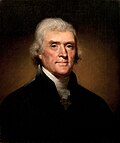
.jpg)


- Thomas Jefferson
- 1743 births
- 1800s in the United States
- 1826 deaths
- 18th-century American letter writers
- 18th-century American philosophers
- 18th-century cryptographers
- 18th-century vice presidents of the United States
- 19th-century American letter writers
- 19th-century American philosophers
- 19th-century presidents of the United States
- 19th-century vice presidents of the United States
- 19th-century Virginia politicians
- Ambassadors of the United States to France
- American architects
- American bibliophiles
- American book and manuscript collectors
- American deists
- American foreign policy writers
- American free speech activists
- American gardeners
- American lawyers admitted to the practice of law by reading law
- American libertarians
- American male non-fiction writers
- American neoclassical architects
- 18th-century American planters
- American political party founders
- American political philosophers
- American political writers
- American religious skeptics
- American surveyors
- Anti-clericals
- Bibliophiles
- Burials at Monticello
- Businesspeople from Virginia
- Candidates in the 1792 United States presidential election
- Candidates in the 1796 United States presidential election
- Candidates in the 1800 United States presidential election
- Candidates in the 1804 United States presidential election
- College of William & Mary alumni
- Continental Congressmen from Virginia
- Democratic-Republican Party presidents of the United States
- Democratic-Republican Party vice presidents of the United States
- Enlightenment philosophers
- Fellows of the American Academy of Arts and Sciences
- Founding Fathers of the United States
- Governors of Virginia
- Hall of Fame for Great Americans inductees
- Hemings family
- House of Burgesses members
- Independent scientists
- Inventors from Virginia
- Jefferson family
- Presidents of the American Philosophical Society
- Members of the Royal Netherlands Academy of Arts and Sciences
- Members of the Virginia House of Delegates
- People from colonial Virginia
- People from Monticello
- People of the American colonization movement
- People of the American Enlightenment
- Philosophers from Virginia
- Physiocrats
- Presidents of the United States
- Presidents of the United States who owned slaves
- Randolph family (Virginia)
- Recipients of the AIA Gold Medal
- Sally Hemings
- Signatories of the United States Declaration of Independence
- United States secretaries of state
- University and college founders
- University of Virginia people
- Vice presidents of the United States
- Vice presidents of the United States who owned slaves
- Virginia Democratic-Republicans
- Virginia lawyers
- Washington administration cabinet members
- Writers from Virginia
- Writers of American Southern literature
- 18th-century members of the Virginia General Assembly
- Planters from colonial Virginia
토머스 제퍼슨
토머스 제퍼슨 Thomas Jefferson | |
|---|---|
 토머스 제퍼슨 (1800년) | |
 | |
| 미국의 제3대 대통령 | |
| 임기 | 1801년 3월 4일~1809년 3월 3일 |
| 부통령 | 에런 버 조지 클린턴 |
전임: 존 애덤스(제2대) 후임: 제임스 매디슨(제4대) | |
| 임기 | 1797년 3월 4일~1801년 3월 3일 |
| 대통령 | 존 애덤스 |
전임: 존 애덤스(제1대) 후임: 에런 버(제3대) | |
미국의 제1대 국무장관 | |
| 임기 | 1789년 9월 26일~1793년 12월 31일 |
| 대통령 | 조지 워싱턴 |
후임: 에드먼드 랜돌프(제2대) | |
버지니아주의 제2대 주지사 | |
| 임기 | 1779년 6월 1일~1781년 6월 3일 |
전임: 패트릭 헨리(제1대) 후임: 윌리엄 플레밍(제3대) | |
| 신상정보 | |
| 출생일 | 1743년 4월 13일 |
| 출생지 | .svg) 대영 제국 버지니아 식민지 구치랜드 카운티 대영 제국 버지니아 식민지 구치랜드 카운티 |
| 사망일 | 1826년 7월 4일(83세) |
| 사망지 |  미국 버지니아주 샬러츠빌 미국 버지니아주 샬러츠빌 |
| 국적 | 미국, 영국 |
| 정당 | 민주공화당 |
| 배우자 | 마사 웨일스 스켈턴 제퍼슨 |
| 자녀 | 마사, 제인 랜돌프, 메리 웨일스, 루시 엘리자베스, 엘리자베스 |
| 종교 | 이신론[1] |
| 서명 |  |
토머스 제퍼슨(영어: Thomas Jefferson, 1743년 4월 13일 ~ 1826년 7월 4일)[2]은 미국의 정치인으로 3번째 미국 대통령(재임 1801년 ~ 1809년)이자 미국 독립 선언서의 기초자이다(1776년). 제퍼슨은 영향력 있는 건국의 아버지의 일원이었고, 미국 공화주의의 이상을 추구함으로써 역대 대통령 중 가장 존경받는 대통령 중 한 사람이 되었다. 대통령 재임 기간 중 그의 업적은 루이지애나 매입[3]과 루이스와 클라크의 서부 원정, 지중해 해적 소탕 등이며 소수의견의 존중, 종교·언론·출판 자유의 확립 등에 주력하였다.
과도한 중앙집권을 싫어하는 공화주의자로서 작은 정부를 지향하였으며 연방주의를 반대했다. 시민의 자유, 정교분리, 엄격한 헌법 해석을 지지했다.[4] 또한 도시의 산업 경제보다 농촌 경제가 미국의 특성을 더 잘 보호할 수 있다고 믿었다.
1809년, 퇴임후 버지니아의 몬티첼로에 돌아가 1819년 버지니아대학교를 설립하고 스스로 학장에 취임하여 민주적 교육의 보급에 노력하였다. 또한 철학·자연과학·건축학·농학·언어학 등 다방면에 걸쳐 많은 사람들에게 영향을 주어 '몬티첼로의 성인(聖人)'으로 불리었다.[5] 미국 지폐중 1976년에 첫 발행된 2달러의 앞면에 제퍼슨의 초상화가 새겨져 있다.
어린 시절과 교육
유년 시절
토머스 제퍼슨은 1743년 4월 13일에[2] 버지니아주에서 가장 저명한 가문 중 하나에서 여덟 명의 아이 중 셋째, 그리고 장남으로 태어났다. 어머니는 제인 랜돌프로 농장주이자 선주인 이스암 랜돌프의 딸이었다. 토머스 제퍼슨의 외할아버지인 이스암 랜돌프는 사촌으로는 페이튼 랜돌프가 있었고 이스암 랜돌프의 5촌 조카로는 훗날 제퍼슨의 후임 국무장관이 된 에드먼드 랜돌프가 있었다. 토머스 제퍼슨의 아버지 피터 제퍼슨은 알버마를 군의(Albemarle County, 셰드웰(Shadwell)[6]) 대농장주이자 측량기사였고 제퍼슨은 웨일스 사람의 후손이었다. 1745년 피터 제퍼슨의 절친한 친구인 윌리엄 랜돌프 대령이 죽자, 피터 제퍼슨은 랜돌프의 유언 집행자로서 터카호(Tuckahoe)에 있던 그의 토지와 그의 어린 아들인 토머스 만 랜돌프의 양육도 맡게 되었다. 그 해에 제퍼슨 일가는 다시 알버마를로 돌아가기 전까지 7년 동안 살 터카호로 이주하였고 얼마 안 되어, 피터 제퍼슨은 터카호 군의 군수로 임명되었다.[7] 그리고 피터 제퍼슨은 치안판사와 버지니아주 의원을 지내는 등 많은 요직에서 활약하였다.
교육
1752년 제퍼슨은 스코틀랜드 출신 목사인 윌리엄 더글라스가 운영하던 학교에 입학하였다. 9살에 제퍼슨은 라틴어, 그리스어, 프랑스어를 공부하기 시작하였으나 1757년 제퍼슨이 14살 때, 아버지 피터 제퍼슨이 죽었다. 제퍼슨은 5,000 에이커(약 20km2)와 삼십명의 노예를 상속받았으며 상속받은 땅에다 집을 지었는데 그곳은 훗날 바로 몬티첼로로 불렸다.
아버지가 갑작스럽게 죽은 후, 제퍼슨은 1758년에서 1760년까지 교육받은 목사인 제임스 모우리의 학교에서 공부하였다.[8] 학교는 고든스빌 근처의 프레드릭스빌 교구에 자리 잡고 있었는데 이 곳은 섀드웰에서 12마일(약 19 km) 떨어진 곳이었다. 제퍼슨은 모우리의 집에서 하숙하면서 고전 교육과 역사, 과학을 공부하였다.
1760년, 제퍼슨은 만 16세의 나이에 윌리엄스버그에 있던 윌리엄 앤 메리 대학교에 입학하였다. 제퍼슨은 그곳에서 2년을 공부하였는데 1762년에 수석으로 졸업하였다. 제퍼슨은 철학대학에 들어가 수학과 형이상학, 그리고 윌리엄 스몰 교수가 가르치던 철학을 공부하였다. 스몰 교수는 배움에 열성인 제퍼슨에게 경험주의를 알려주었는데 그는 경험주의에서 프랜시스 베이컨, 존 로크, 아이작 뉴턴의 이론까지 배웠다. 훗날 제퍼슨은 이들을 "세상이 이제까지 만들어낸 3명의 가장 위대한 인물"이라며 칭송하였다.[9] 또한 그는 자신의 프랑스어 수업을 완전히 끝냈고 자신의 그리스어 문법책을 항상 들고 다녔으며, 바이올린을 연습하였고 타키투스와 호메로스의 책을 감명깊게 읽었다. 예리하고 부지런한 학생이었던 제퍼슨은 모든 분야에서 학구적인 궁금증과 욕심을 보여주었고 가족의 전통에 따라, 종종 하루에 15시간씩 공부를 하였다. 제퍼슨의 가장 친했던 대학 동창인 로스웰의 존 페이지는 제퍼슨을 두고 "자신의 가장 친한 친구를 뿌리치고 떠나 자신의 학업에 열중하였다"라고 하였다. 이것을 봐도 제퍼슨은 그리 사교성은 많지 않고 성격이 내성적이었다는 것을 단적으로 보여준다.
대학에 재학 중일때, 제퍼슨은 '납작한 모자 클럽'(Flat Hat Club)이라는 비밀 조직의 회원이었는데 지금은 이 클럽이 윌리엄 앤드 메리 대학 학생 신문으로 이름이 바뀌었다. 제퍼슨은 대학의 건물 중 영국 건축가 크리스토퍼 렌의 이름을 딴 렌 빌딩에서 기숙하였고 본관에서 동창들과의 단체 식사에도 참석하였으며 렌 예배당의 아침, 저녁 예배에도 참석하였다. 제퍼슨은 왕립 주지사 프랑시스 파우키에의 호화 파티에 자주 참석해 바이올린을 연주하고 와인을 마시기 시작하여 이내 와인 마시는 것을 매우 좋아하였다.[10] 1762년 대학을 수석으로 졸업한 후, 조지 위트 아래서 법학을 배웠으며 1767년 버지니아주 법정에서 자신의 변호사 인생을 시작하고 위트에게 자신의 변호 실력을 인정받았다.
변호사로서의 생활

1765년 10월 1일, 토머스 제퍼슨의 큰누나인 제인이 25세의 짧은 생애를 일기로 요절하였다.[11] 제퍼슨의 누나와 여동생이 큰언니 제인의 장례식에도 참석하지 못한 것을 안타까워 한 제퍼슨은 혼자 외롭게 슬픔의 나날을 보냈다. 제퍼슨의 작은누나인 메리는 토머스 볼링과 결혼하고 여동생 마사는 그해 7월에 다브니 카에게 시집갔으나,[11] 친정인 섀드웰에서 멀리 떨어진 각자의 남편의 집에서 살아 오기가 쉽지 않았다. 제퍼슨의 다른 여동생들인 엘리자베스와 루시, 그리고 아직 유아인 애너 스콧과 랜돌프가 그의 말동무가 되어주었다. 제퍼슨은 엘리자베스나 루시가 있을 때 기분이 좋지 않았는데 엘리자베스와 루시가 제퍼슨의 누나들처럼 제퍼슨에게 지적인 영향을 끼치거나 격려를 해주지 않았기 때문이다.[11]
제퍼슨은 버지니아 식민지의 변호사로서 많은 법적 소송을 다루었고 1768년에서 1773년까지 주 의회에서 해마다 100개 이상의 소송을 도맡아 변호하였다.[12] 제퍼슨의 소송 의뢰인 중에는 많은 버지니아주 출신 명문가들이 많았고 제퍼슨 외가인 랜돌프 가문도 포함되어 있었다.[12]
1772년 제퍼슨은 23세의 젊은 과부 마사 웨일스 스켈턴과 결혼하였다. 제퍼슨 부부는 6명의 자녀를 두었는데 마사 제퍼슨 랜돌프(1772년 ~ 1836년), 제인 랜돌프(1774년 ~ 1775년), 사산된 아들(1777년), 메리 웨일스(1778년 ~ 1804년), 루시 엘리자베스(1780년 ~ 1781년), 그리고 엘리자베스(1782년 ~ 1785년)가 있었다. 부인 마사는 1782년 9월 6일에 사망하고 제퍼슨은 다시는 재혼하지 않았다. 제퍼슨은 샐리 헤밍스(Sally Hemings)라는 자신의 노예가 낳은 자식들의 아버지라는 설이 있었으나, 1998년의 유전자 검사로 이들의 아버지가 제퍼슨 또는 제퍼슨의 남자 친척 중 한 사람임이 밝혀졌다.
1774년부터 1800년까지의 정치 인생
독립운동 대열 합류

제퍼슨은 법을 다루는 변호사를 직업으로 삼았지만, 1769년에 버지니아주 자치의회에 알버마를 군을 대표하는 의원이 되었다. 당시 식민지는 영국 본토의 인지세법으로 영국에 반감을 품는 식민지인들이 많아지기 시작할 때였다. 1774년, 참을 수 없는 법(Intolerable Acts)이 영국 의회에서 통과되자, 제퍼슨은 이 법에 대한 여러 대책들을 썼는데 이것이 그가 출판한 첫 번째 팜플렛인 《영국령 아메리카의 권리에 대한 요약》(A Summary View of the Rights of British America)이었다. 이전의 참을 수 없는 법에 대한 비판은 법과 헌법에 맞추어져 있던 것이었으나 제퍼슨은 식민지인들은 모두 자연권이 있으며 스스로 다스릴 수 있다는 급진적인 생각을 표현하였다.[13] 또한 제퍼슨은 영국 의회는 말그대로 영국만의 의회이며, 식민지의 입법권을 행사할 수 있는 자격이 없다 주장하였다.[13] 이 팜플렛은 제1차 대륙회의의 버지니아 선언의 초안으로 쓸 계획이었으나 대륙회의에서 제퍼슨의 생각이 너무나 과격하였음이 증명되었다.[13] 그렇지만 팜플렛은 미국 독립의 이론상 뼈대가 되었으며 제퍼슨을 가장 유식하고 생각이 깊은 독립파 정치인의 한사람으로 각인시키게 해주었다.
독립 선언서 작성
,_by_John_Trumbull.jpg)
제퍼슨은 1775년 6월부터 제2차 대륙회의 위원으로 재직하였는데 대륙회의가 열리고 얼마 안 있어 미국 독립 전쟁이 일어났다. 1776년 6월, 대륙회의에서는 독립 선언 결의의 공포를 숙고하기 시작하였는데 독립 선언 결의는 그리 문체가 깔끔하고 설득력있지 못하였다. 그리고 얼마 안있어 제퍼슨은 새로 창설된 5인 위원회의 한 사람으로 선정되어 이 결의를 바탕으로 독립 선언서를 쓰기 시작하였다. 위원회는 제퍼슨이 초안을 작성하도록 하였는데 제퍼슨이 문필가로서의 실력과 명성이 높았기 때문이었다. 제퍼슨은 자신이 굳게 믿던 계몽 사상을바탕으로 초안을 작성하였다. 그러나 많은 사람들은 이 작업이 그리 중요하지 않다며 얼버무리고 아무도 이 독립 선언서 작업이 중요한 사명감을 가지고 해야 한다는 생각을 하지 않았다.[14] 제퍼슨은 5인 위원회의 다른 위원들의 도움과 버지니아 헌법의 초안과 조지 매이슨의 버지니아 인권 선언, 그리고 다른 자료들을 참고하여 완성하였다.[15]
제퍼슨은 5인 위원회에게 초안을 보여준 뒤 최종적으로 교열하였고 1776년 6월 28일, 7월 2일에 발표할 예정이었던 독립 선언 결의 찬반 투표 직후, 독립 선언서를 공개대륙회의에 공개하였다. 이것이 완성되자 대륙회의는 독립 선언서에 관심이 집중되었다. 며칠 간의 논쟁 뒤, 대륙회의는 선언서의 1/4을 지우거나 고쳤는데 우선 당시 논쟁의 대상이 되었던 노예 무역에 관한 조항은 빠졌으나 제퍼슨은 계몽 사상에 어긋난다며 이를 완강히 반대하였다.[16] 1776년 7월 4일, 결국 독립 선언서가 대륙회의에서 승인되었다. 독립 선언서는 제퍼슨의 업적 중 중요한 위치를 차지하며 그의 설득력있고 논리적인 머릿말은 인권을 수호하며 인권의 가장 기본적인 사상을 담은 유명한 글귀가 되었다.[16]
버지니아주 하원의원 시절
1776년 9월, 제퍼슨은 버지니아로 돌아와 하원의원으로 선출되어 정식 출범된 버지니아주 의회 버지니아주 의회 하원의원에 들어갔다. 의원 재직 기간 중 제퍼슨은 버지니아의 사법 제도를 바꾸고 강화하여 민주적인 주로서의 모습을 보여주려 하였다. 그는 3년동안 무려 126개의 법안을 작성하였는데 이 중에는 장자 상속권을 폐지하는 법안과 버지니아의 종교자유령, 그리고 사법 제도를 합리화시켰다. 1778년, 제퍼슨은 “더 많은 지식의 보급을 위한 법안”(Bill for the More General Diffusion of Knowledge)이라는 교육법을 작성하였는데 이 법안은 최초로 미국의 대학에서 이루어진 선택과목제를 도입하여 기존의 대학 제도 등을 바꿨다.
주 하원의원으로서 제퍼슨은 사형 선고를 반역이나 살인을 제외하고는 선고하지 않는 법안을 제출하였으나 이 사형 선고 개정법은 겨우 1표 차로 부결되었고[17] 버지니아주는 이후로 이 의견을 보류하여 1960년대까지 강간과 같은 죄도 사형으로 다스릴 수 있었다.[18]
버지니아 주지사 시절
1779년부터 1781년까지 제퍼슨은 버지니아주 주지사로 재직하였다. 본래 군인이 아니었던지라 조지 워싱턴같이 정면에서 싸우지 않고 후방에서 미국 대륙군과 독립 세력을 지원하였다. 주지사로서 그는 1780년 주도를 협소한 윌리엄스버그에서 리치먼드로 옮기는 일을 감독하였다. 그는 계속해서 학생 감찰 하의 우수성적자 규약 등을 미국 최초로 만든 윌리엄 앤드 메리 대학의 교육 정책 개혁을 극찬하였다. 1779년, 제퍼슨의 명령에 따라, 윌리엄 앤드 메리 대학은 조지 위트를 미국 대학 최초의 법학 교수로 임명하였다. 그러나 그가 주도한 교육 정책 변화의 성과가 그리 만족스럽지 않았는지 제퍼슨은 대통령에서 물러난 뒤, 버지니아 대학교를 세우는데 이 대학교는 종교적 학문을 배제하고 고등 교육을 가르친 미국 최초의 대학이다.

제퍼슨이 주지사로 재직하는 동안, 미국 독립 전쟁이 한창 진행되고 있었다. 버지니아는 제퍼슨의 임기 동안 두 번 영국군의 침략을 받았다. 1781년 6월, 제퍼슨은 영국군의 급습을 받아 패트릭 헨리, 다른 버지니아 유지들과 함께 영국군 대령 배내스터 탈턴의 기병대에게 붙잡힐 뻔했으나, 영국군이 들이닥치기 10분 전에 리치먼드를 빠져나가 화를 피했다.[19] 주지사로서의 직분을 망각하고 도망가려 했다는 점은 공공에게 실망감을 안겨줬고 그의 미래의 정치적 전망도 어둡게 만들었다. 또한 제퍼슨은 다시 버지니아 주지사로 당선되지 못하였다.[20]
프랑스 공사 시절
제퍼슨은 1784년부터 1789년까지 벤저민 프랭클린의 후임으로 프랑스 공사에 임명되었다. 프랑스 공사에 재직 중인 1787년에는 미국 제헌회의가 열렸는데 프랑스 공사로 해외에 있어 참석할 수 없었다. 일반적으로 제퍼슨은 아직 자신이 지향하는 반연방주의의 색채가 드러나 있는 권리장전이 아직 만들어지지 않았음에도 불구하고 연방주의적인 미국의 헌법을 대체로 지지하였다. 그러나 연방을 지향하고 자신이 독립선언서에서 가장 중요하게 여겼던 개인의 인권에 대하여 아무런 조항이 명시되어 있지 않은 터라 버지니아주 출신 후배인 제임스 매디슨과 연락을 주고 받으며 영국의 권리장전을 모델로 한 새 권리장전을 헌법의 추가 조항인 수정헌법으로서 집어넣으라고 자신의 의견을 피력하였다. 파리에 있으면서, 제퍼슨은 유명한 거리인 샹젤리제에 위치한 공관에서 살았다. 그는 많은 시간을 도시의 고고학적 유적과 파리의 거리 예술 등을 감상하며 보냈다. 그는 파리의 살롱 문화를 좋아하며 도시의 가장 영향력 있는 인사들의 만찬 파티에 자주 초대되어 프랑스와의 친밀감을 쌓고, 더욱 프랑스를 동경하게 되었다. 그의 뛰어난 프랑스어 실력은 프랑스의 유명한 인사들에게 인정을 받으며 더욱 그들과 친밀하게 지낼 수 있었다. 프랑스에 활동하며 그는 많은 사회적 엘리트와 귀족들과 친분을 쌓았으나 정작 1789년 프랑스 혁명이 발발하였을 때, 제퍼슨은 혁명군 손을 들어 혁명을 열렬히 지지하였다.
국무장관 시절

제퍼슨이 프랑스에서 귀국한 후, 이미 아메리카 합중국은 건국되어 있던 상태였다. 제퍼슨은 곧 조지 워싱턴 대통령 아래서 초대 국무장관(1789년 ~ 1793년)을 맡았다. 제퍼슨과 알렉산더 해밀턴은 오랫동안 국가의 재정 정책에 논쟁을 벌였는데 특히 전쟁 때 빌린 빚을 처리하는 일에서 마찰을 빚었다. 해밀턴은 빚을 모든 주가 똑같이 나누어서 갚아야 한다 주장하였으나 제퍼슨은 각 주가 자신들의 빚을 알아서 갚아야 한다고 역설하였다. 당시 제퍼슨이 주지사로 있던 버지니아 주는 독립 전쟁 때 많은 빚을 꾸지 않았는데 공업을 중시하는 뉴잉글랜드 지방의 많은 주들은 엄청난 빚을 떠안고 있었다. 그리고 뉴잉글랜드 출신의 재무장관 해밀턴은 그 빚을 똑같이 나누어 갚자 하니, 자연히 빚을 많이 꾸지 않은 버지니아주, 노스캐롤라이나주, 사우스캐롤라이나주 등의 불만을 샀다. 이렇게 엄청난 반대에 부딪히자 해밀턴은 제퍼슨에게 협상을 요구하여 연방의 수도를 남부 쪽에 양도하는 대신 주들이 똑같이 빚을 나눠 갚는 법을 통과시켜 달라하였고 제퍼슨이 받아들여 수도는 그렇게 뉴욕이 아닌 워싱턴 D.C.로 정해졌다.
제퍼슨과 해밀턴은 미합중국 제1 은행을 세울 때에도 마찰을 빚었는데 제퍼슨은 국영 은행 설립이 헌법에 명시되어 있지 않다 역설하였으나 해밀턴은 수정헌법 제10조에 '국민들이 필요로 하는 것을 연방정부가 행사할 수 있다'는 조목을 들어 합중국 은행 설립을 논리정연히 설명하였다. 워싱턴은 해밀턴의 손을 들어주었고 1791년에 합중국 은행이 설립되었다. 제퍼슨은 연방주의자들과의 논쟁이 격화되자 해밀턴과 다른 연방주의자들을 보고 공화주의를 무너뜨리려는 토리당 당원 또는 왕당파라고 비판하였다. 그는 연방주의가 "왕당주의"와 같다고 설명하고 이렇게 덧붙였다.
| “ | 해밀턴의 추종자들은 왕관, 주교관을 쓰는 군주제를 갈망하고, 이것들을 쓰고 싶어서 안달이 난 사람들이다.[21][22] | ” |
또한 해밀턴은 영국을 국가 정치의 모범으로 삼아야한다 했고, 제퍼슨은 프랑스를 정치의 모범으로 삼아야한다 했을 만큼 이들 둘의 정치적 사상과 견해는 달랐다. 제퍼슨은 제임스 매디슨과 함께 민주공화당을 창당하고 총재가 되어 당을 이끌어나갔다. 제퍼슨은 매디슨, 선거 전략가인 존 J. 베클리와 같이 일하며 연방주의자들에게 맞서기 위해 국가적인 민주공화당의 세력과 통신망을 갖추려 하였다.
제퍼슨은 1793년에 영국과 프랑스가 전왕인 루이 16세의 처형을 빌미로 전쟁을 벌였을 때, 프랑스를 강력히 지지하였다. 역사학자 로렌스 S. 카플란은 제퍼슨의 "프랑스에 대한 본능적인 지지"라는 워싱턴 대통령이 유럽의 전쟁에 끼어들어서는 안된다는 의지를 확고히 하였다 하며 제퍼슨 역시 워싱턴의 중립 선언에 동의하였다.[23] 1793년, 급진적인 신임 프랑스 공사 에드몽 샤를 주네(Edmond-Charles Genêt)가 도착하자 제퍼슨에게 대대적인 환영을 받았으나, 곧 제퍼슨과 국무부를 매우 난처하게 만들었다. 주네는 미국이 중립을 풀고 프랑스를 지원해야 한다 큰소리쳤고 여론을 조종하여 선동하였으며 심지어는 사람들에게 호소하며 이 호소장을 워싱턴에게 주기까지 하였다. 그리고 스스로 미국 정부를 전복한 힘이 있다 큰소리쳤으며 또한 워싱턴이 교수형당한 그림이 그려진 판화를 뿌리는 등 계속 분란을 조장하였다. 제퍼슨은 주네의 대외 활동을 금지하여 소동을 막으려 하였으나. 제퍼슨은 자신의 정치적 성공이 유럽에서의 프랑스군의 승리에 달려있다고 믿을 만큼,[24] 프랑스를 열렬히 지지하였다.

제퍼슨은 아직 프랑스에 대한 호의를 잊지 않았고 프랑스가 전쟁에서 승리하는 것과 프랑스와의 맹약을 희망하였다. 그는 프랑스의 적들, 즉 대부분의 유럽 국가들이 독재정치를 지향하고 정부에 대하여 무제한 권한을 행사하는 것을 두려워 하였다. 또한 1793년 여름까지 프랑스의 상황이 좋지가 않고 연전연패하면 개혁적이고 진취적인 민주공화당의 세력이 의회에서 의기소침해 질지도 모른다 믿고 있었다. 한편 미국 정부는 주네가 계속 난동을 피우자 프랑스에게 그의 소환을 요청하였고 후임자 포쉐가 그를 체포하러 왔으나 워싱턴은 주네의 인도를 거부하고 뉴욕주에서 살게 해주었다.
국무장관 사임과 정치 공백 기간
제퍼슨은 1793년 12월 31일, 국무장관 직을 사임하고 자신의 저택이 있는 몬티첼로로 돌아가 워싱턴과 해밀턴에 대한 정치적 대립을 총지휘하였다. 그러나 1794년의 해밀턴의 압력으로 맺어진 제이 조약은 영국과의 관계를 개선하고 무역을 재개하게 만들었으나 해밀턴에 반대하고 제퍼슨의 신임을 얻은 매디슨은 전쟁으로 가지 않고 과거의 모국인 영국을 압박하는 것을 원하였다. 사실 제이 조약에는 모순점이 많았는데 제대로 영국과의 타협을 마무리짓지 못했고 아직까지 영국이 당시 세계 최대의 강대국이었던 만큼, 영국의 눈치를 봐야 했던 불평등 조약이나 다름없었다. 매디슨은 제이 조약을 보고 '상업 무기'로 영국을 미국에 끌어들여 독재의 길로 가게 만드는 데 충분한 명분을 명시한 문서라고 혹평하였다. 한편, 은퇴한 제퍼슨은 아직까지 막후의 지도자로서 당을 통제하였으나, 대외적으로는 매디슨을 내세웠고 그를 강력히 지지하여 그에게 정치적 발판을 마련해주었다.[25]
1796년 대통령 선거와 부통령 재임 기간
1796년 국민들과 장관들의 권유를 뿌리치고 물러난 조지 워싱턴 대통령 다음으로 워싱턴 아래에서 부통령직을 수행했던 존 애덤스가 연방주의자당 후보로 나왔다. 또한 제퍼슨도 민주공화당 후보로 대통령 선거에 출마하였으나 선거인단수에서 더 많은 인원을 확보한 애덤스에게 패배하였다. 그러나 최고득표자가 대통령, 차점자가 부통령이 되는 당시의 선거 방식에 따라 차점자였던 제퍼슨은 제2대 부통령이 되었다. 또한 같은 당에서 정·부통령이 나오지 않고 각기 다른 당에서 정·부통령이 나오는 진풍경이 벌어졌다. 그리하여 제퍼슨은 대통령인 애덤스를 부통령으로서 도와주기는커녕, 애덤스의 정책을 방해하고 반대하였다. 제퍼슨은 의회에서 지켜야 할 것들을 명시한 의회 의사 절차를 써서 하원의 지침으로 삼았으며 아직 연방주의자들이 과반수 이상의 의석을 확보한 상원에게도 적용하려 하였으나 완강한 반대로 실패하였다.
'XYZ 사건'으로 발발한 프랑스와의 '유사전쟁'(Quasi-War)은 딱히 싸울만한 명분도, 실리도 없던 전쟁이었다. 애덤스 아래의 연방주의자들은 해군을 창설하고 육군을 정비하였으며 세금을 걷어들여 전쟁 준비를 하고 1798년에 애덤스는 외국인 규제법을 승인하였다. 이 법은 미국 시민권을 따려는 이민자들의 미국 체류 기간을 5년에서 14년으로 대폭 늘리고 프랑스에 대한 간첩·배신 행위를 막는다는 명분하에 만들었으나 실제로는 국민들의 정치적 발언 기회를 뺏는 비민주적인 법이었다. 제퍼슨은 이 외국인 보안법이 자신의 정당인 민주공화당을 목표로 삼은 것을 알고 이것을 국외의 적보다 정적이며 프랑스에 우호적인 민주공화당에 대한 정면 공격이라 비판하였다. 민주공화당 소속의 버몬트주의 하원의원 매튜 라이온이 이 법을 비판하자, 애덤스는 그를 감옥에 가두었다. 제퍼슨과 민주공화당원들은 이러한 정치적 보복 공격에 크게 반발하였다. 분개한 제퍼슨과 매디슨은 버지니아-켄터키 결의안을 썼는데, 여기서 그들은 연방정부는 주들이 인정하지 않은 법안을 집행시킬 권한이 없다고 명시하였다. 다시 말하면, 연방정부는 주와 국민들이 원하지 않는 법과 국민들의 정당한 권리를 해칠수 없다는 뜻이다. 이 법안은 주의 권한을 보장하는 이론의 첫 번째 문장으로 쓰여져 있으며 뒷날 주권 우위설과 주의 연방법 거부설을 만드는 원동력이 되었다.
1800년 대통령 선거
제퍼슨은 해밀턴의 출신지인 뉴욕주의 표 분산을 위해 같은 뉴욕주 출신인 에런 버(Aaron Burr)를 부통령 후보로 지명하였다. 곧 민주공화당 당원들을 모아 새 세금에 대한 공격을 퍼붓고 1800년 미국 대통령 선거에 출마하였다. 본래 제퍼슨이 연설하는 것을 좋아하지 않아 제퍼슨은 정식으로 대중 앞에서 선거 운동을 하지 않았다. 수정헌법 제12조가 훗날 제퍼슨이 대통령이 되고 난 뒤, 발효되나 아직 만들어지기 전이라, 여전히 최고득표자는 대통령, 차점자는 부통령이 되는 방식이었다. 1800년 대통령 선거는 선거인단의 문제를 떠안고 있었다. 제퍼슨과 에런 버가 대통령 선거인단 득표에서 각각 73표로 공동 1위를 한 것이다.[26][27] 분명 같은 당에서 나오고 제퍼슨을 대통령으로, 버를 부통령으로 뽑은 민주공화당은 적잖이 당황하였다. 그리고 대통령 결정권은 헌법에 따라 아직 연방주의자들이 득세하던 미국 하원으로 넘어가게 되었다.
하원에서 해밀턴은 같은 주 출신의 버를 두려워하여 그가 대통령이 되면 미국이 독재 정치의 길로 내달릴 것이라 비판하였다. 그래서 그는 차라리 명망도 높고 오랫동안 정치를 한 그의 정치적 라이벌인 제퍼슨을 대통령으로 당선시키는게 낫다 판단되어 그의 추종자들을 조종하였다. 1801년 2월 17일, 새 대통령 취임 15일 전에, 하원에서 제퍼슨을 대통령으로, 버를 부통령으로 선출되었다.[28] 제퍼슨과 버는 정치적 협약을 서로 맺어 민주공화당 정권을 세워서 버는 자신의 공이 크다 여겼다. 그러나 제퍼슨은 그에게 아무런 대가를 주지 않았고 버가 계속 대가를 요구하자 제퍼슨과 에런 버 사이에 갈등이 심화되었다. 또한 일부 연방주의자들과 북부 연합을 만들고 1804년 에런 버가 해밀턴에게 결투를 신청하여 해밀턴을 사살하자,[29] 제퍼슨은 현직 부통령이 저지른 일에 크게 분노했다. 그래서 1804년 미국 수정 헌법 제12조가 발효된후, 제퍼슨은 에런 버를 러닝메이트로 지명하지 않고 대신 조지 클린턴을 지명하였다.
대통령 재임 기간 (1801년 ~ 1809년)
취임과 내각 구성
소란스러웠던 1800년 미국 대통령 선거는 정치적 관계와 해밀턴이 평소에 버를 증오했기 때문에 제퍼슨이 해밀턴의 지지를 얻어 대통령에 당선되었다. 이제 그는 해밀턴과 강경 연방주의자들에게 빚을 졌고 행정부에서 할 것이 아무것도 없던 부통령 에런 버 곁에서 떠나 그와는 일체 정치적인 논의를 하지 않았다. 전직 대통령인 조지 워싱턴은 이미 1799년에 서거하고, 존 애덤스는 대통령 선거에서 진 뒤 고향인 브레인트리로 돌아가자 제퍼슨은 이제 마음대로 국가에 그의 공화주의 정책을 세우고 시행할 수 있게 되었다. 역사학자들은 이러한 제퍼슨이 이끄는 민주주의를 제퍼슨 민주주의라 이름붙이고, 신임 대통령 제퍼슨은 농업주의와 제한된 연방정부를 기초로 한 자신의 정치적 믿음을 바탕으로 정책을 만들었다. 우선 내각을 민주공화당 인사로 바꾸었는데, 에런 버가 힘을 쓰지 못하는 이상, 정권의 실질적인 2인자나 다름없었던 국무장관에는 오랜 정치적 동지이자 같은 주 출신 후배인 제임스 매디슨으로 임명하고, 재무장관에는 스위스 출신의 앨버트 갤러틴을 임명하였다. 제퍼슨은 의회에 민주공화당 출신 상·하원 의원들이 자신들의 주관적인 정치적 사상을 가지고 있었음에도 민주공화당 지도자로서 그들에게 막강한 대통령의 권위를 행사하였다. 정권이 민주공화당으로 넘어간 이후, 연방주의자들이 해밀턴파와 애덤스파로 분리되자 이것은 제퍼슨에게는 의회를 장악할 호기가 되었다. 그의 8년 임기 동안, 제퍼슨은 한개의 거부권도 행사하지 않았다.
제퍼슨의 국내 정책
국채와 군대 문제
제퍼슨은 작은 정부를 원하였기 때문에 정부의 국채를 보상하려고 하였다. 대개 국채는 큰 정부가 졌으며 작은 정부를 지향하던 제퍼슨은 작게 되면 그만큼 정부의 예산과 지출이 줄어들기에 국채 보상에 공을 들였다. 제퍼슨은 해외의 신용을 얻기 위해 빚을 도로 그들에게 갚을 필요까지는 없다 생각하였는데, 이러한 발상은 워싱턴 내각에서 해밀턴이 강력히 주장한 것과 일치하였다. 재무장관 갤러틴은 위스키 반란 때 민주공화당 지지자들을 목표로 삼았던 세금 등 연방주의자들이 만든 고압적인 세금을 철폐하였다. 갤러틴은 연방정부가 관세의 큰 이익을 독점으로 관리해야 하며 직접 과세가 필요하지 않다고 믿었다. 처음에 어느 정도 성공을 거두었을 때, 이 정책은 훗날 그 결과과 순전치 못하였는데 나폴레옹 전쟁 당시 영국과 프랑스로 인해 미국의 무역에 타격을 주었다.
제퍼슨은 자신의 반연방주의 사상에 따라 군주제의 중요 수단인 상비군같은 막강한 군대가 민주 공화국에는 필요없다 여기고 군대의 숫자를 줄였다. 애덤스 행정부 당시 해군으로 들어간 상당수의 연방주의자들은 해직되었다. 연방주의자들은 제퍼슨의 이 정책이 만약 외국에서 침략을 하면 적은 군대가 큰 약점이 된다고 비판하였으나 제퍼슨은 그런 상황이 되면 미국 독립 전쟁처럼 민병대들이 스스로 일어나 국가와 국민을 위해 싸울 것이라고 반박하였다. 제퍼슨은 민간인들을 전쟁에 투입하면 군대의 장교들이 이를 통제하기가 더 어려워 질것이라 여겨 1802년, 육군공병사령부(Army Corps of Engineers)와 웨스트포인트에 미국 육군사관학교를 설립하였다.
임명권과 연방주의자

1796년 존 애덤스가 대통령직을 승계하였을 때, 애덤스는 전임 대통령 워싱턴이 임명한 각료들을 유임시켰다. 그 결과, 미국의 첫 번째 정권이양 시기에서는 연방 정부에 작은 변화밖에 없었지만 1800년 대통령 선거 이후, 연방주의자당과 민주공화당 사이에 정권이 이양되었는데 이것은 단순한 이양이 아닌 정권의 완전교체였다. 대통령으로서 제퍼슨은 연방주의자들이 독점한 정부 요직을 갈아치우고 민주공화당 인사들로 바꿀 힘을 가지게 되었다. 많은 사람들은 임명권이 정권을 장악한 정당과 그 정당 소속의 대통령이 가질 수 있는 특권이라 예상하였으나 제퍼슨은 모든 연방주의자들을 임명된 자리에서 내보낼 것을 주장하는 민주공화당 당원들의 요청을 거부하였다. 대신 그는 애덤스가 임명하였던 정부 각료와 요직에 앉아있는 사람들을 몰아내고 자신의 심복들을 앉혀야 한다 생각하였다. 해밀턴의 연방주의자 강경파보다 온건한 애덤스 연방주의자들은 민주공화당 당원들의 요청으로 해직될 수 있었으나 민주공화당 총재인 제퍼슨은 그들을 계속 유임시켰다. 제퍼슨의 연방정부 인사 전원 해직 거절은 1828년 선거 이후 앤드루 잭슨이 대통령이 된 후 모든 측근 인사들을 자신의 사람들로 바꿀 때까지 계속 지켜졌다.
제퍼슨이 연방주의자들에게 온건한 태도를 취하고 있을 때, 연방주의자들은 당내의 내분에 휩싸여 분열되었다. 아직 민주공화당을 그리 신뢰하지 않는지, 연방주의자들은 민주공화당의 정치 선거운동 참여를 거부하였으나, 한편으로는 민주공화당의 대중적 지지에 매우 놀랐다. 연방주의자들의 정신적 지주인 전임 대통령 애덤스와 존 제이는 공직에서 은퇴하여 고향으로 돌아갔으며 또다른 지도자인 알렉산더 해밀턴은 1804년에 부통령 에런 버와 결투를 벌였으나 그에게 사살당하여 사실상 연방주의자당을 이끌 마땅한 지도자가 없었다. 미국이 점점 영토를 넓혀가자,[30] 제퍼슨의 반연방 민주주의적 사상이 높은 세금과 강력한 중앙 정부를 지향하던 연방주의자들을 제치고 대중들의 마음을 움직였다. 1805년까지, 연방주의자들은 뉴 잉글랜드 지방과 델라웨어주에서만 강세를 보였고 연방주의자 온건파들은 민주공화당에 가입하였다. 그리고 연방주의자당에서 가장 손해를 끼친 탈당 사건은 바로 존 애덤스 대통령의 아들 존 퀸시 애덤스가 연방주의자당을 탈당하고 민주공화당에 입당한 것이었다.
사법부와의 갈등

제퍼슨은 그의 전임자들이 임명한 판사들을 좋아하지 않고 매우 의심하였다. 그가 생각하는 좋은 판사는 현실과는 매우 다른 것이었는데 그가 반연방주의적인 권리장전에서 주장한 것 중 하나는 바로 판사가 사법부에서 가질 수 있는 권한이었다.[31] 그의 주장에 동조한 민주공화당이 지배하고 있던 의회는 애덤스 행정부 때 통과된 1801년의 사법법을 무효로 하여 애덤스 행정부 말기 만들어진 연방주의적인 많은 지역법원들을 없애버렸다. 그러나 사법법 폐기는 그렇게 쉬운 문제가 아니었다. 연방주의자들은 "헌법에 한번 법원이 만들어지고 판사가 임명을 받으면 중죄를 저질러 탄핵을 받지 않는 이상, 판사는 죽을 때까지 재직이 가능하다"라고 제퍼슨의 이러한 행동에 반발하였다. 민주공화당의 제퍼슨은 법원에 대한 정치적 대책을 연방주의자들에게 설명하지 않고, 대신 그들에게 법원이 국가에 끼치는 부담을 이유로 들며 공격을 퍼부었다. 이미 종신 연방주의자 판사들이 지배하던 사법부가 자신들 세력 하의 많은 법원을 만든 뒤부터 전혀 법원이 필요없다는 상황이 발생하기 시작하였다. 민주공화당 당원들은 이러한 법원의 부당한 행동은 사법법을 무효시키기 위하여 법원이 정부에 과도한 걱정을 끼치고 있다고 주장하였다. 그러나 이러한 주장은 헌법에 대한 약간의 해석이 필요하였음에도 불구하고 제퍼슨은 미국 제1 합중국 은행 창설 당시 반대하였던 당원들을 모두 규합하여 상·하원 모두에서 1801년의 사법법을 무효로 하는 데 성공하였다.
이 사태는 애덤스 행정부가 끝나기 바로 직전에 임명된 "심야 판사"들이[32] 제대로 임명을 받지 못하게 만들었다. 민주공화당 인사로부터 사법부를 연방주의자당으 세력권 안에 넣기 위해 "심야 판사"들이 임명된 뒤부터, 제퍼슨은 새 연방 판사들을 임명은 하였으나, 정작 그들에게 자리를 주는 것을 꺼려하였다. 그가 유일하게 어찌해볼 도리가 없었던 것이 하나 있었는데 바로 애덤스 행정부 말기 국무장관을 지냈던 존 마셜이 연방 대법원장으로 임명되었던 것이다. 마셜은 본래 제퍼슨의 5촌 조카로 당숙인 제퍼슨과 같이 법학을 전공하였으나, 사상은 당숙과 매우 달랐는데 그는 존 애덤스의 사상을 그대로 이어받은 열렬한 연방주의자였다. 마셜이 사법부에 끼친 영향은 매우 대단하여 사법부가 주의 권한을 보호하는 대신 연방정부의 권한과 권위를 더 중시하도록 하였다. 가장 중요한 사건인 마베리 대 매디슨 사건은 "심야 판사"중 하나로 임명받은 윌리엄 마베리가 판사로 임명은 받았으나 정작 임명장은 받지를 못하였다. 마베리는 당시 임명장을 가지고 있던 정권의 2인자 국무장관 제임스 매디슨에게 항의를 하여 소송을 걸었다. 마셜을 비롯한 대법관들은 직무집행 영장을 내려 당장 매디슨에게 임명장을 줄 것을 권고하였다. 이 사건은 비록 의회나 정부가 만든 법률은 무엇이든간에 헌법에 합법한가 아닌가를 따져야 하며 연방대법원은 이러한 법률을 위헌으로서 무효화할 수 있도록 하여 오늘날의 사법심사의 시초가 되었다.
민주공화당 인사들은 1801년의 사법법을 무효로 하는 것과 "심야 판사"들을 해직시키는 걸로 만족하지 않았다. 그들은 이참에 연방주의적인 연방 판사들을 대법원에서 해직시키려고 하였다. 첫 번째 소송은 미친 행동을 보이며 공공에서 음주를 하여 기소된 연방주의자 지역 판사 존 핑커링에 관한 소송이었다. 제퍼슨의 조종으로 하원은 1804년에 핑커링을 탄핵하고 상원 역시 탄핵에 찬성하여 얼마 안가 핑커링은 대법원에서 해직당하였다. 그리고 제퍼슨은 이제 연방대법원을 주시하기 시작하였다. 연방주의자 대법관인 새뮤얼 체이스(Samuel Chase)는 대배심원에게 "민주공화당 인사들은 '평화와 질서, 자유와 소유권'을 침해하고 있다"라고 주장하였다. 체이스가 자신을 비난하는 것을 안 제퍼슨은 의회의 지도자들에게 다시 탄핵을 올릴 것을 재촉하였다. 그러나 많은 민주공화당 당원들, 특히 상원 의원들은 이러한 정당한 반박에 대한 규탄은 이미 제퍼슨 행정부 초기 무효화된 연방주의자당의 외국인 규제법을 생각나게 한다고 제퍼슨의 요청을 거부하였다. 정치적 비판으로 대법원 재판관을 해직하는 것을 바라지 않던 상원은 1804년 체이스가 모든 혐의에서 죄가 없다고 선언하였다. 새뮤얼 체이스 사건은 미국 역사상 최초이자 유일한 연방 대법관 탄핵 사건이었다. 당의 최고 지도자인 제퍼슨의 의견에 반대한 민주공화당 소속 연방 상원의원들은 사법부의 독립은 정치적으로 어찌 할 수 없다는 의견을 제퍼슨에게 보냈다.
재선과 민주공화당의 분열
제퍼슨은 1804년 미국 대통령 선거에서 선거인단 표 162표를 확보하여 불과 14표밖에 확보하지 못한 연방주의자당 소속 찰스 핑크니를 손쉽게 물리치고 재선에 성공하였다. 뉴 잉글랜드 지방에서 제퍼슨에 대한 반대세력이 형성되자, 연방주의자들은 이 곳을 제퍼슨 행정부 반대파의 기점으로 삼아 계속 반제퍼슨 세력을 이루고 있었다. 온건한 공화주의를 내건 제퍼슨에게 반대하는 연방 하원의원인 존 랜돌프와 존 테일러는 탈당하고 제퍼슨에게 본래 자신이 주장하던 작고 힘없는 연방정부를 지향하는 "1798년의 원칙"으로 돌아가라고 요청하였다. 이들은 "구민주공화당"(또는 제3당, Tertium Quids)의 당원으로 불렸고, 민주공화당이 유약해 진것은 모두 국무장관 매디슨과 재무장관 갤러틴 때문이라고 강도높게 비판하였다. 제퍼슨이 조지아의 서쪽의 야주 랜드(Yazoo Land) 문제로 혼란에 빠져있을 때, 랜돌프는 하원에서 대통령인 제퍼슨을 정면으로 비판하기 시작하였다. 랜돌프의 이러한 행동은 민주공화당 출신 의원들이 제3당을 멀리하는 계기가 되었다. 그리고 결국에는 마셜의 연방대법원이 플레쳐 대 펙 사건에서 야주 랜드 문제를 종결짓도록 요구받았다. 마셜은 제퍼슨의 야주 랜드 문제에 대한 설명을 지지하는 것에 탐탁하게 여기지 않았으나, 어쨌든 제퍼슨을 지지하였고 마셜은 헌법에 대한 주의 법의 적합성을 따짐으로서 사법부의 권한을 한층 강화하였다.
아메리카 원주민과의 관계
제퍼슨이 대통령으로 취임할 때, 미국 서부 오하이오 계곡에서는 원주민 부족 중 하나인 쇼니족의 추장 테쿰세와 그의 남동생 텐스콰타와가 원주민들을 이끌고 미국 정부에 대항하고 있었다. 그들은 오하이오·일리노이 등의 노스웨스트 지역에서 미국에 대항한 인디언 연합을 만들었고 테쿰세·텐스콰타와 형제는 서부로 향하려는 미국인들을 막는 강력한 존재가 되고 있었다. 제퍼슨은 인디언들에게 미국 문명화를 강요하였다. 일부의 견해는 아메리카 원주민에게 그리 반대하는 입장은 아니었으나 테쿰세 형제를 백인 문화로 문명화시키거나 그들을 서부에서 몰아내는 것이 필요하다 느꼈다고 보는 견해도 있다. 한편 인디언 등에 대한 그의 입장에는 이견이 제기되어 있다.[33] 제퍼슨은 미시시피 강 동부 지역을 미국의 영토로 선언하고, 테쿰세를 비롯한 동부 인디언들을 백인 문화로 편입시키고, 일부는 미시시피 서부로 몰아내는 정책을 추진했다. 제퍼슨의 대통령 재임 기간 남부에서 아메리카 원주민들에 대한 이주가 시작되었다. 문명화된 다섯 부족인 체로키 족, 촉토 족, 머스코지 족, 치카소 족, 세미놀 족은 그들의 영토를 지킬 수 있었는데 바로 이들이 백인들의 문화를 존중하고 그것을 받아들였기 때문이다. 머스코지 족과 한 핏줄인 크릭 족이 앨라배마에 있는 자신들의 영토에서 나가기를 거부하자, 앤드루 잭슨이 이끄는 테네시 민병대가 원정을 펼쳐 호스슈 벤드 전투에서 저항하는 원주민들을 가차없이 살육하고 그들을 서부로 몰아냈다. 한편 아메리카 원주민들을 가리켜 쓰레기라고 했다는 혹평도 존재하고 있다.[34]
노예 무역 제재
제퍼슨의 두 번째 임기 중, 의회에서 제정하고 헌법에 명시한 노예 무역 금지 법안의 기간이 만료되었다. 제헌회의에서 노예 무역 조약으로 만들어진 이 제재는 1808년까지 의회에서 다시 노예 무역에 관한 논의 자체를 막았다. 1807년 북부 출신 연방 하원의원들이 미국에서 노예 무역을 영원히 금지하는 법안을 의회에 제출하였다. 이 법안은 대통령인 제퍼슨의 승인을 받았으나 이 법안의 제정을 놓고 의회가 두 개의 파로 갈라졌다. 북부 출신 하원의원들이 노예 무역을 반대하였으나 정작 자신의 땅에서 잡혀 미국으로 밀수입된 노예들을 자유 시민으로 만들어 북부 자유주에서 살게 해준다는 요구는 없었다. 남부 출신 하원의원들은 노예 무역 제재는 무시될 것이며 노예들을 규제하는 건 의회가 아닌 각 주에게 달려 있다고 반박하였다. 1808년 북부와 남부 사이에 협상안이 타결되어 노예 무역을 금지하였으나 연방정부는 노예 제재에 손을 때고 잡혀온 노예들은 각 주가 관장하도록 하였다. 주 정부는 잡혀온 노예들을 경매에 내보내 가장 높은 값을 부르는 사람에게 노예들을 팔았다. 그러나 노예 무역 제재는 말 그대로 노예 무역만을 금지한 것이었을 뿐, 모든 노예 제도마저 폐지시키지는 못하였다.
제퍼슨의 대외 정책
루이지애나 매입
 이 부분의 본문은 루이지애나 매입입니다.
첫 번째 취임사에서 제퍼슨은 광활한 루이지애나 영토를 미국의 세력권 안에 집어넣으려는 자신의 비전을 피력하였다.[35] 당시 그가 대통령으로 취임할 무렵, 루이지애나는 파리 조약(1763)에 따라 스페인이 영유권을 가지고 있었다. 그러나 제1통령에 올라 프랑스 정권을 장악한 나폴레옹이 1800년 10월에는 스페인과 비밀리에 산일데폰소 조약을 체결하여 루이지애나의 소유권을 되찾았다.[36] 1802년 미국 선박이 뉴올리언스 항구 이용에 문제가 발생하자, 이를 해결해야만 했다. 남부지역에서 생산되는 농산물 수송의 대부분을 미시시피 강에 의존하고 있었기 때문이다.
제퍼슨은 제임스 먼로와 로버트 리빙스턴을 파리로 보내 프랑스와 뉴올리언스 매입에 대하여 협상을 하도록 하였다. 당시 나폴레옹은 아이티에서 반란을 진압하느라 많은 군비를 지출한 상태였고, 영국과의 전쟁을 앞두고 군자금이 필요했다. 나폴레옹은 외무상인 탈레랑을 통해 뉴올리언스 뿐만 아니라 루이지애나 전체에 대한 매입을 제안하였고 협상결과 1,500만 달러에 매각하였다.[37] 제퍼슨은 협상 소식에 매우 기뻐하였으나 곧 그는 영토 매입 결정에 대한 법적인 권한이 없음을 알게 되었다. 그러나 본래 헌법을 신봉하던 제퍼슨은 땅을 살 권한을 의회에 주는 것을 골자로 하는 수정헌법을 준비하기 시작하였다. 당시 루이지애나 편입에는 반대의견이 있었고, 매입에 반대하는 이들은 "사람도 살지 않고, 있는 것은 기껏해야 늑대와 떠돌이 인디언, 엄청난 쓰레기뿐인 땅을 가뜩이나 부족한 돈으로 사들였다"며 제퍼슨을 비난하였다.[38] 제퍼슨 본인도 "미주리 강 상류에는 매머드와 큰땅늘보를 비롯해 선사시대 생물들이 존재하고, 소금으로 이뤄진 산이 펼쳐져 있다"라고 믿기도 하였다.[38]
그러나 미국의 땅값 지불 지연과 프랑스의 국고가 아이티의 반란에 들어갈 군비로 인하여 갈수록 비자, 나폴레옹은 탈레랑에게 만약 미국이 루이지애나 영토의 값을 빨리 지불하지 않으면 프랑스는 영국에게 줄 것이라는 소문을 퍼뜨리라고 지시하였다. 먼로와 리빙스턴이 고심하고 있을 때, 제퍼슨은 흥분을 가라앉히고 새 수정헌법의 이익도 따지지 않은 채 상원에게 병합 조약을 승인할 것을 요구하였다. 연방주의자들의 적은 반대를 제외하고 대다수 상원의원들이 이를 찬성하여 미국은 루이지애나 영토를 미국에 준주로 편입시켰으니 역사학자들은 이것을 바로 루이지애나 매입이라고 부른다. 이 매입으로 미국의 영토는 하루아침에 두 배로 늘어났으며 새 영토가 셍긴 제퍼슨은 이제 그 곳에 살고 있는 프랑스인과 스페인인, 멕시코인, 그리고 아메리카 원주민을 어떻게 다스려야 할지 곰곰이 생각하였다. 각 민족 간의 다툼을 막기 위해 제퍼슨은 루이지애나 정부법을 만들어서 루이지애나 준주를 다스릴 정부를 만들고 세금을 걷을 체계 또한 갖추게 하였다. 하지만 제퍼슨은 미국 독립 당시 '대표없는 곳에 과세 없다'고 강력히 주장하였으나 아이러니하게도 의회에 의원들을 보내지도 못하는 준주인 루이지에나에 과세를 하였다.
1803년 7월 4일 제퍼슨은 프랑스로부터 루이지애나를 사들였다고 공표하였다.[38] 이후 루이지애나 매입이 끝나자 제퍼슨은 새 영토에 무엇이 있는지 관찰하기 위해 서부 탐험대를 만들어 보냈다. 메리웨서 루이스와 윌리엄 클라크가 대장으로 임명되어 새 영토에 있는 과학적인 자료 수집과 분석, 원주민의 민족사 기술, 원주민과 미국 간의 무역망 설립과 새 영토의 자연 탐험을 목적으로 삼아 미지의 서부로 떠났다.
에론 버의 음모
루이지애나 준주에 있는 프랑스인, 스페인인 등 주민들의 불만은 전 미국 부통령 에런 버가 나폴레옹에게 접근하고 다시 루이지애나를 빼앗아 새로 친프랑스적인 국가를 만들려는 버의 음모를 낳았다. 버는 워싱턴 D.C.에서 부통령으로 뽑히지 못하고 출신주인 뉴욕 주에서도 주지사로 당선되지 못하자 크게 분노하였다.낙선의 이유가 초대 재무장관이었던 해밀턴의 방해 때문이라고 판단한 버는 해밀턴에게 결투를 신청하였다. 1804년 7월 뉴저지 주의 위호큰에서 벌어진 결투에서 해밀턴이 사망하자 버는 도망쳤다.[39] 그리고 친구인 제임스 윌킨슨과 멕시코를 공격하고 자신을 "멕시코의 황제"라 참칭하였으나 윌킨슨은 도중에 버를 배신하고 제퍼슨에게 이 사실을 알렸다. 전임 부통령이 이러한 반역에 깊숙이 관여했다는 것에 격노한 제퍼슨의 명령으로 버는 연방군에게 체포되어 워싱턴 D.C.로 호송되었다. 버가 구속된 후 제퍼슨은 버에게 내란반역죄 혐의로 기소하고 재판을 열라고 지시하였다. 그러나 연방대법원에서 판결을 내릴 때, 대법원장 마셜은 당시 반역 도모를 했던 모임에 버가 그 자리에 있었는지 증거가 불충분하다고 설명하였다. 이를 들은 제퍼슨은 크게 놀랐고 마셜과 대법관들은 버가 반역죄 혐의를 받을 자격이 없다 하며, 그가 무죄임을 판결하였다.
지중해 해적 소탕
이 부분의 본문은 제1차 바르바리 전쟁입니다.영국과 프랑스를 제외한 다수의 유럽국가들은 자국 상선을 공격하지 않는다는 조건하에 바르바리 해적 국가들에게 일정한 조공을 받치고 있었다. 독립이전에 미국은 영국의 비호하에 지중해 무역을 하였으므로 아무런 문제가 없었으나 독립후에는 바르바리 해적들의 표적이 되었다.[40] 어쩔수 없이 미국 역시 유럽국가들의 관례에 따라 조지 워싱턴 행정부 때부터 조공을 받치고 안전을 보장 받는 길을 택하였다. 이에 대해 반대 여론도 만만치 않았으나 독립초기에 여러 어려움이 있었기에 묵살되었다.
그러나 제퍼슨의 생각은 달랐다. 바르바리 해적국가들이 조공을 올려서 국고에 부담이 커지자, 1801년 6월 미국 해군과 해병대를 트리폴리로 보내 소탕작전을 전격적으로 진행하였다.[41] 미국의 함대는 스웨덴 함대와 함께 바르바리의 해적들과 맞서 싸웠다. 4년간 계속된 제1차 바르바리 전쟁은 '트리폴리 해안으로 진격한' 미국 해병대가 승리로 종결되었다. 미해군 전함이 침몰되는 큰 피해도 있었으나 1805년 결국 승전국의 자격으로 추후 조공을 받치지 않는 조건하에 트리폴리와 평화 조약을 맺었다.[42] 당시 미국의 사망자는 35명, 부상자는 64명이었으나 바르바리군의 사망자는 800명, 부상자는 1200명이었으니 미국의 최초의 해외 원정으로서 꽤 큰 성과였다.[43]
유럽과의 관계
제퍼슨의 두 번째 임기 중, 영국과 프랑스 사이에서 세계의 패권을 놓고 나폴레옹 전쟁이 시작되었다. 워싱턴이 중립법을 발표하자, 제퍼슨은 미국이 어느 편에 들지도 또는 어느 나라와도 무역을 해서는 안된다는 워싱턴의 견해를 인정하고 받아들였다. 나폴레옹의 세력을 약화시키기 위해, 영국 정부는 분명 중립을 선언하던 미국의 선박들을 약탈하고 그 선원들을 붙잡아 영국의 군대에 강제로 징용하였다. 영국 의회는 긴급 칙령을 공포하여 유럽과의 모든 무역을 금지하였다. 나폴레옹은 1806년의 베를린 칙령과 1807년의 밀라노 칙령에서 효과적으로 유럽으로부터 영국 무역을 고립시키고 이를 무시하는 중립국의 선박을 마음대로 침략하는 것을 허용하였다. 제퍼슨은 이러한 영국과 프랑스의 행동에 미국의 중립성이 흔들리다며 심각하게 동요하였다. 이 긴장은 버지니아주 해안에서 일어난 체서픽-레퍼드 사건에서 절정에 다다랐는데 영국의 전함 레퍼드 호(The Leopard)가 미국의 선박 체서픽 호(The Chesapeake)를 수색하겠다는 것이었다. 체서픽 호의 선장은 이를 단호히 거절하고 레퍼드 호는 체서픽 호에 대포를 발사하여 미국인 선원 3명이 사망하고 18명이 부상을 입었다. 이 소식을 들은 여론은 제퍼슨에게 강력한 조치를 요구하였다.
이러한 요구를 받은 제퍼슨은 의회의 협조를 얻어 1807년 출항금지법에 서명하였다. 이 법안은 영국과 프랑스에게 어느 국가든 다 무역할 수 있는 미국의 중립성을 존중해 줄 때까지 영국 또는 프랑스와의 무역을 일체 금지하였다. 배를 출항시킬 수 없자, 많은 미국인들은 즉각 유럽과 위험한 밀무역을 하기 시작하였다. 제퍼슨은 이에 크게 노하여 연방정부의 권한을 이용, 연방군을 동원하여 미국의 해안을 지키고 캐나다와의 무역로를 차단하였으며 의심스러운 밀무역업자의 선박을 공격하여 침몰시켰다. 또한 수송선을 포함한 모든 배는 군대나 정부 관료의 승인을 받지 않고는 승객이나 짐을 실어 나르지 못한다고 명령하였다. 출항금지법은 민주공화당에게 매우 불리한 결과를 낳았다. 경제에서 무역을 많이 의존한 뉴 잉글랜드 지방은 다시 연방주의자당을 지지하기 시작하였다. 제퍼슨은 출항금지법을 지지하는 도중 연방정부에게 개인의 사생활을 침해당하였다 주장하는 지지자들의 지지를 잃었다.[44] 심지어 영국과 프랑스는 출항금지법 적용 후, 자신들의 경제가 그리 심각하게 나빠지지 않았다며 이러한 제퍼슨의 정책을 크게 비웃었다. 1808년 제임스 매디슨이 대통령에 당선된 후, 그의 평판은 출항금지법으로 매우 나빠졌고 민주공화당의 여당으로서의 지위 역시 흔들리게 되었다.

행정부와 내각
| 직책 | 이름 | 임기 |
|---|---|---|
| 대통령 | 토머스 제퍼슨 (Thomas Jefferson) | 1801년 ~ 1809년 |
| 부통령 | 에런 버 (Aaron Burr) | 1801년 ~ 1805년 |
| 조지 클린턴 (George Clinton) | 1805년 ~ 1809년 | |
| 국무장관 | 제임스 매디슨 (James Madison) | 1801년 ~ 1809년 |
| 재무장관 | 새뮤얼 덱스터 (Samuel Dexter) | 1801년 |
| 앨버트 갤러틴 (Albert Gallatin) | 1801년 ~ 1809년 | |
| 법무장관 | 레비 링컨 1세 (Levi Lincoln Sr.) | 1801년 ~ 1804년 |
| 존 브레킨리지 (John Breckinridge) | 1805년 ~ 1806년 | |
| 시저 A. 로드니 (Caesar A. Rodney) | 1807년 ~ 1809년 | |
| 육군장관 | 헨리 디어본 (Henry Dearborn) | 1801년 ~ 1809년 |
| 해군장관 | 벤저민 스토더트 (Benjamin Stoddert) | 1801년 |
| 로버트 스미스 (Robert Smith) | 1801년 ~ 1809년 | |
재임 기간에 임명된 대법관
제퍼슨은 대통령 재임 기간 동안 3명의 연방 대법관을 임명하였다.
- 윌리엄 존슨(William Johnson) - 1804년
- 헨리 브락홀스트 리빙스턴(Henry Brockholst Livingston) - 1807년
- 토머스 토드(Thomas Todd) - 1807년
재임 기간 연방에 가입한 주
 오하이오주 - 1803년 3월 1일

버지니아 대학교의 아버지
대학교에 대한 자세한 설명은 버지니아 대학교 문서를 참고하십시오.
대통령에서 물러난 후, 제퍼슨은 계속 공직에서 일하였다. 그는 더욱 수준높은 교육을 학생들에게 가르칠 수 있지만 다른 대학들처럼 교회의 영향을 받지 않는 대학을 짓기를 매우 희망하였다. 제퍼슨은 교육받은 사람들이 제대로 된 사회를 만드는 데에 크게 일조할 것이라 믿었고, 또한 경제적 사정이 좋지 않은 사람들에게도 공부할 수 있는 길을 열어주기 위하여 대학이 특정 계층이 아닌 모두에게 공평한 기회를 줘야 한다고 생각하였다.[45] 1800년 1월에 조지프 프리스틀리에게 보낸 편지에서 제퍼슨은 대학을 짓기 전 십수년간 대학 건축과 운영 계획 등을 만들어 놓았다고 썼다.
1819년 마침내 버지니아 대학교의 설립이 이루어지면서 그의 꿈은 이루어졌다. 그러나 정식으로 개교하지는 않아 1825년에야 대학에 학생들이 편입되었는데 버지니아 대학교는 학생들에게 원하는 선택과목의 강의를 들을 수 있도록 허락한 최초의 대학교였다. 당시 버지니아 대학교 설립은 북아메리카에서 가장 큰 건축 사업 중 하나로 제퍼슨의 교육 이념에 따라 교회보다는 도서관을 중요시하였다. 사실 대학 캠퍼스 예배당은 그의 본래 계획에는 없었으나 설립하도록 허락하고, 대신 예배당이 대학교에 관한 모든 교육적인 정책에 철저히 관여하지 못하게 하였다. 1826년에 죽을 때까지, 제퍼슨은 많은 학생들과 교수들을 자신의 집인 몬티첼로로 초대하였는데 이 중 훗날 유명한 소설가가 되는 에드거 앨런 포도 있었다.
제퍼슨은 버지니아 대학교의 교정을 만들면서 교육과 신생 공화국의 농업 중심의 민주주의를 강하게 나타내는 디자인을 채택하였다. 전문적인 학생을 육성하려는 제퍼슨의 교육 이념은 그의 교정 설립 계획에서도 잘 드러났는데 전문적인 학생을 육성하기 위해 만든 교정을 더 런(The Lawn)이라고 이름붙였다. 대학생들은 여러 개의 교정 별관에서 독특한 자신들만의 전문 분야를 개척해 나갔는데, 별관은 사각형의 건물로 교실, 실험실, 교무실, 그리고 기숙사 등으로 사용되었다. 매우 특이한 것이, 정면에서 보면 별관들의 크기가 같아보이지만 사실은 크기가 약간 다르다. 또한 별관들은 각 학생용 시설과 여러 개의 회랑으로 서로 연결되어 있었다. 큰 정원과 텃밭은 뱀 모양의 벽으로 둘러싸여 있어 제퍼슨이 주창한 농업 중심의 생활방식을 강조하고 과학적 농업 기술을 가르쳤다.
제퍼슨의 매우 질서있고 꼼꼼한 교정 설립 계획은 중앙의 더 런이라 불리는 사각형 건물을 놓고 좌우에 서로 연결되는 회랑과 학생 전용 건물들을 세워놓아 조화를 이루게 하였다. 안뜰은 지식의 보고인 도서관과 같이 평지에 에워싸져 있었다. 도서관의 맞은편에 있는 부지는 훗날 세워질 건물의 자리를 마련하기 위해 잔딧밭으로 내버려두었다. 더 런에 있는 건물들의 크기는 중앙의 도서관에 가까워질수록 크기가 달라지는데 계속 가까이 갈수록 건물이 차이가 나며 건물의 위치 역시 계속 도서관으로 다가갈수록 약 1m씩 높은 곳에 위치해 있다. 중앙의 도서관은 가장 높은 위치에 있으며 이러한 디자인은 미래로 향해 끊임없이 올라가면 정상의 자리를 차지할 수 있다는 뜻을 내포하고 있다.
제퍼슨은 고대 그리스와 고대 로마 스타일을 매우 좋아하였는데 그는 과거 민주주의 국가들의 건축 스타일이 미국의 민주주의를 가장 잘 나타낼 것이라 생각하였다. 각각의 건물들은 모두 고대 2층의 신전의 정면으로 디자인하였고 도서관은 로마의 판테온을 모델로 삼아 건축하였다. 이 소박한 벽돌로 쌓은 교정 건물들의 조화는 종교와 교육은 분리되어야 한다는 공공 교육의 중요성을 보여주는 질서정연한 건축학적 결정체였다. 이러한 교정 설립 계획과 건물 건축은 오늘날까지 지적인 생각과 염원을 표현하고 있는 인간이 만든 건축물의 좋은 본보기가 되고 있다. 미국 건축가 협회 회원 간의 투표에서 제퍼슨의 버지니아 대학교 설립이 미국 건축학 역사상 가장 중요한 작업이라고 칭송하였다.
버지니아 대학교는 버지니아 주의 교육 체계의 결정체로 만들어졌다. 제퍼슨은 모든 주의 주민들이 이제 자신의 능력에 따라 대학교에 들어와 공부를 할 수 있다는 견해를 가지고 있었다.
죽음

제퍼슨은 미국 독립기념일인 1826년 7월 4일에 향년 83세로 사망하였는데 향년 그 날은 미국 독립선언 50주년이 되는 날이었다. 공교롭게도 같은 날, 독립 선언서를 같이 쓴 동지이자, 부통령 재임 당시 대통령으로 가장 큰 정적 중 하나, 그러나 화해하고 다시 좋은 친구로 지냈던 존 애덤스도 사망하였는데 애덤스는 제퍼슨이 죽고 몇 시간 뒤에 세상을 떴다. 애덤스가 죽기 전 마지막으로 남긴 말이 "토머스 제퍼슨은 아직 살아 있는데…"라고 하였으나, 이미 그 시간 제퍼슨은 세상을 떠나고 없었다.[46]
제퍼슨은 미국에서 가장 부유한 가문 중 하나에서 태어났으나, 정작 죽을 때에는 엄청난 빚에 시달리고 있었다. 제퍼슨의 장인이 죽을 때, 제퍼슨과 그의 처남이 땅을 나누었는데 당시 빚이 있던 장인의 몫까지 제퍼슨과 처남이 다 맡아야 하였고 그 빚의 이자까지 불어나 엄청난 빚을 떠안았다.
제퍼슨은 빚을 갚기 위해 미국 독립 전쟁 이전에 땅을 팔았으나 당시 그가 받은 지폐는 전쟁이 끝난 뒤 엄청난 인플레이션으로 돈 가치가 매우 떨어져 쓸모없게 되었다. 콘월리스는 전쟁 때, 제퍼슨의 농장으로 쳐들어가 농장을 파괴하였고 영국인 채권자들이 전쟁이 끝난 뒤 제퍼슨에게 와서 돈을 당장 갚으라고 요구하였다. 그 뒤로 대통령이 된 뒤, 국가에서 주는 수당으로 조금 경제적인 여유가 생겼다. 그러나 1819년 경제 불황 때, 빚을 갚아달라는 친척의 말에 돈을 꾸어주었으나 갚지를 못하자, 다시 경제적으로 어려움에 빠져들었다. 제퍼슨에게 돈을 꿔 준 채권자들은 몬티첼로에 들이닥치고 몬티첼로를 압류하여 경매에 부치려 하였으나 다행히 제퍼슨은 몬티첼로를 끝까지 지켜냈다.
그가 죽은 후, 그의 땅은 경매로 넘어갔다. 1831년 제퍼슨의 552 에이커(223 헥타르)에 달하는 영지는 제임스 T. 바클레이라는 사람에게 7000달러로 팔렸다. 토머스 제퍼슨은 샬러츠빌에 있는 몬티첼로 영지에 묻혔다. 그는 유서에서 몬티첼로를 정부에 헌납하고 모조 전쟁이나 바버리 전쟁에서 죽은 해군 장교들의 아이들을 가르칠 학교로 쓰기를 희망하였다. 제퍼슨의 묘비문은 그가 스스로 쓰기를 고집하였는데 묘비문에는 이렇게 쓰여 있다.
|
묘비 아래에 있는 사각형의 기둥에는 또 이렇게 쓰여져 있다.
|
한국어로 번역한 제퍼슨의 묘비문은 다음과 같다.
|
|
그는 자신이 한 일에서 미국 대통령이었다는 사실을 제외시켰는데 자신이 한 일 중 가장 쓸데없는 일이라고 생각하였기 때문이다. 또한 묘비문 밑에 쓰여있는 이니셜인 O.S.는 구력, 즉 율리우스력을 뜻하는데 제퍼슨이 태어날 때 영국은 아직 율리우스력을 썼고 1752년에 가서야 영국 정부는 신력법을 선포하여 쓰는 달력을 율리우스력에서 그레고리력으로 바꾸었다.[47]
기타
외모와 성격
많은 사람들은 제퍼슨이 홀쭉하고 매우 큰 키를 자랑한다고 설명하였다. 실제로 제퍼슨의 키가 6피트 4인치(190 cm)로 파티 등 사람들이 모이는 자리에서 언제나 돋보였다고 한다.[48]
"몬티첼로의 성인"으로 불리던 제퍼슨은 새로운 자신의 이미지를 만들어, 사람들로부터 또다른 별명인 "인민의 사람"이라고 불리기도 하였다. 그가 평생 국가보다는 인민을 중요시여겼기 때문에 이런 별명이 붙여졌던 것이다. 그는 백악관에서 손님을 맞을 때 매우 검소하고 싼 옷을 입고 맞아 이러한 대통령의 근검절약 정신에 미국 인민들 역시 감명받았다. 제퍼슨의 국무장관 제임스 매디슨의 아내인 돌리 매디슨과 제퍼슨의 딸들은 제퍼슨의 이러한 백악관 의례를 완화하고, 검소하기 그지없던 백악관의 만찬을 호화스럽고 흥미로운 파티의 장으로 만들었다.[49] 비록 제퍼슨은 자유 언론의 강력한 수호자라 자처하였으나 급진적인 언론과는 마찰을 빚어 인민들에게 급진적인 성향으로 가지 말 것을 촉구하였다.[50]
제퍼슨은 매우 실용적으로 글을 썼으며 글에서 자신의 지식을 유감없이 발휘하였으며, 여러 언어에 능하였다. 그는 아일랜드의 시인 오시안의 작품들을 아일랜드어에서 영어로 번역하고 그것을 제임스 맥퍼슨에게 보내 감수를 요청하였다.
대통령으로서 그는 의회의 의원들 앞에서 일반교서를 연설하는 대신, 일반교서를 써서 그 서한을 의회에 보내 의회가 제퍼슨을 대신하여 대외에 발표하도록 하였다.[51] 그는 8년의 대통령 재임기간 동안 두 번 연설하였는데 하나는 1기 대통령 취임사, 다른 하나는 2기 대통령 취임사였다. 제퍼슨은 혀가 짧아 발음이 부정확하였는데[52] 그로 인하여 구두로 연설하는 대신 글을 쓰는 것으로 대신하였다. 제퍼슨은 성격이 매우 내성적이고 폐쇄적이었던 것으로도 알려져 있다. 제퍼슨은 아내 마사의 죽음 때, 그와 그녀 사이에 주고받은 편지들을 붙태우고, 당시 외롭고 쓸쓸한 자신의 모습의 초상화를 그렸다. 그는 많은 사람들과 같이 일하는 것보다는 자신의 집무실에서 혼자 일하는 것을 매우 좋아하였다.[53]
대인관계
에런 버와 알렉산더 해밀턴의 결투 문서를 참고하십시오.제퍼슨은 정적(政敵)에게도 비교적 관대한 인물로 자신과 미 합중국 대통령의 자리를 놓고 경쟁한 바 있는 에런 버를 한때나마 존중했었다. 제퍼슨은 평소에 버를 미워했던 알렉산더 해밀턴의 도움으로 미 합중국의 대통령에 당선이 되었으며 낙선한 버가 부통령이 되자 버를 정적으로서 대한 것이 아니라 부통령으로서 대하고 그에 걸맞은 예우를 갖춰줬다. 하지만 버에 대한 제퍼슨의 감정이 실망으로 바뀌는 사건이 1804년 7월 11일에 발생했는데 그것이 에런 버와 알렉산더 해밀턴의 결투였다.
제퍼슨은 그들이 살고 있는 뉴욕주에서는 분명히 결투가 법으로 금지되어 있음에도 불구하고 이 두 사람이 법으로 금지된 결투를 하기 위해 자신에게 알리지 않고 자기들 마음대로 결투가 허용된 뉴저지주로 이동해서 결투를 벌여 결국 알렉산더 해밀턴이 사망하는 사고가 발생하자 제퍼슨은 버에게 크게 실망한 나머지 버를 차기 대선에서 부통령 후보에서 제외시켰으며 버 대신 조지 클린턴을 부통령 후보로 지목하여 재선에 성공했다. 또한 그것으로 끝낸 것이 아니라 제퍼슨은 버를 정계에서 영원히 매장시켰다.
취미와 활동
제퍼슨은 당시 영국의 휘그당 귀족들에게 인기가 있던 신팔라딘 양식을 미국에 처음으로 소개한 뛰어난 건축가였다. 이 건축 양식은 정치적 자유와 공화주의식 미덕을 아우르는 계몽 사상을 연상시켰다. 제퍼슨은 샬러츠빌에 자신의 유명한 저택인 몬티첼로를 지었는데 이곳에는 자동문, 최초의 회전의자, 그리고 제퍼슨이 발명한 발명품 등 당시 최신 시설을 갖추고 있었다. 근처에는 미국 대통령이 유일하게 세운 대학교로 제퍼슨이 손수 설계해서 만들어 세웠으며 미국에서 최초로 종교적인 학문을 배제한 순수한 고등 교육을 가르친 버지니아 대학교가 있다. 오늘날, 몬티첼로와 버지니아 대학교는 미국에 4개밖에 없는 유네스코(UNESCO) 세계문화유산에 같이 등재되어 있다. 제퍼슨은 버지니아주 베드포드 군 린츠버그 근처에 포플러 수목원을 디자인하였는데 공직으로 심신이 지쳐 있을 때, 잠시나마 안정을 되찾아줄 휴양지로 삼았다. 또한 그는 버지니아주 의사당을 지을 때 로마 제국 시대에 남부 프랑스 님에 세워진 메종 카리를 모델로 삼아서 설계하였다. 제퍼슨은 연방 건축 양식이 미국에 그 기반을 다질 수 있도록 큰 도움을 주었다.
제퍼슨은 어릴 때부터 고고학에 큰 관심을 가지고 있었다. 제퍼슨은 때때로 발굴 작업을 한 층 더 발전시킨 공을 높이 사 "고고학의 아버지"로도 불렸다. 1784년 버지니아에 있는 그의 영지에서 아메리카 인디언의 무덤이 발견되었을 때, 제퍼슨은 무언가 발견될 때까지 단순히 밑으로 계속 파는 방식을[54] 피했다. 대신 쐐기를 토굴에서 제거하여 토굴 안의 무덤으로 들어가 그 곳의 지층 등을 세밀히 관찰하고 관찰 기록을 적었다.

토머스 제퍼슨은 몬티첼로의 연못을 좋아하였다. 대략 깊이가 3피트(1 m)로 석회반죽으로 연못을 지었다. 그는 낚시에서 잡은 물고기나 장어 등을 가져와 이곳에 놓아 주었다. 제퍼슨이 죽은 뒤, 없어졌으나 지금은 다시 복원되어 몬티첼로의 서쪽에 자리 잡고 있다.
1780년 제퍼슨은 벤저민 프랭클린이 만든 미국 철학 협회에 가입하여 부통령으로 재임하기 시작한 1797년에서 1815년까지 회장으로 재직하였다.
제퍼슨은 와인 애호가이자 미식가이기도 하였다. 프랑스 공사 시절(1784년 ~ 1789년), 그는 프랑스와 다른 유럽의 와인 명산지를 돌아다니며 최고의 와인을 사서 자신의 공관이나 버지니아의 집으로 보냈다. 그는 와인에 대해서 자신의 의견을 다음과 같이 피력하였다.
| “ | 우리 미국은 유럽과 같이 다양한 와인을 만들지 못하며 그와 똑같이 만들 수도 없지만, 질은 유럽의 것과 다르지 않다.[55] | ” |
제퍼슨은 몬티첼로에 넓은 포도밭을 가지고 있었는데 이곳에서 그는 유럽에서 와인용으로 자주 쓰이는 포도인 비티스 비니페라(Vitis vinifera)의 씨앗 등을 심었으나 미국의 포도 풍토병으로 포도 농사가 수포로 돌아갔다.
1801년 제퍼슨은 현재 미국 의회에서도 쓰이고 있는 의회 의사 절차 설명서를 발간하였고 1812년에 개정판을 새로이 발간하였다. 1802년부터 흑인 노예 샐리 해밍스와의 사이에서 태어난 사생아의 의혹이 제기되었으나 그는 이를 부인하거나 대응하지 않았다.
미영 전쟁 기간인 1814년 8월, 워싱턴 D.C.가 영국군에게 함락당하고 미국 의회도서관이 불타자, 제퍼슨은 평생 자신이 수집한 책들을 국가에 헌납하고 싶다고 요청하였다. 1815년 1월, 의회는 제퍼슨의 요청을 받아들이고 제퍼슨에게 23,950 달러를 주고 그의 6,487개의 귀중한 책들을 헌납받았는데 그의 헌납은 의회도서관이 다시 일어서서 명실상부한 국립도서관이 되는 기틀이 되었다. 오늘날 의회도서관 웹사이트에서 연방 의회 정보를 알려주는 도우미를 '토머스'(THOMAS)라 이름붙였는데, 바로 의회도서관에 자신의 책을 아낌없이 기증한 제퍼슨을 기리기 위한 것이다.[56]1764년 발간되어 제퍼슨이 소장하다가 의회도서관에 기증한 두 권의 쿠란은 2007년 미국 최초의 무슬림 출신 하원의원이 된 케이스 엘리슨이 하원에서 선서할 때에 쓰이기도 하였다.[57]
정치 철학

제퍼슨은 미국에 공화주의를 뿌리내리는 데 매우 중추적인 역할을 하였다. 그는 영국의 귀족적 정치 독점 방식은 단점이 많고 시민 사회에 대한 미국인들의 열정이 독립을 가능하게 하였다고 역설하였다. 1790년대 그는 해밀턴과 존 애덤스가 영국의 군주제를 도입하여 공화제를 없애버리려 한다고 여러 번 경고하였다. 또한 미영 전쟁을 지지하여 미국이 영국군을 몰아내고 영국이 지배하던 캐나다를 압박하여 캐나다까지 손에 넣을 수 있을 것이라 생각하였다. 제퍼슨이 생각한 미국의 공화주의 이상은 자유 농민이 자신들의 뜻에 따라 다스리는 농업 국가로의 발전이었다. 제퍼슨이 이러한 사상은 상업과 공업을 중시한 알렉산더 해밀턴과 크게 비교되어, 워싱턴 행정부에서 같이 장관으로 일할 때, 많은 마찰을 일으켰다. 제퍼슨은 특이하고 예외적인 것에 큰 호기심을 가지고 탐구하여 후세의 미국인들은 그를 “미국 경험주의의 아버지”라고 이름붙였다. 특히 제퍼슨은 아직 인구가 적지만 단결된 미국이 산업화되었으나 각 민족으로 분열된 유럽에서 발생한 후유증을 피할 수 있을 것이라 장담하였다.
제퍼슨의 공화주의적 정치 사상은 17세기에 영국 작가들이 창당한 국가당의 이념에서 큰 영향을 받았다. 그 중에서도 특히 개인권을 양도할 수 없다고 역설한 존 로크에게 크게 영향을 받았다. 또한 역사학자들은 제퍼슨과 동시대 사람인 장-자크 루소도 제퍼슨에게 많은 영향을 끼쳤을 것이라고 주장하였다.[58]
그는 미국 은행 설립에 강하게 반대하고 자신의 의견을 존 테일러에게 보낸 편지에서 다음과 같이 피력하였다.
| “ | 나는 국립 은행 설립이 상비군 설립보다 훨씬 위험하다는 자네의 의견을 존중하고 또 그렇다 생각하네. 그리고 국립 은행 설립으로 야기된 이러한 국고 낭비를 모두 우리의 후손들이 다른 나라에게서 빌린 차환으로 갚아야 할 것이고 후손들에게 희망도 없는 가짜 미래를 물려주는 것일세.[59][60] | ” |
그러나 매디슨과 의회는 미영 전쟁 당시 경제 불황에 빠진 이유가 국립 은행이 설립되지 않았다 하여 1816년 제퍼슨의 충고를 무시하고 헨리 클레이의 주도로 미국 제2 은행을 세운다.
제퍼슨은 모든 사람들이 각각 자신들만의 "절대권"을 가지고 있다고 믿었다. 또한 절대권은 정부 설립 여부와 상관없이 사라지지 않으며 다른 사람이 그 절대권을 줄 수도, 받을 수도, 혹은 뺏을 수도 없다 역설하였다. 절대권은 바로 개인에게 주어진 "자유"의 권한이라고도 설명하였다. 제퍼슨은 절대권을 이렇게 설명하였다.
| “ | 올바른 자유는 우리가 다른 사람의 인권을 침해하지 않고 스스로 조절하면 아무도 막을 수 없다. 나는 "법의 규제 아래"라고 쓰지 않았는데 왜냐하면 법은 폭압자의 뜻이지 우리의 뜻이 아니며, 언제나 우리의 사생활과 인권을 침범할 수 있기 때문이다.[61][62] | ” |
그리고 제퍼슨은 정부가 자유권을 만들 수 없으며, 이를 위반해선 안 된다고 강조하였다. 또한 정당한 자유의 제한은 법에 쓰여 있는 것이 아니라 다른 사람이 가지고 있는 똑같은 자유를 침범하지만 않으면 되는 간단한 것이라고도 말하였다. 제퍼슨은 정부가 다른 사람의 자유를 침범하는 사람들을 규제해야 할 뿐만 아니라, 정부 자체도 개인의 자유는 건드리지 말아야 한다고도 얘기하였다. 그는 당시 버지니아에서 장자에게만 토지를 상속하는 장자 상속권에게 반기를 들어, 모든 아들들에게 공평히 유산을 분배하여야 한다고 주장하였다.[63]
제퍼슨은 인간이 다른 사람과 좋은지 나쁜지 구별할 수 있는 타고난 도덕성과 스스로 자신을 제한할 수 있는 선천적인 자연권을 가지고 있다고 믿었다. 그는 또한 도덕성이 무정부주의적 사회를 움직여 오로지 사람의 도덕성만 있어도 정부가 필요없다 하였으나, 그에 대하여 제대로 설명하지는 못하였다.제퍼슨은 여러 번 부족 안에서 스스로 다스리는 아메리칸 원주민의 생활과 제도를 극찬하였다.[64] 또한 이러한 이유로, 일부 학자들은 제퍼슨을 보고 감상적, 철학적 무정부주의자라고도 부른다.[65]
제퍼슨은 케링턴 대령에게 보내는 편지에서 정부 없이 사는 인디언들이 엄격하고 막강한 정부 치하의 유럽인들보다 행복지수가 높다고 설명하였다.[66] 그러나 제퍼슨은 무정부주의가 귀족, 평민 등 어느 계급에게나 모순적이라고 믿었다.[67] 또한 제퍼슨은 국민들로부터 통치에 대한 찬성을 얻고 미국의 세력 확장을 위하는 미국 정부를 비판하지 않고 오히려 칭송하였다.
독립 선언서의 서문에서 제퍼슨은 이렇게 썼다.
| “ | 우리들은 다음과 같은 것을 자명한 진리라고 생각한다. 즉, 모든 사람은 평등하게 태어났으며, 조물주는 몇 개의 양도할 수 없는 권리를 부여했으며, 그 권리 중에는 생명과 자유와 행복의 추구가 있다. 이 권리를 확보하기 위하여 인류는 정부를 조직했으며, 이 정부의 정당한 권력은 인민의 동의로부터 유래하고 있는 것이다. 또 어떠한 형태의 정부이든 이러한 목적을 파괴할 때에는 언제든지 정부를 변혁 내지 폐지하여 인민의 안전과 행복을 가장 효과적으로 가져올 수 있는, 그러한 원칙에 기초를 두고 그러한 형태로 기구를 갖춘 새로운 정부를 조직하는 것은 인민의 권리인 것이다.[68] | ” |
"인민의 동의"를 주창한 제퍼슨은 사람들이 과거 조상들의 행동으로 인하여 정신적으로 나뉠 수 없다고 굳게 믿었다. 또한 여기에는 빚과 법도 포함되었다. 제퍼슨은 "어느 사회이든 간에 완벽한 헌법이나 법을 만들 수 없다. 지구는 현재 살고 있는 사람들의 몫이다."[69]라고 말하였다. 또한 제퍼슨은 법학 혁명의 순환을 계산하였고 "모든 헌법과 모든 법은 19년 뒤에 자연적으로 만료된다. 그리고 법 효력 기간이 그보다 길게 효력되도록 강요받으면 이것은 강압이지, 권리가 아니다"[70]라고 주장하였다. 그는 오랫동안 계산을 통하여 삶의 자연적 순환 기간이 19년임을 알아내었으며 이 19년의 기간 뒤에는 자신이 믿는 "성숙"[71]의 시대가 온다 생각하였다.[72] 또한 제퍼슨은 국채가 반드시 없어져야 한다 역설하였다. 그는 현재 살고 있는 사람들이 이전 세대의 빚을 져야 하는 정신적 의무를 부정하였다. 그는 빚을 갚는 것을 보고 "권리에 대한 질문이 아닌 관대함에 대한 질문"이라고 비꼬았다.[73]
제퍼슨은 주의 권한을 지키는 데 앞장을 서서 특히 1798년의 켄터키-버지니아 안에서 연방 정부의 권한이 커지는 것을 크게 우려하기도 하였다. 그러나 그의 정책 중 일부는 오히려 연방 정부의 권한을 강화하였다. 그의 정책 중 가장 중요한 것은 1803년의 프랑스인과 인디언이 살고 있던 거대한 영토인 루이지애나를 사들인 루이지애나 매입이었다. 그가 만든 출항 금지법은 외교 정책으로서는 크게 실패하였으나 연방 정부가 전쟁으로 이끌 수 있는 무역 분쟁을 조종할 수 있는 긍정적인 면도 보여주었다.
총기 소지에 대한 견해
자유에 대한 제퍼슨의 의견은 개인의 자유로까지 그 범위가 넓어져서 제퍼슨은 이러한 개인의 자유를 크게 주창하였다. 그의 "비망록"(Commonplace Book)에서 제퍼슨은 총기 소지와 관련하여 자신의 의견을 피력한 베카리아 후작 체사레의 글을 인용하였다. 체사레는 "총기 소지를 금지하는 법은 범죄를 저지른 사람들이나 정부에 충성하지 않는 사람들에게만 적용된다…그리고 일부 법은 법을 어긴 공격자에게는 이득이 되고 공격을 받은 피해자에게는 해악이 된다…혹여 비무장한 사람들이 무장한 사람들보다 큰 자신감과 분노를 느끼고 공격할 수 있기에 정부는 이들의 살인을 막으려 하지 말고 오히려 독려를 해주어야 한다."[74][75][76]라고 자신의 의견을 밝혔다. 제퍼슨은 대체로 총기 소지에 관하여 체사레의 견해와 뜻을 같이 하였다.
경제와 재벌에 대한 견해
제퍼슨은 경제와 재벌에 대하여서는 부정적인 견해를 가지고 있었고 이렇게 이야기하였다.
| “ | 나는 우리가 정부에 자신의 힘을 믿고 도전하며 우리의 법도 어길 수 있는 주식회사의 재벌이 생겨나서는 안된다고 생각한다.[77][78] | ” |
이것은 제퍼슨이 미국 정부와 사회를 크게 위협할 수 있는 힘을 가진 재벌에게 내릴 수 있는 대통령으로서의 엄중한 경고이기도 하였다.
사법부에 대한 견해
제퍼슨은 변호사로서 사회 생활을 시작하였으나 결코 좋은 연설자는 아니었으며 법정에 있는 것이 그리 탐탁지 않았다 한다. 오히려 그는 훌륭한 글솜씨를 가지고 있었다. 제퍼슨은 판사는 반드시 법에 능통한 법률 전문가가 되어야 하지만 정책을 만들어서는 안된다 주장하였다. 제퍼슨은 1801년 연방 대법원의 마베리 대 메디슨 사건 판결을 보고 민주주의의 위반이라고 강도높게 비판하며 의회를 조종하여 연방 대법원의 권한을 약화시키는 수정헌법을 통과시키려 하였으나 정작 의회에서는 그를 지지하는 충분한 지지 세력을 얻지 못하였다. 제퍼슨은 계속해서 연방 대법원의 사법심사권에 반대하며 다음과 같이 피력하였다.
| “ | 재판관들을 헌법 문제에 관한 최고의 중재인이라 생각하는 것은 매우 위험한 발상이며 이러한 생각을 계속 가진다면 재판관들은 우리를 과두정치의 독재 체제로 몰아놓을 것이다. 우리들의 재판관은 우리들만큼 정직하지만 우리들보다 결코 더 정직하지는 않다. 그들은 정당을 위해, 권력을 위해, 특전을 위해 우리들과 같은 열정을 가지고 있다. 재판관들의 표어는 "좋은 판결은 더 넓은 사법부의 권한이다."(boni judicis est ampliare jurisdictionem)라 하지만 그들의 권력은 그들이 평생 그 자리를 유지하는 만큼 매우 위험하며 자신의 입맛에 맞추려는 다른 정부 직원들 만큼 책임감이 있지도 않다. 우리의 헌법은 단 한 개의 법원을 세우지 않았고 우리의 헌법은 어떤 것이라도 신뢰받아도, 시간과 정당이 맞지 않으면 그 정당의 당원은 독재자가 되어 군림할 것도 알고 있다. 헌법은 우리 안에서 모든 사람이 평등하고 모든 사람이 권리를 쥐고 있다는 그 신성한 원칙하에 빈틈없이 만들어졌다.[79][80] | ” |
정치 폭력에 대한 견해
제퍼슨은 유혈 사태인 셰이스의 난에 관한 소식을 듣고 난 뒤, 존 애덤스의 사위인 윌리엄 W. 스미스에게 다음 의견이 쓰여져 있는 편지를 보냈다.
| “ | 한두 세기에서 몇 명이 목숨을 잃는 것이 그리 중요한 것인가? 예나 지금이나 ‘자유의 나무’는 독재자와 애국자의 피로서 다시 살아난다. 그 피가 바로 '자유의 나무'의 천연 비료인 것이다.[81][82] | ” |
자존에 대한 견해
1789년 3월 13일, 제퍼슨은 프랜시스 홉킨슨(Francis Hopkinson)에게 보낸 편지에서 다음과 같이 썼다.[83]
| “ | 나는 내 자신의 의견을 가지기 두려워 한번도 정치적이거나 종교적인 의견을 표명한 적이 없다. 나의 이러한 우유부단한 의견은 나에게 개인인 내 자신을 존중하는 것보다도 전체를 더 존중하고 중요히 여기게 만들었다.[84] | ” |
종교적 견해와 평가
마크 놀은 1800년도에 제퍼슨이 대통령에 당선될지 모르는 상황에서 복음주의자들(장로교, 회중교, 침례교, 감리교등)이 공포에 떨었다고 말하는데, 그 이유를 다음 세가지로 주장한다.[85]
- 제퍼슨은 미국 혁명이 끝나자 마자 버지니아주에 있었던 국교회를 폐지하였다. 이것은 복음주의자들이 기뻐할 만한 일이 아니었다. 왜냐면 종교를 너무 하챦게 여기는 제퍼슨의 급진적인 성격이 미국에 있는 종교들에게 악영향을 미칠 것으로 우려되는 상황이었다. 제퍼슨은 신앙보다 이성과 자유를 중시하였기 때문에 종교에 대한 반감을 가지고 있었다.
- 제퍼슨이 프랑스와 모종의 친분이 있다는 의문이었다. 프랑스 혁명에 격분해 있었던 그 당시 신앙인들은 이런 일에 대하여 프랑스의 철학과 혁명적 사상이 미국에 유입될 것을 염려하였다.
- 제퍼슨이 가졌던 정치적인 당파정치의 경향이다. 조지 워싱턴은 당파정치를 반대하였으나 그 이후 존 아담스의 연방당과 제퍼슨의 민주공화당간의 격렬한 논쟁은 그리 보기 좋은 것은 아니었다.
티모시 드와이트목사는 제퍼슨이 만일 당선된다면, 교회가 이성의 전당이 될 것이며, 거룩한 예배가 쟈코뱅의 미치광이 춤으로 변질될 것이라고 경고하는 설교를 하였다. 그는 제퍼슨은 확실한 이단자 또는 이교도라고 주장했다.
어록
토머스 제퍼슨의 종교관이 리처드 도킨스의 저작 만들어진 신에 소개되어 있다.
- "각 종교의 사제들은 마녀가 빛을 두려워 하듯 과학의 발전을 두려워 하고 있다. 그들은 그들에게 치명적인 영향을 미칠 과학적 선구자들의 도래에 눈을 찡그리며, 그들의 삶을 지탱하는 사기극의 분파를 만들어 간다." -만들어진 신 4장 도입부, 리처드 도킨스
사생활
제퍼슨은 평생에 걸쳐 여러 여성과 부적절한 관계로 논란이 되기도 하였다. 샐리 해밍스 등 외에 절친한 친구인 잭 워커의 아내인 베치 워커에 반해 계속 찾아갔고, 한 번은 워커가 사업상의 이유로 출장을 가자 그는 곧장 베치를 찾아가 구애하였다.[86] 1784년 프랑스 공사로 재직할 때는, 부임 초인 1784년부터 당시 프랑스 미술계에서 이름을 알리고 있었던 유명인사인 마리아 코스웨이(Maria Cosway)와 부적절한 관계를 가지게 된다. 마리아는 기혼여성으로 마리아의 남편은 제퍼슨과 친구였다. 마리아의 남편은 자신의 아내와 제퍼슨의 관계를 인정하고, 이를 허용하기도 했다.[86]
제퍼슨은 그의 여자 흑인 노예였던 샐리 헤밍스(Sally Hemings)의 아이 아버지 여부를 놓고 대한 논란이 불거졌다. 샐리 해밍스는 제퍼슨보다 28살 연하의 흑인 여성이었다.[87] 그 외에 영국 여인인 코스웨이 부인 등과 염문을 뿌리기도 했다.[88] 이는 그의 사후 영화화되어 《대통령의 연인들》의 소재가 되었다.[88]
1802년부터 흑인 노예 샐리 해밍스와의 사이에서 태어난 사생아의 의혹이 제기되었으나 그는 이를 언급하지 않거나 회피하였다. 하지만 제퍼슨의 반대파 정치인과 노예제도 폐지론자들, 그리고 미국 정부 출범초기, 미국에 대해 비판적인 영국 등에서 이를 계속 문제삼아 왔다. 그 뒤 매디슨 헤밍스는 자신이 제퍼슨의 아들임을 주장하였으나 이를 입증하지 못해 생전에 인정받지 못하였다. 그 뒤로도 샐리 해밍스의 후손들 역시 제퍼슨 가의 일원이라 주장하기도 했다.
논란과 공방은 백년 이상 지속되다가 1998년 논란을 종식시키기 위 유전자 감별법을 실시하였다. 감별 방법으로는 부계로만 유전되는 Y 염색체를 이용한 친자확인법으로, 제퍼슨의 아들로 이어지는 남계 후손들은 후손이 끊어졌고 제퍼슨의 남동생 거의 모두가 영·유아기에 사망하였으나 토머스 제퍼슨의 막내남동생이었던 랜돌프 제퍼슨은 60세까지 살며 후손을 이어갔다.
첫 유전자 검사에서 임상 병리학자인 유진 포스터 박사는 톰 우드슨의 셋째 아들의 후손으로 현재 오하이오주 데이턴에 살고 있는 토머스 우드슨 목사의 유전자를 감식한 결과 제퍼슨 가문에서 발견되는 특이한 Y염색체가 발견되지 않았다고 발표하였다.[89] 포스터 교수는 이전에 샐리 헤밍스의 막내아들 이스턴 헤밍스의 후손에 대한 DNA 조사에서 혈연 관계가 입증되지 않았다고 발표, 샐리 헤밍스의 자식 중 한 명 또는 전부가 제퍼슨의 후손이라던 토머스 제퍼슨 기념재단과 우드슨 후손들의 주장을 반박했다.[89] 그러나 1998년 제퍼슨의 남동생 랜돌프 제퍼슨의 직계후손 5명과 샐리 헤밍스의 막내아들 이스턴 헤밍스(Eston Hemings)의 자손 1명을 대상으로 이들로부터 얻은 Y 염색체의 유전정보를 비교하였다. 유전자 검사 결과, 이스턴 헤밍스는 사후 제퍼슨의 아들로 판명되었다.[87], 2007년 11월 학술잡지 《네이처》에 발표되었다. 1998년 매디슨 헤밍스의 후손들은 제퍼슨가의 남성들과 DNA 유전자 검사를 한 결과 제퍼슨 가의 유전자를 가진 것으로 판명되어, 제퍼슨 가의 자손으로 인정되었다. 샐리 헤밍스의 자손들 중 일부는 제퍼슨 가의 후손으로 인정되고 있다.
르네상스맨
제퍼슨은 영국과 프랑스의 계몽 지식인들에게 큰 감명을 받아 계몽 사상을 자신의 평생 정치 철학으로 삼았다. 폭넓은 지식과 교양, 재능으로 그는 줄곧 벤저민 프랭클린과 더불어 18세기 미국 최대의 르네상스 인간(르네상스맨)으로 평가되기도 한다.
제퍼슨은 박학다식한 사람으로 대통령 외에도 여러 분야에 탁월한 재능을 발휘했다. 그는 원예가였고 정치인이었으며 그 외에도 법률가, 건축가, 과학자, 고고학자, 고생물학자, 작가, 발명가, 농장주, 외교관, 음악가, 그리고 버지니아 대학교의 창립자였다. 1962년 존 F. 케네디 대통령이 백악관 연회장에서 열린 만찬에서 49명의 노벨상 수상자들을 환영할 때, 케네디가 "나는 토머스 제퍼슨 대통령이 이곳에서 혼자 식사한 경우를 제외한다면, 역대 백악관에서 열린 만찬 중 재능과 지식의 총집합체에서 여러분들이 최고라고 생각합니다."[90]라고 할 정도로 제퍼슨은 여러 분야에서 다재다능하였다는 평가가 있다. 미국의 역대 대통령 중에서 8년의 재임 기간 동안 한 번도 거부권을 행사하지 않은 유일한 대통령이며, 현재까지도 미국의 역대 대통령 중 가장 훌륭한 대통령 중 하나로 인정받으며 역대 대통령 조사 순위에서도 상위권을 차지하고 있다. 현재 통용되고 있는 미국의 2달러 지폐에는 그의 초상화가 그려져 있다. 그러나 흑인 여성인 샐리 헤밍스와의 불륜 관계로 5명의 사생아가 제퍼슨의 서자녀일 가능성이 있다는 논란이 있다.
계몽주의
제퍼슨은 반연방주의를 지향하여 자작농을 공화주의 미덕의 모범이라 이상화하였고, 도시와 자본가를 믿지 않았으며 각 주의 독립적인 권한과 강력히 그 권한이 제한된 연방정부를 지향하였다. 제퍼슨은 또한 인권을 중요시하고 계몽주의의 기본 원칙인 '사람 밑에 사람 없고 사람 위에 사람 없다', '모든 사람은 신 앞에 평등하다'고 역설하였으나 사실 그는 200여 명의 노예를 가지고 있던 농장주였고 흑인과 아메리카 원주민의 인권을 부정하는 견해를 가지고 있었다.
일화
그는 대통령 재임 시절 불곰을 키웠다고 한다.
평가와 비판
긍정적 평가
미국의 건국의 아버지 중 가장 혁명적인 인물로서, 신의 이름을 빌어 미국 혁명을 정당화하는 주장을 하였다. 군주제에 저항(영국에 반발하는 것)은 신에 대한 복종이라는 그의 발언에서 이를 알 수 있으며, 권리장전 헌법을 제정할 때에도 이런 종교적인 관점을 많이 강조하였다.
그는 비록 이신론자라는 비판을 기독교인들(청교도나 칼빈주의자들)받았지만, 품위와, 지나치다 싶을 정직, 국가를 위한 이타주의적인 헌신을 한 지도자였다.[91]
부정적 평가
하지만 인간의 권리를 백인의 부르주아나 중산층 이상의 계급에 한정 지었다는 비판을 받고 있다. 생전 흑인 노예와의 사이에서 사생아를 둔 것이 1998년 유전자 검사결과 사실로 판명되면서 이에 대한 비판도 제기되고 있다. 한편 그는 만인이 평등하다는 주장을 하였으며 '사람 밑에 사람 없고 사람 위에 사람 없다', '모든 사람은 신 앞에 평등하다','자유는 하나님의 선물로 이를 침해하는 것은 그의 분노를 일으킬 수밖에 없다', '하느님이 공정하다는 사실을 생각할 때 조국을 위해 몸이 떨린다'는 어록을 남겼다.[92] 하지만 그는 200여 명의 노예를 가지고 있던 농장주였고 자신의 노예들을 해방하지 않고 죽기 전까지도 그는 노예를 소유하고 있었다.[93][94] 또한 쇼니 족 추장 테쿰세 형제 등에게 강제로 미국문명을 주입하는 과정에서의 마찰도 존재했다. 일부에서는 그가 부성을 가장한 인종차별주의적, 백인우월주의적 가치관을 지녔다는 시각도 존재하고 있다.[33] 노예 제도가 미국인들의 도덕적 성격에 나쁜 영향을 미친다는 것을 인식하면서도, 노예 제도의 폐지에 대해서는 큰 관심이 없었다는 주장도 있다.[95] 또한 노예 제도로 인하여 참혹한 유혈 사태가 벌어질 것이라 예언하기도 하였다.
가족
- 부인: 마사 웨일스 스켈턴 제퍼슨(Martha Wayles Skelton Jefferson)
- 자녀: 마사 제퍼슨, 제인 랜돌프 제퍼슨, 아들 1명 유산, 메리 웨일스 제퍼슨, 루시 엘리자베스 제퍼슨, 엘리자베스 제퍼슨
- 정인: 마리아 코스웨이(Maria Cosway)
- 정인: 샐리 헤밍스(Sally Hemings, 1771년 ~ ?), 부인 마사 웨일스 스켈턴 제퍼슨의 이복여동생[96]
문화에 나온 제퍼슨
- 1995년 닉 놀테 - 영화 《대통령의 연인들》
- 2000년 샘 닐 - 《아메리칸 스캔들》
- 윌리엄 웰스 브라운, 《클로텔 제퍼슨 대통령의 딸》(윌리엄 웰스 브라운 저, 오준호, 2005년 번역본, 황금출판사)
- 뮤지컬 해밀턴, 토마스 제퍼슨역
같이 보기
역대 선거 결과
| 선거명 | 직책명 | 대수 | 정당 | 득표율 | 득표수 (선거인단) | 결과 | 당락 |
|---|---|---|---|---|---|---|---|
| 1779년 선거 | 버지니아 주지사 | 2대 | 반연방주의자당 |  100.00% 100.00% | 1표 | 1위 |  |
| 1780년 선거 | 버지니아 주지사 | 2대 | 반연방주의자당 | 100.00% | 1표 | 1위 | |
| 1792년 선거 | 미국의 부통령 | 1대 | 반연방주의자당 |  3.03% 3.03% | 4표 | 3위 | 낙선 |
| 1792년 선거 | 미국의 대통령 | 1대 | 반연방주의자당 |  1.52% 1.52% | 0표 (4명) | 4위 | 낙선 |
| 1796년 선거 | 미국의 부통령 | 2대 | 민주공화당 |   33.17% 33.17% | 68표 | 1위 |  |
| 1796년 선거 | 미국의 대통령 | 2대 | 민주공화당 |    46.55% 46.55% | 31,115표 (68명) | 2위 | 낙선 |
| 1800년 선거 | 미국의 대통령 | 3대 | 민주공화당 |  61.43% 61.43% | 41,330표[99] (73명) | 1위 |  |
| 1804년 선거 | 미국의 대통령 | 3대 | 민주공화당 | 72.79% | 104,110표 (162명) | 1위 | |
각주
- Randall, 1994 p.203
- 토머스 제퍼슨의 출생일은 신력인 그레고리력에서 기초한 것이다. 그러나 제퍼슨은 영국과 식민지가 아직 율리우스력을 쓸 때 태어나 현재 그의 묘비에는 출생이 1743년 4월 2일로 적혀있다. 1750년 영국에서 신력법이 제정되어 1752년에 공포되었는데 신력으로 1752년 1월 1일부터 영국은 정식으로 그레고리력을 사용하기 시작하였다.
- 아서 골드워그 <이즘과 올로지> 랜덤하우스코리아 2009.12.4, p70
- 아서 골드워그 <이즘과 올로지> 랜덤하우스코리아 2009.12.4, p69
- [네이버 지식백과] 토머스 제퍼슨 [Thomas Jefferson] (두산백과)
- 그 후 에지 힐(Edge Hill)로 개명되었다.
- Henry Stephens Randall, The Life of Thomas Jefferson
- Library of Congress. “The Thomas Jefferson Papers Timeline: 1743–1827”. 2007년 4월 21일에 확인함.
- Merrill D. Peterson, Thomas Jefferson: Writings, p. 1236
- Thomas Jefferson on Wine by John Hailman, 2006
- Henry Stephens Randall, The Life of Thomas Jefferson. p 41
- Henry Stephens Randall, The Life of Thomas Jefferson. p 47
- Merrill D. Peterson, "Jefferson, Thomas"; American National Biography Online, February 2000.
- Ellis, American Sphinx, 47–49.
- Maier, American Scripture. Other standard works on Jefferson and the Declaration include Garry Wills, Inventing America: Jefferson's Declaration of Independence (Garden City, New York: Doubleday, 1978; ISBN 0-385-08976-7) and Carl L. Becker, The Declaration of Independence: A Study in the History of Political Ideas (1922).
- Ellis, American Sphinx, 50.
- “Part I: History of the Death Penalty”. 2008년 5월 7일에 원본 문서에서 보존된 문서. 2008년 11월 9일에 확인함.
- https://web.archive.org/web/20090826135326/http://users.bestweb.net/~rg/execution/VIRGINIA.htm. 2009년 8월 26일에 원본 문서에서 보존된 문서. 2008년 11월 9일에 확인함.
|제목=이(가) 없거나 비었음 (도움말) - Bennett, William J., America: The Last Best Hope (Volume I): From the Age of Discovery to a World at War, Nelson Current, 2006, p. 99, The Greatest Revolution ISBN 1-59555-055-0
- Ferling, p. 26
- Hamiltonians were panting after...and itching for crowns, coronets and mitres.
- Ferling, 2004. p. 59
- "Foreign Affairs," in Peterson, ed. Thomas Jefferson: A Reference Encyclopedia (1986) p 325
- Schachner, 1951. c.1 : p.495
- Miller (1960), 143–4, 148–9.
- 박구재 <지폐, 꿈꾸는 자들의 초상> 황소자리 2006년 p162
- 앨런 브링클리 <있는 그대로의 미국사 1> 휴머니스트 2005 p303
- 앨런 브링클리 <있는 그대로의 미국사 1> 휴머니스트 2005 p304
- 박구재 <지폐, 꿈꾸는 자들의 초상> 황소자리 2006년 p163
- 버몬트주, 켄터키주, 테네시주는 연방주의를 지지하는 주로 가입하였고 오하이오도 1803년에 가입하였다.
- Letter to Madison, March 15 1789: "In the arguments in favor of a declaration of rights, you omit one which has great weight with me, the legal check which it puts into the hands of the judiciary. This is a body, which if rendered independent & kept strictly to their own department merits great confidence for their learning & integrity. In fact what degree of confidence would be too much for a body composed of such men as Wythe, Blair & Pendleton?."
- 애덤스가 자신의 임기 만료 직전에 연방주의를 신봉하는 판사들을 임명하였기에 이들을 속칭으로 "심야 판사"라 부른다.
- 황규철, 《흑인과 미국 인디언에 대한 토마스 제퍼슨의 부성(父性)을 표방한 백인우월주의 - 『버지니아주에 관한 비망록』을 중심으로》 (서울대학교연구소, 2001년)
- 아메리카 인디언을 철저히 파괴한 미국의 역사-서프라이즈 2007-2-16
- The Revolution of 1803. Annual Editions: United Sates History vol. 1
- 앨런 브링클리 <있는 그대로의 미국사 1> 휴머니스트 2005 p337
- 앨런 브링클리 <있는 그대로의 미국사 1> 휴머니스트 2005 p340
- [인문사회]美역사 개척한 최초의 대륙횡단 원정기 동아일보 2009년 1월 3일자
- 앨런 브링클리 <있는 그대로의 미국사 1> 휴머니스트 2005 p343
- 모모이 지로 <해적의 세계사> AK커뮤니케이션즈 p214
- 모모이 지로 <해적의 세계사> AK커뮤니케이션즈 p224
- 모모이 지로 <해적의 세계사> AK커뮤니케이션즈 p230
- 이구한 <이야기 미국사> 청아출판사 2002.2.16 p176~177
- 당시 출항금지법으로 무역을 할 수 없게 되자, 생업으로 알고 살았던 뉴 잉글랜드 지방 사람들은 제퍼슨이 자신들의 사생활을 침해하였다고 강한 불만을 나타내었다.
- “Jefferson on Politics & Government: Publicly Supported Education”. 2009년 8월 18일에 원본 문서에서 보존된 문서. 2008년 11월 9일에 확인함.
- Jefferson Still Survives. 보관됨 2009-09-23 - 웨이백 머신 Retrieved on 2006-12-26.
- Monticello Report: The Calendar and Old Style (O. S.), Thomas Jefferson Foundation (Monticello.org), 1995년 5월 (2008.12.17. 확인)
- Monticello Report: Physical Descriptions of Thomas Jefferson 보관됨 2009-07-13 - 웨이백 머신. Accessed 2007년 9월 14일.
- “'Thomas Jefferson (1743–1826)' at the University of Virginia”. 2008년 12월 3일에 원본 문서에서 보존된 문서. 2008년 12월 25일에 확인함.
- “Thomas Jefferson”. 2009년 11월 8일에 원본 문서에서 보존된 문서. 2008년 12월 25일에 확인함.
- 이러한 일반교서 발표 방식은 제28대 대통령 우드로 윌슨이 반신불수가 된 후 다시 일어났다.
- “Thomas Jefferson: Silent Member”. 2007년 9월 27일에 원본 문서에서 보존된 문서. 2007년 7월 23일에 확인함.
- 'American Sphinx' by Joseph J. Ellis at Futurecasts.com
- 당시 고고학계에서 이러한 방식은 관행이었다.
- "We could in the United States make as great a variety of wines as are made in Europe, not exactly of the same kinds, but doubtless as good."
- “THOMAS (Library of Congress)”. 2006년 1월 26일에 원본 문서에서 보존된 문서. 2008년 12월 25일에 확인함.
- Amy Argetsinger and Roxanne Roberts (2007년 1월 3일). “But It's Thomas Jefferson's Koran!”. 워싱턴 포스트. C03면. Retrieved on 2007년 1월 3일
- J. G. A. Pocock, The Machiavellian Moment: Florentine Political Thought and the Atlantic Republican Tradition (1975), 533; see also Richard K. Matthews, The Radical Politics of Thomas Jefferson, (1986), p. 17, 139n.16.
- "sincerely believe, with you, that banking establishments are more dangerous than standing armies; and that the principle of spending money to be paid by posterity, under the name of funding, is but swindling futurity on a large scale."
- Thomas Jefferson to John Taylor 1816년 5월 28일, in Appleby and Ball (1999) p 209); also Bergh, ed. Writings 15:23
- "rightful liberty is unobstructed action according to our will within limits drawn around us by the equal rights of others. I do not add 'within the limits of the law,' because law is often but the tyrant's will, and always so when it violates the rights of the individual."
- Letter to Isaac H. Tiffany, 1819년 4월 4일 in Appleby and Ball (1999) p 224.
- Brown, pp. 51–52
- “Notes on Virginia”. 2013년 5월 31일에 원본 문서에서 보존된 문서. 2008년 12월 25일에 확인함.
- Adler, Mortimer Jerome. The Great Ideas. Open Court Publishing 2000. p. 378
- "I am convinced that those societies (as the Indians) which live without government, enjoy in their general mass an infinitely greater degree of happiness than those who live under the European governments."
- Letter to James Madison 보관됨 2008-12-06 - 웨이백 머신, 1787년 1월 30일
- Professor Julian Boyd's reconstruction of Jefferson's "original Rough draft" of the Declaration of Independence
- no society can make a perpetual constitution or even a perpetual law. The earth belongs always to the living generation.
- "Every constitution then, and every law, naturally expires at the end of nineteen years. If it is to be enforced longer, it is an act of force, and not of right."
- 개인이 자신을 위해 사고하고 이유를 달 수 있는 것을 의미한다.
- Letter to James Madison 보관됨 2010-03-28 - 웨이백 머신, 1789년 9월 6일
- Letter to James Madison 보관됨 2010-03-28 - 웨이백 머신, 1789년 9월 6일; Daniel Scott Smith, "Population and Political Ethics: Thomas Jefferson's Demography of Generations," The William and Mary Quarterly, 3rd Ser., Vol. 56, No. 3 (Jul., 1999), pp. 591–612 in jstor
- http://quotes.liberty-tree.ca/quote/cesare_beccaria_quote_e215
- “The James Madison Research Library and Information Center”. 2009년 1월 9일에 원본 문서에서 보존된 문서. 2008년 12월 25일에 확인함.
- 'Gun-Free Zones' - WSJ.com
- "I hope we shall crush…in its birth the aristocracy of our moneyed corporations, which dare already to challenge our government to a trial of strength and bid defiance to the laws of our country"
- Favorite Jefferson Quotes
- "To consider the judges as the ultimate arbiters of all constitutional questions a very dangerous doctrine indeed, and one which would place us under the despotism of an oligarchy. Our judges are as honest as other men and not more so. They have with others the same passions for party, for power, and the privilege of their corps. Their maxim is boni judicis est ampliare jurisdictionem and their power the more dangerous as they are in office for life and not responsible, as the other functionaries are, to the elective control. The Constitution has erected no such single tribunal, knowing that to whatever hands confided, with the corruptions of time and party, its members would become despots. It has more wisely made all the departments co-equal and co-sovereign within themselves."
- 윌리엄 C. 자르비스(William C. Jarvis)에게 보낸 편지, 1820년
- "What signify a few lives lost in a century or two? The tree of liberty must from time to time be refreshed with the blood of patriots and tyrants. It is its natural manure.'
- Letter to William Smith, November 13, 1787
- “Encyclopædia Britannica's Guide to American Presidents”. 2009년 8월 27일에 원본 문서에서 보존된 문서. 2008년 12월 25일에 확인함.
- "I never had an opinion in politics or religion which I was afraid to own. A costive reserve on these subjects might have procured me more esteem from some people, but less from myself."
- Noll, Mark A., 1946- (1988). 《One nation under God? : Christian faith and political action in America》 1판. San Francisco: Harper & Row. 75-77쪽. ISBN 0-06-066303-0.
- 제퍼슨 "혼외정사는 죄가 아냐! 나랑 한번만 하자 응?" 스포츠한국 2008년 9월 19일자
- [과학] 진실을 밝히는 게놈의 능력 한겨레21 2001년 제343호
- [깨진 링크([https://web.archive.org/web/*/http://cinema.chosun.com/site/data/html_dir/2000/07/09/20000709000011.html 과거 내용 찾기)] [홍성남의 비디오 X파일] '대통령의 연인들'] 시네마조선 2000년 7월 9일자
- “Untitled Document”. 2008년 8월 7일에 원본 문서에서 보존된 문서. 2009년 4월 22일에 확인함.
- ("I think this is the most extraordinary collection of talent and of human knowledge that has ever been gathered together at the White House – with the possible exception of when Thomas Jefferson dined alone."), 1962년 4월 29일 dinner honoring 49 Nobel Laureates (Simpson’s Contemporary Quotations, 1988, from Public Papers of the Presidents of the United States: John F. Kennedy, 1962, p. 347).
- Noll, Mark A., 1946- (1988). 《One nation under God? : Christian faith and political action in America》 1판. San Francisco: Harper & Row. 194쪽. ISBN 0-06-066303-0.
- 노예에서 대통령으로 보관됨 2016-03-04 - 웨이백 머신 미주한국일보 2009-01-26
- "우리는 미국에 대해 제대로 알고 있나?" 프레시안 2006년 9월 18일자
- 18세기 미국 헌법의 힘[깨진 링크(과거 내용 찾기)] 신동아 2009년 4월호
- 근대적 인종주의의 본격적 발전 - [강철구의 '세계사 다시 읽기'] <26> 인종주의와 서양문명 ③ 프레시안 2008년 1월 24일자
- 마사 웨일스 스켈턴 제퍼슨의 아버지와 흑인노예 사이에서 태어난 혼혈 흑인노예이다.
- 생전에 제퍼슨의 아들임을 주장했고 그의 후손들 역시 꾸준히 제퍼슨가의 후손임을 주장한 결과 1998년 유전자 검사를 통해 입증됐다.
- 제퍼슨 또는 제퍼슨가의 남자 중 한 사람이 이들의 아버지이다.
- 버와 제퍼슨은 선거인단 득표수가 동일하였기에 하원에서 제퍼슨을 대통령으로, 버를 부통령으로 지명하였다.
외부 링크

 위키미디어 공용에 토머스 제퍼슨 관련 미디어 분류가 있습니다.
 위키인용집에 토머스 제퍼슨 관련 문서가 있습니다.
- 네이버 캐스트 : 오늘의 인물 - 토머스 제퍼슨
- 버지니아 대학교
- The Papers of Thomas Jefferson - Digital Edition
- University of Virginia Jefferson Papers
- [https://web.archive.org/web/20090924021237/http://etext.lib.virginia.edu/jefferson/biog/index.html 보관됨 2009-09-24 - 웨이백 머신 B. L. Rayner's 1829 Life of Thomas Jefferson, an on-line etext]
- "The Hobby of My Old Age": Jefferson's University of Virginia
- Quotations from Jefferson
- University of Virginia biography
- [https://web.archive.org/web/20090111101715/http://www.whitehouse.gov/history/presidents/tj3.html 보관됨 2009-01-11 - 웨이백 머신]
- Library of Congress
- Library of Congress: Jefferson exhibition
- Library of Congress: Jefferson timeline
- Thomas Jefferson: A Resource Guide from the Library of Congress
- National Park Service
- Monticello - Home of Thomas Jefferson
- Poplar Forest-Thomas Jefferson's second home
- [1]
- The Papers of Thomas Jefferson at the Avalon Project
- (영어) 토머스 제퍼슨 - 미국 의회 인명 사전
- Thomas Jefferson의 작품 - 프로젝트 구텐베르크
- Online catalog of Thomas Jefferson's personal library, based on the catalog of books he sold to the Library of Congress in 1815
| 제3대 미국 대통령 | |
|---|---|---|
| 전임 존 애덤스 | 1801년 3월 4일 ~ 1809년 3월 3일 | 후임 제임스 매디슨 |
| 조지 워싱턴 · 존 애덤스 · 토머스 제퍼슨 · 제임스 매디슨 · 제임스 먼로 · 존 퀸시 애덤스 · 앤드루 잭슨 · 마틴 밴 뷰런 · 윌리엄 헨리 해리슨 · 존 타일러 · 제임스 K. 포크 · 재커리 테일러 · 밀러드 필모어 · 프랭클린 피어스 · 제임스 뷰캐넌 · 에이브러햄 링컨 · 앤드루 존슨 · 율리시스 S. 그랜트 · 러더퍼드 B. 헤이스 · 제임스 A. 가필드 · 체스터 A. 아서 · 그로버 클리블랜드 · 벤저민 해리슨 · 그로버 클리블랜드 · 윌리엄 매킨리 · 시어도어 루스벨트 · 윌리엄 하워드 태프트 · 우드로 윌슨 · 워런 G. 하딩 · 캘빈 쿨리지 · 허버트 후버 · 프랭클린 D. 루스벨트 · 해리 S. 트루먼 · 드와이트 D. 아이젠하워 · 존 F. 케네디 · 린든 B. 존슨 · 리처드 닉슨 · 제럴드 포드 · 지미 카터 · 로널드 레이건 · 조지 H. W. 부시 · 빌 클린턴 · 조지 W. 부시 · 버락 오바마 · 도널드 트럼프 · 조 바이든 · 도널드 트럼프 | ||
| 제2대 미국 부통령 | |
|---|---|---|
| 전 임 존 애덤스 | 1797년 3월 4일 ~ 1801년 3월 3일 | 후 임 에런 버 |
| 존 애덤스 · 토머스 제퍼슨 · 에런 버 · 조지 클린턴 · 엘브리지 게리 · 대니얼 D. 톰킨스 · 존 C. 칼훈 · 마틴 밴 뷰런 · 리처드 멘터 존슨 · 존 타일러 · 조지 M. 댈러스 · 밀러드 필모어 · 윌리엄 R. 킹 · 존 C. 브레킨리지 · 해니벌 햄린 · 앤드루 존슨 · 스카일러 콜팩스 · 헨리 윌슨 · 윌리엄 A. 휠러 · 체스터 A. 아서 · 토머스 A. 헨드릭스 · 리바이 P. 모턴 · 애들레이 E. 스티븐슨 · 개릿 A. 호바트 · 시어도어 루스벨트 · 찰스 W. 페어뱅크스 · 제임스 S. 셔먼 · 토머스 R. 마셜 · 캘빈 쿨리지 · 찰스 G. 도스 · 찰스 커티스 · 존 낸스 가너 · 헨리 A. 월리스 · 해리 S. 트루먼 · 앨번 W. 바클리 · 리처드 닉슨 · 린든 B. 존슨 · 휴버트 험프리 · 스피로 애그뉴 · 제럴드 포드 · 넬슨 록펠러 · 월터 먼데일 · 조지 H. W. 부시 · 댄 퀘일 · 앨 고어 · 딕 체니 · 조 바이든 · 마이크 펜스 · 카멀라 해리스 · J. D. 밴스 | ||
| 전임 (미국 국무부 신설) | 제1대 미국의 국무장관 1789년 9월 26일 ~ 1793년 12월 31일 | 후임 에드먼드 랜돌프 |
| 전임 벤저민 프랭클린 | 프랑스주재 미국 공사 1784년 ~ 1789년 | 후임 윌리엄 쇼트 |
| 전임 존 애덤스 | 미국의 국가 원수 1801년 3월 4일 ~ 1809년 3월 4일 | 후임 제임스 매디슨 |


- 토머스 제퍼슨
- 1743년 출생
- 1826년 사망
- 미국의 정치인
- 미국의 대통령
- 미국의 부통령
- 미국의 국무장관
- 미국의 발명가
- 웨일스계 미국인
- 버지니아주의 정치인
- 미국 육군사관학교
- 지폐의 인물
- 미국 독립 전쟁 관련자
- 버지니아주지사
- 프랑스 주재 미국 대사
- 대학 설립자
- 버지니아 대학교
- 이신론자
- 농업인
- 1792년 미국 대통령 후보
- 1796년 미국 대통령 후보
- 1800년 미국 대통령 후보
- 1804년 미국 대통령 후보
- 미국 독립선언 서명자
- 반연방주의자
- 랜돌프가
- 제퍼슨가
- 대륙회의 대표
- 잉글랜드계 미국인
- 아일랜드계 미국인
- 독일계 미국인
- 영국계 미국인
- 스코틀랜드계 미국인
- 미국계 영국인
- 잉글랜드계 영국인
- 스코틀랜드계 영국인
- 독일계 영국인
- 조지 워싱턴 행정부의 각료
- 미국의 정치철학자
- 중농주의자
- 18세기 미국 사람
- 19세기 미국 사람
- 18세기 영국 사람
- 버지니아주 출신 작가
- 미국의 정치 작가
- 18세기 미국의 철학자
- 19세기 미국의 철학자
- 18세기 미국의 작가
- 유니테리언
- 애서가
- 버지니아주 하원의원
- 미국 건국의 아버지
- 1800년대 미국
토마스 제퍼슨

| 토마스 제퍼슨 Thomas Jefferson | |
.jpg) | |
| 임기 | 1801년 3월 4일 – 1809년 3월 4일 |
|---|---|
| 부통령 | 아론 바 (1801-1805) 조지 클린턴 (1805-1809) |
| 임기 | 1797년 3월 4일 – 1801년 3월 4일 |
| 대통령 | 존 아담스 |
| 임기 | 1790년 3월 22일 – 1793년 12월 31일 |
| 대통령 | 조지 워싱턴 |
| 임기 | 1783년 11월 1일 – 1784년 5월 7일 |
| 출생 | 1743년 4월 13일 ( 율리우스력 4월 2일) 13 식민지 · 버지니아 식민지 샤드웰.svg) |
| 죽음 | 1826년 7월 4일 (83세) 미국 , 버지니아 주 샬로츠빌.svg) |
| 정당 | 민주공화당 |
| 출신 학교 | 윌리엄 앤 메리 대학 |
| 배우자 | 마사 제퍼슨 |
| 자녀 | 마사 워싱턴 제퍼슨 제인 랜돌프 이름 없는 아들 메리 제퍼슨 엡스루시 엘리자베스 루시 엘리자베스 |
| 서명 |  |
.svg)


  |
토마스 제퍼슨 ( 토마스 제퍼슨 , 영국 : Thomas Jefferson , 1743 년 4월 2일 < 율리우스 력 > / 4월 13일 < 그레고리오 달력 [ 주석 1 ] > - 1826년 7월 4일 )는 미국 정치인 . 제3대 미국 대통령 (1801년 - 1809년)에서 ' 미국 독립 선언 '의 기초자 중 한 명이다.
아내 마사 제퍼슨 은 남편이 대통령으로 취임하기 전에 33세에 사망했고, 대리로 딸 마사 워싱턴 제퍼슨이 퍼스트 레이디 를 맡았다 .
개요
미국 독립 선언 (1776년)의 주요 집필자이며, 미국 의 공화제 의 이상 을 추구한 것으로 가장 영향력이 있던 미국 건국의 아버지 의 한 사람으로 여겨지고 있다. 공화제를 추진하고 영국 의 제국주의 에 대항하는 위대한 '자유의 제국' [ 1 ] 의 그늘에 있는 힘으로서 미국의 모습을 그렸다. 수도 워싱턴 DC 에서 취임 연설을 실시한 최초의 대통령이다.
대통령 취임 중에는 루이지애나 인수(1803년)와 루이스 클라크 탐험대 (1804년 - 1806년)를 진행했고, 재임 중에는 영국과 같은 강국과의 전쟁을 회피했다.
정치철학자로서 계몽시대 의 인물이며 영국이나 프랑스의 많은 지식인과 알게 되었다. 공화제의 미덕의 체현자로서 요만 (독립자영농민)을 이상화해, 도시나 금융가를 신용하지 않고, 주의 권한 이나 엄격히 제한된 연방 정부 에 찬성했다. 제퍼슨은 정교 분리 원칙을 지지하고 [ 2 ] , 버지니아 신교의 자유법(1779년, 1786년)을 기초했다. 제퍼슨 유민주주의 의 명조 였고, 25년간 미국 정치권을 들었던 민주공화당 의 창설자이자 지도자였다. 전시 버지니아 에서 지사 (1779년-1781년)를 맡았고, 초대 국무장관 (1789년-1793년) 및 제2대 미국 부대통령 (1797년-1801년)도 역임했다.
박학자인 제퍼슨은 수많은 전문 분야 중에서도 원예학자 , 정치 지도자, 건축가 , 고고학자 , 고생물학자 , 발명가 및 버지니아 대학 의 창설자로서 뛰어나고 있었다 . 존 F. 케네디 는 1962년 백악관 에 49명의 노벨상 수상자를 초청한 자리에서 “나는 이 오늘 모여 받은 여러분이 백악관에 한때 모아진 가장 뛰어난 재능과 지식의 집대성이라고 생각합니다. . . 2013년 현재 2기를 완전히 맡은 미국 대통령 중 의회 법안에 대해 한 번도 거부권을 발동하지 않은 유일한 인물이다. 학자들에 의한 미국 대통령의 평가 에서도 항상 위대한 자의 한 사람으로 여겨져 왔다.
평생
삶과 교육
제퍼슨은 1743년 4월 2일 에 [ 주석 1 ] , 피터 제퍼슨(1708년 3월 29일 - 1757년 8월 17일) 및 제인 랜돌프(1720년 2월 20일 - 1776년 3월 31일)의 아들로 버지니아 식민지 에서 태어났다. 부모는 함께 버지니아 정착민의 오래된 가계의 출현이었고, 버지니아 식민지에서도 가장 저명한 사람들과 밀접하게 관련이 있는 가정이었다. 10명 형제의 3번째이며, 형제 중 2명은 해절했다 [ 4 ] . 어머니는 선장이자 농원주를 겸하고 있던 아이샴 랜돌프의 딸이자 페이턴 랜돌프 의 사촌 자매이자 부유한 영국계 젠트리 의 손녀였다. 아버지는 알베마르 카운티(샤드웰, 당시는 엣지힐)에서 농원주와 측량사를 하고 있던 웨일스인의 후손이었다. 아버지의 오래된 친구인 윌리엄 랜돌프 대령이 1745년에 죽었을 때, 아버지는 유언 집행 인이 되어 , 타카호에 있던 랜돌프의 지방과 유아의 토마스 맨 랜돌프 주니어의 번거로움을 보았다. 이 해 제퍼슨 가문은 타카호로 이전했고, 7년 동안 지내고 난 후에 알베마르의 집으로 돌아갔다. 아버지는 그 당시의 중요한 지위인 카운티의 대령 의 자리에 지명되었다 [ 5 ] .
교육
1752년 제퍼슨은 스코틀랜드 인 목사 윌리엄 더글라스가 경영하는 현지 학교에 다니기 시작했다. 9살 때, 라틴어 , 고대 그리스어 및 프랑스어를 배우기 시작했다. 1757년 14세 때 아버지가 죽었다. 제파슨은 약 5,000 에이커 (20 km 2 )의 영지와 수십 명의 노예 를 상속했다. 제파슨은 그곳에 집을 지었고 나중에 몬티첼로 라 불리게 되었다.
아버지의 사후, 1758년부터 1760년까지 학식이 있는 목사 제임스 몰리의 학교에서 배웠다. 이 학교는 프레드릭스빌 카운티 의 고든즈빌 근처에 있었고, 샤드웰에서 12마일(19km) 떨어져 있었기 때문에 제퍼슨 아몰리스 집에 하숙했다. 여기에서는 고전교육을 받고 역사와 과학을 배웠다.
1760년 16세 때 윌리엄스버그 에 있는 명문 윌리엄 앤 메리 대학 에 입학하고 대학교육을 2년간 받고 1762년 에 우등상을 받고 졸업했다. 윌리엄 앤 메리 대학에서는 철학과에 들어가 윌리엄 스몰 교수 하에서 수학 , 형이상학 및 철학 을 배웠습니다. 스몰은 공부 열심한 제퍼슨에게 존 록 , 프랜시스 베이컨 및 아이작 뉴턴 등 영국 경험주의자 의 저작을 소개했다. 제퍼슨은 그들을 "세계가 낳은 가운데서도 가장 위대한 3명"이라고 불렀다 [ 6 ] . 제파슨은 프랑스어를 극복하고 어디에 가도 그리스어 문법책을 가지고 다니고 바이올린 을 냄새맡고 타키투스 와 호메로스 의 책을 읽었다. 민감하고 근면한 학생이었던 제퍼슨은 이 모든 분야와 가풍 에 탐욕스러운 호기심을 보여 하루에 15시간 공부하는 일도 많았다. 친한 학우인 로즈웰의 존 페이지는 제퍼슨에 대해 “가장 친한 친구와 헤어져도 공부하는 곳으로 날아갈 수 있다”고 말했다.
제퍼슨은 대학 시대에 플랫헛클럽협회라는 비밀결사 회원이 됐다. 오늘 크리스토퍼 경의 렌빌이라고 불리는 대학 건물에 기숙해, 살롱에서 공통의 식사를 먹고, 렌 예배당에서 아침과 저녁 예배에 참가했다. 버지니아 총독 프란시스 포키에의 호화로운 파티에 참석하는 일도 많아, 거기서 바이올린을 연주해, 와인을 즐긴다는 것을 기억했다 [ 7 ] . 졸업 후 조지 와이스 와 함께 법률을 공부하고 1767년 버지니아 법정 변호사로 인정받았다.
대학 졸업 후
1765년 10월 1일 제퍼슨의 긴 누나 제인이 25세에 죽었다 [ 8 ] . 이미 몇 년 전에 자매의 메리가 토마스 볼링에 며느리, 이해 7월 초에는 마르타가 더브니 카와 결혼했다. 자매들이 없어진 외로움에 누나의 죽음은 쫓아 깊은 상실감에 빠지게 되었다 [ 8 ] . 결혼한 자매는 모두 남편의 집으로 옮겨가고, 가정에는 아래 여동생들인 엘리자베스와 루시와 두 명의 유아가 있을 뿐이었다. 엘리자베스와 루시는 누나와 같은 지적 자극을 주지 않았기 때문에 그녀가 있어도 마음의 안락이 되지 않았다 [ 8 ] .
제퍼슨은 버지니아 식민지에서 변호사로서 많은 사건을 다루기로 했고, 1768년부터 1773년 사이에는 일반 법원에서만 매년 100건 이상의 소송을 다루는 한편 수백의 사례 상담을 했다 [ 9 ] . 제파슨의 고객 목록에는 어머니의 가계 인 란돌프 가 등 버지니아 의 특권계급 가족원이 포함되어 있었다 . 특히 흑인의 변호활동에 열심이었다.
몬티첼로


1768년 제퍼슨은 신고전 양식의 저택 몬티첼로 건설을 시작했다. 제파슨은 어린 시절부터 섀드웰 부지에 아름다운 산 정상과 같은 집을 세우고 싶었다 [ 10 ] [ 11 ] . 몬티첼로를 위해 큰 부채를 하고 충분히 돈을 쓰고 화려한 건축가의 안드레아 팔라디오 나 고전형식을 연구한 것에 근거해 신고전 양식의 환경을 창출했다 [ 12 ] .
몬티첼로는 제파슨의 노예 농장 이기도 했다. 70년 동안 600명 이상의 노예를 소유했다. 몬티첼로 농장에 있는 노예의 대부분은 서로 사이에서 결혼해 아이들을 벌었다. 제파슨은 굴뚝이나 사실 청소와 같은 어려운 일을 하기 위해 중요한 지위에 있는 신용할 수 있는 노예 몇 명에게만 급여를 지불했다. 직접 노동의 날에 언급한 것은 없지만, 제파슨의 노예는 아마 새벽부터 황혼까지 계절에 따라 길고 짧은 것은 있어도 하루 종일 일했을 것이다. 단편적인 기록에서는 몬티첼로의 노예 숙소에서는 기독교와 아프리카인의 전통을 도입하여 풍부한 정신생활이 있었음을 보여주고 있다. 제파슨이 노예들에게 문법 교육을 지시했다는 기록은 없지만, 몬티첼로의 몇몇 노예는 읽고 쓸 수 있었다 [ 13 ] .
정력(1774년부터 1800년)

독립으로 향할 무렵
제퍼슨은 법률실무를 하는 가운데, 1769년 부터 알베마르군 선출의 버지니아 식민지 의회 의원이 되었다. 1774년 영국 의회 에서 견디기 어려운 제법이 성립된 뒤 그에 반대하는 결의문을 쓰고 그것이 확대되어 첫 출판물이 되는 '영국령 미국의 권리에 관한 요약'에 결실했다. 견딜 수 없는 제법에 대한 당초의 비판은 그것이 합법이고 합헌인가라는 것이 초점이었지만, 재화성은 식민지인은 자신들을 다스릴 자연의 권리가 있다는 급진적인 생각을 제안했다 [ 14 ] . 또한 영국의 의회는 영국에서만 의회이며 식민지에서 입법 할 권한이 없다고 주장했다 [ 14 ] . 조지아 3세에 대해서는 “왕은 인민의 소사이며 주인이 아니다”라고 명언했다 [ 15 ] .
이 문서는 제1차 대륙회의 로 향하는 버지니아 대표단을 위한 지시서로서 의도된 것이었지만, 제파슨의 생각은 너무 급진적이며 그 대표단에는 맞지 않는 것을 알았다 [ 14 ] . 제파슨은 실제로 혁명을 제창하기까지는 이르지 못하고 식민지를 '영령 아메리카'라고 부르고 있지만 [ 15 ] 그래도 이 책자가 미국 독립 의 이론적 틀을 만드는 데 공헌했고, 제파슨은 가장 사려깊은 애국적 대변자로 주목받았다.
독립선언의 초안
미국 독립 전쟁이 시작된 직후인 1775년 6월 제퍼슨은 제2차 대륙회의 버지니아 대의원 중 한 명이 되었다 [ 16 ] . 참석한 대표 중 두 번째 젊음임에도 불구하고 대륙회의는 그에게 영국 총리 프레드릭 노스경으로부터의 화해 제안에 대한 거부 등 몇 가지 중요한 문서의 초안을 위임했다 [ 16 ] .
대륙 회의가 1776년 6월 리처드 헨리 리의 독립 결의안을 심의하기 시작했을 때, 제퍼슨은 결의안과 관련된 선언을 준비하기 위한 5인 위원회 위원으로 지명되었다. 존 아담스, 벤자민 프랭클린을 포함하여 이 위원회는 [ 16 ] , 제퍼슨을, 붓이 서 있다는 평판이 있었기 때문에 초고 작성자에게 선임했다. 이 역할은 형식적인 작업으로 보였고 당시에는 그것이 큰 책임을 수반한다고는 아무도 생각하지 않았다 [ 17 ] . 제퍼슨은 다른 위원과 상담해 자신이 제안한 버지니아 헌법 의 초안이나 조지 메이슨이 기초한 버지니아 권리장전 등 다른 자료에서 인용한 문장으로 초고를 썼다 [ 18 ] . 4페이지로 구성된 제퍼슨의 독립선언의 초고는 6월 11일부터 쓰기 시작되었다 [ 16 ] .
제퍼슨이 이 초고를 위원회에 보여주고 최종판이 되어 6월 28일 대륙회의에 제출되었다. 7월 2일에 독립 결의안이 통과된 후 대륙회의는 선언 쪽에 주의를 돌렸다. 며칠간의 논의로 대륙 회의는 말을 수정하고 전문의 1/4 가까이를 삭제했다. 삭제된 부분은 대서양 노예 무역을 비판한 것이고, 이 수정에 제파슨은 불만이었다 [ 19 ] . 7월 4일 미국 독립선언이 승인됐다. 이 선언은 결과적으로 제파슨의 명성을 올리게 되었고, 그 웅변한 전문은 그 후의 인권선언 의 규범이 되었다 [ 19 ] .
버지니아 국회의 의원
,_by_John_Trumbull.jpg)
독립선언 채택 후 버지니아로 돌아와 9월에는 새로운 버지니아 국회의 의원으로 선출됐다. 이 의원 재임 중에 민주적인 국가로서 그 새로운 자세를 반영하기 위해 버지니아의 법 체계를 재기록 갱신하는 데 착수했다. 3년 동안 장자상속제 폐지, 신교 자유의 확립 및 사법체계의 합리화 등 126개의 법안을 썼다. 1778년 제퍼슨이 쓴 '지식의 보다 광범위한 보급을 위한 법안'은 미국 대학에서는 첫 연구의 선택제 도입 등 그의 졸업교에서 여러 학제적 개혁으로 이어졌다.
제퍼슨은 국회의원인 동안 살인 과 반역을 제외하고 모든 범죄에 대해 극형을 폐지하는 법안을 제안했다. 그 사형개혁법안은 1표 차이로 부결되어 [ 20 ] , 버지니아주에서는 강간 같은 범죄는 1960년대까지 죽음으로 처벌받는 것으로 남았다. 제화성은 노예수입금지법은 성립시켰으나 노예제 자체를 금지 시킬 수 없었다.
버지니아 주지사
제퍼슨은 1779년 부터 1781년 까지 버지니아 주지사를 역임했다. 1780년 에는 윌리엄스버그에 있던 수도를 일본의 중심에 가까운 리치몬드 로 옮기는 것을 감독했다. 국내 최초로 학생들이 관리하는 윤리규정 등 윌리엄 앤 메리 대학교 교육 개혁을 계속 제창했다. 1779년 제퍼슨의 명령으로 윌리엄 앤 메리 대학은 조지 와이스를 미국 대학에서 첫 법학 교수로 지명했다. 추진하려고 학제 개혁의 진행이 느리게 불만을 불러 일으킨 후 버지니아 대학의 설립자가 되었다. 이 대학은 고등교육이 종교적 원리와 완전히 분리된 것으로서 미국에서는 최초의 대학이 되었다.
제퍼슨이 지사를 맡은 기간에 버지니아는 영국군 에 사정 2번 침략됐다. 우선 은 베네딕트 아놀드 , 이어 찰스 콘월리스 가 지휘하는 부대였다. 1781년 6월 제퍼슨은 패트릭 헨리 와 기타 버지니아의 지도자들과 함께 영국군의 기병대를 지휘하는 바나스터 탈튼 대령에 의해 위태롭게 잡히게 되었다 [ 21 ] . 제파슨의 실적을 대중이 인정하지 않았기 때문에 그 후의 정치적 영달이 늦어져, 버지니아에서는 공직에 다시 선택되는 것은 없었다 [ 22 ] . 그러나 1783년에는 국회에서 대륙회의(이때는 연합회의 ) 대표로 선출되었다.
독립 전쟁
1780년 리치몬드 가 영국군에 점령되어 몬티첼로로 피난 했다. 대통령 탄생 이전에 그는 영국에서 미국 최대의 실력자로 눈길을 끌었다. 여론은 그의 적전 도망을 비난했다.
연합회의 대표
버지니아 국회는 1783년 6월 6일 제파슨을 연합회의 대표로 지명했고, 그 임기는 11월 1일부터 시작되었다. 제퍼슨은 외환 환율을 설정하는 위원이 되었고 미국 통화는 십진법에 근거해야 한다고 권고했다.
또 국무위원회 즉 연합회의가 회기 중에 행정부로 기능하는 조직의 설정도 제안했다.
1784년 5월 7일 제퍼슨은 전권 공사로 선출되었을 때 연합회의를 떠나 1785년에 주프랑스 공사가 되었다.
주 프랑스 공사

제퍼슨은 1785년부터 1789년까지 주프랑스 공사를 맡았기 때문에 필라델피아 헌법 제정회의 에는 참석할 수 없었다. 헌법 초안에는 권리장전이 부족했음에도 불구하고 전체적으로는 새로운 헌법을 지지하고 문통 상대 제임스 매디슨 으로부터 경과를 알리고 있었다.
파리 에 머무는 동안 샹젤리제 거리 에있는 주택에 살았습니다. 많은 시간을 나누어 시내의 볼거리가 있는 건축물을 탐험하고, 또한 파리가 제공하는 예술을 즐겼다. 살롱 문화의 애아가 되어, 시내의 가장 저명한 사람들에게 만찬에 초대되는 일도 많았다. 제퍼슨 자신도 종종 프랑스와 유럽의 사교계에서 사람들을 응답했다. 제퍼슨은 파리에 딸들을 동반하고 있으며, 몬티첼로에서 헤밍스 가문의 두 명의 노예도 데려왔다. 제임스 헤밍스는 수업료를 지불하고 프랑스 요리사로 훈련시켰다. 제임스 헤밍스는 제퍼슨이 필라델피아 에 있을 때 요리사를 맡았다. 제임스의 여동생인 샐리 헤밍스는 유부녀의 이모 여동생이었지만, 제퍼슨의 어린 딸을 따라 해외로 건너갔다. 제퍼슨은 이 파리에서 샐리 헤밍스와의 긴 관계를 시작했고, 그가 죽을 때까지 관계는 계속 아이를 벌고 있다. 2명의 헤밍스는 파리 체재 시대에 프랑스어를 기억했다 [ 23 ] .
1784년부터 1785년까지 제퍼슨은 미국과 프로이센 간의 무역관계를 구축했다. 프로이센의 대사 프리드리히 빌헬름 폰 트레마이어와 미국 존 아담스 가 두 사람 모두 헤이그 에 있었고, 벤자민 프랭클린이 파리에 있었기 때문에 그들도 이 움직임에 관여했다 [ 24 ] .
프랑스 혁명 발발 직전의 프랑스 사회를 중얼거림으로 관찰하고, 농민의 희생 위에 성립되어 있는 것을 강하게 느꼈다 [ 25 ] . 제퍼슨은 사교계와 귀족의 특권계급과 많은 우호관계를 구축했지만, 1789년 프랑스혁명이 시작되었을 때는 혁명지지자 쪽으로 돌았다.
국무장관
프랑스로부터의 귀국 후에는 초대 대통령 조지 워싱턴 하에서 초대 국무장관을 맡았다(1790년-1793년). 제퍼슨과 알렉산더 해밀턴 은 국가 재정 정책 , 특히 전시 부채의 자금 모금에 대해 논쟁을 시작했다. 해밀턴은 부채가 각 주에서 평등하게 부담되어야 한다고 생각했고, 제퍼슨은 각 주가 각각에 부담한 부채에 대해 책임이 있다고 생각했다( 버지니아 는 독립 전쟁 중에 많은 부채를 갖고 있지 않았다). 연방 당원 과의 추가 쟁론 속에서 공화제를 위협하는 토리 나 군주제주의자와 해밀턴이나 연방당의 다른 사람들을 동일시하게 되었다. 연방주의를 왕당주의로 의지하여 "해밀턴 지지자들은 왕관, 크라운 및 주교관을 기다리고 싶어서 견디지 못한다고 지적했다 [ 26 ] 제퍼슨과 제임스 매디슨 은 민주공화당을 설립 하고 이끌었다. 제퍼슨은 1793년 프랑스와 영국이 개전 했을 때 강하게 프랑스를 지지했다. 27 ] . 1793년에 행동적인 프랑스 공사 에드먼 샤를 제네가 착임하여 미국의 중립을 바꾸려고 여론을 조작해 대중에게 어필하려고 했다. 이를 위험시한 제화성은 저지를 꾀했다. 샤크너에 따르면, 제파슨은 국내 정치적 성공이 유럽에서 프랑스군의 성공에 걸려 있다고 생각했다 [ 28 ] .

제퍼슨은 프랑스에 대한 공감에 고집했고 프랑스군이 해외에서 성공하고 국내에서 활기차게 될 것으로 기대했다. 프랑스가 유럽 전장에서 실패하는 것은 “우리 나라의 군주제 지지자를 엄청나게 건강하고 정부 운영 기조에 의심스럽게 영향을 준다. 실제로 이번 여름이 프랑스에게 비참한 결과가 되면 내가 많은 개혁을 기대하고 있는 새로운 미국 의회에서 공화제 추진의 활력을 떨어뜨리게 될 것이다.
공직을 떠나
제퍼슨은 1793년 에 20여년 만에 몬티첼로로 돌아와 거기서 해밀턴과 워싱턴에 대한 반대 운동을 획책했다. 그러나 해밀턴이 주도한 1794년 의 제이 조약 이 영국과의 평화와 무역 부활을 가져오고, 한편 제퍼슨으로부터 강하게 지지를 받고 있던 매디슨은 전쟁을 하지 않고 '옛 모국과 싸우기를 바란다' [ 29 ] . "'상업이라는 무기'가 미국이 선택하는 조건에 영국을 동의시키기에 부족하다는 것이 공화제 추진자 사이의 신조가 됐다". 공직을 떠난 제파슨은 강하게 매디슨을 밀어주었다 [ 29 ] . 집을 신축하고 나중에 미국의 주거로서는 유일하게 세계유산으로 등록되어 있다. 또 오로지 농업에 종사해 연구도 했다. 현재 백악관 농장에는 이 땅의 씨앗이 뿌려져 있다.
1796년 대통령 선거와 부 대통령
1796년 미국 대통령 선거에서 제퍼슨은 민주공화당의 후보자가 되어 존 아담스 에게 패배했지만 선거인 투표에서 2위가 되어 부대통령으로 취임했다(1797년-1801년). 이 기간에 제화성은 의회절차 매뉴얼을 썼지만, 다른 일로는 상원에서의 논의를 회피했다.
프랑스와의 선전포고 없는 해양전쟁 인 의사전쟁이 진행되고 있는 가운데, 존 아담스가 지도하는 연방당은 해군을 만들고, 육군을 강화하고, 새로운 세금을 부과하고, 전쟁을 준비하고, 또 1798년 에는 외국인·치안제법 을 제정했다. 제화성은 외국인·치안제법이 위험한 적성 외국인보다 자신의 민주공화당에 대한 공격이라고 해석했다. 이 법은 버몬트 선출 미국 하원 의원 매튜 라이언의 가장 유명한 공격을 시작으로 민주 공화당에 대한 공격에 사용되었다. 제퍼슨과 매디슨은 연방정부가 각 주에 의해 구체적으로 위촉되지 않은 권한을 행사할 권리가 없다고 선언한 켄터키주 및 버지니아주 결의를 익명으로 써 민주공화당 측에 대한 지원을 호소했다. 이 결의안은 연방정부가 그러한 권한을 행사할 경우 법이 한 주에 의해 무효화될 수 있음을 의미했다. 이 결의는 주의 권한 이론을 시작하여 세상에 내놓은 것이었다.
1800년 대통령 선거
제퍼슨은 뉴욕 주 출신인 아론 바와 밀접하게 협력하면서 자당을 규합하며 특히 신세를 공격하며 1800년 미국 대통령 선거에 뛰어들었다. 당시의 습관에 따라 공공연한 선거운동은 하지 않았다. 미국 헌법 수정 제12조의 성립 전에 이 새로운 나라의 선거 제도의 문제가 노출되었다. 선거인 선거에서 제퍼슨과 바의 득표수가 같은 수로 1위를 차지하며 미국 하원 (이 때는 아직 연방당이 다수당이었다)에서 당선자를 결정하게 됐다.

연방당이 지배하는 하원에서 행해진 긴 토의 후, 해밀턴은 제퍼슨이 바보다 정치적 악이 되지 않을 것이라고 자당을 설득했다. 이런 선거제도의 추문은 신생도 없는 이 나라를 약화하게 될 것이라고도 말했다. 1801년 2월 17일 하원에서 31번째 투표가 진행되어 제퍼슨이 대통령으로 바가 부대통령으로 선정됨에 따라 이 문제는 결착했다. 다음 1804년 선거 때, 제퍼슨이 바를 부대통령 후보에서 벗어났다고 해서 바의 제퍼슨에 대한 악의가 생겼다. 제퍼슨은 바가 결투 에서 해밀턴을 죽인 후 바를 후보자에서 제거했다.
이때 선거에서 제퍼슨이 연방당 존 아담스에 승리한 것은 당시 선거인 선거제도가 5분의 3 타협(노예 인구의 5분의 3을 각 주 자유인구에 가산해 그 총수로 선거 인원수가 할당됐다)에 준거했던 것을 밝혔다. 제파슨이 선정된 것은 남부 가 노예를 보유하고 있기 때문에 남부의 선거 인원수가 증가하고 있는 것에 근거했다. 즉 제파슨이 얻은 선거인표 중 12표는 선거권이 없고, 그 인간성도 부정되고 있는 노예의 수로부터 얻고 있던 것이었다(제파슨과 아담스의 선거인 선거득표수의 차이는 8표였다) [ 30 ] [ 31 ] . 제퍼슨이 1승을 차지한 뒤 ' 니그로 대통령'이라고 불리며 '머큐리 앤 뉴잉글랜드 팔라디움 오브 보스턴' 종이 1801년 1월 20일 일판에서는 제퍼슨이 '노예의 어깨에 짊어진 자유의 성전'을 이길 때 민주주의의 승리로 그 당선을 축하하는 고통이 있었다는 비판 기사가 실렸다" [ 31 ] [ 32 ] .
대통령(1801년~1809년)

독립전쟁 때 빈약한 군비 때문에 적전 도망한 쓴 경험에서 부국 강병 정책을 추진했다. 제퍼슨은 연방 정부의 많은 세금을 철폐하고 주로 관세 수입에 의존하려고 했다. 존 아담스 정권에서 성립하고 있어 제퍼슨이 위헌이라고 믿던 외국인·치안제법 하에서 투옥된 사람들을 석방했다. 1801년 사법권법을 철폐하고 아담스의 '자정 판단'에서 임명된 많은 판사를 해직했다. 이로써 ' 마버리 대 매디슨 사건 '에 관한 중요한 대법원 판결이 이끌리게 되었다. 제퍼슨은 미국으로서는 최초의 중요한 해외전쟁이 된 제1차 바바리 전쟁 (1801년 - 1805년)을 지휘해 이에 승리했다. 1802년 에는 웨스트포인트 의 육군사관학교를 설립했다.
1803년 , 연방의회의 토지를 구입하는 권한에 대해 합헌성에 의심이 있었음에도 불구하고, 미시시피강 이서 의 루이지애나를 프랑스 로부터 1500만 달러로 인수 했다(미국의 초등학생용 역사 교과서에는 제퍼슨은, “우리를 위해, 아마 사상 최대의 바겐). 이렇게 얻은 토지는 현재 미국 영토의 23%에 해당한다.
1807년 제퍼슨 정권에서는 최초의 부대통령이었던 아론 바가 제퍼슨의 명령으로 반역죄로 재판에 걸렸지만 무죄가 되었다. 이 재판에서는 수석 재판관의 존 마샬이 제퍼슨을 소환했지만 제퍼슨은 대통령 특권을 행사하고 대통령으로 따를 필요는 없다고 주장했다. 마샬이 헌법에서는 법원 명령 에 따른 임무에 대해 대통령에게 예외를 인정하지 않았다고 주장하며 제퍼슨이 부러졌다.
2기째 말에 철폐된 1807년 통상금지법 이 효과가 없었던 것은 제퍼슨의 평판을 손상시켰다.
1803년 제퍼슨은 흑인을 미국 우편을 운반하는 업무에서 배제하는 법안에 서명했다. 역사가인 존 호프 프랭클린은 이 서명을 “그렇게 함으로써 이익을 얻을 수 없는 자유 흑인에 관한 근거가 없는 혐오의 표명”이라고 불렀다 [ 33 ] .
1807년 3월 3일 제퍼슨은 미국에서 노예 수입을 불법으로 하는 법안에 서명했다 [ 34 ] [ 35 ] .
내각

| 직명 | 성명 | 임기 |
|---|---|---|
| 대통령 | 토마스 제퍼슨 | 1801년 - 1809년 |
| 부통령 | 아론 바 | 1801년 - 1805년 |
| 조지 클린턴 | 1805년 - 1809년 | |
| 국무장관 | 제임스 매디슨 | 1801년 - 1809년 |
| 재무장관 | 사무엘 덱스터 | 1801년 |
| 앨버트 갤러틴 | 1801년 - 1809년 | |
| 육군 장관 | 헨리 디어본 | 1801년 - 1809년 |
| 사법장관 | 레비 링컨 | 1801년 - 1804년 |
| 로버트 스미스 | 1805년 | |
| 존 브렉킨 리지 | 1805년 - 1806년 | |
| 시저 오거스타스 로드니 | 1807년 - 1809년 | |
| 우정장관 | 조셉 하버 샴 | 1801년 |
| 기드온 그레인저 | 1801년 - 1809년 | |
| 해군 장관 | 벤자민 스토다트 | 1801년 |
| 로버트 스미스 | 1801년 - 1810년 |
지명한 대법원 판사
- 윌리엄 존슨 - 1804년
- 헨리 블록홀스트 리빙스턴 -1807
- 토마스 토드 - 1807년
가입한 주
- 오하이오주 - 1803년 3월 1일
대통령직 후
대학의 아버지

제퍼슨은 대통령직을 그만둔 뒤에도 공공사업 활동을 계속했다. 아담스와도 복연해 많은 서한을 나누었다. 새로운 고등교육기관의 설립에 점차 관심을 갖게 되었고, 특히 다른 대학에서는 제공하지 않는 새로운 많은 분야에서 학생들이 전문화할 수 있는 교회의 영향 없는 기관을 고집했다. 제퍼슨은 사람을 교육하는 것은 조직화된 사회를 건설하는 좋은 방법이라고 생각했고, 학교는 일반 대중에 의해 그 비용을 충당받는 것으로 그다지 부유하지 않은 자라도 배울 수 있도록 해야 한다고 생각했다 [ 36 ] . 1800년 1월에 영국 출신의 화학자 조제프 프리스트 리에 향한 편지로 대학을 오래전부터 만들려고 했던 것을 전하고 있었다.
그 꿈은 1819년 에 버지니아 대학을 창립함으로써 실현되었다. 당시 버지니아 주민들은 고등교육을 받기 위해 타주로 갈 필요가 있었다. 1825년에 개교했을 때, 학생에게 선택 코스 리스트를 제공한 것으로는 최초의 대학이 되었다. 대학은 당시 북아메리카 에서 최대급의 건설 프로젝트가 되었고, 교회가 아닌 도서관을 중심으로 정한 것으로 특징이 있었다. 당초 계획에서는 캠퍼스에 예배당이 없었다. 제퍼슨은 죽을 때까지 학생과 교사를 집에 초대했다.
제퍼슨은 버지니아 대학 부지의 건축 설계에 종사했다고 널리 인정되고 있다. 그것은 새로운 공화국에서 주가 제공하는 교육과 농업 민주주의라는 강한 욕망을 강렬하게 표현하는 혁신적인 디자인이 되었다. 학습을 위한 특화된 시설을 창설한다는 그 교육에 관한 개념은, 자신이 「학제촌」이라고 부른 캠퍼스 배치 계획에 구체적으로 나타나고 있다. 개별 학술 시설은 잔디가있는 안뜰을 향한 파빌리온 에 의해 시각적으로 특징적인 형태로 나타나며, 각 파빌리온에는 교실, 교원실 및 주택이 있습니다. 개별 건물은 특징이 있지만 시각적 중요성은 평등하며 학생 숙박 시설의 전면 외관이되는 야외 아케이드로 연결되어 있습니다. 뒷면에는 정원과 채소밭이 있어 사행한 벽으로 둘러싸여 농본적 생활양식의 중요성을 주장하고 있다.

제퍼슨이 특히 주문한 배치계획은 더 론이라고 명명한 중앙의 직사각형 안뜰을 둘러싸는 건물군의 조화이며, 그 안뜰의 가장자리는 교실과 그것을 연결하는 아케이드로 나누어져 있다. 안뜰의 일단은 테이블 상좌에 해당하는 장소로, 지식의 보고인 도서관으로 나누어져 있다. 도서관의 다른 쪽은 미래 확장을 위해 개방된 채로 있었다. 잔디밭은 일련의 계단이 달린 테라스 곳에서 솟아오르고, 다른 부분보다 몇 피트 높아지고 있다. 정점으로서 가장 눈에 띄는 장소에 있는 도서관까지 일어서 있다. 한편 이 학제 마을이 장래에의 쉬운 움직임을 줄 것도 시사하고 있다.
건축양식을 보면 제퍼슨이 역사적 연상으로 미국의 민주주의를 가장 잘 보여줄 것으로 생각한 고대 그리스 양식과 로마 양식의 제창자였다. 각 학술동은 안뜰을 향한 2층짜리 사원으로 설계되었으며, 도서관은 로마 의 판테온을 본뜬다. 안뜰을 둘러싼 건물의 조화는 확실히 비종교적인 공공교육의 중요성을 건축적으로 표명한 것이며, 종교색의 배제는 정교분리 원칙을 보강하고 있다. 이 캠퍼스의 계획과 건축상의 취급은 오늘날에도 지적 사고방식과 소망을 표현하기 위한 빌딩 건축의 패러다임 으로서 기능하고 있다. 미국 건축학회 회원에 의한 조사에 의해, 이 제퍼슨의 캠퍼스를 미국에서 가장 의미 있는 건축 작품으로 평가했다.
이 대학은 버지니아의 교육 체계의 정점에 오는 것으로 고안되었다. 제퍼슨의 생각으로는 주 내의 시민이라면 누구나 일정한 능력 기준을 충족하는 것만으로 입학할 수 있는 것으로 여겨졌다.
죽음

제퍼슨은 1826년 7월 4일 미국 독립 선언 채택으로부터 50주년 기념일에 버지니아주에서 83세로 사망했다. 이상하게도 선배 대통령이며 독립을 요구한 동국인, 위대한 정치적 라이벌, 나중에는 친구가 되어 문통 상대이기도 한 존 아담스도 같은 날 몇 시간 후에 매사추세츠주 에서 사망했다. 존 아담스 의 임종의 말은 '토마스 제퍼슨은...'이었다. 마지막 부분은 거의 목소리가 되지 않았지만, 「불멸이다」라고 말하려고 했다고 한다 [ 37 ] .
제퍼슨은 북아메리카에서도 가장 부유한 가계로 태어났지만 죽을 때는 큰 부채가 있었다.
제퍼슨의 문제는 장인이 죽을 때 시작되었습니다. 제퍼슨과 형제는 장인의 부채가 결제되기 전에 재산을 신속하게 분할했다. 이로써 그들의 각각이 부채의 전액에 책임있는 형태가 되어 예상한 것보다도 고액이 된 것을 알 수 있었다.
제퍼슨은 부채를 지불하기 위해 독립전쟁 전에 토지를 매각했지만, 그 대금을 받기 전에 전시 돌박자도 없는 인플레이션 속에서 지폐는 무가치한 것으로 바뀌었다. 전쟁 중에 찰스 콘월리스가 제퍼슨의 농장을 황폐화했고, 전쟁이 끝날 때 영국 채권자가 집금을 재개했다. 또 1819년 금융위기로 부채를 내지 못한 친척과 친구의 약속어음에 서명했다. 제퍼슨의 공적인 성망만으로 생전에 채권자들이 몬티첼로를 압수해 팔아버리는 사태를 면했다.
제퍼슨의 죽음 이후, 그 소유지는 경매로 매각되었다. 1831년 552에이커(2.34km 2 )의 토지는 제임스 T. 버클리에 7,000달러(오늘 가격으로 14만달러 상당)로 매각되었다. 제퍼슨은 버지니아 주 샬로츠빌 에 있는 몬티첼로 장원에 매장되어 있다. 그 유지에 의해 몬티첼로는 미국에 맡겨져 해군사관의 고아를 위한 학교에 사용되는 것으로 여겨졌다. 그 자신이 쓴 묘비명 에는 그 자신의 말과 '더 이상 말사는 없다'라고만 적혀 있다(버지니아 주지사, 부대통령 및 대통령을 맡은 것은 생략되어 있는 것이 특징) [ 38 ] . 묘비명은 다음과 같다.
|
|
묘비명 아래에 있는 다른 명판
|
|
인물
제퍼슨은 슬리밍형으로 키가 크고 신장 약 6피트(183cm)로 매우 자세가 좋았다 [ 39 ] .
'몬티첼로의 성인'은 또 다른 별명인 '인민 속 남자'를 얻는 듯한 이미지를 키웠다. 백악관 방문객을 로브와 슬리퍼 같은 평상복으로 맞이해 대중적인 분위기를 만들었다. 국무장관 제임스 매디슨의 아내인 돌리 매디슨 과 제퍼슨의 딸들이 백악관의 외교 의례를 완화하고 공식적인 공식 만찬도 보다 형식적으로 즐겁게 하는 사교행사로 바꿨다 [ 40 ] . 제퍼슨은 언론 출판의 자유를 빼앗긴 수호자였지만, 때로는 당파적인 신문과 싸워 대중에게 어필했다 [ 41 ] .
제퍼슨의 글은 실리적이며 큰 지성을 보여줍니다. 또한 많은 언어에 능통했다. 오시 안을 번역하기 위해 게일어를 배우고 원고를 찾아 제임스 맥퍼슨 에게 편지를 보냈다.
제퍼슨은 대통령으로서 스스로 일반 교서 연설을 하는 관습을 멈추고 문서로 의회에 연설 원고를 나눴다(일반 교서 연설은 우드로우 윌슨 이 부활시켰다). 이 때문에 대통령에 있는 동안에는 불과 2회의 연설을 했을 뿐이었다. 제퍼슨은 혀가 부족하고 [ 42 ] 이 일도 있어 연설하는 것보다 쓰는 것을 선호했다. 죽을 때 그와 아내 사이에 교제된 편지를 모두 태우고, 때때로 개인적인 껍질을 지키려고 하는 사람의 이미지를 만들었다. 실제로 공중의 면전에 있는 것보다 사무소에서 개인적으로 일하는 것을 선호했다 [ 43 ] .
관심과 행동
제퍼슨은 뛰어난 건축가이자 새로운 팔 라디오 양식을 미국에 가져오는 데 특히 영향을 미쳤다. 이 양식은 영국의 휘그당 귀족에게 인기가 있었고, 공화제 시민의 미덕과 정치적 자유에 관한 계몽 사상과 관련이 있었다. 제퍼슨은 샬로츠빌 근처에 자가 몬티첼로를 설계했다. 그 근처에는 버지니아 대학이 있으며 미국 대통령이 설립한 유일한 대학이 되고 있다. 제퍼슨은 이 대학의 첫번째 건물의 구조와 원래의 커리큘럼과 주거 양식을 설계했다. 몬티첼로와 버지니아 대학을 아울러 미국에 4개밖에 없는 인공물의 세계 유산 으로 꼽힌다.
제퍼슨은 버지니아 주 린치버그 에 가까운 베드퍼드 카운티에 포플러 포레스트를 공공 생활에서 사적인 대피소로 설계했다. 제퍼슨은 남프랑스의 님 에 있는 고대 로마 신전 메종 칼레를 모델 로 한 버지니아 주 의회 의사당 설계에 공헌했다. 제퍼슨 건축술은 미국에서 그 후에 연방 작풍 건축술을 유행하는 것을 시작하게 힘이 있었다.
제퍼슨은 많은 작은 실용품을 발명했다. 예를 들어 회전식 북 스탠드와 ( 찰스 윌슨 필 과의 협업에서) 원고를 쓴 채로 복사를 만드는 계기인 폴리 그래프에 대한 많은 개선이 있었다 [ 44 ] . 몬티첼로에는 자동문이나 최초의 회전의자 등 제퍼슨이 발명한 편리한 장치가 있었다. 기계적으로 그림을 그리는 장치로서 흥미를 가진 것에는 피시오그노트레이스의 이용이 있었다. 1802년 찰스 윌슨 필이 이 도구의 수채화 스케치를 상세한 설명서와 함께 제퍼슨에게 보냈다 [ 45 ] . 이 그림은 현재 미국 의회 도서관 의 제퍼슨 문서 안에 들어 있다. 1804년 샤를 페브레 드 생 메만이 피시오그노 트레이스를 사용해 제퍼슨의 긴 원형 실루엣 초상화를 제작했다. 이것은 당시 가장 잘 알려진 제퍼슨의 초상화가 되었다 [ 46 ] .
제퍼슨이 흥미를 품은 가운데는 당시 아직 여명기에 있던 고고학이 있었다. 그는 발굴 기술 개발에 맡긴 역할을 인정받아 '고고학의 아버지'라고 불리기도 했다. 1784년에 버지니아의 영지 내에 있던 인디언 의 마운드를 조사했을 때, 무언가가 나타날 때까지 단순히 아래를 향해 파고 나간다는 당시의 습관을 피했다. 그 대신에 마운드를 세로로 절단하여 안으로 걸어 넣도록 하고, 안에 들어가 있는 것의 층을 조사해 거기로부터 결론을 끌어냈다.
제퍼슨은 몬티첼로에 있는 낚시 연못을 즐겼다. 그것은 깊이가 3 피트 (1 m) 있었고 박격포로 벽을 덮고 있었다. 그 연못은 최근 잡은 물고기를 지키기 위해서나 장어를 신선하게 유지하기 위해서 사용되었다. 이 연못은 최근 수리되어 몬티첼로의 서쪽에서 볼 수 있습니다.
1780년, 벤자민 프랭클린의 미국 철학회에 참가했다. 1797년부터 1815년까지 그 회장을 맡았다.
제퍼슨은 새에게도 관심이 있었다. 그 작품 '버지니아 각서' 중에는 출신주에서 찾은 새 목록이 들어 있지만 '틀림없이 아직 쓰지 않고 분류되지 않은 많은 종'이 있다고 한다. 영국인 자연과학자 마크 케이츠비가 그린 버지니아의 새 그림은 "형태와 포즈에 관해서는 일반적으로 너무 과장된 색채보다 이기고 있다"고 말했다.
제퍼슨은 와인 의 열렬한 애호가이자 수집가이자 미식가라고 말했다. 프랑스 체류 중(1784년-1789년) 프랑스와 기타 유럽의 와인 생산지를 호화롭게 여행해 미국에 와인을 되찾았다. "우리는 미국에서 유럽에서 만들어진 만큼 풍부한 종류의 와인을 정확히 같은 종이 아니라 의심도 없이 좋은 것으로 만들 수 있을 것"이라는 대담한 발언을 한 것으로도 알려져 있다. 몬티첼로에는 광범위한 포도원이 있었지만, 상당 부분은 유럽의 ' 비티스 비니페라 '종의 와인용 포도이며, 미국에서 태어난 포도의 질병에 대해서 살아남지 못했다.
1801년 제퍼슨은 '의회 운영 매뉴얼'을 출판했다 [ 47 ] . 이것은 현재도 사용되고 있다. 1812년에는 제2판을 출판했다.
미국 영국 전쟁 중 1814년 8월, 영국군이 워싱턴 DC 와 미국 의회 도서관을 구운 후, 제퍼슨은 그 장서 기증을 국가에 제안했다. 1815년 1월, 의회는 이 제안을 수락하고 6,487권의 장서에 23,950달러를 지불했다. 위대한 국립 도서관을 위해 기금이 준비되었습니다. 오늘, 미국 의회 도서관의 연방 입법부 정보 웹사이트는 제퍼슨에 의해 토마스로 명명되었다 [ 48 ] . 2007년 제퍼슨의 꾸란 1764 년판 2권본이 미네소타 주 선출 미국 하원 신인 의원에서 무슬림 키스 엘리슨의 선서에 사용되었다 [ 49 ] .
정치철학과 견해

제퍼슨은 "최소의 통치가 최선의 정부이다"라는 신조를 가지고 있으며, 아담 스미스를 칭찬하고, 동시대의 데스텟 드 트러시 [ 50 ] 나 쟌 바티스트 세이와의 교제를 갖고, 해밀턴이 주도하는 국가에 의한 산업화나 국립은행의 설립에 반대했다.
그는 미국에서 공화제를 발전시키는 지도자였다. 영국의 귀족성은 본질적으로 부패하고 미국인이 시민도덕에 헌신한 것이 독립을 요구했다고 주장했다. 1790년대 해밀턴과 아담스가 공화제를 위협하는 영국적인 군주제를 부과하려고 한다고 반복 경고했다. 미영전쟁을 지지하고 캐나다 에서 영국 군사와 사상적인 위협을 배제할 수 있을 것으로 기대했다.
제퍼슨이 미국의 미덕으로 그린 것은, 자신의 일은 스스로 처하는 자작농의 농본적 국가의 것이었다. 그것은 해밀턴이 그리는 상업과 제조업의 국가라는 것과 대조를 이루고, 제퍼슨은 해밀턴의 생각을 너무 유혹이 너무 많아 부패로 이어지는 것이라고 말했다. 제퍼슨의 미국의 특이성과 가능성에 대한 깊은 생각이 미국 예외주의 의 아버지라고 말하게 되기까지 되었다. 특히 아직 인구가 적은 미국은 계급으로 나뉘어 산업화된 유럽의 공포로 여겨지는 것을 피할 수 있다고 확신했다.
제퍼슨의 공화제 원리는 18세기 영국 정부에 대항한 저작자들의 농업 정책을 지지하는 당에 의해 강하게 영향을 받았다. 특히 존 록의 불가분의 권리 원칙에 영향을 받았다. 역사가들은 프랑스의 동시대인 장 잭 루소 의 영향도 약간 발견하고 있다 [ 51 ] . 미국 원주민학의 블루스·E·조한센 이 , 제퍼슨은 공화제 의 이상을 이로 코이 연방 의 합의제 민주주의 시스템으로부터 배워, 인디언 의 회의체를 정치 모델로서 크게 참고로 했다고 한다 [ 52 ] 와 같이, 몇몇 학자는 제퍼슨이 이로코이 연방.
은행과 은행가에 대한 견해
제퍼슨은 두 번째 미국 은행 설립에 격렬하게 반대했다. “나는 여러분들과 함께 이 은행을 설립하는 것은 군대를 유지하는 것보다 위험하다고 진심으로 생각 한다 . 그래도 매디슨과 연방의회는 미영전쟁에서 생긴 재정적 혼란 상태를 보고 제퍼슨의 충고를 무시하고 1816년 제2합중국은행을 설립했다.
제퍼슨은 동료들에게 많은 편지를 쓰고 은행에 대한 자신의 견해를 정의하는 경우가 많았다. 그 중에서도 가장 분명한 것이 1816년 5월 28일자 존 타일러에게 보낸 편지이며, "...은행 제도는 우리가 똑같이 쭉 비난해 온 것이다. 나는 그것이 우리의 조직 전부 몸에 남겨진 오점이라고 생각하고, 그것은 보호되지 않으면 파괴로 이어질 것이고, 이미 부패한 도박꾼에게 공격받고 있어 우리 시민의 자산과 도덕을 날리는 것이 진행되고 있다 . 54 ] .
개인의 권리
제퍼슨은 개인 개인이 "어느 불가분의 권리"를 가지고 있다고 믿었다. "즉, 이러한 권리는 정부가 있든 없든 존재한다. 사람은 그들을 만들어내고, 꺼내거나 넘겨 버릴 수도 없다." 제퍼슨이 가장 명확하게 설명한 것은 "자유"의 권리이다. “합법적인 자유는 타인의 평등한 권리에 의해 우리 주위에 끌리는 제한 내에서 우리의 의사에 의해 방해받지 않는 행동 이다 . 정부는 자유의 권리를 '창조할 수' 없지만 실제로 그것을 침범할 수 있다는 게 제퍼슨의 생각이었다. 개인의 합법적 자유의 한계는 법이 말하는 것이 아니라 단순히 다른 개인이 동일한 자유를 가지는 것을 금지하는 앞에서 기억하는 것입니다. 제퍼슨에게 적합한 정부는 사회를 구성하는 개인이 타인의 자유를 침해하는 것을 금지할 뿐만 아니라 개인의 자유를 축소하지 않도록 '정부 자체'를 구속하는 것이었다.
평등이라는 것에 대한 제퍼슨의 참여는 버지니아 주에서 처음 태어난 아들이 모든 땅을 상속한다는 장자 상속제의 폐지를 성공시켰음에 나타났다 [ 56 ] .
제퍼슨은 사람이 타인과 사귀는 가운데 옳은 일과 잘못되었다는 것을 분별하는 태어난 도덕관을 가지고 있다. 게다가 무정부주의 사회라도 그것이 꽤 작으면 충분히 기능하기에 충분할 만한 도덕관이 있다고 생각했다. 일부 기회에서는 인디언 부족 내에서의 생활양식을 칭찬하고 있었다 [ 57 ] 제퍼슨은 때로는 이성적인 무정부주의자로 보일 수도 있다 [ 58 ] .
“칼링턴 대령에게 보낸 편지” 속에서는 “나는 (인디언과 같은) 정부 없이 생활하는 사회가 그 전체 집단으로 유럽 정부 하에서 생활하는 사람들보다 절대적으로 큰 정도의 행복을 누릴 것이라고 확신한다.”고 말했다. 그러나 제퍼슨은 무정부주의가 "대다수의 인민과는 공존할 수 없다"고도 생각했다 [ 59 ] . 그러므로 미국과 같은 넓은 범위에 걸친 정부는 '통치되는 자의 동의'에 의해 존재할 수 있다고 제창했다.
제퍼슨이 쓴 미국 독립 선언 초고의 전문에서는 다음과 같이 썼다.
우리는 다음 진실이 신성하고 부정할 수 없다고 생각한다. 모든 사람은 평등하고 독립적으로 창조되고, 평등하게 창조된 것으로부터 고유하고 불가분의 권리를 얻을 수 있으며, 그 중에서도 생명, 자유 및 행복의 추구의 권리가 지켜진다. 이러한 목적을 확실히 하기 위해 정부는 사람들 안에서 만들어지고 치료받는 자들의 동의로부터 그 권한을 얻을 수 있다. 어떠한 형태의 정부도 이러한 목적의 장애일 때는 언제나 그것을 변경하거나 폐지하고 새로운 정부를 수립하여 인민의 안전과 행복을 가장 잘 실현할 수 있는 원칙에 기초를 두고 그러한 형태로 권한을 조성하는 것이 인민의 권리이다 [ 60 ] .
제퍼슨은 “통치받는 자의 동의”에 매우 고집했기 때문에 개인은 이전 세대의 행동으로는 도덕적으로 제한될 수 없다고 생각했다. 여기에는 부채와 법률도 포함되었다. “어떠한 사회도 영원한 헌법 혹은 영원한 법률조차 만들 수 없다. 이 대지는 항상 살아 있는 세대에 속한다”고 말했다. 또한 합법적 혁명의 적절한 반복으로 간주되는 것을 예측하기도 했다. “모든 헌법, 심지어 모든 법률은 19년 후에 자연 소실한다. 더 오랫동안 계속된다면 힘의 행사이며 권리의 행사 가 아니다 . ” 또한 국채 는 배제되어야 할 것이라고 제창했다. 현존하는 사람들이 이전 세대의 부채를 지불하는 도덕적 의무감을 가질 수 있다고 믿지 않았다. 그러한 부채를 지불하는 것은 "관대함의 문제이며, 권리의 문제가 아니다"라고 말했다 [ 62 ] .
주 권한
특히 1798년 켄터키주와 버지니아주 결의에서 제퍼슨이 주권을 강하게 변호한 것은 연방 정부의 권한확대에 대한 적의를 시작시켰다. 그러나 제퍼슨의 외교정책 중 일부는 정부의 강화 자체였다. 가장 중요한 것은 1803년의 루이지애나 인수이며, 그 광대한 외국의 영지와 프랑스인이나 인디언의 거주자까지 모두 병합하기 위해 암묵의 권력을 사용했다 [ 63 ] . 1807년 통상금지법을 집행한 것은 외교정책에서는 실패했지만 연방정부가 전쟁으로 이어질 수 있는 무역을 통제함으로써 지방 수준까지도 그 큰 힘으로 간섭할 수 있음을 보여주었다.
무기 휴대에 대해
제퍼슨의 자유에 대한 기울기는 개인의 자유의 많은 분야로 확장했다. 저작 '당연한 책'(Commonplace book) 속에서 총 통제 에 관한 체사레 베카리아 의 말을 끌었다. "무기 휴대를 금지하는 법은... 범죄를 저지르는 두려움이 없거나 범하지 않는다고 결정한 자만 무장 해제하는 것이다.... 그러한 법은 습격당하는 자에게는 나쁘고 , 공격자 에게는 잘 기능 한다 . ]
법인에 대해
제퍼슨은 1816년 조지 로건으로 향해 다음과 같이 썼다.
이 점에서 영국은 정부의 불품행과 그 시민의 고결함 사이의 대조로 우주에서 가장 주목할 만한 현상을 나타내고 있다. 그러므로 미덕과 이익은 불가분하다는 금언의 진실의 예를 증명하고 있다. 그것은 예측되어 온 것처럼 그 인민의 파멸이지만, 이 파멸은 몇 세대에 걸쳐 참사를 준비해 온 세습 귀족제에 떨어지게 되는 것이고, 가장 무겁게 떨어지는 것이 된다. 나는 이 예로부터 경고를 받고, 이미 우리 정부에 힘을 시험하려고 도전하고, 우리나라의 법에 저항하려고 하는, 우리의 금을 쏟은 법인의 귀족제를 그 탄생 때부터 붕괴할 것을 기대하고 있다 [ 67 ] .
사법에 대하여
제퍼슨은 변호사로 단련되어 있었기 때문에, 재능 있는 필자였지만, 이야기나 변호는 서투르고, 법정에서도 결코 능숙하지는 않았다. 제퍼슨은 판사는 전문 분야의 전문가이어야 하지만 정책에 착수해서는 안 된다고 생각했다. 1803년 '마버리 대 매디슨 사건'에 관한 대법원 판결이 민주주의에 대한 침범이라고 비난했지만, 그것을 뒤집기 위한 헌법 수정을 제안하는 연방 의회를 충분히 지지하지 않았다. 위헌심사제 의 원리에는 반대를 계속해 다음과 같이 적었다.
헌법에 관한 모든 의심을 궁극적으로 판단하는 자로서의 판사를 생각하는 것은, 실로 매우 위험한 원리이며, 우리를 해 과두 정치의 독재하에 두는 것과 같다. 우리의 판사는 다른 사람과 마찬가지로 정직하며 그 이상이 아닙니다. 그들은 다른 사람들과 마찬가지로 당파, 권력 및 그 소속 단체의 특권에 대한 열정이 있습니다. 이들의 금언은 “좋은 재판관은 넓은 사법권이다”(boni judicis est ampliare jurisdictionem)이며, 그들의 권력은 그들이 종생 그 직장에 있고 선출됨으로 통제되는 다른 장교보다 책임이 없기 때문에 더 위험해진다. 헌법은, 어떻게 신뢰할 수 있는 것이라도, 시간의 경과와 당파에 의해, 그 성원이 폭군이 될 수도 있는 것을 알고 있어, 그러한 단일의 법원을 만든 것은 아니다. 모든 부가 서로 가운데 함께 평등하고 주권을 갖도록 현명하게 만들어진 것이다 [ 68 ] .
정부를 묶고 개인의 권리를 유지하는 반역에 대해
독립전쟁 후 제퍼슨은 개인의 자유를 지키기 위해 필요한 때는 반역이나 폭력으로 정부를 구속할 것을 제창했다. 1787년 1월 30일자 제임스 매디슨에게 보낸 편지에서 "여기서 이 작은 반란은 좋은 일이며, 물리적 폭풍만큼 정치 세계에서는 필요하다.... 그것은 정부의 건강을 위해 필요한 약 이다 . " 마찬가지로 아비게일 아담스 에게 보낸 1787년 2월 22일자의 편지에서는 “정부에 대한 저항의 정신은 어떤 상황에서는 매우 귀중하기 때문에 나는 항상 그것을 활동적으로 해두 고 싶다. 그것은 잘못되었을 때 행사되기도 하지만 전혀 하지 않는 것보다 좋다 ” 9 . 셰이즈의 반란 에 대해 유혈 사태가 있었다고 들었던 후, 존 아담스의 의리의 아들인 윌리엄 S. 스미스에게 향한 1787년 11월 13일자의 편지는 “1세기 또는 2 세기 동안에 몇 명의 생명이 잃어버리는 것이 중요한 것인지, 자유의 나무는 애국자와 폭정자의 피로 시간부터 시간을 거쳐 새롭게 되어 가야 한다 . 70 ] . 1787년에 윌리엄 S. 스미스에게 보낸 또 다른 편지에서는 “그리고 어느 나라가, 위정자가 시간부터 시간을 거쳐 경고되지 않으면, 사람들 이 저항의 정신 을 유지 하는 그 자유를 지킬 수 있을까? 그들에게 무기를 가져라.”
자기 평가
1789년 3월 13일자 프란시스 홉킨슨 에게 보낸 편지에서는 “나는 정치나 종교에서 소유하는 것을 두려워할 듯한 의견을 한 번도 한 적이 없다 .
여성의 참정권
제퍼슨은 여성의 참정권 에 대해 제창하는 사람이 아니었다. 저자 리처드 모리스는 “아비게일 아담스를 예외로 제퍼슨은 지적인 여성을 혐오했다. , 집으로 향해 '우리의 좋은 부인은... 정치적인 논의에서 자극해 오는 남편의 마음을 꾸준히 진정시키는 데 마음을 나누고 있다'는 기대를 표명했다. 제퍼슨은 대통령인 동안 "여성을 직책에 맡기는 것은 대중이 준비되지 않은 혁신이다. 나도 준비되지 않았다."라고 썼다 [ 72 ] .
종교관
토마스 제퍼슨의 종교관은 당시의 정통적 기독교 에서 벗어나 넓게 다양화하고 있었다. 그 생애를 통해 신학 , 성경 연구 및 도덕에 깊이 관심을 끌었다 [ 73 ] . 가장 밀접하게 연관된 것이 성회 , 이신론 의 종교 철학 및 유니테리안 주의 였다 . “대담하게도 하나님의 존재를 문제로 했다.
대 인디언 정책
‘ 루이스 클라크 탐험대 ’를 조직해 서방 인디언 부족의 문화·언어와 풍속을 모으고 있다. 제퍼슨은 인디언을 " 고귀한 야만인 "이라고 부르고 백인 과는 다른 그들의 문화에 대해 경외심을 숨기지 않았다 [ 요출전 ] .
한편 제퍼슨은 대통령으로서 인디언의 강제이주 정책을 공식 입안한 최초의 인물이었다 [ 74 ] [ 75 ] .
'인디언 민족의 강제 이주'라는 민족 정화 는 앤드류 잭슨 이 시작했다고 오인되는 방향이 많지만, 이것은 잭슨이 대통령 취임중인 1830년 연방 의회가 ' 인데 '이언 이주법 '을 성립시켰기 때문이며, 또 잭슨 자신이 군인으로서, 또 대통령으로서 수많은 미시시피 이후의 인디언 민족에 대한 멸종 작전에 스스로 관여했기 때문이었다 . 74 ] . 그러나 잭슨은 단지 제퍼슨이 1803년에 시작하는 일련의 사문서 중에서 세운 계획을 법제화하고 실행했을 뿐이다(예를 들면 윌리엄 헨리 해리슨에게 준 다음 편지를 참조) [ 74 ] .
제퍼슨이 미국의 식민지 영토를 확대하기 위해 처음으로 '인디언의 강제 이주'를 정책 입안한 것은 1776년부터 1779년 사이이며, 이는 체로키 족 과 쇼니족 과 같은 연합 국가 를 그 조상 전래의 토지에서 미시시피 강 이서로 강제적으로 강제한다 .
제퍼슨의 인디언 멸종 정책의 시작은 조지아 주 에서 체로키족 국가를 어떻게 배제하는가 하는 것으로, 이것은 만약 조지아 주가 서방에 '발견'한 '새로운 토지'의 공식적인 권리를 놓아버리게 되면 미군은 조지아 주를 전력으로 원제하고 조조. 당시 체로키족은 미국 정부와 그들의 영토권 보장조약을 체결했고, 제퍼슨은 조지아주와 결탁하여 이를 저지른 것이다 [ 74 ] .
인디언에 대한 동화 정책
미국과 인디언과의 국가간 조약의 제1호는 1778년에 델라웨어족이 미국 독립으로 아군했다고 하여 델라웰라족을 중심으로 한 인디언 국가의 조직을 연방인정한다는 것이었다. 제퍼슨은 인디언과의 연방조약을 적극적으로 실시해, 조약과 포함된 보류지 제도를 추진했다. 「보류지」(Reservation)란, 장래 모든 토지가 미국의 것이 될 때까지, 내무성이 인디언을 위해서 「특별히 취해 둔(Reserve) 토지」를 말해, 인디언 부족에게 영토를 주는 것으로, 서방의 백인이 없는 토지에 이주시켜 버린다고 하는 것이다. 이들이 영토로 삼고 있는 토지는 백인 정착민에게는 매력적인 비옥한 땅인 경우가 많아 식민지 확대를 위해서는 인디언들에게 거기를 떠나게 하고 '연금(食糧)과 교환하여 먼 보류지에 정착시킨다'는 이 계획은 이상적인 해결책으로 보였다.
제퍼슨의 계획은 모든 인디언과 조약을 맺고 '국가'로서 보류지에 정착시키고, 그 독자적인 문화, 종교 및 생활습관을 버리고, 미국이 감독하는 '부족정부'를 설립시키고 백인문화, 기독교 및 정주농경생활을 강제 하는 동화 정책 이었다 [ 74 ] . 이 계획이 완료되려면 “1000년이 걸릴 것”이라고 제퍼슨은 예측했다. 그러나 현실에는 인디언과의 조약 체결은 1868년에 종료되었다. 확대하는 백인의 이식은 제퍼슨의 예상보다 훨씬 빨리 엄청난 것이었다.
제퍼슨의 예측에서는 사냥채집생활을 보내는 인디언들을 농경민으로서 백인과 동화시키면 [ 76 ] 그들은 백인과의 교역에 경제적으로 의존 하게 되고 광대한 영토 는 필요 없게 되어 상품과의 교역 혹은 미지급의 부채를 돌려주기 위해 땅을 놓는다 .
1803년 제퍼슨은 윌리엄 헨리 해리슨에게 보낸 편지에 다음과 같이 기록했다.
그들은 놓을 수 있지만, 우리는 아무래도 원하는 "땅"과 우리가 놓아도 좋지만 그들이 원하는 것을 교환하는이 계획을 촉진하기 위해 우리는 "교역"을 추진 할 것입니다. 그리고 그들이 그 교역품 덕분에 빚이 생겼을 때, 그들 중에서도 영향력 있는 개인이 그 빚으로 우왕좌왕하는 것을 보고 기뻐하게 될 것이다. 왜냐하면 우리는 그 개인이 이러한 빚을 돌려주지 못하고, 이것을 막대기로 끌기 위해 토지를 양도할 수밖에 없게 되는 것을 지켜보기 때문이다. ...이렇게 하면 우리의 식민지는 점차 인디언들을 둘러싸고 접근해 나가게 되며, 그들은 시간이 오면 미국의 시민으로서 받아들여지거나 미시시피 강 건너편에 이주하게 된다. 전자는 확실히 그들에게 가장 행복했던 역사의 끝이다. 그러나이 절차에서는 그들의 애정을 키우는 것이 필수적입니다. 아마도 우리의 강대함에 대한 약점을 그들은 두려워할 것이기 때문에, 우리는 그들을 두드리는 손을 멈추고 있을 뿐이라는 것을, 그들은 알아야 한다. 게다가 우리들에 대한 관대함의 전부는 순수하게 인도적인 동기에서 나온다는 것을 알아야 한다. 만약 어떠한 때에도 그들 부족이 저쪽에 보지 않고 '손도끼(the hatchet)'를 휘두르면 평화의 유일한 조건으로 그 부족의 땅을 모두 다루고 미시시피강 너머로 쫓아가는 것이 다른 부족에게 보이게 되어 최종적인 통합으로 향하게 된다. [ 77 ]
강제 이주와 인디언 멸종 정책
제퍼슨은 인디언들이 동화 정책 에 저항했다면 그들을 그 영토에서 강제 퇴거시켜 백인이 없는 서부에 강제 정주시켜야 한다고 생각했다 [ 74 ] . 제퍼슨을 비롯해 백인들은 인디언 부족 국가에서의 추장을 독임제의 수장 으로 오해 하고 , 그들과 협약을 맺으면 모든 부족민이 이에 따르는 것으로 파악하고 평화위원회를 추장들과 면회시켜 수많은 협약에 서명시켰다. 이 「서명」이란, 문자를 가지지 않는 인디언에게 「×표」를 쓰게 한다, 라고 하는 것이었다.
인디언 사회는 기본적으로 합의제이며 '부족장'이나 '수장'은 존재하지 않는다. 백인들이 '지도자'라고 생각하는 추장은 단순히 부족 속의 '조정자', '돌보는 역' 혹은 '봉사자'일 뿐, 그들에게 부족민을 '이끄는' 권한은 없었다 [ 78 ] .
하지만 백인들은 추장들의 서명을 모든 조약의 승인으로 파악하고 이를 바탕으로 강제이주 기타 인디언 정책을 추진했다. 부족의 합의를 거치지 않은 힘 만들기의 ‘평화’는 부족을 반발시킬 뿐이었다. "모든 것을 공유하는"인디언 문화에서 토지는 아무것도 아니었다. "추장이 종이에 ×표를 썼기 때문에 본 적도 없는 먼 땅으로 이사하겠다"고 강요받고, 침묵하는 인디언 부족 등이 없었다. 백인의 오해는 피의 ' 인디언 전쟁 '을 낳아 미국의 민족 정화를 격화시켜 나갔다.
1807년 제퍼슨은 그가 육군 장관 의 헨리 디어본 장군(인디언 문제의 탑 각료)에게 이렇게 지시하고 있다.
인디언의 저항자와는 '수도끼(the hatchet)에서 만난다'(죽여야 한다). 그리고 ... 우리는 어떤 부족이든, 그 부족이 모두 살해당할지, 미시시피 강 너머로 몰아 넣을 때까지, 우리는 결코 그것 (수동)을 두지 않을 것입니다. ... 전쟁에서 그들은 우리의 일부를 죽일 것이다. 우리는 그들 모두를 파괴합니다. [ 79 ]
1812년 제퍼슨은 다음 성명을 내렸다.
미국인은 인디언들을 숲의 괴물과 함께 스토니 산맥 안쪽으로 밀어넣어야 한다.
1813년 제퍼슨은 알렉산더 폰 훔볼트에게 다음 편지를 보냈다.
친구여, 아시다시피 우리는 우리 가까이에있는 원주민의 행복을 위해 여기에서 선의있는 계획을 추구하고 있습니다. 우리는 그들과의 평화를 유지하기 위해 아무것도 내고 아쉬웠다. 그들에게 농업과 가장 필요한 기술의 기본을 가르치고, 그들 사이에 다른 자산을 확립함으로써 산업을 장려하는 것입니다. 이 방법으로 그들은 중저한 규모의 토지 소유로 생계를 세우고 확대해 나갈 수 있게 되었을 것이다. 그들은 우리와 피를 섞어서 멀지 않은 시점에서 우리와 융합하고 의기투합해야 했다. 이 전쟁(미국 전쟁)을 시작했을 때, 우리는 그들에게 평화와 중립을 유지하도록 압력을 가했지만, 영국의 흥미있는 무절조 정책이 이러한 불행한 백성을 구하기위한 우리의 노력을 모두 망쳤습니다. 그들은 우리 가까이에 있는 부족의 대부분을 건의하고 우리에게 손 도끼를 향하게 하고, 프론티어 에 있는 여자와 아이를 급습해서 잔인한 학살을 했다. 우리는 인디언 모두에게 죽임을 수행해야합니다. 혹은 우리의 손이 닿는 범위 너머의 새로운 '석'으로 그들을 쫓아야 한다. [ 80 ]
제퍼슨의 집요한 인디언 멸종 정책에 대해 우생학 사상 과 관련시키는 연구자도 많다. 역사가 데이비드 스탠나드 는 그 저서에서 이렇게 말했다 [ 81 ] .
제퍼슨이 사용한 이 같은 단어가 1939년 독일 지도자들 에 의해 선언되어 유럽 유대인들을 향한 것이라면 이들은 현대의 기억으로 새겨질 것이다. 그러나 이들은 미국의 창립자 중 한 사람에 의해 발표되었기 때문에, 대부분의 역사가에게 있어서는, 제퍼슨의 「지혜」와 「인도성」에 대한 그들의 끈질긴 칭찬 속에서, 편리하게 무시되어 버리고 있는 것이다.
노예제에 대해서
| 5 센트 동전 에 그려진 제퍼슨의 초상화 |
|---|
 |
제퍼슨은 명언을 동반한 노예제 폐지론자였지만 그는 평생 많은 흑인 노예를 소유하고 있었다. 이 사실은 불가해 보이지만, 전기 작자들은 제퍼슨이 큰 부채를 안고 있어 노예를 어음이나 담보로 한 것으로 짐이 되고 있었다고 지적하고 있다. 그는 자신이 부채로부터 해방될 때까지 노예를 해방할 수 없었고, 그 부채는 없어지지 않았다 [ 82 ] . 그 결과, 제퍼슨은 양심의 저책과 시련을 맛보고 있었던 것처럼 보인다. 그 갈등은 몬티첼로 등에서 그나 그 가족과 가장 밀접하게 일하고 있던 노예들의 대우에도 나타났다. 제퍼슨은 노예들을 단련시키고 고품질의 기술을 가르쳤다 [ 83 ] . 노예제에 대해 “우리는 곤경에 빠지고 있다. 노예를 계속 잡거나 안전하게 떠날 수도 없다. 정의는 하나의 척도에 있고 자위 본능은 다른 척도에 있다”고 적었다 [ 84 ] .
재퍼슨은 그 공직에 종사하고 있던 오랜 기간에 여러 번 노예제를 폐지하거나 노예제의 진전을 제한하려고 했다. 제임스 리멘과 같은 자유주의 권고자를 후원하고 격려했다 [ 85 ] . 전기작가에 따르면 제퍼슨은 “노예를 모두 해방하는 것이 국가와 사회의 책임이라고 생각했다. [ 86 ] ” 1769년 제퍼슨은 버지니아 식민지 의회의 의원으로서 의회에 버지니아의 노예를 해방하라고 제안했지만 성공 하지 못했다 . 미국 독립 선언의 첫 논문에서는 영국 왕실이 식민지에 노예를 수입하는 것을 돕고 있다고 비난하고, 왕실은 "인간성 자체에 대해 잔인한 전쟁을하고있다. 그에 대해 공격한 적도 없었던 먼 사람들의 생명과 자유의 신성한 권리의 대부분을 침해하고 그들을 잡아 다른 반구로 데려가 노예로 만들었다”고 고발했다. 그러나 이 문장은 사우스캐롤라이나와 조지아의 대의원의 요청으로 독립선언에서 제외되었다.
1778년 버지니아 국회는 제퍼슨이 제출한 버지니아에게 더 이상 노예를 수입하는 것을 금지하는 법안을 통과했다. 다만, 이것은 노예의 완전한 해방으로 이어지지 않고, 제퍼슨의 말에서는, 「수입에 의한 악덕이 늘어나는 것을 멈추고, 최종적인 해방에 대해서는 장래의 성행에 맡겼다」라고 되었다. 1784년 북서부 조례가 된 것을 제퍼슨이 기초했으며, 이는 북서부 영토 에서 미국에 가입을 인정받는 새로운 주에서는 '노예제도 자발적이지 않은 도제봉공 도 없어야 한다'고 규정했다 [ 88 ] . 1807년 제퍼슨은 대통령으로서 노예 무역을 폐지하는 법안에 서명했다.
제퍼슨은 1784년 '버지니아 각서' 중에서도 노예제를 다음과 같이 공격했다.
우리의 매너는 우리 사이에 노예가 존재함으로써 만들어진 불행한 영향이 확실히 있었다. 주인과 노예 사이의 교제 전체는 가장 엄청난 열정의 영구적 행사였고, 한편으로는 끊임없는 전제, 다른 한편으로는 품위를 떨어뜨리는 굴종이었다. [ 89 ]
역시 '버지니아 각서' 속에서 '몸과 마음의 쌍방에서의 천분으로' 흑인은 백인에 뒤떨어져 있다는 의심을 추진했다 [ 90 ] . 그러나 흑인은 어떠한 나라에서도 자유롭게 살 권리가 있을 것이며, 거기에서는 사람들이 그들을 그 성격으로 판단하고 노동을 위한 도구라고는 보이지 않는다고도 썼다 [ 91 ] . 또 “이러한 사람들이 자유롭게 해야 한다는 운명 이외에 아무것도 확실한 것은 이 책에 적혀 있지 않다. (그러나) 두 인종은... 같은 정부하에서는 살 수 없다. 성격, 습관, 의견은 그들 사이에 지울 수 없는 뚜렷한 선을 그린다.”라고도 썼다 [ 40 ] . 역사가 스티븐 앰블로즈 에 따르면, “제퍼슨은 모든 노예 소유자와 미국 사회의 다른 많은 백인들과 마찬가지로 흑인을 뒤떨어지고 아이와 같은 존재이며, 신뢰할 수 없는 자, 물론 자산으로 본다. 그는 정치의 천재인 제퍼슨은 아프리카계 미국인 이 자유인으로서 사회에서 생활하는 길을 발견할 수 없었다. 분명히 일부 사람들은 신뢰할만한 가치가 있다고 생각했습니다 [ 92 ] . 오랫동안 생각한 결론으로 제퍼슨은 노예들을 해방하고 아프리카 식민지로 평화롭게 돌려보내야 한다고 생각했다. 그렇게 하지 않으면 전쟁이 되는 것을 두려워하며 그 자신의 말로 “인간성은 품은 전망 을 두려워 떨어야 한다 .
1809년 2월 25일, 제퍼슨은 지금까지의 견해를 뒤집고 그레고와르 신부 에게 향하여 다음과 같이 썼다.
당신은, 8월 17일부의 편지를 받는 사카에를 받았습니다. 그와 함께 친절하게도 「니그로의 문학」의 책을 보내 주셔서 감사합니다. 태어나서 그들에게 할당된 이해의 정도에 대해 나 자신이 품고 표명한 의심의 완전한 반론을 보고 싶다. 제 의심은 나라의 제한된 범위에서 개인적으로 관찰한 결과입니다. 거기서는 그들의 천분을 발전시킬 기회가 풍족하지 않고, 실행할 기회도 아직 적습니다. 그러므로 나는 큰 망설임을 표명했다. 그러나 그들의 재능의 정도가 어쨌든 그들의 권리에 대한 척도가 아닙니다. 이삭 뉴턴 경이 이해력이 뛰어났기 때문에 그는 사람이나 다른 사람의 자산의 영주가 아니었다. 이 과제에 대해서는 매일 국민의 의견을 획득하고 있으며, 인류의 다른 색과 평등한 발판으로 재구축을 향해 희망적인 행보가 행해지고 있습니다. 그러므로 여러분이 그의 인종의 사람들에게 상당한 지성을 관찰할 수 있게 해준 많은 예에 대해 내 감사의 마음을 받으십시오. 그것은 그들의 해방의 날을 앞당기는 데 효과가 없습니다. 그리고 내가 진심으로 당신에게 제시하는 높이 정확히 존경과 숙고의 감정을 마음에 드십시오. [ 94 ]
1814년 8월, 에드워드 콜스와 제퍼슨은 콜스의 노예 해방의 개념에 대해 서한을 나누었다. "당신의 혼자이지만 환영의 목소리는 이것을 내 귀에 전한 최초의 것이었고, 나는 이 문제에 통창의 일반적인 침묵을 모든 기대에는 불편한 냉담함을 나타내는 것으로 받았다 . [ 95 ]
1817년, 폴란드인 장군에서 미국 독립 전쟁으로 미국에 협력한 타데우스 코시추스코가 죽을 때, 제퍼슨은 그 유언 집행인으로 지명되었다. 코시추스코는 그 유산을 팔아서 얻은 이익을 제퍼슨이 노예들을 해방하는데 사용될 것을 요구했다. 제퍼슨은 당시 75세였고, 그 노예들을 해방하지 못하고 너무 나이가 들어서 유언집행인의 의무를 이룰 수 없다고 말했다. 그러나 그는 당시 버지니아 대학의 창설을 위해 정력적으로 움직이고 있었다 [ 96 ] . 일부 역사가들은 제퍼슨 이 노예 를 해방하는 것에 대한 불안 을 느꼈다고 추측합니다 .
1819년 이후 토지 가격이 하락한 것으로 제퍼슨은 추가 부채를 안았다. 결국 그 노예들 중에서 가장 신뢰하고 있던 5명(2명은 그 혼혈의 아들로 여겨지는 자들)을 해방하고, 의회에는 그들이 버지니아 주내에 머물도록 청원했다. 제퍼슨이 죽은 후, 가족은 경원에 가득한 부채를 지불하기 위해 장원의 잔디밭에 [ 96 ] 남아있는 노예들을 매각했다 [ 98 ] .
기념
제퍼슨에 의해 명명된 장소 도 참조. (영문)
제퍼슨은 건물, 조각, 통화 등 많은 방법으로 기념해 왔다.
- 제퍼슨의 탄생 200년 기념일인 1943년 4월 13일에는 워싱턴 DC에서 제퍼슨 기념관이 제막되었다. 이 기념관의 내부에는 높이 19피트(5.8m)의 제퍼슨의 동상과 그의 저작에서 문장을 뽑은 동판이 담겨 있다. 가장 유명한 것은 기념관 천장 근처에 새겨진 “나는 하나님의 제단에 걸어 사람의 마음에 미치는 모든 형태의 전제에 대한 적의를 맹세한다.”라는 말이다 [ 99 ] .
- 당초의 묘석, 현재의 위령비는 미주리 대학 캠퍼스 의 안뜰에 있다.
- 제퍼슨은 조지 워싱턴, 테오도어 루즈벨트 및 에이브러햄 링컨 과 함께 러쉬모어 산 의 바위에 새겨진 자로서 조각가의 갓슨 보 그램 의 손에 의해 선정되어 캘빈 쿨리지 대통령이 승인했다 [ 100 ] .
- 제퍼슨의 초상은 미국의 2달러 지폐, 5센트 동전 및 100달러 저축 채권 시리즈 EE에 사용된다.
- 최근 제퍼슨을 기념한 것에는 미국 해양 대기청 관측선 토마스 제퍼슨 이 2003년 7월 8일 버지니아주 노퍽 에서 발사한 것을 들 수 있다. 이것은 미국 해양 대기청의 국립 해양국의 전신인 해안 탐사국을 제퍼슨이 설립한 것을 기념하는 것이다.
- 2005년에는 시카고 의 밀워키 애비뉴를 따라 제퍼슨 공원 교통 센터 현관에 청동 기념비가 놓여졌다.


우표에 제퍼슨
토마스 제퍼슨의 초상을 사용한 우표는 1856년의 것이 처음이었다. 이것은 우체국이 워싱턴과 프랭클린의 초상을 사용하여 처음 두 종류의 우표를 낸 9년 후였다. 제퍼슨은 워싱턴만큼 인기가 있고 유명하지만 몇몇 우표에만 사용되고 있으며, 워싱턴이나 프랭클린과는 달리 기념 우표는 1904년 발행한 것 1종 뿐이다(본 기사 초의 우표). 다른 우표는 보통 우표에만 사용되고 있지만, 유일하게 1903년 발행한 50센트 우표만은 상기 기념 우표와 같은 정도 보이는 것이 되었다 [ 101 ] .
| ||||
|


결혼과 가정
1772년 제퍼슨은 29세로 23세의 미망인 마사 웨일스 스켈레톤 과 결혼했다. 부부에게는 마사 워싱턴 제퍼슨 (1772년-1836년), 제인 랜돌프(1774년-1775년), 사생아에서 이름을 붙이지 않은 아들(1777년), 메리 제퍼소 n 엡스(1778년-1804년), 루시 엘리자베스(1780년-1781년) 및 다른 루시 엘리자베스(1782년-1785년)와 6명의 아이가 태어났지만, 4명은 철절했다. 아내 마사는 여섯 번째를 낳은 후 1782년 9월 6일 에 죽었다. 제퍼슨은 아내의 간청으로 종생 재혼하지 않았다.
아내 마사가 조속해지기 때문에 퍼스트 레이디 의 역할은 장녀인 마사 워싱턴이 맡았다.
노예의 샐리 헤밍스에 따르면 아이들
제퍼슨은 그 노예의 혼자 샐리 헤밍스와 오랫동안 친밀한 관계에 있었다고 여겨지고 있다. 샐리는 4분의 1만 흑인의 피를 끌고 있어 선처와는 이모 자매였다고 생각되고 있다 [ 102 ] . 제퍼슨이 대통령 재임 중에, 저널리스트들이 제퍼슨은 아내의 사후에 헤밍스와의 사이에 몇 명의 아이를 벌었다고 주장했다. 20세기 말에 이루어진 DNA형 감정 에서는 제퍼슨의 혈근으로 이어지는 한 남자, 아마도 제퍼슨 그 사람이 샐리 헤밍스의 아이들의 적어도 한 아버지였음을 보여주었다.
1998년 의 DNA형 감정은 샐리의 아들 에스턴 헤밍스와 제퍼슨의 남자계 사이에 DNA의 연결이 있다고 결론지었다. 제퍼슨의 후손들 몇 명으로부터 헤밍스의 아이들의 아버지라고 주장된 제퍼슨의 조카인 카 형제는 에스턴의 아버지가 아니라는 것을 알았다. 동시에 제퍼슨의 남자계와 토마스 제퍼슨의 할아버지의 후손인 토마스 우드슨의 후손 사이에도 연결이 없는 것으로 나타났다. 이 연구에서는 비교를 위해 시험할 수 있는 (제퍼슨의 정통의 자손으로부터) 직계의 남성 자손이 없었기 때문에, 토마스 제퍼슨 자신이 조상이라고는 증명할 수 없었다 [ 103 ] 가 , 제퍼슨의 Y 염색체 는 비교적 드문 형태인 하프로그룹 T 에 속 하고 있는 것이 밝혀졌다 [ 104 ] .
이 DNA형 감정 결과의 출판에 이어 2000년 과 2001년 에 3개의 연구 성과가 보고되었다. 2000년 에는 몬티첼로를 운영하고 있는 토마스 제퍼슨 재단이 박사들과 1명의 ( 의학박사 로 구성된 9명의 학제간 조직내 연구위원회를 지명해 헤밍스의 아이들의 아버지 에 관한 연구를 했다. 이 위원회는 “토마스 제퍼슨 이외의 제퍼슨 가문이 [헤밍스의 6명의] 아이들의 아버지일 가능성은 매우 적다”는 결론을 내렸다 [ 106 ] .
2001년 토마스 제퍼슨 유산협회(TJHS) [ 107 ] 가 독립된 13명의 학자로 구성된 위원회에 있는 연구를 의뢰했다. 이 위원회는 제퍼슨의 부성의 문제는 설득력 있는 결론에는 되지 않는다고 했다. 2001년 4월 12일 에는 보고서를 제출했다. 이 학자위원회의 대부분의 결론은 "제퍼슨과 헤밍스의 관계는 결코 증명할 수 없다"는 것이었다. 학자의 대부분은 가장 있을 것 같은 가설로서 제퍼슨의 동생인 랜돌프가 헤밍스의 막내인 에스턴의 아버지라는 것이었다. 랜돌프가 헤밍스의 아버지의 후보자라는 가설은 이때 처음으로 시사되었다.
2001년 후반 '전미계통학학회 계간지'에 계통학적 시점에서 자료를 조사한 기사가 게재됐다. 이 기사의 저자는 토마스 제퍼슨 과 샐리 헤밍스 사이를 연결하는 데이터는 신빙성이 있으며 그 증거의 중요성과 일관성이 있다고 결론 지었다. 토마스 제퍼슨 유산 협회의 보고서는 방법에 문제가 있고 데이터에 대한 편견이 있으며 증거의 중요도를 무시하고 있다고 비판했다 [ 108 ] .
논쟁 배경
샐리 헤밍스가 낳은 아이들 가운데 4명이 성인했다. 비벌리, 할리엣, 매디슨 및 에스톤의 4명이다. 제퍼슨은 그 중 두 명에 대해 그들이 거의 21세에 이르렀을 때 해방했다. 제퍼슨의 딸은 제퍼슨의 사후 샐리 헤밍스에게 '자유 시간'을 주었다. 이것은 당시의 비교적 자주 있던 습관으로서 고위 노예에게 마음대로 시간을 보내게 하는 것이었지만, 해방한다는 의미는 아니었다. 헤밍스는 법적으로 노예로 죽었다 [ 109 ] .
19세기 초에 제퍼슨이 헤밍스와 아이들을 낳았다는 추측이 시작되었다. 제퍼슨은 아내가 죽었을 때 아직 39세였고 아내에게는 재혼하지 않을 것이라고 약속했다. 당시 백인의 노예 소유자가 노예의 여성과 성적 관계를 가지는 것은 자주 있는 이야기였다 [ 110 ] . 예를 들어 제퍼슨의 장인 존 웨일즈는 과부가 되고 나서 엘리자베스 헤밍스와 긴 관계가 이어져 6명의 아이를 낳았다. 그 막내가 샐리 헤밍스였다 [ 111 ] . 특권계급의 백인 남성은 그러한 관계를 부정 또는 은폐했지만, 혼혈의 아이들의 존재가 그 사실을 증명하고 있어, 남부 노예 소유자의 아내로 저명한 메리 체스너트는 그 「메리 체스너트 의 일기」로, 또 파니 켐블 은「조지아・플랜테이션이다.
제퍼슨이 헤밍스와의 사이에 아이들을 낳았다는 주장은, 문제가 많은 저널리스트, 제임스 T캘린더가 버지니아주의 신문인 「리치몬드 리코더」 1802년 9월 1일의 판에 기사를 게재하기 몇 년 전부터 현지의 가십의 씨가 되고 있었다. 그 기사에서는 "(제퍼슨이) 노예 중 한 명을 애인으로 하고 있어, 지금까지도 오랫동안 그랬다. 그녀의 이름은 샐리이다"라고 적혀 있었다. 1800년 제퍼슨이 대통령에 당선한 뒤 캘린더는 자신을 우체국장으로 해주지 않으면 이 기사를 게재하자 제퍼슨을 위협했다. 신문은 다른 증언도 게재하고 있어 이 화제는 정치풍자 만화가 되었다. 제퍼슨은 이 문제에 대해 아무것도 공언하는 일은 없었지만, 그 사문서에서는 헤밍스와의 육체적 관계를 부정하고 있었다고 알려져 있다 [ 112 ] [ 113 ] .
제퍼슨은 1814년 흑인과 백인의 결혼에 대해 “백인과 흑인의 피의 결합은 이 나라를 사랑하는 사람도, 인간성의 훌륭함을 사랑하는 사람도 무심한 얼굴로는 동의할 수 없는 열화를 낳는 것”이라고 적었다. 역사가 중에는 제퍼슨이 그 쓴 것과 모순되는 행동을 할 리가 없다고 주장하는 자가 있다 [ 114 ] . 20세기의 중요한 제퍼슨 전기 작가 듀마 말론은 제퍼슨이 헤밍스 사이에 아이들을 낳았다는 주장은 믿을 수 없는 것으로서 제퍼슨이 말한 원칙과는 어울리지 않는다고 주장했다. 그러나, 그 증거나 역사적으로 돌아다니고 있는 의견은 말론의 평가에는 대립하고 있다.
헤밍스의 아이들은 제퍼슨이 프랑스에서 돌아온 후에 태어났다. 역사가 듀마 말론이 다른 목적으로 만든 제퍼슨의 연보는 아이들 각각이 출산되었을 때 제퍼슨이 몬티첼로의 집에 있었음을 보여줍니다. 다만 이 무렵은 정무를 위해 장기간 집을 비우는 경우가 많았다. 헤밍스의 아이들은 특별한 기회를 받았다. 그의 피는 8 분 의 7이 백인 이었고, 제퍼슨의 손자 토마스 제퍼슨 랜돌프는 모든 아이 가 제퍼슨과 닮았다 .
샐리 헤밍스의 아이들은 다음과 같았다.
- 할리엣 헤밍스 (1인째) 1795년 10월 5일 - 1797년 12월 7일
- 비벌리 헤밍스, (아마도 윌리엄 비벌리 헤밍스의 이름) 1798년 4월 1일 - 1873년 이후
- 명명되지 않은 딸, (아마도 헤밍스의 자매 테니어의 이름을 따서 테니어라고 이름 붙여진) 1799 년생, 신생아에서 사망
- 할리엣 헤밍스 (2번째) 1801년 5월 22일 - 1863년 이후
- 매디슨 헤밍스, (아마도 제임스 매디슨 헤밍스의 이름) 1805년 1월 19일 - 1877년
- 에스턴 헤밍스, (아마도 토마스 에스턴 헤밍스의 이름) 1808년 5월 21일 - 1856년
역사가 아네트 고든-리드는 "샐리 헤밍스의 아이들 중 한 명을 제외한 모든 것이 제퍼슨과 랜돌프의 가계로 이어지는 사람의 이름을 주어졌으며, 그것은 토마스 제퍼슨으로 연결되어 있다 . ] . 매디슨과 에스턴은 목수로 훈련되었고 팔이 높은 삼촌 존 헤밍스 (John Hemings)에서 도제 봉공을했습니다. 소년 3명은 모두 바이올린을 연주하는 것을 기억했다. 비벌리는 몬티첼로의 무도회에서 연주를 요구할 정도가 되었다. 성인 에스턴은 음악가로서 살아갈 만큼의 것을 벌 수 있을 정도로 향상했다 [ 116 ] . 제퍼슨은 바이올린을 좋아했다. 할리엣은 직조를 가르쳤지만 노예의 아동의 대부분이 일하기 시작하는 나이보다 늦은 14세에 일하기 시작했다.
1822년 비벌리와 할리엣은 각각 몬티첼로 출신의 성인으로 '도망'했다. 제퍼슨은 그들 뒤를 쫓아내려고 하지 않았고 찾지 못했다. 민생 위원이 할리엣 여행 비용을 제공했다. 해리엣은 제퍼슨이 법적으로 해방한 유일한 여자 노예였다 [ 117 ] . 헤밍스 집은 몬티첼로를 떠나 법적 혹은 '사실상' 자유인으로서 살았던 유일한 가족이었다 [ 118 ] .
제퍼슨은 그 유지로 매디슨과 에스톤을 해방했고, 의회에는 그들이 주내에 머물게 하도록 청원도 했다. 샐리 헤밍스는 "자유 시간"을 주어진 후에 몬티첼로를 떠나게 했다. 그녀는 샬로츠빌에서 죽기까지 몇 년 동안 아들 매디슨과 에스톤과는 멀리 살았다. 그러나 아이들 중 두 명과 마찬가지로 노예라는 법적인 신분은 변하지 않았다. 법에 의해 제퍼슨은 자립할 수 있는 노예만을 해방할 수 있었다 [ 119 ] [ 120 ] [ 121 ] . 1830년 인구조사에서는 조사원이 헤밍스 집 중 3명을 백인으로 분류했다 [ 122 ] .
비벌리와 할리엣은 동생 매디슨에 의하면 '양가의' 백인의 상대와 결혼하여 백인 사회에 들어갔다고 한다. 매디슨은 1873년 S.F. 매디슨은 그와 그의 형제가 토마스 제퍼슨의 아이였고, 제퍼슨은 어머니 샐리 헤밍스에게 아이들이 커지면 해방하기로 합의했다고 말했다. 헤밍스의 회상기의 비판자는 그 부정확함을 지적했지만, “헤밍스의 코멘트의 압도적 다수가 외부 자료로 증명됨을 인정했다 [ 123 ] ”.
매디슨과 에스톤은 혼혈 여성과 결혼했다. 어머니가 죽은 후 가족과 함께 버지니아를 떠나 오하이오 주 칠레 코시 로 이전했습니다. 거기에는 큰 해방 흑인 사회가 있었고, 많은 백인들 사이에도 노예제 폐지에 빠진 강한 감정이 있었다. 웨트모어 기사가 게재되기 몇 년 전에 형제 토마스 제퍼슨과의 관계에 관한 현지 담화가 있었고, 1902년 기사에 게재되었다 [ 124 ] .
몇 년 후인 1852년, 에스턴은 가족과 함께 위스콘신주로 옮겨서 성을 제퍼슨으로 바꿨다. 동시에 그와 가족은 백인 사회에 들어갔다. 에스턴의 장남 존 웨일즈 제퍼슨은 남북 전쟁 에서는 백인사관으로 종군해 대령의 자리까지 나섰다.
대조적으로 매디슨 헤밍스와 그 후손의 대부분은 자신을 아프리카계 미국인으로 인정했다. 아들 중 한 명은 남북 전쟁 때 유색인 연대에 들어가 앤더슨 빌 포로 캠프에서 죽었다 [ 121 ] . 20세기에 들어서 매디슨의 손자 중 한 명인 프레드릭 매디슨 로버츠는 캘리포니아 주 의회에서 첫 아프리카계 미국인 의원이 되어 서해안 주에서는 첫 공직을 맡은 흑인이 되었다.
저작
- 파리에서 프랑스 남부와 이탈리아 북부로 여행했을 때의 메모( Memorandums taken on a journey from Paris into the southern parts of France and Northern Italy , in the year 1787 )
- 영국령 미국의 권리에 관한 요약 ( A Summary View of the Rights of British America ) (1774년)
- 자서전(1821년)
- 무기를 취하고 일어나는 것의 대의와 필요의 선언 ( Declaration of the Causes and Necessity of Taking Up Arms ) (1775년)
- 버지니아 각서 ( Notes on the State of Virginia )
- 제퍼슨 성경 , 나사렛 예수님의 평생과 도덕 ( Jefferson Bible ) (영문)
- 미국 상원에서 사용하기 위한 의회 운영 매뉴얼 ( Jefferson 's Manual ) (1801년)
- 『토마스 제퍼슨과 의회법』 고토 미츠오 , 키타 하라 히토시 감역 , 모리시타 시로, 히라오카 쇼오, 무라야마 타카코, 아키하 나가시 공역. 성문당, 2008.3
- 1 폰테누블로, 1785년 10월 28일 제임스 매디슨에게 서한
2 파리, 1789년 9월 6일 제임스 매디슨 데서 서한(서간 2) 3 뉴욕, 1790년 2월 4일 5 몬티셀로, 1824년 6월 5일 존 카트라이트 소령 데서 서한(서간 5) 『대지의 용익권 은 살아 있는 사람들에 속한다』
각주
주석
출처
- ↑ Robert W. Tucker, and David C. Hendrickson, Empire of Liberty: The Statecraft of Thomas Jefferson (1990)
- ↑ Jefferson, Thomas. “ Jefferson's Wall of Separation Letter ”. US Constitution Online. 2008년 4월 13일에 확인함.
- ↑ April 29, 1962 dinner honoring 49 Nobel Laureates ( Simpson's Contemporary Quotations , 1988, from Public Papers of the Presidents of the United States : John F. Kennedy, 1962, p. 347).
- ↑ “ Facts on Thomas Jefferson ”. Revolutionary-war-and-beyond.com (1943년 4월 13일). 2010년 2월 4일에 확인함.
- ↑ Henry Stephens Randall, The Life of Thomas Jefferson
- ↑ Merrill D. Peterson, Thomas Jefferson: Writings , p. 1236
- ↑ Thomas Jefferson on Wine by John Hailman, 2006
- ^ a b c Henry Stephens Randall, The Life of Thomas Jefferson . p 41
- ↑ a b Henry Stephens Randall , The Life of Thomas Jefferson . p 47
- ↑ Thomas Jefferson 214쪽
- ↑ TJ to John Minor August 30, 1814 Lipscomb and Bergh, WTJ 2:420-21
- ↑ ArchitectureWeek. “ The Orders - 01 ”. 2009년 7월 20일에 확인함.
- ↑ “ nMonticello ”. Plantationdb.monticello.org. 2009년 9월 2일에 확인함.
- ↑ a b c Merrill D. Peterson , "Jefferson, Thomas"; American National Biography Online , February 2000.
- ↑ a b 내쉬 p.116 정치 진출
- ^ a b c d 내쉬 p.117
- ↑ Ellis, American Sphinx , 47-49.
- ^ Maier, American Scripture . Other standard works on Jefferson and the Declaration include Garry Wills, Inventing America: Jefferson's Declaration of Independence (1978) and Carl L. Becker, The Declaration of Independence: A Study in the History of Political Ideas (1922
- ^ a b Ellis, American Sphinx , 50.
- ↑ “ Part I: History of the Death Penalty ”. Deathpenaltyinfo.org. 2009년 9월 2일에 확인함.
- ↑ Bennett, William J. (2006). “The Greatest Revolution”. America: The Last Best Hope (Volume I): From the Age of Discovery to a World at War . Nelson Current. p. 99. ISBN 1-59555-055-0
- ↑ Ferling 2004 , p. 26
- ↑ Annette Gordon-Reed, The Hemingses of Monticello: An American Family , New York: WW Norton & Company, 2008
- ↑ The Diplomatic Correspondence of the United States of America . Books.google.com 2009년 9월 2일에 확인함.
- ↑ 모리무라 진 「대지의 용익권은 살아 있는 사람들에 속한다--재산권과 세대간 정의에 대한 제퍼슨의 견해 」 「이치바시 법학」 제5권 제3호, 이치바시 대학 대학원 법학 연구과, 2006년, 715-762페이지, ISSN 13470388 , 02 NA2 .
- ↑ Ferling 2004 , p. 59
- ↑ "Foreign Affairs," in Peterson, ed. Thomas Jefferson: A Reference Encyclopedia (1986) p 325
- ↑ Schachner 1951 , p. 495
- ↑ a b Miller (1960), 143-4, 148-9.
- ↑ An American History Lesson For Pat Buchana , Kenneth C. Davis, Huffington Post , July 18, 2009.
- ↑ a b Thomas Jefferson, the 'Negro President' , Gary Willis on The Tavis Smiley Show , February 16, 2004.
- ↑ Negro President: Jefferson and the Slave Power Archived 2008년 12월 8일, at the Wayback Machine ., Review of Garry Willis's book on WNYC , February 16, 2004.
- ↑ [John Hope Franklin, Race and History: Selected Essays 1938-1988 (Louisiana State University Press: 1989) p. 336] and [John Hope Franklin, Racial Equality in America (Chicago: 1976), 2
- ↑ Martin Kelly. “ Thomas Jefferson Biography - Third President of the United States ”. 2009년 7월 5일에 확인함.
- ↑ Robert MacNamara. “ Importation of Slaves Outlawed by 1807 Act of Congress ”. 2009년 7월 5일에 확인함.
- ↑ “ Jefferson on Politics & Government: Publicly Supported Education ”. Etext.lib.virginia.edu. 2009년 9월 2일에 확인함.
- ↑ Jefferson Still Survives. Retrieved on 2006-12-26.
- ↑ Courtesy of the Library of Congress, American Memory, The Thomas Jefferson Paper Series 1.
- ↑ Monticello Report: Physical Descriptions of Thomas Jefferson . Retrieved September 14, 2007.
- ^ a b “ 'Thomas Jefferson (1743-1826)' at the University of Virginia ”. Americanpresident.org. 2009년 9월 2일에 확인함.
- ↑ “ Thomas Jefferson ”. Spartacus.schoolnet.co.uk (1999년 9월 22일). 2009년 9월 2일에 확인함.
- ↑ “ Thomas Jefferson: Silent Member ”. 2007년 7월 23일에 확인함.
- ↑ “ 'American Sphinx' by Joseph J. Ellis at ”. Futurecasts.com. 2009년 9월 2일에 확인함.
- ↑ “ "Jefferson's Inventions" ”. Cti.itc.virginia.edu. 2009년 9월 2일에 확인함.
- ^ Physiognotrace http://lewis-clark.org/content/content-article.asp?ArticleID=2539
- ↑ The Jefferson Encyclopedia
- ^ [1]
- ↑ Ellis, Joseph J. (1994). “ American Sphinx: The Contradictions of Thomas Jefferson ”. Library of Congress. 10-03-14 보기. 오류: 보기 날짜가 제대로 작성되지 않았습니다. ( 설명 )
- ↑ Amy Argetsinger and Roxanne Roberts (2007년 1월 1일). “But It's Thomas Jefferson's Koran!” . Washington Post : p. C03 2007년 1월 3일에 확인함.
- ↑ 그는 Trace의 주요 경제 논고 인 Traité de la volonté (Eléments 4 권)의 영어 번역 Treatise on Political Economy (1818)를 스스로 감독했다.
- ↑ JGA Pocock, The Machiavellian Moment: Florentine Political Thought and the Atlantic Republican Tradition (1975), 533; see also Richard K. Matthews, The Radical Politics of Thomas Jefferson , (1986), p. 17, 139n.16.
- ↑ 『Debating Democracy: Native American Legacy of Freedom』( Bruce E. Johnson, Clear Light Books, 1998년)
- ↑ Thomas Jefferson to John Taylor May 28, 1816, in Appleby and Ball (1999) p 209); also Bergh, ed. Writings 15:23
- ↑ Monticello, May 28, 1816: http://yamaguchy.netfirms.com/7897401/jefferson/jefftaylor.html
- ↑ Letter to Isaac H. Tiffany, April 4, 1819 in Appleby and Ball (1999) p 224.
- ↑ Brown 1954 , pp. 51–52
- ↑ “ Notes on Virginia ”. Etext.lib.virginia.edu. 2009년 9월 2일에 확인함.
- ↑ Adler, Mortimer Jerome (2000). The Great Ideas . Open Court Publishing. p. 378
- ↑ Letter to James Madison , January 30, 1787
- ↑ “ Professor Julian Boyd's reconstruction of Jefferson's "original Rough draft" of the Declaration of Independence ”. Loc.gov (2005년 7월 6일). 2009년 9월 2일에 확인함.
- ↑ Letter to James Madison , September 6, 1789
- ↑ Letter to James Madison , September 6, 1789; Daniel Scott Smith, "Population and Political Ethics: Thomas Jefferson's Demography of Generations," The William and Mary Quarterly, 3rd Ser., Vol. 56, No. 3 (Jul., 1999), 1999 )
- ↑ Louisiana Purchase
- ↑ Cesare Beccaria
- ↑ “ The James Madison Research Library and Information Center ”. Madisonbrigade.com. 2009년 9월 2일에 확인함.
- ↑ Kopel, David B. (2007년 4월 18일). “ 'Gun-Free Zones' - WSJ.com ”. Online.wsj.com. 2009년 9월 2일에 확인함.
- ↑ Ford, ed, Paul Lester (1899). The Writings of Thomas Jefferson, Vol X, 1816-1826 . New York, London: GP Putnam's Sons
- ↑ Letter to William C. Jarvis, 1820
- ↑ a b c Melton , The Quotable Founding Fathers , 277.
- ↑ Letter to William Smith , November 13, 1787
- ↑ “ Encyclopadia Britannica's Guide to American Presidents ”. Britannica.com. 2009년 9월 2일에 확인함.
- ↑ Seven Who Shaped Our Destiny , p. 133, Richard B. Morris, 1973, Harper & Row Publishers, Inc.
- ↑ Charles Sanford, The Religious Life of Thomas Jefferson (Charlotte: UNC Press, 1987).
- ^ a b c d e f g Miller, Robert (July 1, 2008). Native America, Discovered and Conquered: : Thomas Jefferson, Lewis & Clark, and Manifest Destiny . Bison Books. p. 90. ISBN 978-0803215986
- ↑ a b Drinnon, Richard (March 1997). Facing West: The Metaphysics of Indian-Hating and Empire-Building . University of Oklahoma Press. ISBN 978-0806129280
- ↑ 실제로는 농경민인 인디언 부족도 먼 곳의 보류지로 쫓기고 있다
- ↑ a b Jefferson, Thomas (1803년). “ President Thomas Jefferson to William Henry Harrison, Governor of the Indiana Territory, ”. 2009년 3월 12일에 확인함.
- ^ 『Readings in Jurisprudence and Legal Philosophy』( Felix S. Cohen , 1952년)
- ↑ James P. Ronda, Thomas Jefferson and the changing West: from conquest to conservation (1997) p. 10; text in Moore, MariJo (2006). Eating Fire, Tasting Blood: An Anthology of the American Indian Holocaust . Running Press. ISBN 9758
- ↑ “ Letter From Thomas Jefferson to Alexander von Humboldt December 6, 1813 ”. 2009년 3월 12일에 확인함.
- ↑ David E. Stannard, American Holocaust: The Conquest of the New World ,Oxford Univ Pr(1993)
- ↑ Herbert E. Sloan, Principle and Interest: Thomas Jefferson and the Problem of Debt (2001) pp. 14-26, 220-1.
- ↑ Hitchens 2005 , p. 48
- ↑ Miller, John Chester (1977). The Wolf by the Ears: Thomas Jefferson and Slavery. New York: Free Press, p. 241. The letter, dated April 22, 1820, was written to former Senator John Holmes of Maine.
- ↑ Macnaul, WC (1865). The Jefferson-Lemen Compact.
- ↑ Willard Sterne Randall, Thomas Jefferson: A Life . p 593.
- ↑ The Works of Thomas Jefferson in Twelve Volumes at the Library of Congress.
- ↑ Ordinance of 1787 Lalor Cyclopadia of Political Science
- ↑ Notes on the State of Virginia , Ch 18.
- ↑ Notes on the State of Virginia Query 14
- ↑ “ 'Jefferson, Thomas, 1743-1826 . Notes on the State of Virginia ' at University of Virginia Library ”. Etext.lib.virginia.edu. 2009년 9월 2일에 확인함.
- ↑ Flawed Founders by Stephen E. Ambrose.
- ↑ Hitchens 2005 , pp. 34–35
- ↑ Letter of February 25, 1809 from Thomas Jefferson to French author Monsieur Gregoire, from The Writings of Thomas Jefferson (HA Worthington, ed.), Volume V, p. 429. Citation and quote from Morris Kominsky, The Hoaxers , pp
- ↑ Twilight at Monticello , Crawford, 2008, Ch 17, p.101
- ^ a b Why we should all regret Jefferson's broken promise to Ko?ciuszko, Nash&Hodges http://hnn.us/articles/48794.html
- ^ For your freedom and ours, the Ko?ciuszko squadron, Olson&Cloud, pg 22-23, Arrow books ISBN 0-09-942812-1
- ↑ Peterson 1975 , pp. 991–992, 1007
- ↑ Office of the Historic American Buildings Survey/Historic American Engineering Record (HABS/HAER), of the National Park Service, Library of Congress (1994년 9월). “ Documentation of the Jefferson Memorial ”. 2009년 9월 4일에 확인함.
- ↑ National Park Service. “ Carving History ”. Mount Rushmore National Memorial . 2009년 9월 4일에 확인함.
- ↑ Scott Stamp Catalog, Index of Commemorative Stamps
- ^ “ ''John Wayles Paternity'' ”. Wiki.monticello.org (2009년 5월 19일). 2012년 7월 22일 시점의 오리지널 보다 아카이브. 2009년 9월 2일에 확인함.
- ↑ Foster, EA, et al. ; Jobling, MA; Taylor, PG; Donnelly, P; De Knijff, P; Mieremet, R ; Zerjal , T ; 27-28. doi : 10.1038/23835 . ISSN 0028-0836 . PMID 9817200 .
- ↑ “ ISOGG 2008 Y-DNA Haplogroup T ”. Isogg.org. 2009년 9월 2일에 확인함. ※구분류에서는, 하프로그룹 K2로 분류되고 있었지만, 현재는 이 SNP 를 가지는 하프로그룹 은 T로 분류되고 있다.
- ↑ “ ISOGG 2008 Y-DNA Haplogroup T ”. Isogg.org. 2009년 9월 2일에 확인함.
- ↑ “Appendix J: The Possible Paternity of Other Jeffersons, A Summary of Research” . Report of the Research Committee on Thomas Jefferson and Sally Hemings . Thomas Jefferson Foundation. (January 2000)
- ↑ “ The Scholars Commission on the Jefferson-Hemings Issue ”. Tjheritage.org. 2015년 9월 15일 시점의 오리지널보다 아카이브 . 2009년 9월 2일에 확인함.
- ↑ Leary, Helen FM (September 2001). “Sally Hemings's Children: A Genealogical Analysis of the Evidence” . National Genealogical Society Quarterly 89 (3): 165-207 .
- ↑ Annette Gordon-Reed, Thomas Jefferson and Sally Hemings: An American Controversy , Charlottesville, VA: University of Virginia Press, 1997, p. 66
- ↑ Joshua D. Rothman, Notorious in the Neighborhood: Sex and Families across the Color Line in Virginia, 1787-1861 , Chapel Hill: University of North Carolina Press, 2003, pp. 18-19
- ↑ Annette Gordon-Reed, Thomas Jefferson and Sally Hemings: An American Controversy , Charlottesville: University of Virginia Press, 1997, pp. 128-129
- ↑ Mayer, David N. (April 9, 2001). “A. Denials by Jefferson Himself and Virtually All His Contemporaries” . The Thomas Jefferson - Sally Hemings Myth and the Politicization of American History . Ashbrook Center. 오리지널 2011년 7월 25일.
- ↑ “ Sally Hemings: An American Scandal Time Line ”. 2009년 8월 8일에 확인함.
- ↑ Miller, John Chester (1977). The Wolf by the Ears: Thomas Jefferson and Slavery . New York: Free Press. p. 207
- ↑ Annette Gordon-Reed, Thomas Jefferson and Sally Hemings: An American Controversy , Charlottesville: University of Virginia Press, 1997, pp. 216-217
- ↑ a b Annette Gordon-Reed, Thomas Jefferson and Sally Hemings: An American Controversy , Charlottesville: University of Virginia Press, 1997, p. 220
- ↑ Annette Gordon-Reed, Thomas Jefferson and Sally Hemings: An American Controversy , Charlottesville: University of Virginia Press, 1997, p. 219
- ↑ Annette Gordon-Reed, Thomas Jefferson and Sally Hemings: An American Controversy , Charlottesville: University of Virginia Press, 1997, p. 66
- ↑ “ Thomas Jefferson and Sally Hemings: A Brief Account ”. 2009년 7월 5일에 확인함.
- ↑ Charles Giuliano (2008년 6월 6일). “ Thomas Jefferson's Monticello An American Masterpiece by a Founding Father ”. 2009년 7월 6일에 확인함.
- ^ a b Foner, Eric (2008년 10월 3일). “The Master and the Mistress (A review of Annette Gordon-Reed's The Hemingses of Monticello: An American Family ” . New York Times 2009년 2월 10일에 확인함.
- ↑ Annette Gordon-Reed, Thomas Jefferson and Sally Hemings: An American Controversy , Charlottesville: University of Virginia Press, 1997, p.209
- ↑ Annette Gordon-Reed, Thomas Jefferson and Sally Hemings: An American Controversy , Charlottesville: University of Virginia Press, 1997, p. 213
- ↑ “ A Sprig of Jefferson was Eston Hemings ”. Jefferson's Blood . Public Broadcasting Service. 2008년 4월 27일에 확인함.
참고문헌
 이 문서에는 미국 에서 저작권이 사라진 다음 백과 사전 본문이 포함되어 있습니다: Chisholm, Hugh , ed. (1911). “ Jefferson, Thomas ”. Encyclopædia Britannica (영어). Vol. 15 (11th ed.). Cambridge University Press.

1차 사료
- Thomas Jefferson: Writings: Autobiography / Notes on the State of Virginia / Public and Private Papers / Addresses / Letters (1984, ISBN 978-0-940450-16-5 ) Library of America edition. There are numerous one-volume collections
- Thomas Jefferson, Political Writings ed by Joyce Appleby and Terence Ball. Cambridge University Press. 1999 online
- Lipscomb, Andrew A. and Albert Ellery Bergh, eds. The Writings Of Thomas Jefferson 19 vol. (1907) not as complete nor as accurate as Boyd edition, but covers TJ from birth to death. It is out of copyright, and so
- Edwin Morris Betts (editor), Thomas Jefferson's Farm Book , (Thomas Jefferson Memorial: December 1, 1953) ISBN 1-882886-10-0 . Letters, notes, and drawings-a journal of plantation management recording histions implementing innovations such as horizontal plowing and crop-rotation, and Jefferson's own moldboard plow. It is a window to slave life, with data on food rations, daily work tasks, and slaves' clothing. The book portrays the industries pursued blacksmith's shop and spinning and weaving house.
- Boyd, Julian P. et al., eds. The Papers of Thomas Jefferson . The definitive multivolume edition; available at major academic libraries. 31 volumes covers TJ to 1800, with 1801 due out in 2006.
- The Jefferson Cyclopedia (1900) large collection of TJ quotations arranged by 9000 topics; searchable; copyright has expired and it is online free.
- The Thomas Jefferson Papers, 1606-1827, 27,000 original manuscript documents at the Library of Congress online collection
- Jefferson, Thomas. Notes on the State of Virginia (1787), London: Stockdale. This was Jefferson's only book
- Shuffelton, Frank, ed., (1998) Penguin Classics paperback: ISBN 0-14-043667-7
- Waldstreicher, David, ed., (2002) Palgrave Macmillan hardcover: ISBN 0-312-29428-X
- online edition
- Cappon, Lester J., ed. The Adams-Jefferson Letters (1959)
- Howell, Wilbur Samuel, ed. Jefferson's Parliamentary Writings (1988). Jefferson's Manual of Parliamentary Practice, written when he was vice-President, with other relevant papers
- Melton, Buckner F. : The Quotable Founding Fathers , Potomac Books, Washington DC (2004).
- Smith, James Morton, ed. The Republic of Letters: The Correspondence between Thomas Jefferson and James Madison, 1776-1826 , 3 vols. (1995)
전기
- Meacham, Jon (2012). Thomas Jefferson: The Art of Power . Random House LLC. ISBN978-0679645368.
- 존 미참 '토마스 제퍼슨 권력의 기법' 모리모토 나리역, 시라이즈샤(상하), 2020년. ISBN 978-4560097434 & ISBN 978-4560097434
- Appleby, Joyce. Thomas Jefferson (2003), short interpretive essay by leading scholar.
- Bernstein, RB Thomas Jefferson . (2003) Well regarded short biography.
- Burstein, Andrew. Jefferson's Secrets: Death and Desire at Monticello. (2005).
- Cunningham, Noble E. In Pursuit of Reason (1988) well-reviewed short biography.
- Crawford, Alan Pell, Twilight at Monticello , Random House, New York, (2008)
- Ellis, Joseph. “ American Sphinx: The Contradictions of Thomas Jefferson ”. 10-03-14 보기. 오류: 보기 날짜가 제대로 작성되지 않았습니다. ( 설명 )
- Ellis, Joseph. American Sphinx: The Character of Thomas Jefferson (1996). Prize winning essays; assumes prior reading of a biography.
- Hitchens, Christopher (2005), Thomas Jefferson: Author of America , short biography.
- Malone, Dumas. Jefferson and His Time , 6 vols. (1948-82). Multi-volume biography of TJ by leading expert; A short version is online .
- Onuf, Peter. "The Scholars' Jefferson," William and Mary Quarterly 3d Series, L:4 (October 1993), 671-699. Historiographical review or scholarship about TJ; online through JSTOR at most academic libraries.
- Padover, Saul K. Jefferson: A Great American's Life and Ideas (1952), Signet.
- 솔·K·파도버편 “제퍼슨의 민주주의 사상” 토미타 호랑이 남역 , 유신당 “미국 사상사총서”, 1961년
- Pasley, Jeffrey L. "Politics and the Misadventures of Thomas Jefferson's Modern Reputation: a Review Essay." Journal of Southern History 2006 72(4): 871-908. Issn: 0022-4642 Fulltext in Ebsco.
- Peterson, Merrill D. (1975). Thomas Jefferson and the New Nation A standard scholarly biography.
- Peterson, Merrill D. (ed.) Thomas Jefferson: A Reference Biography (1986), 24 essays by leading scholars on aspects of Jefferson's career.
- Randall, Henry Stephens (1858). The Life of Thomas Jefferson (volume 1 ed.)
- Schachner, Nathan (1951). Thomas Jefferson: A Biography 2 volumes.
- Salgo, Sandor (1997). Thomas Jefferson: Musician and Violinist Abook detailing Thomas Jefferson's love of music.
- 로데릭 내쉬 『인물 아메리카사(上)』 아다치 야스역, 신시오샤 <신시오 선서 >, 1989년 4월. ISBN 4-10-600358-9 .
학술연구
- Ackerman, Bruce. The Failure of the Founding Fathers: Jefferson, Marshall, and the Rise of Presidential Democracy. (2005)
- Adams, Henry. History of the United States of America during the Administrations of Thomas Jefferson (1889; Library of America edition 1986) famous 4-volume history
- Wills, Garry, Henry Adams and the Making of America (2005), detailed analysis of Adams' History
- Banning, Lance. The Jeffersonian Persuasion: Evolution of a Party Ideology (1978)
- Brown, Stuart Gerry (1954). The First Republicans: Political Philosophy and Public Policy in the Party of Jefferson and Madison
- Channing; Edward. The Jeffersonian System: 1801-1811 (1906), "American Nation" survey of political history
- Dunn, Susan. Jefferson's Second Revolution: The Election Crisis of 1800 and the Triumph of Republicanism (2004)
- Elkins, Stanley and Eric McKitrick. The Age of Federalism (1995) in-depth coverage of politics of 1790s
- Fatovic, Clement. "Constitutionalism and Presidential Prerogative: Jeffersonian and Hamiltonian Perspectives." : American Journal of Political Science, 2004 48(3): 429-444. Issn: 0092-5853 Jull
- Ferling, John (2004). Adams vs. Jefferson: The Tumultuous Election of 1800
- Finkelman, Paul. Slavery and the Founders: Race and Liberty in the Age of Jefferson (2001), esp ch 6-7
- Hatzenbuehler, Ronald L. "I Tremble for My Country": Thomas Jefferson and the Virginia Gentry, (University Press of Florida; 206 pages; 2007). Argues that the TJ's critique of his fellow gentry in Virginia masked his own reluctance to change
- Hitchens, Christopher (2005). Author of America: Thomas Jefferson . HarperCollins
- Horn, James PP Jan Ellen Lewis, and Peter S. Onuf, eds. The Revolution of 1800: Democracy, Race, and the New Republic (2002) 17 essays by scholars
- Jayne, Allen. Jefferson's Declaration of Independence: Origins, Philosophy and Theology (2000); traces TJ's sources and emphasizes his incorporation of Deist theology into the Declaration.
- Roger G. Kennedy. Mr. Jefferson's Lost Cause: Land, Farmers, Slavery, and the Louisiana Purchase (2003).
- Knudson, Jerry W. Jefferson and the Press: Crucible of Liberty. (2006)
- Lewis, Jan Ellen, and Onuf, Peter S., eds. Sally Hemings and Thomas Jefferson: History, Memory, Civic Culture . (1999)
- McDonald, Forrest. The Presidency of Thomas Jefferson (1987) intellectual history approach to Jefferson's Presidency
- Matthews, Richard K. "The Radical Political Philosophy of Thomas Jefferson: An Essay in Retrieval," Midwest Studies in Philosophy, XXVIII (2004)
- Mayer, David N. The Constitutional Thought of Thomas Jefferson (2000)
- Onuf, Peter S. Jefferson's Empire: The Languages of American Nationhood . (2000). Online review
- Onuf, Peter S., ed. Jeffersonian Legacies . (1993)
- Onuf, Peter. "Thomas Jefferson, Federalist" (1993) online journal essay
- Perry, Barbara A. "Jefferson's Legacy to the Supreme Court: Freedom of Religion." Journal of Supreme Court History 2006 31(2): 181-198. Issn: 1059-4329 Fulltext in Swetswise, Ingenta and
- Peterson, Merrill D. The Jefferson Image in the American Mind (1960), how Americans interpreted and remembered Jefferson
- Rahe, Paul A. "Thomas Jefferson's Machiavellian Political Science". Review of Politics 1995 57(3): 449-481. ISSN 0034-6705 Fulltext online at Jstor and Ebsco.
- Sears, Louis Martin. Jefferson and the Embargo (1927), state by state impact
- Sloan, Herbert J. Principle and Interest: Thomas Jefferson and the Problem of Debt (1995). Shows the burden of debt in Jefferson's personal finances and political thought.
- Smelser, Marshall. The Democratic Republic: 1801-1815 (1968). "New American Nation" survey of political and diplomatic history
- Staloff, Darren. Hamilton, Adams, Jefferson: The Politics of Enlightenment and the American Founding. (2005)
- Taylor, Jeff. Where Did the Party Go?: William Jennings Bryan, Hubert Humphrey, and the Jeffersonian Legacy (2006), on Jefferson's role in Democratic history and ideology.
- Tucker, Robert W. and David C. Hendrickson. Empire of Liberty: The Statecraft of Thomas Jefferson (1992), foreign policy
- Urofsky, Melvin I. "Thomas Jefferson and John Marshall: What Kind of Constitution Shall We Have?" Journal of Supreme Court History 2006 31(2): 109-125. Issn: 1059-4329 Fulltext: in Swetswise, Ing
- Valsania, Maurizio. "'Our Original Barbarism': Man Vs. Nature in Thomas Jefferson's Moral Experience." Journal of the History of Ideas 2004 65(4): 627-645. Issn: 0022-5037 Fulltext: in Project
- Wagoner, Jennings L., Jr. Jefferson and Education. (2004).
- Wiltse, Charles Maurice. The Jeffersonian Tradition in American Democracy (1935), analysis of Jefferson's political philosophy
- PBS interviews with 24 historians
- 샤논 라니아 '대통령 제퍼슨의 아이들' 지바 시게키 번역, 아키라분사, 2004년, 241쪽. ISBN 47949-660-8-3
- 아카시 노리오「제파슨의 흑인관」 「도시사 미국 연구」 제7호, pp.22-39, 도시사 대학 미국 연구소, 1970년 12월 25일
종교
- Gaustad, Edwin S. Sworn on the Altar of God: A Religious Biography of Thomas Jefferson (2001) Wm. B. Eerdmans Publishing, ISBN 0-8028-0156-0
- Sanford, Charles B. The Religious Life of Thomas Jefferson (1987) University of Virginia Press, ISBN 0-8139-1131-1
- Sheridan, Eugene R. Jefferson and Religion , preface by Martin Marty, (2001) University of North Carolina Press, ISBN 1-882886-08-9
- Edited by Jackson, Henry E., President, College for Social Engineers, Washington, DC "The Thomas Jefferson Bible" (1923) Copyright Boni and Liveright, Inc. Printed in the United States of America. Arranged by Thomas Jefferson. Translated by RF Weymouth. Located in the National Museum, Washington
일본어 문헌
- 제퍼슨(츠지시로, 오가도, 1948년)
- 토마스 제퍼슨( 장수 선도 강서원, 1950년)
- 신세계에의 서곡 제퍼슨의 생애와 그 사상
- 지에퍼슨 미국 민주 제도의 창시자
- 제퍼슨 미국 독립혁명( 토미타 호랑이 , 세이분도 신코샤(역사의 인간상), 1961년)
- 토마스 제퍼슨과 ' 자유의 제국 ' 의 이념 미국 건국사 서설
- 대노예주·마약신사 제퍼슨 미국사의 원풍경
- 몬티첼로의 제퍼슨 미국 건국의 부조의 내면사(아카시 기오, 미네르바 서방(Minerva 서양사 라이브러리), 2003년 3월)
저작의 번역
- 강연서 간집(사이토 신역 ,(세계대 사상 전집 철학·문예사상편 25) 가와데서 방신사 , 1959년)
- 제퍼슨의 민주주의사상
- 세계의 명저 33(중앙공론사, 1970년) 마츠모토 시게하루 책임 편집
- 버지니아 기억서(나 카야 켄이치 역, 이와나미 문고, 1972년)
- 토마스 제퍼슨과 의회법(고토 미츠오, 키타하라 히토시 감역, 모리시타 시로, 히라오카 쇼오, 무라야마 타카코, 아키하 나가시 공역, 성문당(번역 총서), 2008년)
관련 서적
- 장수선 '토마스 제퍼슨' 도장서원, 1950
- 필립스 러셀 「지에퍼슨 미국 민주 제도의 창시자」삼륜 다케히사 번역 시사통신사 「 시사 신서」, 1958
- 솔 K. 파도버 편 '제퍼슨의 민주주의 사상' 미국 사상사총서 도미타 토라오 역 유유도 , 1961
- 도미타 호랑이 남자 '제파슨 미국 독립 혁명 역사의 인간상' 세이후미도 신코샤 , 1961
- 아카시 노리오 '토마스 제퍼슨과 '자유의 제국'의 이념 미국 건국사 서설 '미네르바 서방 , 1993
- 야마모토 간오『대 노예주·마약 신사 제퍼슨 미국사의 원풍경』 아하사, 1994
- 니시카와 히데카즈『토마스 제퍼슨 전 기사전』 「미국 역대 대통령 대전 제1 시리즈 건국기의 미국 대통령 3」대학교육 출판, 2014.1
- 존 미참 '토마스 제퍼슨 권력의 기법' 상하, 모리모토 나리 역 백수사, 2020.2
- 아카시 노리오 「몬티첼로의 제퍼슨 미국 건국의 부조의 내면사」미네르바 서방 「Minerva 서양사 라이브러리」, 2003.3
관련 항목
- 1792년 미국 대통령 선거 - 1796년 미국 대통령 선거 - 1800년 미국 대통령 선거 - 1804년 미국 대통령 선거
- 몬티첼로
- 미국 독립 선언 - 미국 건국의 아버지
- 켄터키 주 및 버지니아 주 결의
- 루이지애나 인수
- 미국 철학
- 미국의 계몽사상
- 제퍼슨 디스크 - 제퍼슨이 발명한 암호기. 36장의 원반이 있어, 원반의 가장자리에는 1장마다 26문자의 알파벳이 랜덤한 순서로 새겨져 있다. 이 암호기의 원리는 나중에 재발명되어 미군의 암호기 M-94 가 되었다.
- 제퍼 소니아 - 식물
- 몬티첼로 협회
- 식민지주의 - 노예
- 동화 정책 - 인디언 전쟁
- 우생학 - 백인 지상주의
- 벤자민 스프링커 - 제퍼슨의 흑인 열등론에 반박한 아프리카계 과학자.
- 제퍼슨 인 파리 / 젊은 대통령의 사랑 - 닉 노르 티 주연 , 제임스 아이볼리 감독. 주 프랑스 공사의 무렵을 그린 1995년의 영화.
- 어쌔신 크리드 III - 유비 아이 소프트 판매 컴퓨터 게임. 다운로드 컨텐츠 「워싱턴왕의 압정」에 등장.
- 해밀턴 (뮤지컬) - 알렉산더 해밀턴 의 반생을 린 =마누엘 미란다가 뮤지컬화한 작품. 2016년 토니 상 11관에 빛나, 제퍼슨 역의 래퍼 데이비드 디그스 는 조연 남우상을 수상.
- 마카로니 앤 치즈 - 원형을 생각했다고 한다.
- 프렌치 프라이즈 - 미국 대사로서 파리에 주재한 후 미국에서 퍼졌다고 한다.
외부 링크


- The Thomas Jefferson Encyclopedia , for information on TJ's life and times, written and referenced by historians at Monticello
- 버지니아 대학
- The Papers of Thomas Jefferson - Digital Edition
- Biography on White House website
- 미국 의회 도서관
- Library of Congress: Jefferson exhibition
- Library of Congress: Jefferson timeline
- Thomas Jefferson: A Resource Guide from the Library of Congress
- 미국 국립공원국
- Monticello - Home of Thomas Jefferson
- Poplar Forest-Thomas Jefferson's second home
- "Frontline: Jefferson's blood: Chronology: The Sally Hemings story (1977), PBS
- The Papers of Thomas Jefferson at the Avalon Project
- United States Congress. “토마스 제퍼슨 (id: J000069)” . Biographical Directory of the United States Congress (영어).
- Notes on the State of Virginia from American Studies at the University of Virginia.
- 토마스 제퍼슨의 작품 (인터페이스는 영어) - 프로젝트 구텐베르크
- Online catalog of Thomas Jefferson's personal library , based on the catalog of books he sold to the Library of Congress in 1815
- 토마스 제퍼슨 : 작가별 작품 목록 - 푸른 하늘 문고
- ' 제퍼슨(Thomas Jefferson)' - 코트 뱅크
| 공직 | ||
|---|---|---|
| 선대 존 아담스 |  미국 대통령 미국 대통령1801년 3월 4일 -- 1809년 3월 4일 | 차대 제임스 매디슨 |
| 미국 부통령 1797년 3월 4일 -- 1801년 3월 4일 | 차대 아론 바 | |
| 선대 존 제이 ( 미국 외무장관 으로서) | 미국 국무장관 Served under: 조지 워싱턴 1790년 3월 22일 - 1793년 12월 31일 | 차대 에드문드 랜돌프 |
| 선대 패트릭 헨리 | 버지니아 주지사 1779년 - 1781년 | 차대 윌리엄 플레밍 (대행 ) 토마스 넬슨 주니어 (선출) |
| 당직 | ||
| 신당결성 | 민주공화당 대통령 후보 1796 1 , 1800 , 1804 | 차대 제임스 매디슨 |
| 외교직 | ||
| 선대 벤자민 프랭클린 | 재프랑스 아메리카 합중국 전권 공사 1785년 - 1789년 | 차대 윌리엄 쇼트 |
| 주석 | ||
| 1. 1804년 헌법수정 제12조 통과 전 각 대통령 선거인은 2표를 투표하고 최다득표자가 대통령으로 다음 점 후보가 부대통령이 되었다. 따라서 1976년 대통령 선거에서 민주공화당 은 제퍼슨을 대통령 후보로 삼았으나 다음 점이 되었기 때문에 부대통령으로 취임했다. | ||


댓글 없음:
댓글 쓰기