Thursday, September 18, 2025

Ordinary People (Guest novel) - Wikipedia

Ordinary People (Guest novel) - Wikipedia

Ordinary People (Guest novel)

From Wikipedia, the free encyclopedia
Ordinary People
First edition hardback
AuthorJudith Guest
Cover artistJames Zar
LanguageEnglish
GenrePsychological novel
PublisherViking Press
Publication date
July 1976
Publication placeUnited States
Media typePrint (hardback & paperback)
Pages245 pp. (first edition, hardback)
ISBN0-670-52831-5 (first edition, hardback), ISBN 0-14-006517-2.
OCLC2020624
813/.5/4
LC ClassPZ4.G954 Or PS3557.U345

Ordinary People is Judith Guest's first novel. Published in 1976, it tells the story of a year in the life of the Jarretts, an affluent suburban family trying to cope with the aftermath of two traumatic events.

Although it won critical praise and awards upon its release, it is best remembered today as the basis for the 1980 film version, which won four Academy Awards including Best Picture. The novel received the 1976 Janet Heidinger Kafka Prize and is also assigned in many American secondary school English classes.

Title

They are ordinary people, after all. For a time they had entered the world of the newspaper statistic; a world where any measure you took to feel better was temporary, at best, but that is over. This is permanent. It must be.[1]

Synopsis

Life is seemingly returning to normal for the Jarretts of Lake Forest, Illinois (a suburb of Chicago) in September 1975. It is slightly more than a year since their elder son Buck was killed when a sudden storm arrived while he and his brother Conrad were sailing on Lake Michigan. Six months later, a severely depressed Conrad attempted suicide by slashing his wrists with a razor in the bathroom. His parents committed him to a psychiatric hospital from which he has only recently returned after eight months of treatment. He is attending school and trying to resume his life, but he recognizes he still has unresolved issues, particularly with his mother, Beth, who has never really recovered from Buck's death and keeps an almost maniacally perfect household and family.

His father Calvin is a successful tax attorney who gently leans on Conrad to make appointments to see a local psychiatrist, Dr. Tyrone C. Berger. Initially resistant, he slowly starts to respond to Dr. Berger and comes to terms with the root cause of his depression, his identity crisis and survivor's guilt. Also helping is a relationship with a new girlfriend, Jeannine Pratt.

Calvin sees Dr. Berger as the events of the recent past have caused him to begin to doubt many things he once took for granted, leading to a midlife crisis. This leads to strain in his marriage as he finds Beth increasingly cold and distant, while she in turn believes he is overly concerned about Conrad to the point of being manipulated. This friction becomes enough that Beth decides to leave him. Father and son, however, have closed the gap between them.

Characters

  • Conrad Keith Jarrett, the son of Beth and Calvin, "Con" or "Connie" to his family and friends. He celebrates his 18th birthday midway through the novel. Like his late brother, he is a good swimmer, but quits the school swim team because being around water reminds him too much of Buck. He had always been somewhat overshadowed by his brother. He has passive tendencies as well.
  • Calvin Jarrett, 41, "Cal". His professional success has enabled him to provide a very comfortable life to his wife and sons, which for a long time was a source of great pride to him as he had himself grown up in a Detroit orphanage without ever knowing his father. His mother died when he was eleven. He has long felt lucky, but the family's recent travails have caused him to begin to doubt that and wonder who he really is.
  • Beth Jarrett, 39. A homemaker who has long kept the Jarrett household neat and well-organized, to the point of being anal retentive. She plays golf and is very active in the community. The novel gives little detail of her personal background, but her still-living parents provide some clues as to how she might have become this way.
  • Dr. Tyrone C. Berger, the psychiatrist who helps Conrad work through his issues.
  • Jeannine Pratt, a new student at Lake Forest who eventually becomes Conrad's girlfriend. Like him, she has a dark episode in her recent past.
  • Joe Lazenby, one of Conrad's friends, who drives him to school. Alone among the swimmers, he recognizes that Conrad is still having difficulties. Conrad and he have a falling out during the novel, but they manage to mend their relationship towards the end.
  • Kevin Stillman, A member of Lazenby's carpool and the swim team's diver, a group of people Conrad has long concluded are generally lousy human beings. He can be very insensitive, and not just to Conrad (he is known to make suggestive comments to passing girls). One day after Conrad has quit the team, he and Conrad get into a fist fight which Conrad wins.
  • Carole Lazenby, Joe Lazenby's mother, and a friend of Beth Jarrett.
  • Ray Hanley, Calvin's law partner and longtime friend. Calvin had consoled Ray seven years earlier during a time when his wife Nancy had left him over an extramarital affair he was having; now Ray returns the favor.
  • Nancy Hanley, Ray's wife, very disillusioned about marriage even though she took her husband back and seems to be continuing to live with him. At one point she tells Calvin she wishes Ray had just stayed with his girlfriend.
  • Cherry, 19, Ray and Calvin's current secretary. Calvin does not think her competent at her job despite her pleasant personality, and he and Ray both lament the lack of talent once available to them. Her breakup with her boyfriend leads Calvin to ruminate about how "people are like icebergs ... only one-seventh visible".
  • Howard, Beth's father. Very jovial, he often speaks in clichés.
  • Ellen, Beth's mother. Her outward cordiality masks critical tendencies similar to her daughter. At one point Calvin speculates that Beth's fastidiousness may be a response to Ellen's personality.
  • Karen Susan Aldrich, a fellow patient at the hospital and friend to Conrad. Released three months before him, she had likewise made a nonfatal suicide attempt. When Conrad reads of her later suicide in the newspaper, he is devastated as he had seen her as a role model for his own successful recovery.
  • Mr. Faughnan, the choir director at Lake Forest. He is a perfectionist who cares only that his choir perform well, and does not take a personal interest in any of its members. This allows Conrad to relax in the class.
  • Coach Salan, the swimming coach at Lake Forest. While he allows Conrad two days a week off to see Dr. Berger and stays late with him to work out on the other days, Conrad does not like him. He only begrudgingly allowed Conrad to rejoin the team, and once told Conrad that a friend of his with similar problems had "been in and out of institutions his entire life". When Dr. Berger says that remark may have been simply a sign that he didn't know what else to say, Conrad responds that it was simply "stupid".

Three other characters do not appear in the story directly but have a strong effect on it nonetheless, recalled extensively by Conrad and Calvin:

  • Jordan "Buck" Jarrett, the son who died in the sailing accident. Conrad and Calvin's memories depict Buck as a daredevil but also something of a natural leader, and a son any family would have liked to have.
  • Dr. Leo Crawford, Conrad's psychiatrist at the mental institution. Conrad trusted him as the only doctor who really understood him, and he refers Conrad to Berger.
  • Arnold Bacon, Calvin's mentor and father figure in college and law school, died a few years before the story starts. He and Cal had stopped talking while he was still a student because he disapproved of law students marrying and he felt Beth was "not a sharer" (Beth in turn felt Bacon was trying to "own" Cal).

Major themes

Loss and the different ways people deal with it are a major theme of Ordinary People. Conrad loses not only his brother but a good portion of his then-self when Buck dies. His father finds himself re-examining his life and seeing it more the result of random chance and accident than any ability on his part. Beth tries to control it like everything else in her life. She and Conrad were, Calvin notes, the only people not to cry at Buck's funeral.

Technique

Guest's chapters alternate between Conrad and Calvin, in third person limited omniscient narration entirely in the present tense. Readers are privy to their thoughts but not those of the other characters in the scene, not even Cal or Conrad if they happen to intrude. The narrative frequently goes into patches of italicized interior monologue and stream of consciousness.

The novel also circles around both the accident that killed Buck and Conrad's suicide attempt. In the initial chapters they are both only referenced or discussed in the most general terms; later on we learn more details and finally get brief flashbacks from Conrad.

History

Origin

Guest began Ordinary People as a short story, but found herself writing more and more as she explored the characters in greater depth, wanting to know more about their backgrounds. "Before I knew it," she says "I was 200 pages in".[2] It took her three years to write, after she gave up her teaching job and decided to concentrate on actually finishing a novel.[3]

It became focused on the psychology of the characters, particularly Conrad.

I wanted to explore the anatomy of depression—how it works and why it happens to people; how you can go from being down but able to handle it, to being so down that you don’t even want to handle it, and then taking a radical step with your life—trying to commit suicide—and failing at that, coming back to the world and having to "act normal" when, in fact, you have been forever changed.[2]

Publication

Guest did not have an agent initially. The first publisher she sent it to, Ballantine Books, rejected it.[3] The second sent a rejection letter that read in part: "While the book has some satiric bite, overall the level of writing does not sustain interest and we will have to decline it."[3] An editor at Viking Press bought the manuscript, but the company waited eight months before putting it out,[3] the first time in 26 years it had published an unsolicited manuscript.[4]

In 1976, it won the Janet Heidinger Kafka Prize for best first novel.[5] 90,000 copies were sold in hardback; Robert Redford, who eventually directed the film, acquired the rights before publication (actually traveling to Guest's suburban Minnesota home to do so).[6] Since 1976, half a million copies of the paperback have been sold.[7]

Legacy

In the wake of the film version, the novel has been assigned in many American high school (and sometimes middle school) English classes due to its young-adult protagonist. This has led to some challenges to its inclusion on reading lists and curricula due to not only the subject matter but a short scene near the end of the novel in which Conrad and Jeannine make love.[8] The American Library Association ranked it 59th on its list of the 100 most frequently challenged books in school libraries during the 1990s.[9]

References to other works

  • At the beginning of the novel, Conrad is reading Jude the Obscure (in which Jude attempts suicide, Jude's mother has died by suicide, and Jude's son commits murder-suicide[10]) in English class. Later, he reads an exam question that mentions Lord Jim and Of Human Bondage as other works he might have read.
  • Calvin recalls having enjoyed The Three Musketeers as a young man.
  • Karen's drama club is doing A Thousand Clowns.
  • During one of his therapy sessions, Conrad mentions his comparison of himself to John Boy from The Waltons.

Film, TV, and theatrical adaptations

Robert Redford bought the rights to Guest's manuscript before it was published, intending not to act in it but make his directorial debut with the film. Ordinary People was released in 1980, winning that year's Academy Award for Best Picture. Redford and Timothy Hutton also received Oscars for directing and acting, respectively. It also won the Best Adapted Screenplay award, written by Alvin Sargent.

A play of the same name was published in 1983, in an adaptation by Nancy Pahl-Gilsenan.[11]

References

  1.  Guest, Judith; Ordinary People; Ballantine Books; New York, New York; 1976, 87.
  2.  Guest, Judith; 2005; Ordinary People; judithguest.com; retrieved September 14, 2006.
  3.  Guest, Judith; 2005; Biography Archived 2006-06-17 at the Wayback Machine at judithguest.com; retrieved September 16, 2006.
  4.  Ordinary People study guide; bookrags.com; retrieved September 17, 2006.
  5.  University of Minnesota Communicators Forum; 2004; Opening Session; retrieved September 17, 2006.
  6.  Silverman, The Time of Their Lives, p.178 describes Redford's phone call to Guest
  7.  Ouellette, Jeannine; November 2004; Judith Guest: Ordinary PersonThe Rake; retrieved September 17, 2006.
  8.  WILGOREN, JODI (June 14, 1994). "Teaching Life Lessons : It's a book about suicide, sex and teen-age pain. But despite the fuss it's causing, 'Ordinary People' helps kids open up"Los Angeles TimesISSN 0458-3035. Retrieved February 18, 2019.
  9.  American Library Association, 100 most frequently challenged books 1990-2000; retrieved September 15, 2006.
  10.  "Jude the Obscure | WorldCat.org"search.worldcat.org. Retrieved February 17, 2024.
  11.  Dramatic Publishing Official Listing accessed 07-28-2023
===

Paperback
$29.74


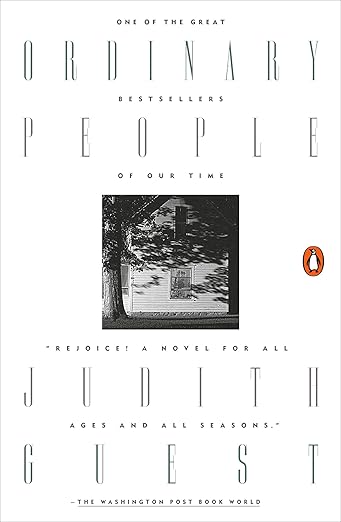
Ordinary People 
Paperback – 28 October 1982
by Judith Guest (Author)
4.4 4.4 out of 5 stars (1,349)

One of the great bestseller of our time: the novel that inspired Robert Redford's Oscar-winning film starring Donald Sutherland and Mary Tyler Moore

In Ordinary People, Judith Guest's remarkable first novel, the Jarrets are a typical American family. Calvin is a determined, successful provider and Beth an organized, efficient wife. They had two sons, Conrad and Buck, but now they have one. In this memorable, moving novel, Judith Guest takes the reader into their lives to share their misunderstandings, pain, and ultimate healing. Ordinary People is an extraordinary novel about an "ordinary" family divided by pain, yet bound by their struggle to heal.

===
Customer reviews
4.4 out of 5 stars

Colin Baldwin
5.0 out of 5 stars 
Love the book and the movie adaptation from the 80s.
Reviewed in Australia on 6 September 2022
Verified Purchase
SPOILER ALERT TO A DEGREE

I’ve just put down this book. I’ve decided not to overthink a review, but first I had to take a breath; stare out the window for a while.

My heart aches. I have a multitude of emotions, not excluding a type of joy. What a novel! Judith Guest knew what she was doing here.

But let me start off with the 1980 movie of the same name, directed by Robert Redford. I’ve watched it three times. Yes, the sets and clothing may be dated, but the story is for all-time.
This film won Oscars for best picture, best director, best adapted screenplay and best supporting actor to Timothy Hutton (back then, he was the youngest recipient at age 20), with identical Golden Globe Awards, giving Mary Tyler Moore best actress.

I was told the movie remained true to the book. And boy, it sure does. Achingly so.

Given I’m a fan of this movie, it was natural to approach the novel with all the faces and characters already formed in my mind. This can be a trap but, in this instance, it was flawless. The roles and performances of Moore and Donald Sutherland as the parents, and Hutton as Conrad, their son, aligned with what I read on the pages. The supporting cast matched all the secondary characters in the book.

Conrad. What a great name for a young man to carry such a weight on his shoulders…

This story is about an ‘ordinary’ family in the process of fracturing. Rarely do we get to read such plausible text about the awkwardness and tragedy of familial bonds that shift and waver. Of course, there are both subtle and brutal layers. Both the book and the film expertly peel off these layers at the right pace. Readers may relate to some characters more than others, but I make no judgments on behaviours. There are no rule books on how we should behave in crises, are there?

I love it when there is no hesitation to award a book 5 stars. ‘Ordinary People’ belongs to that category.
Helpful
Report
From other countries

Mr. O. Walter
5.0 out of 5 stars Almost as good as the film
Reviewed in the United Kingdom on 13 April 2019
Verified Purchase
I'm a huge fan of the film version, and the book did not disappoint, though it wasn't as good. It was nice to have the backstory of some of the characters fleshed out, though Calvin's history seemed a but contrived and soap opera-like, and I would have liked have to gained a better understanding of what it was in Beth's history to make her such a selfish and emotionally repressed adult.
One person found this helpful
Report

Keato
5.0 out of 5 stars Brilliant
Reviewed in the United States on 9 June 2025
Verified Purchase
Someone recommended this book last month. Even though the book was written a while ago, and I loved the movie, I decided to read it. I am so glad that I did. The writing is perfect, the characters so real, and the emotion gut- wrenching. I want to give this book to everyone to enjoy deeply.
One person found this helpful
Report


Waymark, Graeme
4.0 out of 5 stars An author with a deft touch of pen, well-crafted with a unique 'closing' tool to keep characters alive and readers curious.
Reviewed in Canada on 25 October 2013
Verified Purchase
Firstly, I want to say that it did not get five stars. Only because I reserve the full five for the most exceptional novels I read such as 'The Heart So White' by Javier Marias, Gabriela, Cinnamon and Clove by Jorge Amada, Of Mice and Men, John Steinbeck and "Love In the Time of Cholera by Gabriel Garcia Marquez. This novel is more in line with John Irving's "A Prayer for Owen Meany" or Salinger's 'Catcher in the Rye'...in my opinion.

That out of the way - the novel by itself, deserves a high rating - very high - but it lacks 'les petites choses' that could have taken it to greatness.

Having said that, the depth and breadth of emotions explored thru each member of the family - even that of the one who no longer was a part but did have flashback cameo roles, - was superb and well crafted. Never once did I feel a deviation from the true character of the individual. On a simple critique, I do wish the author had not used a son and father's name that had a sort of alliterative, 'sound-alikeness' to them. Initially I would get mixed up as to who was the dad and who was the son. But that is just a little personal gripe of mine.

Without introducing any spoilers, although anyone reading this who has not yet read the book undoubtedly already has a pretty good idea of the theme and it is difficult to not reveal the tragedy of which the book centered. How each reacted, emoted, sustained their emotions and behaved in the short, mid and long term was an exercise in eloquence by the author who must have lived much of this form of tragedy to be able to speak so well, passionately and strongly of it. Of considerable interest to me was the peripheral insinuation of old friends and new, support people, seniors, co-workers and colleagues. No one of importance to the life of the protagonist, was missed; yet, the author did not expend any exaggerated amount of writer's energy on marginal players.

Allowing a marginal or peripheral character to carry the conclusion of the novel side by side with the protagonist Conrad, and with an unanswered question left hanging of "will SHE return" - meaning the mother, lent an extraordinarily creative way to underline the unsaid question throughout the book of "will HE return" meaning Jordan, the brother of Conrad.

The question of 'fathering' is laid out like an open book and explored from the point of view of responsibility to being held to account and more; however, the issue of 'mothering' is as absent as is Jordan throughout the novel. It is left to assume it was once there but perhaps only a memory remains. The resultant vacuum compels the reader to become involved and make self-judgments which can later be tested against resultant behaviors or by psychiatric inputs through character narration.

The contrast between being a member of a swim team, a choir or a family is touched on deftly by Judith Guest in a manner that left me in awe of the author's craftsmanship. What struck me about the tools used by the author, was the 'deftness', the manner she kept so true to the major depression of more than one character using curt, short, staccato bursts of words that did not necessarily make whole sentences, not even simple ones!

The penmanship was razor cut like the mind of a depressed individual can be between the fog, detached like single words can be from sentences or phrases. The synergy of the novel can be found through the detachment, where the characters would otherwise be doing an improvisation on the pages; however, with the distinct, discrete and disconnected speech of more than one character the pages are permeated with melancholy and self-defeating, unanswered depression that like the novel searches for a remission - for relief.

The word 'divorce' becomes a sword cutting through the air as if, by itself, it will release the tension, the grip of not a tomorrow that one or more are afraid to face but a today which, poses only one challenge to the whole family: to get through.

The inevitable though not necessarily predictable, separation - commences a process: the day brings light to compete with the darkness and what before, could not be seen, is now at least glimpsed.

Where the protagonist was isolated and searching for meaning, he takes a step forward. He lets go of his crutches. His parents find themselves in another form of isolation that excludes their sons, allowing them ironically to become whole again emotionally while apart physically. It is an upbeat ending without ending. It is both unique and well done. It leaves a question hanging by which readers can remember the novel, and its primary characters. The ending does what good endings should do - it pulls everything together into the sort of whole that the characters spent the entire novel doing and like all human endeavors, were measurably successful but with a long way to go yet to overcome a huge personal family tragedy that exposed the unpredictable number of human flaws that contributed to making suffering for them as difficult as it was or it would be for we readers in similar circumstances.
2 people found this helpful
Report

LuluCheerful
4.0 out of 5 stars Pricey but a Great Novel
Reviewed in the United Kingdom on 5 November 2022
Verified Purchase
Perhaps it’s just been a long long time since I read an actual book (usually use kindle) but the quality of the print doesn’t seem the best. £15 is pricey for a paperback but I’m grateful to be able to get my hands on this book as it’s not easy to find. First read it 24 years ago as a teenager after watching the film. And started reading the book again today it is still a great read. These characters are all in their heads, lost and confused. And these are the type of stories I enjoy.
Report

tappy
5.0 out of 5 stars Drama worth knowing.
Reviewed in the United States on 2 March 2024
Verified Purchase
For me, choosing the five stars is not about happy endings. Lives are complex, emotions are often denied, and change is difficult for everyone. Accepting life on life's terms requires a lot of personal honesty. Judith Guest handles all the tough topics without apology. She allows the imperfection of her characters and permits their struggles to challenge the reader. Read this, dear reader, if you accept the challenge.
2 people found this helpful
Report

Amazon Customer
5.0 out of 5 stars 
A book for a wide range of ages from young adults to middle age. I last read it as a 16yr old right after it came out in 1982.
Reviewed in the United States on 31 October 2016
Verified Purchase
I read this book many years ago while in high school right after it came out in 1982. I remember thinking then with my 16yr old mind what an awesome, well written book it was. It was definitely different than other books I had read at the time. I've thought about this book often over the next 30+ yrs and wishing I could read it again but not being able to find it. The movie based on this book is also excellent with a very good cast, I've seen it several times over the yrs. It was quite excited to find this book on sale on kindle so of course I grabbed it up along with the audible book. Will be interesting how my now 50 yr old mind will appreciate it. The book read as a teen was the first edition, paperback version(oh how the world has progressed). I know as a teen I related to Conn the best, it will be interesting who my favorite character will be this time around, I imagine it will still be Conrad. I think this book will appeal to a wide range of readers age wise. I'm looking forward to reading this book again, and most likely I will end up reading it more than once.
9 people found this helpful
Report

Swim_Home
5.0 out of 5 stars Lovely story
Reviewed in the United Kingdom on 28 March 2013
Verified Purchase
First picked this book up at an airport bookstall years ago, and then enjoyed it again as a stunning film directed by Robert Redford. thought I'd return to the book and find it has lost nothing with passing time. One of my all-time favourite books.
4 people found this helpful
Report

jonathon juwer
3.0 out of 5 stars Poor condition....
Reviewed in the United States on 8 July 2020
Verified Purchase
I’m looking forward to reading the book. I’ve heard from very reliable sources that it’s phenomenal. It’s not about the content of the book that upsets me. It’s the shape that it arrived in.

I got the book in the mail today and it’s not in ‘good’ or ‘great’ shape like it was sold to me as. It looks like something was spilled on it while it was open and nobody took the time to straighten the pages before drying it out. It’s a mess, but it’s readable. I’m gonna keep it, but I’m a little bit irritated that I purchased it assuming it was in better condition than it is.... 🙄
Customer image
Customer image
Report
===
Profile Image for Julie G.
Julie G
998 reviews
3,825 followers

Follow
December 2, 2018
Once, when my middle child was 7 or 8 years old, I was listening to the usual rhythm of her saying her evening prayer, when she surprised me by adding, “And Lord, please remember, when I die, I want to come back as a horse. Amen.”

I laughed out loud at her prayer, but then I immediately realized my mistake, when I saw her face. She wasn't joking. I switched gears quickly, got serious, and said, “Honey. I don't get it. Why are you asking God to bring you back as a horse?”

She answered very matter-of-factly, “Being a person is too hard. I don't want to come back as one, next time. Horses know exactly what to do and they have more fun.”

Well, how can anyone argue with THAT? She's right. A horse eats, it drinks, it sleeps, it plays, it procreates, it eliminates, it dies. The horse's trajectory is ruled by nature. It does what a horse does. The end.

But, humans. Sigh. Humans.

Humans have strayed so far from the caves, our code for being human has become lost to us. Gone are the days of “Ugga, Ugga, Ugga” and all of our problems were solved. Gone are the days of the finger point to the vagina, the penis, the fire, the meat, the water, the baby, the sky, the ground. Our fingers used to do the talking, and I bet we were a HELL of a lot happier, too. (I've pointed my finger at Viggo Mortensen's penis in an earlier review, and nothing happened. It's like all the magic's gone.)

But, I digress.

Now, depending on culture, religion, geography, and social and economic status, the code can be completely different for each person, and chances are, the human code for YOU is close to impossible anyway, and you feel as though you're failing every day.

Nobody's role is simple, these days. Not even a kid's. It used to mean minding your manners, respecting those who were bigger than you, treating each day as a surprise package, waiting to be opened. . . this is the age of perfection, kid. Everybody try their emotional and physical damndest. Strive, strive. Correct all defects.

Correct all defects. Don't show weakness.

The code for humans is so complicated now, it seems based on a pursuit of perfection we sought for ourselves, but had no realistic basis. We have holy texts that guide us to be good, but none that I'm aware of that ask us to be God.

But we ain't Divine, people. And most of us are doing a lousy job of being perfect, but an excellent job of being miserable.

And no make-up or yoga pants or juice cleanse or private college or grad school or Paleo diet or test scores or attractive spouse or clever children or 2-car garage or 4,000 square foot home or Mercedes Benz or colored hair or bank account or successful career or skinny ass or perpetual smile is ever going to make us PERFECT.

Because we're ORDINARY, people.

And as far as I'm concerned. . . the sooner we head back to the caves, the better.

I'm headed to mine right now. (I'm trading in my overpriced yoga pants for leopard skins, and Viggo M's ass better be waiting for me).

My daughter says she'll carry me on her back.
70s-forever-more-1970s-titles
 
books-that-inspired-a-viggo-review
 
favorite-books
 
...more

189 likes

72 comments

Like

Comment


Profile Image for Colin Baldwin.
Colin Baldwin
227 reviews
40 followers

Follow
July 7, 2022
SPOILER ALERT TO A DEGREE

I’ve just put down this book. I’ve decided not to overthink a review, but first I had to take a breath; stare out the window for a while.

My heart aches. I have a multitude of emotions, not excluding a type of joy. What a novel! Judith Guest knew what she was doing here.

But let me start off with the 1980 movie of the same name, directed by Robert Redford. I’ve watched it three times. Yes, the sets and clothing may be dated, but the story is for all-time.
This film won Oscars for best picture, best director, best adapted screenplay and best supporting actor to Timothy Hutton (back then, he was the youngest recipient at age 20), with identical Golden Globe Awards, giving Mary Tyler Moore best actress.

I was told the movie remained true to the book. And boy, it sure does. Achingly so.

Given I’m a fan of this movie, it was natural to approach the novel with all the faces and characters already formed in my mind. This can be a trap but, in this instance, it was flawless. The roles and performances of Moore and Donald Sutherland as the parents, and Hutton as Conrad, their son, aligned with what I read on the pages. The supporting cast matched all the secondary characters in the book.

Conrad. What a great name for a young man to carry such a weight on his shoulders…

This story is about an ‘ordinary’ family in the process of fracturing. Rarely do we get to read such plausible text about the awkwardness and tragedy of familial bonds that shift and waver. Of course, there are both subtle and brutal layers. Both the book and the film expertly peel off these layers at the right pace. Readers may relate to some characters more than others, but I make no judgments on behaviours. There are no rule books on how we should behave in crises, are there?

I love it when there is no hesitation to award a book 5 stars. ‘Ordinary People’ belongs to that category.


I’m now interested to know how readers found this in reverse, meaning they read the book before watching the movie. Did the characters in the book translate well on the screen?

Show more
favorites
 
maybe-future-re-read

129 likes

37 comments

Like

Comment

Profile Image for Julie.
Julie
Author 
6 books
2,285 followers

Follow
October 9, 2012
It is one thing to read a book written by a contemporary author, set in the not-too-distant past; it is another entirely to read one written in and completely of its time. To read Ordinary People is to step through the looking glass into the sweetly familiar terrain of mid-1970s. But beneath the surface details is a book of timeless themes and incomparable elegance.

As a fan of the 1980 movie, I could hear the voices of the actors as I read the dialogue: Mary Tyler Moore's controlled high-pitched fury, Donald Sutherland's velvet sorrow, Judd Hirsch's nasal sarcasm. But Judith Guest's brilliant, unaffected writing brings life to the characters in a more personal and profound way. You become a participant, not a passive observer, in the inner lives of a family as it falls apart, slowly, wretchedly, inevitably.

I was just eleven years old when Ordinary People appeared in cinematic form in the autumn of 1980, but I remember it as a seminal cultural event of the era, hand-in-hand with Kramer vs. Kramer, released at the end of 1979. It was the year my parents divorced, my oldest brother joined the Marines, the American hostage crisis in Iran dominated the headlines, we waited hours in line at the Cinerama to see The Empire Strikes Back, Reagan took office and John Lennon was murdered - my political and socio-cultural self awakened at the start of a new decade to my formative years and to a world about to enter hyper-speed.

I can't imagine Ordinary People is still being read in high school English classes, but more's the pity. The clothing and music have changed, but the universal nature of adolescence - the sense of isolation, the discovery of love and the longing to be accepted coupled with the struggle to assert one's individuality - remains. Anyone who has suffered depression, whether as a teen or as an adult, will walk in step with Conrad Jarrett as he struggles to return from a shadow life to one with dimension and hope. And what a gift to have one's conflict and confusion validated by Guest's honest, aching, clean prose.

best-of-2012
 
classic
 
read-2012
 
...more

100 likes

25 comments

Like

Comment

Profile Image for Susan's Reviews.
Susan's Reviews
1,224 reviews
749 followers

Follow
December 13, 2021
I saw the very excellent movie, Ordinary People, starring Donald Sutherland and my one time crush Timothy Hutton first. That movie moved me very deeply. The book was just as memorable and I have my own copies of both, and watch and reread them every once in a while.


Conrad and Buck are out sailing when their boat capsizes. Conrad is able to hang on, but Buck loses his grip and drowns. The Jarrett family is torn apart and Conrad's survivor's guilt leads him to attempt suicide. (If suicidal ideation is a trigger for you, then this is not the book for you - but I will state that this subject is very sensitively handled.) Conrad's mother, Beth, was closer to Buck, whereas the father, Calvin Jarrett, was very supportive of Conrad. Lines were drawn and heartbreaking decisions had to be made so that Conrad could get the help he so desperately needed.


Books about families in crisis are one of my favourite reads. I love psychoanalysis (Frankl is my hero - his wonderful books pulled me out of more than one crisis in my lifetime.) I highly, highly recommend both the book and the excellent movie. Stay well, everyone!

60 likes

10 comments

Like

Comment

Profile Image for Fabian.
Fabian
999 reviews
2,081 followers

Follow
October 23, 2018
Boo!

But rather interesting, is it not, how I find myself choosing below-par novels lately which have, somehow, spawned off better-than-average silver screen adaptations*! Here--the underrated work of the artist otherwise known as the screenwriter in its glory.

This is bizarrely lame--the subjects become known superficially, their problems are mundane.

Not a wise choice, people. But, apparently, vanilla can be swiftly transformed into gold (Oscar-wise).

*"Bridges of Madison County" and "Up in the Air", to mention the first that come to mind.

51 likes

5 comments

Like

Comment


Profile Image for Chris.
Chris
Author 
49 books
12.9k followers

Follow
May 21, 2024
A classic for good reason: a devastating exploration of the losses that tear a family apart, and how, after an inexplicable tragedy, the survivors try to move forward. Beautifully written and impeccably observed -- and without a single wrong note. Just a treasure.

47 likes

3 comments

Like

Comment

Profile Image for Anne-Marie.
Anne-Marie
313 reviews
39 followers

Follow
January 23, 2010
Books like Ordinary People are why I read.

This is the first book I've read on the subject of depression that isn't written as a memoir, from a clinical stand point, or with the intention of "self-help". With that said, Ordinary People was the most concise version of depression I've ever seen. Judith Guest has to have had first-hand experience with depression or else she needs to get out of my head. There is so much comfort in seeing your own inexplicable emotions laid out before you page after page.

Although Conrad's depression was most likely situational, it was severe:

-sleep is no longer just a necessity, it becomes his only refuge

-the only safe place is in his bed

-using routines as a method to appear and feel normal

-constant negative self-talk

-believing that everyone hates him as much as he hates himself and using that belief to justify his isolation

- seeing a friend (who he met and then grew close to in "The Bin") after they were both discharged --> there is an awkwardness in that situation that is unhealthy

The whole dynamic of a cold, distant mother and the overly-concerned father was refreshing.

And Berger, if only everyone could have a doctor like him! Some of Berger's wisdom that really stood out for me:

"Depression is not sobbing and crying and giving vent, it is plain and simple reduction of feeling."

" . . . crazy world or maybe it's just the view we have of it, looking through a crack in the door, never being able to see the whole room, the whole picture."

"I keep telling you that feeling is not selective. You can't feel pain, you aren't gonna feel anything else either."
top-shelf

45 likes

1 comment

Like

Comment

Profile Image for Sophy H.
Sophy H
1,824 reviews
103 followers

Follow
September 13, 2024
This was a short but very impacting story about a family in various stages of grief and healing.

The characters are cleverly constructed and feel very real and present.

I really identified with Conrad, the son who feels not quite at home in his own skin and has been through some serious issues (no spoilers).

A very intelligently written, quiet but soulful story from Judith Guest.
fiction-or-historic-folklore

29 likes

9 comments

Like

Comment

Juju
25 reviews
2 followers

Follow
July 27, 2007
This book was first recommended to me by my high school English teacher. I had just read Lord of the Flies, and she could tell I needed something to restore my faith in humanity. This book is incredible!

It is a real, unflinchingly honest look at life and all of the horrible things that happen. It is also a reminder of the reasons that life is still worth living in spite of those horrible things.
fiction

27 likes

Like

Comment


Profile Image for Corey.
Corey
Author 
85 books
277 followers

Follow
July 5, 2019
A powerful story told in simple, unadorned prose. Redford, though, saw the poetry beneath the surface and made a GREAT movie from a good book.

22 likes

5 comments

Like

Comment

Displaying 1 - 10 of 1,491 reviews
===

===

===

No comments:

Post a Comment