2018년 3월 19일 월요일

Kim Jong-un's nuclear ambition: what is North Korea's endgame?

Kim Jong-un's nuclear ambition: what is North Korea's endgame?


Asian Affairs

Kim Jong-un’s nuclear ambition: what is North Korea’s endgame?

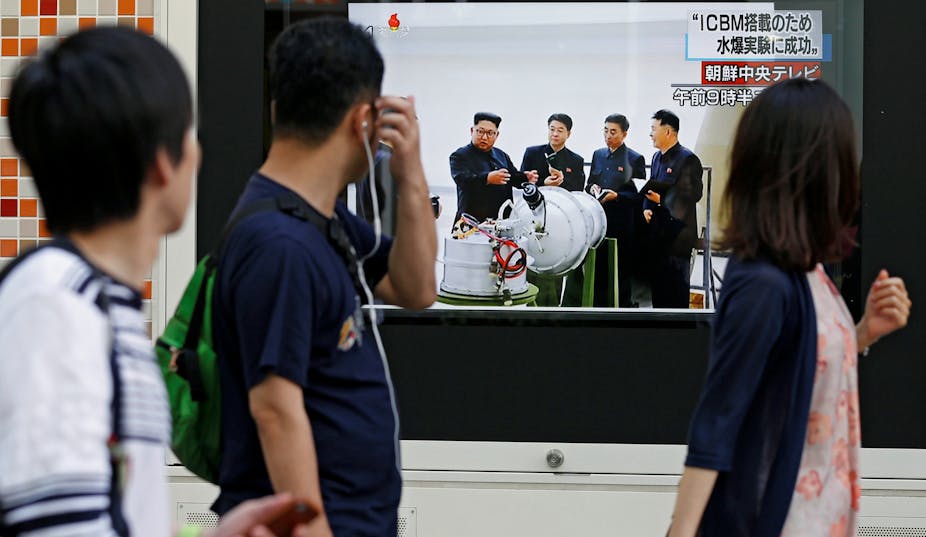
Reuters/Toru Hanai

North Korea’s sixth nuclear test, following soon after a series of missile provocations, tells us a great deal.

Most obviously, North Korea does not feel at all constrained by US President Donald Trump’s rhetoric, and nor has it been coerced by UN sanctions. It also illustrates the acute regional tension caused by the acceleration of the isolated country’s weapons acquisition program.

While we wait for technical detail that will reveal the exact magnitude of the blast, and thus how close the regime has come to acquiring a viable nuclear weapon, it is important to try to determine just what it is that North Korea seeks in taking the risky, expensive and diplomatically fraught steps down the nuclear path.

Further reading: Q&A: what earthquake science can tell us about North Korea’s nuclear test

Determining intent in the mind of political leaders is always a fraught endeavour. Working out what the leader of a highly closed society like North Korea wants is harder still.

On this question there is little reliable information, and the best we have is educated guesswork. But discerning what Kim Jong-un wants from his nuclear gambit is necessary to determining how to respond to North Korea’s latest test.

North Korea’s nuclear program began in the early 1990s, and in its first decade or so was often thought to be a means of extorting financial and material support. The Agreed Framework, established in 1994 to manage the crisis, looks in hindsight like a reward for stopping the country from behaving badly.

Given how economically fraught North Korea’s existence had become after the Soviet Union’s collapse, nuclear blackmail as a means to remain viable had a certain logic.

The tempo and success of the various tests show that North Korea’s nuclear program is not a creative revenue-raising exercise. For one thing, the country is no longer as economically fragile as it was in the 1990s. More importantly, the program is so far down the path of weapon acquisition that this motive can be ruled out definitively.

If there were any doubts, the latest tests show North Korea is committed to acquiring a nuclear weapon that can hit the US and other targets both near and far. The reasons are as follows.

Contrary to the way it is often portrayed, North Korea is motivated by the same concerns as all country. Above all, Kim wants nuclear weapons to increase the country’s sense of security.

Due to their destructive force, nuclear weapons are thought of as the ultimate guarantee. The regime perceived that Iraq and Libya were vulnerable to regime change because they could not deter the US or other powerful countries.

As a country that believes the US and its allies pose a significant threat, nuclear weapons are increasingly seen as the only way it can protect itself. While North Korea has a very large military – its defence force is comprised of nearly 1.2 million people – its equipment is badly outdated, and would perform poorly in a fight with US or South Korean forces.

Nuclear weapons are thus a way to maximise the chances of regime survival in what North Korea thinks is a hostile international environment.

The ability to confer disproportionate power on their owners bestows nuclear weapons with considerable prestige. North Korea wants to be taken seriously as a military power of the first rank. The only way in which it can achieve that ambition is through acquiring nuclear weapons.

And while North Korea has been protected by China – it is the reclusive country’s only partner – it is also aware of the vulnerability that that dependence brings. An indigenously developed nuclear weapon promises security, status and autonomy.

Finally, Kim has made nuclear weapons a core part of North Korea’s identity under his leadership. The country’s constitution was amended in 2012 to describe North Korea as a nuclear-armed state.

This was a clear statement of intent not only about getting the weapons, but about their importance to North Korea’s political identity. They are intimately bound up with Kim’s leadership and his sense of North Korea’s place in the world.

How to calibrate the response to North Korea has to start from recognising the fundamental importance of the weapons to North Korea, and more particularly to Kim’s leadership. He cannot be bought off, and the desire to have a properly nuclear-free Korean peninsula is impossible for as long as he rules.

Further reading: Trump can’t win: the North Korea crisis is a lose-lose proposition for the US

All policy options are unpalatable but some are much worse than others.

Regime change or some other coercive effort to stop North Korea comes with the risk of horrendous loss of life as well as no clear guarantee that it would work.

Equally, cutting off the already very isolated country could cause it to collapse with millions of refugees. And more likely North Korea would figure out a way around any more strict sanction regimes, as it has done for many years already.

The best-case scenario is a negotiation in which North Korea agrees to freeze its program. It would not hand over what it has but it would stop going any further. Yet even this is difficult to envisage, and politically would be very difficult for Trump to accept.

The most important thing policymakers in the US, China, Japan and elsewhere can do now is begin to prepare for a North Korea with nuclear weapon capabilities. It is the most likely outcome given Kim’s ambitions and the very limited choices the outside world has.

But while it would be dispiriting development, it would be likely to create a more stable environment than the volatile context created by North Korea’s sprint to the finish.

For more on this topic, you can listen to Benjamin Habib and Nick Bisley discuss North Korea on this recent La Trobe Asia podcast.


-------------

76Comments
  1. william hollingsworth

    Having been comprehensively flattened once by the Americans through relentless bombing raids on their civilian population the North Koreans have every right to protect themselves however they see fit. The USA is still the only country to use atomic bombs against a civilian population so they are probably not the ones to set the ethical standards for nuclear armament and their deployment. China has also not forgotten its 100 years of humiliation so kowtowing to Trump is definitely not on its agenda.
    1. Terry Reynolds

      logged in via Facebook
      In reply to william hollingsworth
      William, Communist North Korea was bombed by the US, Australia, Great Britain and other UN assembled countries during the Korean War because it invaded free South Korea supported by Communist Russia and later newly Communist China against UN wishes.
      Korea had been occupied by Japan for 35 years and that occupation ended with the US led defeat of Japan. Russia declared war on Japan after the US nuclear bombing of Hiroshima and Nagasaki in August 1945 to gain territory like the 1000km long string of unoccupied Kuril Islands which they still refuse to hand back to Japan 72.
      The Russians also immediately occupied North Korea and the US backed South Korea below the 38th parallel to keep it communist free.
      It was Communist North Korea that invaded South Korea five years later in 1950, that caused the UN to develop a world wide non0communist force led by the US to kick them out which they successfully did despite Communist China providing large numbers of troops on North Korea’s side. Small thanks from China for the US assisting China rid itself of the Japanese during WW11.
      The US has guaranteed South Korea’s security ever since with Australian support. It has also guaranteed ours and Japan’s since and without it who knows what would have taken place in Asia over the past 70 years. It was our PM Robert Menzies that urged the US to get involved in the Vietnam war to stop Communist expansion backed by Russia and China from making is way down though SE Asia to Australia in a domino effect.
      You can argue about the merits of the Vietnam war too, but though the US pulled out of Vietnam in 1972 and the Communists invaded South Vietnam three years later in 1975 in breach of a 1972 agreement with the US, Communist expansion into SE Asia faltered and most of SE Asia is free and democratic. I would call that longer term outcome, success.
      The US has been the sole provider of guaranteed freedom for a lot of countries for the past 70 years and thankfully continues to do so with many a hot and tot cruel despot being deposed by US military action.
      Are you going to blame the US and Britain for flattening many German cities during WW11 in reprisal for Germany trying to occupy all of Europe and its attempts to flatten British cities.
      Europe and most of Asia has been peaceful for 72 years since the Allies led by the US won WW11 against Germany and Japan and the US rebuilt their economies under the Marshall plan..
      The US, Britain and Australia had to intercede in Iraq to stop another North Korean type leadership gaining nuclear weapons and menacing all of the Middle East. Yes, like WW1 and WW11 a lot of innocent people died. About 100 million from the combined world wars but we and the US didn’t start them.
      Communist Russia did not hesitate to starve to death 10 million Ukrainian’s in the 1930’s to bring them to heal ;and China 50million of its own people in its revolutionary actions in the 1960’s.
      If North Korea starts threatening Australian cities with nuclear attack, say unless we pay them huge amounts of money or in goods, or say surrender of North Western Australia to them, as megalomaniac leaders are inclined to do, what do we do? What if the take out Adelaide just to show they are serious. Then what?
      The only realistic outcome is a US nuclear strike on North Korea to wipe out its military and leadership with the loss as always occurs with huge numbers of civilians and the taking control of the place by the UN. That will ensure China and Russia who continue to be destabilising forces in the world get the message. The West will not back down!
      1. william hollingsworth

        In reply to Terry Reynolds
        I could argue endlessly on the many points you have raised and even agree on one or two but see no merit in a pre-emptive nuclear attack on North Korea. It would have even worse consequences to the destabilizing effect the war in Iraq has had.
        1. Tom Saunders

          logged in via Google
          In reply to Terry Reynolds
          [You can argue about the merits of the Vietnam war too, but though the US pulled out of Vietnam in 1972 and the Communists invaded South Vietnam three years later in 1975 in breach of a 1972 agreement with the US, Communist expansion into SE Asia faltered and most of SE Asia is free and democratic. I would call that longer term outcome, success.]
          After WW2 the US backed and financed France in trying to reconquer its Indochina colonies (Vietnam, Cambodia, Laos). The US knew that by doing this, it was opposing popular Vietnamese nationalism in the form of the Viet Minh represented by Ho Chi Minh - The US State Department described Ho in 1948 as
          “the symbol of nationalism and the struggle for freedom to the overwhelming majority of the population”
          In 1954 the French withdrew, and the US imposed a client regime in South Vietnam against Geneva conventions that called for unification of the country by elections in 1956. By 1959, the Diem regime in South Vietnam
          “had crushed all opposition of every kind, however anti-communist it might be. He has been able to do this simply and solely because of the massive dollar aid he has had from across the pacific, which kept in power, a man who, by all laws of human and political affairs, would long ago have fallen. Diem’s main supporters are to be found in North America, not here in Free Vietnam…”
          The Kennedy administration escalated the war in South Vietnam in 1961-2 in an effort to drive several million people into “strategic hamlets” (i.e concentration camps) in which they would be “protected” behind barbed wire and armed guard, from the guerrillas whom the US acknowledged they were willingly supporting. The leading US govt Vietnam specialist and hysterical anti-communist, Douglas Pike, even acknowledged that the NLF (Southern chapter of the Viet Minh, or “Viet Cong” in the US media), was the only
          “truly mass-based political party in South Vietnam”
          John Paul Vann, widely considered the most knowledgeable US govt official about South Vietnam at the time, wrote in 1965:
          “The existing Government is oriented toward the exploitation of the rural and lower class urban populations. It is, in fact, a continuation of the French colonial system of government with the upper class Vietnamese replacing the French. …The Dissatisfaction of the agrarian population…is expressed largely through alliance with the NLF.”
          In 1964 the US received it’s ‘blank cheque’ for escalating combat operations after the Gulf of Tonkin incident, invading the South in 1965. What followed was the successful destruction of South Vietnam, parts of North Vietnam, and even the northern parts of Laos, where the US acknowledged it’s bombing had nothing to do with the war in Vietnam. As an aside, I recommend a book called “Voices from the Plain of Jars” which chronicles some of the atrocities committed by the US air force in Laos’ Plain of Jars, the most heavily bombed area on earth.
          In October 1972, a 9-point peace plan was negotiated in Paris, which stipulated that “the south Vietmanese people shall decide for themselves the political future of South Vietnam,” a clause which the US and South Vietnam client regime objected to. They eventually singed in January 1973. The Paris agreements committed the signatories to
          “respect the independence, sovereignty, unity and territorial integrity of Vietnam as recognised by the 1954 Geneva Agreements on Vietnam.”
          Reunification of Vietnam was to be carried out
          “step by step by peaceful means…and without foreign interference.”
          “The United States will not continue it’s military involvement or intervene in the internal affairs of South Vietnam”
          Kissinger immediately made it clear that large numbers of “civilian technicians” under the supervision of a US Major General, would remain in Vietnam (nullifying the articles outlining withdraw procedures). Nixon announced that the GVN (client regime) would be recognised as the only
          “sole legitimate government in South Vietnam” [later changed to “all Vietnam”]
          (nullifying the articles outlining the political process to be observed by the two recognised parties in South Vietnam, and the basic principle that no outside interference or tendency would be imposed on the internal affairs of the country.)
          The GVN immediately set about expanding it’s territory in breach of the agreement, by using US supplied equipment to add over 700 villages and 1million people into it’s borders (expending 16 times more ammunition than the North in the same period). When the PRG responded, the GVN collapsed amidst US slogans that “Communists cannot be trusted” (despite the fact that the GVN was first to breach the terms of the agreement).
          [The US has been the sole provider of guaranteed freedom for a lot of countries for the past 70 years and thankfully continues to do so with many a hot and tot cruel despot being deposed by US military action.]
          After putting together the above I’ll keep it short here. The US has been one of the largest enablers of “cruel despots” - heres a list for you to peruse, I suggest googling the event for the Wikipedia entry if you’d like to learn more. Particularly difficult reading, especially some of the Latin American death squads supported by the US in places like Guatemala and El Salvador:
          This is essentially a short answer to Bush’s question (“Why do they hate us?”) - i.e. overthrowing democratically elected, massively popular leaders, and installing murderous tyrants who are favourable to US interests.
          [The US, Britain and Australia had to intercede in Iraq to stop another North Korean type leadership gaining nuclear weapons and menacing all of the Middle East. ]
          Absolute fantasy. The US and UK were Saddams allies leading up to the 2003 invasion. In 1989 Bush I declared normal relations with Iraq (only a year after Saddam gassed the Kurds). The US also provided millions in military aid to Iraq as a proxy against Iran. Iraq had long been prized for it’s oil of course (the Bush family made their money in oil and recognised the need for tighter control of supply in the face of OPEC).
          Around this time the US had many opportunities to show how committed it was to it’s anti-WMD rhetoric. Two UN resolutions were adopted: the first called for stronger measures to prevent the militarisation of space, and the second reaffirmed the 1925 Geneva Protocol banning poisonous gasses and bacteriological methods of warfare. Both passed unanimously, with two abstentions (The US and Israel). Also of note, international intelligence agencies predicted an escalation of Islamic terrorism if Iraq were invaded, not a reduction. But much has been written about this elsewhere.
          1. robert woolley

            In reply to Terry Reynolds
            “unless we pay them huge amounts of money or in goods, or say surrender of North Western Australia to them”
            Perhaps just selling it to them at a touch inflated price would be enough to pacify them. Just who legitimately ‘occupies’ North Western Australia would probably be a mute point for some of the local indigenous survivors.
                1. Terry Reynolds

                  logged in via Facebook
                  In reply to Tom Saunders
                  Tom, I take it after reading that tome that you don’t like the US.
                  Easy to speak your mind when your in a country free of communist oppression thanks to the US.
                  1. Henry Verberne, asking questions

                    In reply to Terry Reynolds
                    “The only realistic outcome is a US nuclear strike on North Korea to wipe out its military and leadership with the loss as always occurs with huge numbers of civilians and the taking control of the place by the UN”.
                    Why it that the case? Seems to be a far better approach is to stop upping the ante with belligerence, accept that NK is a nuclear state and engage with them diplomatically.
                    1. Terry Reynolds

                      logged in via Facebook
                      In reply to robert woolley
                      Robert, I bet the local indigenous people who you say would consider Australian ownership of all of the north west as a moot point would be really happy having the North Koreans come in and take over as their masters. I guess they will continue to get first class health services, education, the vote and the ability to live anywhere they like within Australia as well as generous aged and disability pensions to spend in the North Korean supermarket with no shelves, as there is usually no stock.
                      I can see the local aborigines goose stepping in North Korean Uniforms down the main street of Broome with big forced smiles on their faces..
                      1. Terry Reynolds

                        logged in via Facebook
                        In reply to robert woolley
                        Robert, they spend much of the North Koreans income on weaponry and if you have been missing the news reports over the past fifty years, starving their people to concentrate on weaponry. Their population has survived for decades on food aid from the US and other western nations.
                        If they dropped their military expenditure and focussed on the needs of their people even giving them the right to a free democratic vote and the right to own land and a business then things might improve for their oppressed people.
                        1. william hollingsworth

                          In reply to Terry Reynolds
                          South America has not benefited from American benevolence where dictators have been supported to benefit US corporate economic interests. The USA double crossed the Vietnamese who had defeated the Japanese only to have their independence thwarted by French colonial rule backed by the Americans.The invasion of Iraq resulted in ISIS being formed and the power vacuum created by the removal of Saddam Hussein allowed Iran to over run the country.That the USA helped win World War 2 is beyond dispute.
                          1. Tom Saunders

                            logged in via Google
                            In reply to Terry Reynolds
                            Terry, Seriously?
                            I tried hard to provide an honest, comprehensive comment addressing some of the inaccuracies I perceived in your comment. If that’s all you can muster after reading my contribution then I was wrong to assume you were interested in a genuine ‘conversation’ about this issue. If the US comes off looking bad when recounting the historical record it must be those dam communists!
                              1. Robert Fantozzi

                                In reply to Terry Reynolds
                                Whilst I agree in general with the historical view the preemptive attack will be rather difficult even for the US. It will not happen in my opinion unless Eyebrows attacks first. That is highly unlikely since he knows that he cant win and would lose everything in a retaliation. A retaliation which would be sanctioned by everyone except probably China and Russia. A first strike by the US on the other hand would have a global condemnation and for that reason would not occur since it would enable both China and Russia to respond.
                                1. Philip Hewett

                                  In reply to Terry Reynolds
                                  William, you say:
                                  The only realistic outcome is a US nuclear strike on North Korea to wipe out its military and leadership with the loss as always occurs with huge numbers of civilians and the taking control of the place by the UN. That will ensure China and Russia who continue to be destabilising forces in the world get the message. The West will not back down!“
                                  That is a most reprehensible and utterly simplistic proposition. It is barbaric. It is ill thought out and the claimed outcomes are tragically wrong headed. I can think of no more contemptable and monstrous proposition than to argue for a cold blooded nuclear strike as you so flippantly say "with the loss, as always…with huge numbers of civilians”
                                  The casual nuance in your words toward the horrific loss of life is truly chilling. It is in fact propositions such as yours that have been acted on time and time again to no other end than to perpetuate barbarism - have we learnt nothing from history?
                                    1. Garry Baker

                                      In reply to Terry Reynolds
                                      Well done Terry, you have explained the 1950’s conflict in NK rather well. The bottom line though is they did not use Nuclear weapons there ….Only in Japan, where the estimates for invasion of the place by conventional means indicated 3m+ would have lost their lives. Unacceptable losses in the mind of the mind of the US president, so the Go button was pressed
                                      However in moving to the scenario going on right now …It’s my view this is far from being just a Nth Korea test of US resolve … Rather, it may well be sponsored by China, with NK acting out the part.
                                      The hermit kingdom has nothing to lose, given that very few in the world have an ebb and flow of commerce with them .. Other than with China, who they are utterly dependent on for their basics in life.
                                      Such a vicarious arrangement serves multiple purposes … # Makes NK look tougher …. # And without flexing its own muscles on the global stage, China gets to read and monitor likely ….American .. Japanese ..Sth Korean responses in real time…. Along with a take of the wider sentiment viewed elsewhere in the world
                                      Handy things to know if a wider and far more important conflict in the Sth China Sea is to be prosecuted with their land grab (the big game)
                                      Devious take on what really might be happening .. huh
                                      Bottom line is this … The US alone has a capacity to turn NK into a car park within a day, wiping out most life as they know it …. Even without using Nuclear weapons … So why not test their tipping points by means of supplying a sacrificial Lamb - NK
                                      Maybe the above is not the case at all … However you can bet the farm on it being figured as a possible scenario within the US military machine (with their Donald not included .. one might add)
                                      The thing is, mere politicians in government come and go with their short terms of office …Whereas plotting Generals act out a lifetime career with their “keep America safe” mission statements … So why on earth would they ever talk to the media about their calls on what could really be happening .
                                      Suppose though, with time and tide some expert writing for Lord Murdoch’s press might advance a few ideas along these lines
                                    2. Toby McCrossin

                                      logged in via Facebook
                                      “Kim… cannot be bought off, and the desire to have a properly nuclear-free Korean peninsula is impossible for as long as he rules.”
                                      Simply not true. The DPRK regime is willing to negotiate it’s nuclear weapons program provided the USA ceases its hostility towards the country. This from 38 North…
                                      [T]he DPRK would neither put its nukes and ballistic rockets on the table of negotiations in any case nor flinch even an inch from the road of bolstering the nuclear force chosen by itself unless the US hostile policy and nuclear threat to the DPRK are definitely terminated.
                                      In the past month, that formulation has been repeated several times (at least five) in DPRK media. Significantly, it appeared in the August 7 Government statement responding to the recent UNSC sanctions. Government statements are not chopped liver. They are vetted, and possibly written, at the highest levels of the regime.
                                          1. Michael James

                                            In reply to Toby McCrossin
                                            The DPRK regime might feasibly be willing but Kim Jong-un not at all. I am sure the upper echelons of the government/nomenclatura would be happier with a Chinese-PRC type system which allowed them to retain tight control (and privileges) while having a economically developed country. But the heritable dictatorship, no.
                                            The only real hope of real advance is a peaceful transition from the toxic Kim family cult, and that is only possible with China’s help/collusion. But China doesn’t hold so much sway over the regime anymore but it can credibly guarantee the DPRK’s survival against the South and the US, and help it to develop along the same lines as China. (And it seems China has nurtured or at least kept in reserve that half-brother Kim Jong-am, who feasibly could step in; after Kim Jong-un assassinated him in Kuala Lumpur there is still the son. )
                                            1. Toby McCrossin

                                              logged in via Facebook
                                              In reply to Michael James
                                              “The DPRK regime might feasibly be willing but Kim Jong-un not at all.”
                                              If such were the case, why is DPRK state run media saying that they are willing to negotiate? If Kim is as all powerful as he’s made out to be he’s hardly going to allow multiple statements to be made that are contrary to his own position.
                                              1. Tony Souter

                                                logged in via Facebook
                                                “Above all, Kim wants nuclear weapons to increase the country’s sense of security.”
                                                This would be more realistically stated as: “Above all, Kim wants nuclear weapons to increase the regime’s sense of security.”
                                                All war is about domestic policy. For Kim, for Trump, for Turnbull.
                                                1. Terry Reynolds

                                                  logged in via Facebook
                                                  In reply to Tony Souter
                                                  I would have thought North Korea like many countries around it would be no less secure without nuclear weapons.
                                                  To suggest all war is about domestic policy is childlike.
                                                  No rational leader wants war but it seems us in the Protestant Christian West have to step up time and time again to stop megalomaniac despots in other countries around us, or even a long way from us to keep some sort of order and freedom in the world.
                                                    1. jeanine coleman

                                                      What should have been done 67 years ago - it is time the US grew up - negotiated fairly and stopped bullying or buying countries off. Mr Trump needs to man up and behave like a responsible adult otherwise all he is doing is making the US look like a great big joke not a great power. Unfortunately the joke in this case is far from funny and affects to many people in the world. And just for the record Mr Turnbull, spouting the same rhetoric as the US makes you look as stupid as them.
                                                      1. Ross Barrell (Aikido student) 
                                                        Ross Barrell (Aikido student) is a Friend of The Conversation

                                                        In reply to jeanine coleman
                                                        Yes Jeanine. I listened to Mr Turnbull referring to Kim Jong-Un as “Evil”. A dangerously simplistic diagnosis I’d say.
                                                        Kim is not “evil”. Pragmatic? Yes. Ruthless? Doubly so. But “evil” is just so much childish drivel. Not befitting a first world leader. So, considering Turnbull’s domestic performance over the past year or so, I was not surprised.
                                                          1. Terry Reynolds

                                                            logged in via Facebook
                                                            In reply to jeanine coleman
                                                            Fortunately, the US and Britain are the two adult countries of the world and have to enforce behaviour on others for everyone’s benefit.
                                                            Australia has to support Britain and the US as does NZ and Canada. Without us and our willingness to defend others, the world would be a horrible place.
                                                            Jeannine if you think that the US is making itself look like a great big joke, not a great power the you are mistaken. The US is ready to strike North Korea and as it has nuclear weapons, it won’t be a hands tied behind its back attack like in Iraq or Afghanistan. Parts of North Korea will vaporised.
                                                            1. Terry Reynolds

                                                              logged in via Facebook
                                                              In reply to Christine James
                                                              Ross and Christine, Malcolm Turnbull was doing what a true ally of the US and a believer in world order must do. Make a public statement that Australia stands side by side with the US.
                                                              If you think Kim Jong-In is just a misguided pragmatist, God help us!
                                                                  1. Henry Verberne, asking questions

                                                                    In reply to Terry Reynolds
                                                                    “, it won’t be a hands tied behind its back attack like in Iraq or Afghanistan. Parts of North Korea will vaporised”.
                                                                    I don’t think even Trump is stupid and callous enough to condemn possibly millions of South Koreans and the many citizens of NK to death- because that will be the result. Would China stand idly by or Russia?
                                                                    WW three could ensue.
                                                                    Should NK actually launch nukes which are aimed at SK, Japan, the US etc there may be no choice. Until and unless that eventuates I predict that the US, for all its belligerence matching NK, will not act.
                                                                    1. Steve Hindle

                                                                      As time progresses, the idiotic “Axis of Evil” speech by G.W. Bush against Iraq, Iran and North Korea looks to have done great harm. By demonising these countries and burning whatever diplomatic bridges there may have been, Bush handed over to Barack Obama a chalice too poisoned to be fixed within his term; soft power is messy and takes time. Now we have a US President that tweets from the hip and basically has no idea what he is doing.
                                                                      1. Lorraine Joseph

                                                                        I dont understand Kim Jong Uns motivations either..Pity the poor indoctrinated people who seem trapped and sitting ducks. Perhaps they could release all women and children if there is any war imminent. Drop messages of aid if they flea to a border? China has an excess of male population and should be happy to take North Korean women. That leaves Kim Jong Un and his men alone laughing for a while at least. I dont think its good to launch rockets making your land the target unless you have a plan to be elsewhere…when the response comes. Sanctions just reinforce the poor respect they must have for the world and fuel hatred. Already North Korean women work in China so get them all out I say.Save the children.
                                                                        1. adam bonner

                                                                          The safest bet now is for Kim Jong un to develop a reasonably large set of mobile ICBM’s with miniaturised nuclear warheads so that any pre-emptive strike would be unlikely to take them all out, ensuring a launch would have devastating affect. The West would be humbled and this is important too. We need to ensure that Western and UN ambitions to strike at the heart of a nation state’s ability to defend itself are not only rendered ineffective for this episode but for future episodes. We cannot allow an international system built on hypocrisy, lies and treachery where the very treaties are used to maintain Western hegemony and superiority. The nation state system is not democratic, nor is it subject to the whims of an international policeman without legitimacy. North Korea has stood up to the bully and won. That message is extremely powerful and gives hope in a broken system.
                                                                            1. Lorraine Joseph

                                                                              In reply to adam bonner
                                                                              I dont think you can fix anything with a bomb…even a fancy one like you describe…Unless you want to do some opencut mining? Well Kim Jong Un has peoples attention…what does he want changed about the outdated Western systems that we are struggling with? I always thought that China was going to add to the blend of intellegent answers. The solutions cant be instant like the destruction of a bomb. The solutions and blending of systems take openness over time. Competition is not the name of the game…Will there be a tradeoff?… I keep thinking of Tiawan somewhere in this story…and I dont know why.
                                                                              1. Terry Reynolds

                                                                                logged in via Facebook
                                                                                In reply to Elliott Stevens
                                                                                Elliot, the people writing in support of North Korea on this topic would not even holiday in North Korea for fear of being jailed for life or shot over some minor and innocent indiscretion.
                                                                                TC is supposed to be a cerebral medium for astute erudite people to assist in a debate.
                                                                                1. Terry Reynolds

                                                                                  logged in via Facebook
                                                                                  In reply to Lorraine Joseph
                                                                                  Lorraine, nuclear bombs on Horishima and Nagasaki did and saved perhaps a million US, and Australian servicemens lives in August 1945.
                                                                                  Bombs also flattened Germany into submission and defeat in WW11.
                                                                                  Haven’t you heard about this aspect of our history yet?
                                                                                  1. Toby McCrossin

                                                                                    logged in via Facebook
                                                                                    In reply to Terry Reynolds
                                                                                    “nuclear bombs on Horishima and Nagasaki did and saved perhaps a million US, and Australian servicemens lives in August 1945.”
                                                                                    This is bunkum. The Japanese regime did not surrender because of the atomic bombings, they surrendered because the Soviet Union was about to invade Hokkaido.
                                                                                    “Bombs also flattened Germany into submission and defeat in WW11.”
                                                                                    Again, wrong. Bombing had the opposite effect on the German population. It actually solidified there support of Hitler.
                                                                                    “Fire and Fury: The Allied Bombing of Germany, 1942-1945, by Randall Hansen goes into the fact that the terror bombing prolonged the war as German military & civilian resistance actually increased.”
                                                                                    Read more
                                                                                        1. Henry Verberne, asking questions

                                                                                          In reply to Terry Reynolds
                                                                                          Terry, I think you misrepresent those you claim “writing in support of North Korea”.
                                                                                          I cannot speak for others but you are indulging in straw man argument when you suggest that. I for one do not have the slightest doubt that NK is a very oppressive regime that violates human rights and tolerates no dissent.
                                                                                          But I and others have the view that the action you suggest might be effective but at huge and possibly catastrophic global result.
                                                                                          And please do not denigrate TC because you disagree with the views of the author. Poor form!!
                                                                                          1. Toby McCrossin

                                                                                            logged in via Facebook
                                                                                            In reply to Terry Reynolds
                                                                                            No it isn’t. If you had bothered to read the links I posted you would have learned that the American generals at the time considered the nuclear bombings unnecessary.
                                                                                              1. adam bonner

                                                                                                In reply to Lorraine Joseph
                                                                                                You can fix a lot with a deterrent and that is what NK needs and what the West can’t stand. It isn’t fancy. It is relatively old technology but the speed at which it travels makes it impervious to Western countermeasures and means its is a real deterrent. China should add to the blend by saying a few simple words “we will stand by our ally”. The solutions can’t be instant like the detonation of the bomb and the openness is just window dressing.
                                                                                                1. Robert Fantozzi

                                                                                                  In reply to adam bonner
                                                                                                  After the armistice was signed the US & SK have abided by and not broken the deal in any way .neoither have threated NK in any way. On teh contrary Nk has build up a massive froce on et border constantly on guard and menacing South Korea . In the mean time SK has grown economically and is very wealthy whilst NK has gotten poorer.The NK people want to leave and many have but Eyebrows kills them if he catches them or send his goons to kill them O/S. ( like his Step brother) So exactly how is it that the NK after all those years and all that water under the bridge,now needs a deterrent?I think you may have a vary different understanding of the situation .
                                                                                                  1. Lorraine Joseph

                                                                                                    In reply to Terry Reynolds
                                                                                                    Yes Terry, I didnt realise that it probably saved Korea from the Japanese…according to this video… https://www.youtube.com/watch?v=CxxpFegNLik The history and interaction going on in this region is pretty complex. I doubt many Australians know very much or could see things from Koreas, Japans and Chinas perspective.. I still wonder about shipping competition and the failure of Hanjin shipping and consequent sales of terminals in ports like Tiawan and Tokyo.. https://www.porttechnology.org/news/hanjin_shipping_bankruptcy_costs_10_billion Also seen articles about PROK moving armaments via sea and and then there is US supplying arms to Taiwan … reported a the end of June…https://www.aol.com/article/news/2017/06/30/trump-administration-sells-1-4b-in-arms-to-taiwan-leaves-china-outraged/23009744/ I dont claim to be as well informed as you Terry but I try to consider a wide range of possabilities and understand or account for what seems so aggressive to us. If there is understanding of this situation and a negotiated deal …everyone could win something. Life will not be lost out of ignorance and fear. These days corporations can be multinational and have bigger impacts and even mercenaries than countries and its easy to label them by a country name and thats a mistake. Also I would not discount internet disruption in such conflicts.Australia is really out of its league as am I Terry.
                                                                                                    Read more
                                                                                                    1. Lorraine Joseph

                                                                                                      In reply to Lorraine Joseph
                                                                                                      oh correcting that weird abbreviation PROK?? I am just learning these abbreviations it should be DPRK moving arms via sea…US evidently put sanctions on this a while back.http://www.abc.net.au/news/2014-07-31/us-puts-sanctions-on-north-korea-shipping-companies/5636878 I dont have time to study all the info but shipping is the subject of disagreement. I see a few unfortunate prangs happening at sea… freight costs are extremely low and shipping Companies worldwide are struggling I have read.
                                                                                                      1. Lorraine Joseph

                                                                                                        In reply to adam bonner
                                                                                                        Well I agree with you about openness being wiondow dressing,, I can feel Chinas distaste for palava..a better phrase is needed..like having a big picture taken from all sides instead of just one window…There are lots of windows to consider like US is going to destablise things even more by https://www.aol.com/article/news/2017/06/30/trump-administration-sells-1-4b-in-arms-to-taiwan-leaves-china-outraged/23009744/ We dont know the half of it. Is this stuff in our news? NOT.
                                                                                                        1. lily hidalgo

                                                                                                          The primary motivation of self-defense, as history stand in testimony –the unfinished/open-ended antagonism with the west. (This in the face of its neighbor Vietnam that decades ago emerged victorious & triumphant – the consolidation of north & south as one nation.) The south of the peninsula that embraced democracy & open market reap the benefits of globalization — but it’s not like prosperity for all for easy taking while nurturing their distinct identity as one nation with the north (despite its irreverent leader & institutions). In the puny north, the patriotic fervor of a one people in a united peninsula keep the fire burning in their hearts. Isolation and vulnerability are mutually reinforcing and sustains the unshakeable resolve to up the ante not only for national survival but the ultimate unity of one people and one nation — possible only if it could hurdle & surmount the formidable alliance/allies of the south.
                                                                                                          1. Lorraine Joseph

                                                                                                            In reply to lily hidalgo
                                                                                                            Lily Your response is indead an good one. Thankyou. What do you know about Korean industry/ economy …the shipping industry?
                                                                                                            Hanjin Shipping was declared bankrupt on February 17, 2017 by a South Korean court. Hanjin’s collapse is the largest to hit the shipping sector and sent shockwaves through the industry.“
                                                                                                            Was China the financier? I read that shipping costs are so low that its a bit like a trade war on the seas. I think so many factors come into play and we just dont know what is going on.
                                                                                                            1. Terry Reynolds

                                                                                                              logged in via Facebook
                                                                                                              In reply to lily hidalgo
                                                                                                              Lily, the Vietnamese had been occupied by China for 800 years and the French 200 years and the Japanese about 5 years. They wanted everyone out.
                                                                                                              Many Vietnamese did not want to fall under communist rule but the communists North Vietnamese eventually took over in 1975 by breaching a 1972 agreement with the US not too, when the US pulled out. The US did not want to be there but had to face the problem of Communist expansion right throughout ASE Asia.
                                                                                                              The war in Vietnam stopped that expansion south and our SE Asian neighbours have remained free and democratic.
                                                                                                              1. lily hidalgo

                                                                                                                In reply to Lorraine Joseph
                                                                                                                Thank you, Lorraine. China has emerge the dominant player in southeast Asia, in the continent and increasingly elsewhere esp Africa. They say, he who holds the gold, makes the rules & an astute & savvy power player as China sustains its alliances in mutually beneficial pragmatic relationships in the global arena. The Chinese in general enjoy gambling – taking big risks for even greater & bigger stakes — in like manner as they have with globalization to their advantage. They got more billionaires than anywhere?
                                                                                                                1. lily hidalgo

                                                                                                                  In reply to Terry Reynolds
                                                                                                                  Thank you Terry. Am still inclined to believe all the north wanted was to rid themselves of vestiges of any kind/influence (if not influence) of any colonial power and unite their people. As history indicate, it had & has left alone its small neighbors to their own devices – focusing on rebuilding their own nation & state. Now, a stable & secure economy, independent foreign policy & peacefully well-integrated to the sub-regional bloc ASEAN.
                                                                                                                  1. Lorraine Joseph

                                                                                                                    In reply to lily hidalgo
                                                                                                                    Hi Lily, Yes I believe all that you state. Big everything, and we should include big problems I think. They must be wonderfully organised but so many must find it tough as the the China machine keeps going and growing. They have evolved this way because of the circumstances through history.From being isolationist to spreading their influence rapidly..as you say taking the gambles. I would have been content to stay focused on hometown China. They sure are competitive. Yes we are different but still can swap ideas. Just got to remember we think differently and even words have different concepts. I realised when a friend who is Chinese told a story to me an English speaker and then told the same story to another Chinese…Much more said to the Chinese person….not offended but just showed our communications are not the same or possibly as perfect. Nice to talk lily.
                                                                                                                  2. Dennis Argall

                                                                                                                    logged in via Google
                                                                                                                    “The best-case scenario is a negotiation in which North Korea agrees to freeze its program. It would not hand over what it has but it would stop going any further. Yet even this is difficult to envisage, and politically would be very difficult for Trump to accept.”
                                                                                                                    Indeed difficult, and a trap of mind among the diplomatists. Diplomacy is a tool, not an objective. As with Clausewitz’s advice (generally forgotten) that statesmen, having taken up the instrument of policy war, should be conscious that war drives out policy to pursue its own ends, so also with diplomacy, a policy instrument, not a policy. Having been involved with nuclear proliferation policy development in the 1970s it is evident that the weave of non-proliferation policy since then has in important respects failed. Attention is needed to motivation to nuclear capability, rather than punitive and fencing issues.
                                                                                                                    There is nothing in the quote above about a future for the region and beyond, other than in diplomats’ careers.
                                                                                                                    There is nothing in the hysterical mainstream discussion of this subject reflective of awareness of the persistent threat of violence against North Korea. There is no apparent awareness that ‘preventive war’ as proposed by Trump against North Korea is historically illegal. Has the DPRK at any time threatened nuclear first strike? I am astonished also by the ease with which generally sensible people base a readiness to change a regime on ‘bad haircut’. It must be an outlet for hostility to hair styles that surround us every day.
                                                                                                                    Among the members of the Axis of Evil, Iraq didn’t have weapons of mass destruction but has been destroyed anyway, largely now in Iran’s sphere of influence. Libya dismantled its program and was destroyed anyway. Iran has conformed and conformed and remains subject to tightening sanctions and threats of war. There are no models of acquiescent behaviour yielding better than death for DPRK rulers.
                                                                                                                    A thoughtful piece in a south Korean news site on the perils of competitive escalation:http://english.hani.co.kr/arti/english_edition/e_northkorea/809594.html
                                                                                                                    and we have no coverage here of this forum in Vladivostok where ROK President Moon confers with Russian President Putin tomorrow.
                                                                                                                    Every gap in the wall of hostility has to be pursued, not shut off. Prime Minister Abe will also be there.
                                                                                                                    There is a future in which Northeast Asia is a power hub politically and economically. But it does not fit with US ambitions to denude all others of nuclear second strike capacity as a basis for hegemony, while its conventional wars destabilise the spaces in between. Much depends on where Japan fits. Abe’s commitment to impractical courses hostile to Korea and China has more to do with the past than the future.
                                                                                                                    1. Lorraine Joseph

                                                                                                                      In reply to Dennis Argall
                                                                                                                      You are very knowledgable and I am not. I guess I represent the general public with little knowledge of history or present issues in this region. Thankyou for the information. I am not in a position to judge it although you make such a good and informed arguement. So I will tell you what an uninformed person might see. I see the US in a position of power in this region because it used a nuclear bomb on Japan. In doing that they frighten/take subtle charge of the region and also have taken responsability for Japans protection. Kim Jong Un is trying to free the region of this subtle charge and China doesnt mind that either. I think there is room for negotiation and US has to let go. To give China the subtle charge in an honourable way whilst appologising for their use of the bomb in Japan. A graceful retreat. After all Trump wants US for US…he is right but can he be that Humble?
                                                                                                                      1. Dennis Argall

                                                                                                                        logged in via Google
                                                                                                                        In reply to Lorraine Joseph
                                                                                                                        Hi Lorraine
                                                                                                                        I’m 74 and I guess I’ve been learning about North Asia for almost 50 years. And for some reason still learning!
                                                                                                                        With the internet it is possible to learn much more about other countries than ever before. Important to steer away from the big speeches and look at life.
                                                                                                                        This is an interesting youtube movie taken from public transport in Pyongyang.https://www.youtube.com/watch?v=2at3dmLg8lY If streets look empty streets in Beijing were more empty in 1985. Things change. Enemies change, capacities to hate seem to remain.
                                                                                                                        This is a charming Pyongyang feature movie exploring ethical issues and difficultieshttps://www.youtube.com/watch?v=_sYR43hSdYw
                                                                                                                        and by contrast a documentary on Seoul’s k-pop world
                                                                                                                        and here a documentary on the historical turning point in election in May of a new president of South Korea.
                                                                                                                        I wrote a long article about this, summary here
                                                                                                                        with a link to write for the whole text.
                                                                                                                        The absence of acknowledgement in the US, Japan and Australia of the what has been happening in South Korea, the alignment of an Australian Prime Minister with Trump with zero mention of South Korea, and Trumps now attacking President Moon for seeking a peaceful outcome on the Korea, at the same time saying he will tear up the US-ROK trade agreement defies decency and common sense. We are in this region, we cannot afford the break down of communication and escalation of conflict.
                                                                                                                        I recommend that you just dig in to the present, as well as the old history. It’s fascinating. The knowledge is ‘sedimentary’ - you need to add it layer after layer. Then it becomes more coherent and it’s easier to question fools!
                                                                                                                        1. Lorraine Joseph

                                                                                                                          In reply to Dennis Argall
                                                                                                                          Thankyou for writing and sharing your knowledge. I have been getting sidetracked because there is so much to learn and so much available now on the wwweb. I feel that different cultures have evolved such different ways of thinking that even without language barriers there can be misunderstandings and different interpretations. Our lifes experiences which are so different from other countries also shapes our minds and emotions. That is why its difficult to empathise…and so allowing others the freedom to be different is a good thing. I still think I would pass the parcel of DPRK to China as they are closer in so many ways. I think they are a better gaurdian and I hope they will allow ROK to be one step more different..I cant say the words but I can feel the musics hope…and you know i might be affending but please accept my ignorance and understand my goodwill.. I send the video “the meaning of Airang song” https://www.youtube.com/watch?v=S43xGMWkEd8 I will continue my interest…
                                                                                                                            1. Dennis Argall

                                                                                                                              logged in via Google
                                                                                                                              In reply to Lorraine Joseph
                                                                                                                              You are right. This is very true:
                                                                                                                              “I feel that different cultures have evolved such different ways of thinking that even without language barriers there can be misunderstandings and different interpretations.”
                                                                                                                              I found that negotiation with Koreans was very different from negotiations with Chinese or Japanese, all different. With Koreans the tendency, if someone offers concessions, is for the Korean side to think “They are offering concessions, lets try to get more!” They respect polite toughness… but at the end of the day can be very relaxed and sentimental.
                                                                                                                              There are some cultural connections between Korea and China but there is a too easy tendency to imagine China has some power over Korea. Linguistically Korean is a very difficult language, with its own alphabet, also using Chinese characters but more closely connected to Finnish and and Turkish.
                                                                                                                              1. Lorraine Joseph

                                                                                                                                In reply to Dennis Argall
                                                                                                                                Yes Dennis, no doubt you have accumulated great insight and intuition on how communication is going. I feel that trust is such a difficult bond for some from those countries to make …not really because we are “westerners and different” but more so I think that these people have suffered greatly, either through povery. or fear of harsh dictatorial management of their lives by their own government. We are sceptical and sarcastic about our leaders but they are fearful.I think there is resentment and have been told jealousy which I can understand. We are lucky and they strive so much. I truely think they are best to deal amongst themselves and hope that they will prosper. We on the other hand are sliding backwards because we dont know how to struggle and have bad policy for our young people. Society is being shaped by strange anti social ideas found on the internet. oh and there is much disgrace and blame delivered to young people for being affluent or successful.I see that Fear and guilt engulf our young people. They are becoming disallusioned and lost. Ha on language…I did not seen my own surname written in its original countries letters until over 60 years old.I just happened to ask my father to write it for me. It looked so strange. Why? because the letters look different from English.We are so Englishified my Australian mother thought that the correct way to write my surname was an ancient dialect…. but the streets in that country on google maps use those weird letters…. I could immediately relate to Asians who have to take on English names because we cant write their letters or even pronounce their real names. Huge difference to adapt to.Nice to chat.
                                                                                                                                1. Lorraine Joseph

                                                                                                                                  In reply to Dennis Argall
                                                                                                                                  I have been told that there are words in some languages that there is no English translation for. Actaully I see those words as concepts that we dont express or havent needed to discribe or been aware of… to give it a word..possibly because its not part of our experience or history. I came across such a “concept” …expressed in English…called unintended sin. I had to think about that because I thought that sin must be something intended…I could understand it by using this example..If I were to help one person/country and unintentionally and unkowingly, badly affect another person/country…well that would be an unintended sin. I think there are a lot of those sins around the world and the internet is showing some to us….Impossible to avoid them I guess. I was interested in the word HAN in the Korean folk song..?I have learnt something. Its a concept and its a feeling and we possibly dont have a word for it because we havent had their experience. Music can relay some meanings. That song Arirang was sung by masses to a peaceful demonstration in South Korea and communication was aided by podcasts to organise the millions of people to gather. The power of the internet is another subject for serious contemplation with the birth of more new words and concepts. Good luck to leaders with so much responsability in such changing times.
                                                                                                                                  1. Paul Johnson

                                                                                                                                    Time to apply the political blow torch to China.
                                                                                                                                    The USA should offer nuclear weapons to Japan , South Korea & maybe even Taiwan - if its OK for North Korea why not others?
                                                                                                                                    China gets to chose North Korea with nuclear weapons or peaceful reunification of North & South Korea , Kims removal & no more nuclear weapons proliferation in Asia.
                                                                                                                                    The USA military remain in South of Korea.
                                                                                                                                    What would China do then generally or about North Korea?
                                                                                                                                    1. Graeme Bennett 
                                                                                                                                      Graeme Bennett is a Friend of The Conversation

                                                                                                                                      In reply to Paul Johnson
                                                                                                                                      The US doesn’t have a lot of leverage on China. Would the Japanese, the South Koreans and the Taiwanese want nuclear weapons pressed on them? The issue would be very divisive for the Japanese at least. The Chinese may take pre-emptive action if they saw the Taiwanese being delivered nuclear arms in particular. Could be messy. The Chinese struggle to control DPRK. They had their preferred successor to KJU murdered and did nothing. They genuinely want to avoid interfering directly in the government of DPRK in part because of their concern about legitimising other countries interfering in the running of China. Plus the buggers might be tempted to loose a missile on Chinese territory if things got too difficult. The concern about China being flooded with North Korean refugees sounds real enough.
                                                                                                                                      Maybe KJU will push things a bit too far for the Chinese to stomach and the Chinese will agree to American action? Sounds a bit farfetched to be honest. If it did happen I suspect the Russians would stay on the sidelines. Hell of a big punt to take though, potentially costing the lives of hundreds of thousands of allies’ civilians and maybe American lives, particularly if the North Koreans gear up some subs to launch nukes. I guess Brisbane may be at risk but I’m a bit conflicted here due to State of Origin.
                                                                                                                                    2. Chris Lloyd

                                                                                                                                      “Contrary to the way it is often portrayed … Kim wants nuclear weapons to increase the country’s sense of security.” Sorry, this makes no sense. There is zero chance of the US or Korea invading NK because they are a client state of China. Unless Kim is utterly delusional and paranoid, this simply cannot be the reason. The only circumstance in which the US would pre-emptively invade is if they felt directly threatened.
                                                                                                                                      “Due to their destructive force, nuclear weapons are thought of as the ultimate guarantee. The regime perceived that Iraq and Libya were vulnerable to regime change because they could not deter the US or other powerful countries.” Again, complete nonsense. There is no parallel with Iraq. Iraq explains why Iran wanted nukes, not NK. NK have almost guaranteed protection from China if they will just not threaten their neighbours.
                                                                                                                                      I think the author is much close in his following paragraphs. The only reason that makes sense to me is that Kim believes that NK should be a legitimate world player. This is surely plausible for an extreme nationalist who has been brought up to believe he is God. China also wants a stronger NK profile to the extent that it displaces US influence.
                                                                                                                                      The problem is that I do not think the world can simply accept NK with deliverable nukes. Trump has plenty of advisors. Kim has no real advisors. This guy killed his brother FFS!

                                                                                                                                      2018년 3월 18일 일요일

                                                                                                                                      1803 JOHN MENADUE. The risks of the ANZUS alliance

                                                                                                                                      The risks of the ANZUS alliance

                                                                                                                                      JOHN MENADUE

                                                                                                                                      When will we wake up to the risks as well as the benefits of the US alliance? (Repost)

                                                                                                                                      14 March 2018

                                                                                                                                      We are a nation in denial that we are ‘joined at the hip’ to a dangerous ally. Apart from brief isolationist periods, the US has been almost perpetually at war; wars that we have often foolishly been drawn into. The US has subverted and overthrown numerous governments over two centuries. It has a military and business complex, almost a ‘hidden state’, that depends on war for influence and enrichment. It believes in its ‘manifest destiny’ which brings with it an assumed moral superiority which it denies to others

                                                                                                                                      . We are running great risks in committing so much of our future to the US. We must build our security in our own region and not depend so exclusively on a foreign protector.

                                                                                                                                      Unfortunately many of our political, bureaucratic, business and media elites have been so long on an American drip feed that they find it hard to think of the world without an American focus.. We had a similar and dependent view of the UK in the past. That ended in tears in Singapore.

                                                                                                                                      In this blog over many months and most recently in the last few days (Is war in the American DNA?), I have drawn attention to the risks we run in being ‘joined at the hip’ to a country that is almost always at war. The facts are not disputed. The US has never had a decade without war. Since its founding in 1776 the US has been at war 93% of the time. These wars have extended from its own hemisphere, to the Pacific, to Europe and most recently to the Middle East. The US has launched 201 out of 248 armed conflicts since the end of WWII. In recent decades most of these wars have been unsuccessful. The US maintains 700 military bases or sites around the world including in Australia. In our own region, mainly to contain China and North Korea, it has massive deployment of hardware and troops in Japan, the ROK and Guam.

                                                                                                                                      The US led illegal invasion of Iraq has resulted, directly and indirectly in the death of a million people and the displacement of millions of people. How can we deny that the US is the most aggressive and dangerous country on our planet.?

                                                                                                                                      The US has been extensively meddling in other countries’ affairs and elections for a century. It tried to change other countries’ interest. governments 72 times during the cold war. Many foreign leaders were assassinated. In the piece reproduced in this blog (The fatal expense of US Imperialism). Professor Jeffrey Sachs said

                                                                                                                                      ‘The scale of US military operations is remarkable. … The US has a long history of using covert and overt means to overthrow governments deemed to be unfriendly to the US. … Historian John Coatsworth counts 41 cases of successful US-led regime change for an overage of one government overthrow by the US every 28 months for centuries”.

                                                                                                                                      The overthrow or interference in foreign governments are diverse, including Honduras, Guatemala, Iran, Haiti, Congo, Indonesia, Japan, Vietnam, Chile, Iraq, Afghanistan and most recently, Syria.

                                                                                                                                      And this interference continued with the undermining of the pro-Russian government in the Ukraine by the US-backed Maidan coup in 2014. Gorbachev and Regan agreed that in allowing the reunification of Germany, NATO would not extend eastwards. But with US encouragement, NATO has now provocatively extended right up to the borders of Russia. Not surprisingly Russia is resisting.

                                                                                                                                      Despite all the evidence of wars and meddling in other countries’ affairs, the American Imperium continues without serious check or query in America or Australia.

                                                                                                                                      I suggest there are several reasons why the American record of war and interference has not been challenged.

                                                                                                                                      The first is what is often described as America’s “manifest destiny”; the God-given right to interfere in other countries’ affairs. This right is not given to others because many Americans see themselves as more virtuous and their system of government better than others.

                                                                                                                                      Despite their assumed world role, many Americans have a limited understanding of other countries’ culture and life. Only 32% of Americans have passports. In the UK and Australia it is 70%. Before he became President, George Bush had only been overseas once. That was to visit Beijing where his father was the Ambassador.

                                                                                                                                      Professor Tom Nichols reported in this blog (How America lost its faith in expertise, and why that matters) Public Policy Polling that revealed that 43% of Republicans and 55% of Democrats supported bombing a place called ‘Agrabah’ which turned out to be a fictional place in a cartoon. Only an ignorant people could presume that their country should bomb a city that did not exist! To this day 70% of registered Republicans doubt that Obama is an American citizen.

                                                                                                                                      The US has invaded countries it knew about and in many cases, cultures and people it knew nothing about, who were assumed to be less virtuous and wise than the US. In examining the failure in Vietnam General Walter T Kerwin Jr observed that ‘we never understood the Vietnamese. We think we know best. We tried to force on them what they should do…’ The ignorance of ordinary America and its politicians, of other countries is legendary but possibly just as important is their resistance to any relief of that ignorance. That may not seem unusual – but it is dangerous for a country with overwhelming military power employed around the globe.

                                                                                                                                      The second reason why the American Imperium continues largely unchecked is the power of what President Eisenhower once called the “military and industrial complex” in the US. In 2018, I would add “politicians” to that complex who depend heavily on funding from powerful arms manufacturers across the country and the “military and civilian personnel” in over 4,000 military facilities . The intelligence community, corporate funding of universities and think-tanks also have a vested interest in the American Imperium.

                                                                                                                                      This complex which co-opts institutions and individuals in Australia, is called by some “the hidden state”. It has enormous influence. No US president nor for that matter any Australian prime minister would likely challenge it.

                                                                                                                                      Australia has locked itself into this complex. Our military and defence leaders are heavily dependent on the US Departments of Defence and State, the CIA and the FBI for advice. But it goes beyond advice. We willingly respond and join the US in disasters like Iraq and the Middle East. While the UN General Assembly votes with large majorities to curb nuclear proliferation, we remain locked in to the position of the US and other nuclear powers.

                                                                                                                                      Our autonomy and independence is also at great risk because our defence/security elites in Canberra have as their holy grail the concept of “interoperability” with the US. This is mirrored in US official and think-tank commentary on the role they see for us in our region. So powerful is US influence and our willing cooperation with it that our foreign policies have been largely emasculated and sidelined by the defence and security views of both the US and their acolytes in Australia.

                                                                                                                                      The concept of interoperability does not only mean equipment. It also means personnel where increasingly large numbers of Australian military personnel are embedded in the US military and defence establishments, especially in the Pacific Command in Hawaii. The last US Commander in Hawaii is to be the new US Ambassador in Australia!

                                                                                                                                      The US military and industrial complex and its associates have a vested interest in America being at war and our defence establishment, Department of Defence, ADF, Australian Strategic Policy Institute and others are locked-in American loyalists.

                                                                                                                                      The third reason for the continuing dominance of the American Imperium is the way the US expects others to abide by a “rules-based international order” which was largely determined at Bretton Woods after WWII and embedded in various UN agencies. That ‘order’ reflects the power and views of the dominant countries in the 1940s. It does not recognize legitimate interests of newly-emerging countries like China who now insist on playing a part in an international rules-based order.

                                                                                                                                      The US only follows an international rules-based order when it suits its own interests. It pushes for a rules-based system in the South China Sea while refusing to endorse UNCLOS (Law of the Sea) or accept ICJ decisions. The invasion of Iraq was a classic case of breaking the rules. It was illegal .The resultant death and destruction in Iraq met the criteria for war crimes. But the culprits have gone scot free.

                                                                                                                                      Although quite factual, some may regard the above critique as over-done. I don’t think so. It is obviously discomforting but it is based on the facts. It restates the obvious. I am also encouraged that many of the harshest and most accurate critics of US policies are Americans who believe that their country should behave more honourably .The problem is that decision-makers and powerful interests in the US, just as in Australia, don’t listen.

                                                                                                                                      It is a myth that democracies like America will behave internationally at a higher level of morality. Countries act in their own interests as they perceive them. We need to discount the noble ideas espoused by Americans on how they run their own country on the domestic front, and look instead at how they consistently treat other countries. Consider how the Kurds are being treated. They led the fight against ISIS but are now abandoned by the US and other ‘allies’. The scrapping of the alliance with them is made the more dishonourable by the emergence of the new version of the US/Saudi alliance with its resulting tragedy in Yemen.

                                                                                                                                      US claims about how well they run their own country are challenged on so many fronts. 43 million US citizens live in poverty, they have a massive prison population with its indelible racist connotations, guns are ubiquitous and they refuse to address the issue. Violence is as American as cherry pie. It is embedded in US behaviour both at home and abroad.

                                                                                                                                      The founding documents of the US inspire Americans and many people throughout the world. “The land of the free and the home of the brave” still has a clarion call. Unfortunately, those core values have often been denied to others. For example, when the Philippines sought US support it was invaded instead. Ho Chi Minh wanted US support for independence but Vietnam was invaded .

                                                                                                                                      Like many democracies, including our own, money and vested interests are corrupting public life. As some have described it, ‘Democracy’ in the US has been replaced by ‘Donocracy’, with practically no restrictions on funding of elections and political activity for decades. Vested interests (the Washington ‘swamp’) are largely unchecked. House of Representatives electorates are gerrymandered and poor and minority group voters are often excluded from the rolls. The powerful Jewish lobby, supported by fundamentalist Christians, has run US policy off the rails on Israel and the Middle East.

                                                                                                                                      The US has slipped to number 21 as a ‘flawed democracy’ in the Economist’s Intelligence 2016 Democracy Index. (NZ was ranked 4 and Australia 10). It noted that ‘public confidence in government has slumped to historic lows in the US.’ That was before Trump!

                                                                                                                                      Many democracies are in trouble. US democracy is in more trouble than most. There is a pervasive sickness.

                                                                                                                                      Our risky dependence on the US cannot be avoided or excused by laying problems at the door of Donald Trump. Malcolm Fraser warned us about a dangerous ally long before Donald Trump came on the scene. US obsession with war and with overthrowing or undermining foreign governments goes back over a century. So does domestic gun violence.

                                                                                                                                      Donald Trump excesses are not likely to significantly move American policies from what has become the norm over two centuries.

                                                                                                                                      Hugh White has pointed out, the US has in effect now given up looking after anyone but itself – “America first” – which makes it very dangerous for a country to be joined at the hip with the US, with or without Donald Trump. It could of course be argued that Trump is just being honest and saying what US presidents have always done, looking after their own interests even if they refused to admit it.

                                                                                                                                      A major voice in articulating American extremism and the American Imperium is Fox News and Rupert Murdoch who exert their influence not just in America but also in the UK and Australia. In the media, Fox News supported the invasion of Iraq and is mindless of the terrible consequences. Rupert Murdoch applauded the invasion of Iraq because it would reduce oil prices. Fox and News Corp are leading skeptics on climate change which threatens our planet. News Corp underpins American imperialist intentions. In April last year the New York Times told us that outside the White House, Rupert Murdoch is Trump’s chief adviser.

                                                                                                                                      But it is not just the destructive role of News Corp in US, UK and Australia. Our media, including the ABC and even SBS, is so derivative. Our media seems to regard Australia as an island parked off New York. We are saturated with news, views, entertainment and sit-coms from the US. It is so pervasive and extensive, we don’t recognize it for its very nature. The last thing a fish recognizes is water.

                                                                                                                                      Leigh Sayles on 7.30 recently interviewed Michael Wolff on his book “Fire and Fury”. The book drew attention to the personal absurdities and eccentricities of President Trump. Leigh Sayles did not bother to ask the obvious question “What are the implications for Australia of this strange President?” Amazing! She followed that up more recently with a public relations gush by Greg Norman on his golfing friend Donald Trump.

                                                                                                                                      In this blog recently, Michael Keating “Who will pay for Trump’s wars?” highlighted that America will have to curb defence spending, despite all the rhetoric about confronting China. Mike Keating described (as Hugh White pointed out) that, based on Australian Treasury figures, by 2030 Chinese GDP is projected to be 70% larger than US GDP. It is already 15 % larger. The US has record debt which the recent tax cuts, like those of Regan and Bush, will only worsen. Current US debt is largely financed by China. Michael Keating asks the obvious question, “Why should China be prepared to finance the US to enter into an arms race with it?” in other words “What country seeks to go to war with its own banker?”

                                                                                                                                      One outcome of the declining comparative US economic power is that the US will ask its allies to do more. We saw the influence of US budgetary pressures in its launch of the pivot to the Pacific. It was designed in part to help the US extricate itself from the Middle East, but also to reduce defence expenses in the budget.

                                                                                                                                      Alternatively, the US may return to its brief periods of isolationism and leave its allies to their own devices. Maybe they will do us a favour!

                                                                                                                                      Despite continual wars, often unsuccessful, the overthrow or subversion of foreign governments and declining US economic influence, US hegemony and domination of Australian thinking continues. Despite all the evidence, why do we continue in denial?

                                                                                                                                      One reason is that as a small, isolated and white community in Asia we have historically sought an outside protector, first the UK and when that failed, the US. We should not bury in Anzackery and its derivatives the enormous price we paid for British ‘protection’. We have not shaken off that dependence and subservience to the UK.

                                                                                                                                      We continue to seek security from our region through a US protector rather than, as Paul Keating put it, security within our own region. Our long-term future depends on cooperation in our region and not reliance on a dangerous and distant ally.

                                                                                                                                      Another reason why we are in denial about the American Imperium, is, as I have described, saturation of our media with US news, views and entertainment. We do not have an independent media . Whatever the US media says about tax cuts for the wealthy, defence or climate change it inevitably gets a good run in our derivative media.

                                                                                                                                      A further reason for the continuing US hegemony in Australian attitudes is the galaxy of Australian opinion leaders who have benefitted from American largesse and support – in the media, politics, bureaucracy, business, trade unions, universities and think-tanks. Thousands of influential Australians have been co-opted by US money and support in ‘dialogues’, study centers and think tanks. Sam Dastyari is small beer compared with the agents of influence that the US has nourished in Australia for decades.

                                                                                                                                      How long will Australian denial of US policies continue? When will some of us stand up? Are our political leaders right in their assessment that any questioning of the threats posed by our interpretation of the benefits and obligations of the US alliance will lose them an election?

                                                                                                                                      In so far as China is any sort of distant threat it would be much less so if we were not so subservient to the US.

                                                                                                                                      What will we do if the US decides to follow the advice of some of its senior generals and use tactical nuclear weapons in North Korea? Their use would engage the US/Australian facilities in Australia a fact that would not escape the notice of China

                                                                                                                                      An American decision to take such military action in North Korea could expose us to great danger. We would likely know about it only after the attack!

                                                                                                                                      A dangerous ally indeed.

                                                                                                                                      The recent statements by Malcolm Turnbull and Julie Bishop that they do not see China and Russia as a threat is encouraging but there is no sign that they plan any changes.

                                                                                                                                      In a post in this blog Andrew Bacevich asked “When will American wars have their Harvey Weinstein moment?” He went on “it took a succession of high-profile scandals before America truly woke up to the plague of sexual harassment and assault. How long will it take before the public concludes that they have had enough of wars that don’t work? Here’s hoping it is before our President in a moment of ill temper, unleashes ‘fire and fury’ on the world”.

                                                                                                                                      When will we wake up? How long will our denial continue about our dangerous ally?

                                                                                                                                      Source from John Menadue:
                                                                                                                                      https://johnmenadue.com/john-menadue-when-will-we-wake-up-to-the-risks-as-well-as-the-benefits-of-the-us-alliance-repost/

                                                                                                                                      1803 Partnerships between universities and arms manufacturers raise thorny ethical questions

                                                                                                                                      Partnerships between universities and arms manufacturers raise thorny ethical questions

                                                                                                                                      March 16, 2018 6.06am AEDT


                                                                                                                                      Australian military personnel during a counter-terrorism training exercise in 2014. Dave Hunt/AAP
                                                                                                                                      ----------


                                                                                                                                      Authors

                                                                                                                                      Alex Edney-Browne
                                                                                                                                      PhD Candidate, International Relations, University of Melbourne

                                                                                                                                      Tilman Ruff
                                                                                                                                      Associate Professor, International Education and Learning Unit, Nossal Institute for Global Health, School of Population and Global Health, University of Melbourne
                                                                                                                                      ---------------

                                                                                                                                      The Australian government is undertaking its biggest defence build-up since the second world war. Research partnerships between Australian universities and defence industries raise major ethical concerns, and may be at odds with the principles of academic freedom.

                                                                                                                                      In its 2016 Defence White Paper, the Australian government committed to an 81% increase in the Defence budget over a decade. The paper also outlined plans to recruit 4400 new Australian Defence Force employees.

                                                                                                                                      Prime Minister Malcolm Turnbull also recently announced a $3.8 billion investment in the arms manufacturing industry. The hope is Australia will become one of the world’s top 10 weapons exporters.

                                                                                                                                      Minister for the Defence Industry Christopher Pyne, Prime Minister Malcolm Turnbull, and Minister for Defence Marise Payne address the media during a visit to a defence manufacturer in January, 2018. Daniel Munoz/AAP

                                                                                                                                      The government has turned to higher education to help fulfil these goals. It needs graduates with the skills to grow and sustain the military and weapons industry, and academic research that contributes to the development of military technologies.

                                                                                                                                      Intensifying ties between universities, the Department of Defence and weapons manufacturers make sense within the government’s wider militarisation efforts. But they may not be ethically justifiable.

                                                                                                                                      Research partnerships

                                                                                                                                      Last year, the University of Melbourne announced a research partnership with Lockheed Martin – the world’s largest weapons manufacturer – through the Defence Science Institute. They established a co-joint research centre adjacent to the University of Melbourne campus.

                                                                                                                                      This is Lockheed Martin’s first research centre outside of the US. The centre will “will provide PhD scholarships and internships, while directly funding research projects and co-authoring applications in the future”. Only a fortnight ago, the University of Melbourne signed another similar agreement – this time with UK weapons manufacturer BAE Systems.

                                                                                                                                      British weapons manufacturer BAE Systems has research partnerships with a number of Australian universities. Will Oliver/AAP

                                                                                                                                      Victorian universities are not alone. Adelaide University, Flinders University and University of South Australia are all part of a research network funded by BAE Systems. According to a BAE Systems press release, this partnership involves “creation of new defence-focused courses and targeted research and development”.

                                                                                                                                      There are 32 Australian universities participating in the Defence Science Partnerships program, so more research partnerships will likely emerge soon. In addition, last year Australia’s Department of Defence partnered with the US Department of Defence on the Multidisciplinary University Research Initiative. This program provides grant funding to Australian universities willing to produce research on “designated topics” with “potential for significant future defence capability”.


                                                                                                                                      Source from the Conversation:https://theconversation.com/partnerships-between-universities-and-arms-manufacturers-raise-thorny-ethical-questions-93005?utm_medium=email&utm_campaign=Latest%20from%20The%20Conversation%20for%20March%2016%202018%20-%2097048378&utm_content=Latest%20from%20The%20Conversation%20for%20March%2016%202018%20-%2097048378+CID_c46a57621b028facbf529f8c73032266&utm_source=campaign_monitor&utm_term=Partnerships%20between%20universities%20and%20arms%20manufacturers%20raise%20thorny%20ethical%20questions


                                                                                                                                      https://theconversation.com/partnerships-between-universities-and-arms-manufacturers-raise-thorny-ethical-questions-93005?utm_medium=email&utm_campaign=Latest%20from%20The%20Conversation%20for%20March%2016%202018%20-%2097048378&utm_content=Latest%20from%20The%20Conversation%20for%20March%2016%202018%20-%2097048378+CID_c46a57621b028facbf529f8c73032266&utm_source=campaign_monitor&utm_term=Partnerships%20between%20universities%20and%20arms%20manufacturers%20raise%20thorny%20ethical%20questions
                                                                                                                                      Top


                                                                                                                                      Ethical issues

                                                                                                                                      These partnerships raise serious ethical concerns. In the past, Lockheed Martin has faced allegations of corruption for political lobbying in the US. In the 1970s, senior officers were found to have coordinated a “program of foreign bribery”. The company still sells its weapons to repressive regimes and governments accused of war crimes, such as Israel, and Saudi Arabia.Lockheed Martin has been under scrutiny for unethical behaviour in the past. Quentin Veuillet/AAP

                                                                                                                                      BAE Systems has faced allegations of bribery and fraud. Its third largest customer is Saudi Arabia (representing 21% of its sales), and its airplanesare used in Saudi Arabia’s current bombardment of Yemen. BAE Systems continue to sell to Saudi Arabia despite protest from non-government organisations, and research showing that one in three air raids have hit civilian sites in Yemen.

                                                                                                                                      Lockheed Martin and BAE Systems are also major manufacturers of nuclear weapons, which are subject to categorical prohibition in the new UN Treaty on the Prohibition of Nuclear Weapons. A growing number of financial institutions are divesting from companies that develop these weapons.

                                                                                                                                      Read more: Australia must sign the prohibition on nuclear weapons: here's why

                                                                                                                                      Research conducted by the World Peace Foundation and the Stockholm International Peace Research Institute show bribery, fraud, sales to repressive regimes and poor environmental practices are endemic to the arms trade.

                                                                                                                                      Universities have downplayed the nature of these companies and the purpose of their research and products. Promotional materials refer to “advanced technology companies” rather than weapons manufacturers. There is no mention of war and surveillance, only “cutting edge technology”.

                                                                                                                                      Academic freedom could be at risk

                                                                                                                                      Another significant ethical concern is military funded research will be expected to demonstrate military value.

                                                                                                                                      In the US, universities are highly reliant on Pentagon funding, particularly for STEM disciplines. US academics have debated the ethics of military-funded research in many fields, most recently neuroscience.
                                                                                                                                      Read more: Margaret Gardner: freezing university funding is out of step with the views of most Australians

                                                                                                                                      The likelihood of academic research being directed towards military objectives is heightened if military funding begins to crowd out alternative sources. This is a possibility in Australia, given the defence budget increase and the wealth of overseas weapons manufacturers.

                                                                                                                                      As Australian research councils struggle and universities face a funding freeze, academics with limited funding options may be driven to seek military funding. This could undermine their control over the direction and use of their research. Academics may be less inclined to speak out against military funding if their department, colleagues, or PhD students rely on it.
                                                                                                                                      ---------