‘Empathy is a kind of strength’: Jacinda Ardern on kind leadership, public rage and life in Trump’s America
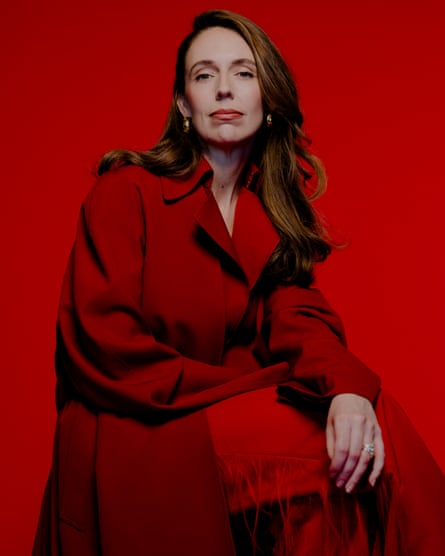
Jacinda Ardern photographed in New York last month.
Photograph: Benedict Evans/The Guardian
Young, progressive and relatable, the former prime minister of New Zealand tried to do politics differently. But six years into power, she dramatically resigned. In an exclusive interview with the Guardian’s editor-in-chief, she explains why
Read an exclusive extract from Ardern’s memoir
Katharine VinerSat 31 May 2025 15.00 AEST
Share
In 2022, a few months before she quit as prime minister of New Zealand, Jacinda Ardern was standing at the sink in the toilets in Auckland airport, washing her hands, when a woman came up to her and leaned in. She was so close that Ardern could feel the heat from her skin. “I just wanted to say thank you,” the woman said. “Thanks for ruining the country.” She turned and left, leaving Ardern “standing there as if I were a high-schooler who’d just been razed”.
The incident was deeply shocking. Ardern had been re-elected in a historic landslide two years before. She enjoyed conversation and debate; she liked being the kind of leader who wasn’t sealed off from the rest of the population. But this, says Ardern, “felt like something new. It was the tenor of the woman’s voice, the way she’d stood so close, the way her seething, nonspecific rage felt not only unpredictable but incongruous to the situation … What was happening?”
The incident came at a pivotal moment: Ardern sensed that the tide was turning against her and she was grappling with whether to go. “Something had been loosened worldwide,” she says, with rage everywhere, public servants being followed and attacked, as if they were “somehow distinct from being human”. We all recognise this rage, but Ardern was at the centre of it, representing progressive politics, tough Covid measures, empathy, emotion, anti-racism, femaleness; a symbol of a different time, more rational, kinder, when rules still meant something. When there were many female leaders – Angela Merkel, Theresa May, Sanna Marin, Mia Mottley, Mette Frederiksen, Tsai Ing-wen.
For all these reasons, Ardern is now missed by progressives, at home and abroad. At her height she had blazed a global trail, modelling a different way of doing politics – wearing a headscarf and embracing weeping bereaved families after the Christchurch mosque massacre, then reforming gun laws in 10 days; taking decisive action on Covid that meant New Zealanders were able to party again while the rest of the world could barely go out; leaving celebrities from Elton John to Stephen Colbert starry-eyed with her poise and wit and humanity. It was Jacinda-mania, and everybody wanted a prime minister like her: young (elected at just 37) and a woman, she offered a different vision of national identity for New Zealand – straightforward, compassionate, diverse, globally desirable – and a different way to lead a country – youthful, human, decent. She had a hunky feminist boyfriend and was pregnant when she became PM; and she was going “to bring kindness back”.
And then, out of the blue, after six years in office, in January 2023, she dramatically announced her resignation. How could she have done this to us, her fans wailed, at a time when the world is falling apart before our eyes?
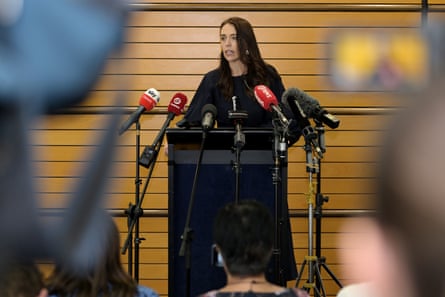 View image in fullscreen‘Burnout is very different from making a judgment in yourself as to whether or not you’re operating at the level you need to be.’ Ardern announcing her resignation in January 2023. Photograph: Kerry Marshall/Getty Images
We meet to discuss her memoir, A Different Kind of Power, for the first major interview she has given since she resigned. Ardern chooses the cafe, a cavernous bare-boards-and-metal type of place, in a small mall in Cambridge, Massachusetts – she is leading a course in empathetic leadership at Harvard. I arrive very early, to get my equipment ready, but Ardern is already there, drinking a huge black tea and primed with her own recording device. “Girly swot,” I joke, using a line she has used about herself. “Ah well,” she laughs, “why hide who you are?”
She has a lovely open face and that famous toothy smile, both emphasised by red lipstick, ballerina-style scraped-back hair and big gold hoops. She is wearing a padded khaki jacket and black clumpy boots.
Ardern and Trump always felt like yin and yang; both took power in 2017, and gave their first speeches at the UN eight days apart, but they take directly opposite political and cultural positions on just about everything. So how does it feel to be the anti-Trump living in Trump’s America?
“I consider myself an observer, observing someone else’s politics,” she says. She’s enjoying the anonymity of being in the US (quite a contrast to New Zealand). “But increasingly what happens in one place affects other places. And it’s not just political culture, it’s also our economies, our security arrangements.”
She chooses her words carefully: once a politician, always a politician. “Political leaders in those moments of deep economic insecurity have two options. One is to acknowledge the environment that they’re in. We’re in a globalised world. We’re in an interconnected world. And we’re in a world of technological disruption. We need a policy prescription that acknowledges all of that. And those are often hard solutions. Hard, difficult to communicate, difficult to implement. But that’s what you’ve got to do. Or …”
She pauses. “You choose blame. Blame the other, blame the migrant, blame other countries, blame multilateral institutions, blame. But it does not fundamentally solve it. In fact, all that happens at the end is you have an othered group, and people who feel dissatisfied and angry and more entrenched.”
Would she call Trump’s America fascism yet?
There is a very long pause – when I listen back to the tape I time it to 11 seconds. “I’m just trying to think about where that takes us,” says Ardern, eventually. “I think probably in my mind, certainly what we’re seeing isn’t anything I’ve ever experienced in my lifetime.”
She is gently funny about Trump the man, without ever going too far, saying he is “taller than I expected, his tan more pronounced”. Vladimir Putin is “quiet, often alone and almost expressionless”. She talks about former Australian prime minister Scott Morrison’s “self-satisfied indifference” and simply rolls her eyes when I mention Boris Johnson. The only really mean comment I can find in the book is about the very rightwing New Zealand politician David Seymour, and it’s laugh-out-loud funny: she was overheard on camera calling him “an arrogant prick”, and is relieved when her aide tells her about it. She thought she’d called him a “fucking prick”.
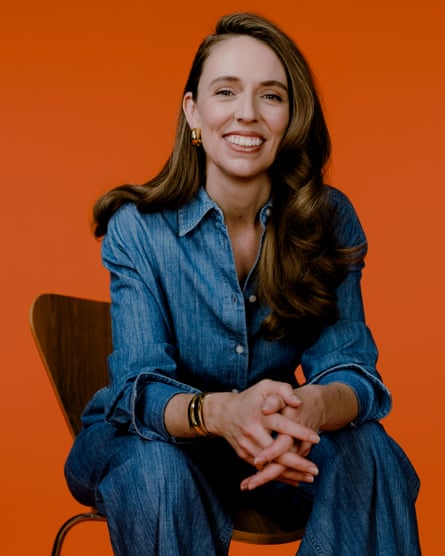 View image in fullscreenArdern: ‘I would not describe myself as cool.’ Stylist: Marisa Ellison. Stylist’s assistant: Lennon Goldsmith. Hair: Antonio Velotta using L’Oréal Pro Hair products and Dyson Supersonic. Makeup: Michelle Reda using Shiseido. Top and jeans, Another Tomorrow. Earrings and cuff, Patricia Von Musulin. Photograph: Benedict Evans/The Guardian
Dame Jacinda Kate Laurell Ardern was born in 1980 in the North Island of New Zealand, and she describes herself as “a very ordinary person who found themselves in a set of extraordinary circumstances”. Ardern and her sister were the first in her family to go to university, and lived at home while studying, to save on costs. Her dad was a police officer; her mother a school dinner lady. She was brought up a Mormon – long skirts, no caffeine and “door-knocking on behalf of God”. A tomboy with a “relentless sense of responsibility”, Ardern famously worked in a fish and chip shop called the Golden Kiwi – already an over-preparer, she got ready for her first shift by endlessly wrapping a cabbage in newspaper.
Throughout her memoir, Ardern reminds us that she was always extremely sensitive and emotional, as well as a “chronic overthinker”. The book is dedicated to “the criers, worriers and huggers”; her thesis is that these people can make great leaders, too. Her father said she was “far too thin-skinned” to be an MP. “Sensitivity was my weakness, my tragic flaw, the thing that might just stop me sticking with the work that I loved,” she writes.
Still, in retrospect, some kind of political career looked inevitable. She witnessed unfairness as a child and couldn’t bear it, particularly when it concerned her town’s Māori community. She was a champion debater at school, studied politics and communications at university, was a researcher for leaders of the NZ Labour party, and even worked in London as a policy adviser at a unit called the Better Regulation Executive (“a job title that would end conversation with most polite company”). She became an MP at 28.
She always had progressive politics but believes being surrounded by people with different points of view helped her. “I have a very diverse family, lots of diverse views, and we haven’t lost any relationships, we’ve always talked,” she says. There’s a bit in the book when a woman in her home town says: “Jacinda, I wanted to tell you that there are a lot of people in Morrinsville who are praying for you … They’re not voting for you, but they are praying for you.” Even her loving grandma admitted that she probably wouldn’t vote for her.
By the time she entered politics, she had stopped being a Mormon; she says the gulf between her religion and her values (especially around LGBTQ+ rights) became too wide. But she won’t speak badly of the church, and believes it taught her a lot about “service and charity”. And, of course, having a door slammed in your face is excellent preparation for politics.
Perhaps it was this upbringing that drove Ardern’s self-effacement – I tell her this is the most modest political memoir I’ve read, and her response is: “Have you read any other New Zealand political memoirs? Because I would not say that’s a trait particular to me.” I say I think she is pretty cool for a politician (interesting ear piercings, likes drum’n’bass, has been seen in Portishead T-shirts). “I would not describe myself as cool,” she says, shaking her head.
For about a decade, Ardern worked diligently as an MP, learning the ropes in politics. In the book she tells an anecdote about the time she asked a fellow MP, known as a bruiser, how to toughen up. He begs her not to. “You feel things because you have empathy, because you care,” he told her. “The moment you change is the moment you’ll stop being good at your job.”
In 2017, she was elected deputy Labour leader. A general election was called and the party was tanking; the poll numbers were so bad that the party leader resigned, and Ardern was unexpectedly tasked with running for prime minister, even though all the billboard posters still had her as the deputy. Leadership was thrust on her. She had 72 hours to formulate a new campaign plan – at the time, she reckoned ‘“winning wasn’t possible, not when we were seven weeks out from the election and polling at 23%”. But she thought she could at least “save the furniture”. In the end there was no clear majority and, after weeks of coalition negotiations, the centre right New Zealand First party chose to go with Labour. She was to become the country’s third female leader.
There was just one thing: in the middle of all this, and days before she became PM, she had found out she was pregnant.
Guilt is part of the package. You can’t get rid of it – you just try and suppress it
Ardern and her partner, Clarke Gayford, had been struggling to conceive and had consulted a fertility specialist; next thing she knew, she was “pregnant, unwed and new to the job”. Gayford presents a popular travel and fishing TV show called Fish of the Day, which has been running for more than a decade, and they met in 2012 at an awards ceremony. A year later he emailed to ask if he could help with her campaign (that old trick). Ardern says Gayford didn’t even own a suit when they met, although he “relished” being part of the group of international leaders’ spouses. He famously held their three-month-old daughter, Neve, in between feeds when Ardern made her debut speech at the UN. When she decided to quit politics, Clarke tried to get her to stay, suggesting she delegate more. “I just don’t want them to feel like they’ve won,” he said. (Gayford makes me think of Margaret Atwood’s husband; he was such a supportive spouse that people used to go round in T-shirts saying “Every woman writer should be married to Graeme Gibson”. Every woman politician should be married to Clarke Gayford.) As Ardern puts it with a smile: “Model of a modern man. Yeah, feminist hero, exactly.”
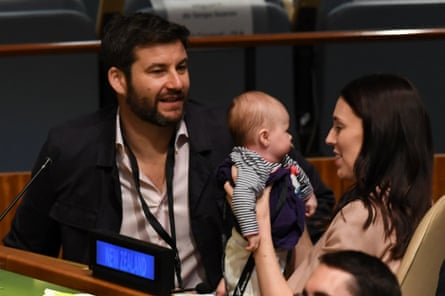 View image in fullscreen‘I think the rehumanisation of people in public life is really important.’ Ardern with Gayford and their daughter, Neve, while in New York for a United Nations assembly, 2018. Photograph: Don Emmert/AFP/Getty Images
Ardern was only the second female leader to give birth in office, after Pakistan’s Benazir Bhutto. The birth was difficult – she couldn’t stand upright properly for weeks afterwards. She constantly felt she should be somewhere else. “It felt like living with chronic discomfort – half guilt, half disappointment – all the time.” She was doing an important job. Even as PM, there’s still guilt about whatever you’re not doing? “If any role was going to give you a bit of a pass on guilt, it might have been leading a country,” she laughs. But she still felt bad. “So I just think that it’s part of the package. And you can’t get rid of it. You can instead just try and make the best decision you can in that moment and try and suppress the guilt. That’s all you can do.”
Why did she leave? “I never wanted to use the line, ‘I’m leaving to spend time with my family’,” she says. “I was very careful not to express anything like that, because I never wanted to convey that you couldn’t have a family or that being in politics meant that you were making a decision to place them on a lower bar, or vice versa.”
Many assume it was because of burnout – on the day Ardern quit, she said she didn’t have “enough gas in the tank” to carry on. But burnout is not to blame, she says today. “Burnout is very different from making a judgment in yourself as to whether or not you’re operating at the level you need to be.” Things were starting to get to her more than usual; and, “of course I was tired, but wasn’t everyone in their 40s?”.
No wonder she was tired: Ardern’s time in power may have been short, but it was particularly tumultuous, punctuated by earthquakes, a terror attack and, of course, a global pandemic. Neve was born in June 2018. Nine months later, a far-right Australian man killed 51 worshippers at a mosque in Christchurch, livestreaming the attack on Facebook. Ardern’s response was instinctive and moving, most notably in the simple statement about the Muslim victims: “They are us.” In a speech that reverberated around the world, she said: “Many of those who will have been directly affected by this shooting may be migrants to New Zealand, they may even be refugees here. They have chosen to make New Zealand their home, and it is their home.” She held the families of the dead and cried with them.
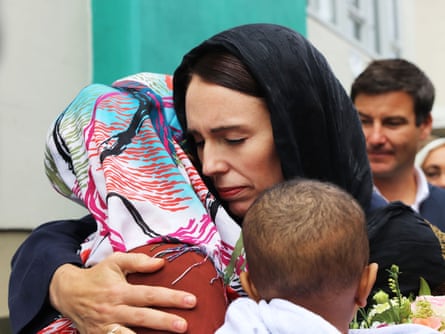 View image in fullscreenArdern offers comfort to a woman following the terror attack in Christchurch, 2019. When Trump asked what America could do, Ardern replied: ‘You can show sympathy and love for all Muslim communities.’ Photograph: Lynn Grieveson/Newsroom/Getty Images
In the book, she describes how Trump called her after the massacre, and it’s subtly revealing about both of them. “We discussed what might happen to the terrorist,” she writes. “I used that word, ‘terrorist’, specifically and President Trump asked if we were calling the gunman that.” She said to him: “Yes, this was a white man from Australia who deliberately targeted our Muslim community. We are calling him that.”
Trump did not respond, but asked if there was anything America could do. “You can show sympathy and love for all Muslim communities,” she told him. It was the reverse of the politics of division: she says that the terrorist “chose us because he knew that New Zealand openly welcomed people of all faiths. He wanted to destroy that.”
What was behind her response, and why does she think so many found it so affecting? She says: “You’re actually leading a collective. They [the public] were deciding how they were responding and I just happened to be in the front of that with them. That’s how it felt to me.” So she believes she was channelling New Zealanders in those moments? “I think it was a reflection of how New Zealanders felt. These things are part of our identity. Perhaps it’s our size, but you can almost feel it. You can feel a response that literally feels like a whole country.”
When she says she can feel it, what’s it like? “It sounds unusual, but I’ve always felt like I had a general sense of where New Zealand is at on something. I relied on it a lot while I was in office. You feel an energy.” It sounds almost physical. “It’s a mood thing. A vibe. Sounds a bit woo-woo. I guess politicians use polls a lot to try and understand that. I wouldn’t let staff give me polls.”
She moved quickly after the attack, announcing the banning of military-style weapons within days; two months later she co-chaired a summit with Emmanuel Macron for world leaders and tech CEOs to commit to “eliminating terrorist and violent extremist content online”. There are now more than 130 governments and tech firms signed up to the “Christchurch Call to Action”.
Christchurch was a massive test. As 2020 came around, she was hoping for a bit of calm. It was not to be.
Ardern’s response to the pandemic stood out worldwide. She was careful, rational, guided by data modelling, scientific experts and public health advisers – the opposite, you could say, of the approach taken by Johnson and Trump. This was a tiny, remote island nation with few intensive-care beds. She closed the border on 19 March 2020 to all non-citizens; there was strict lockdown and contact tracing; and, for a long time, she was personally informed of every single Covid death in the country. And, for a long time, there were very few. While people across the world were banned from seeing their loved ones, many New Zealanders were living a life close to normal. At the end of 2020, while English schools were still closed and hundreds of thousands had died in the US alone, Ardern and Gayford were at a festival watching a band called Shapeshifter (for which, as it happens, they had discussed a shared affinity on their first date).
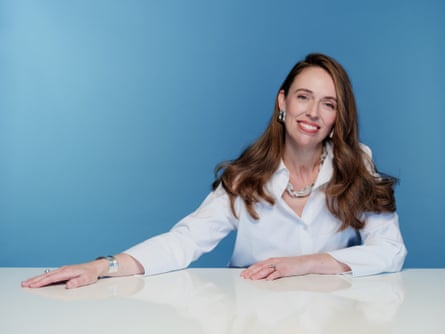 View image in fullscreenArdern: ‘I was probably in power in spite of the power bit.’ Top, by Fforme. Earrings and necklace, by Patricia Von Musulin. Top image: Coat and trousers, by Fforme. Earrings and ring, as before. Photograph: Benedict Evans/The Guardian
But then came the Delta variant, which was much more infectious. Ardern believed that even with strict rules around mask wearing and proof of vaccination, it would be impossible to contain an outbreak. As the lockdown went into its seventh week, she began to see that “New Zealand’s sense of togetherness was starting to fracture”.
Worse was to come. In February 2022, 3,000 anti-vaccine protesters pitched tents and occupied the grounds of Parliament House in Wellington. As she writes of the encampment: “I saw my own image, with a Hitler moustache, monocle and ‘Dictator of the Year’ emblazoned above my face. I saw the gallows, complete with a noose, which people said had been erected for me. I saw the American flags, the Trump flags, the swastikas.” She could hear the protesters shouting, “You stand on the bones of death” through the government doors. And, “We’re coming for you next.”
Did these people hound her out? “Absolutely not,” she says. “I left a year after some of those most difficult patches.” But it must have been horrific. She writes that she had always tried to be “human first, and a leader second. I understood that, to the crowd occupying parliament, I was neither.”
Does she now think she went too hard with restrictions and vaccination mandates? She says that New Zealand “came out of Covid with one of the highest vaccination rates in the world and fewer days in lockdown than nations like the UK, and during this time our country’s life expectancy actually increased”.
She gets little credit for this. I guess it’s hard to get credit for things that didn’t happen; you can’t really prove a negative, prove how many people didn’t die. Oh you can, she says, firmly. “Twenty thousand. Four times my old town. It’s a lot of people.” There’s a long pause. “How do you feel remorse about that?”
It sounds as if she feels she has been unfairly attacked over her approach to Covid. At this suggestion, Ardern goes very still and quiet, and I suddenly realise she has tears in her eyes. “I find Covid really hard,” she says, swallowing her words. “I had a conversation up north, after I’d left office. I was wandering around some markets and I could feel this young woman looking at me, so when she caught my eye I said hello, and we struck up a conversation, and it turned out that she was a teacher who’d had an adverse reaction to the vaccine. And because she didn’t get the second dose, she had stopped working in teaching.”
The New Zealand vaccine mandate meant that people in some professions were required to have it.
“We talked about the fact that we, of course, had an exemption regime, but for some reason it hadn’t worked out for her. It was the kind of conversation that I just wish I could have with everyone: when everything isn’t distilled down into black and white. But the world leaves so little space for that now. And I feel very sad about that.”
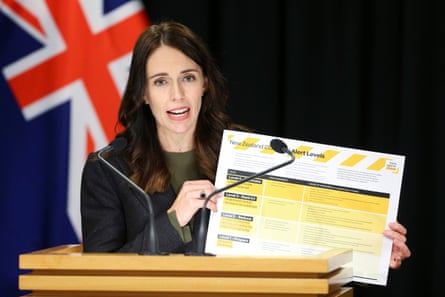 View image in fullscreen‘It’s distressing when you’re misunderstood, or feel misunderstood.’ Ardern giving an update on coronavirus measures, 2020. Photograph: Hagen Hopkins/Getty Images
She’s fighting back tears again. Her tone is so sad. Why does she think it’s still so hard? “People only see the decisions you made, not the choices you had. The first part of Covid, people saw all the choices and decisions. And the second half, it just got hard. It got hard. Vaccines bring an extra layer that’s really difficult.”
I apologise for taking her back to a dark time. “One of the things that still stands out in my mind – I can’t remember if it was a meme or a genuine cartoon – but it was an image of Winnie-the-Pooh and Christopher Robin,” she says. “It was at the tail end of Covid, and Christopher says, ‘How will we know if we succeeded?’ And Winnie says, ‘Because they’ll say we did too much.’ And it captured this idea that there probably isn’t a sweet spot. Maybe there were only two options in the end. Maybe it was: you’ll be attacked for doing too little or you’ll be attacked for doing too much. And I know what I would choose.”
She faced extreme reactions from fellow New Zealanders. “There’d be some people who would spontaneously cry because they absolutely believe that you saved their lives,” says Ardern. “And then there’s someone else on the other end of the spectrum who mirrors that level of emotion, who felt that somehow you ended theirs.”
I’d read a comment and think, holy heck, if half of that was true, I’d dislike me, too
Hardly anyone talks about Covid any more, but it changed our economies, children’s relationships with school, adults’ relationships with work, citizens’ relationship with the state.
Ardern nods. “It disrupted our own sense of security around what we could fundamentally expect. Covid disrupted the baseline.”
And maybe she was a fall guy for that. “It’s distressing when you’re misunderstood, or feel misunderstood,” she says. “Sometimes I’d read a comment and I’d think, holy heck, if half of that was true, I’d dislike me, too.”
Another former PM of New Zealand, Helen Clark, said Ardern had faced “a level of hatred and venom that I believe is unprecedented in this country”.
She was trivialised, called vapid, vacant, even “pretty bloody stupid”. She writes about how women are held to “some unspoken, impossible standard”; how she is careful not to be seen as “humourless and too sensitive” in her response to a cartoon portraying her as a boxing-ring girl in a bikini with black stiletto boots.
Does she think women face particular vitriol? “There’s a magnified impact on women in public life,” she agrees. “And also on those of different ethnic backgrounds and also our LGBTQ+ communities. And I say public life, because I don’t think it’s just politicians; it’s journalists, academics.”
As she left parliament, Ardern said that she hoped her leaving would “take the heat out of politics”; that it “might make our politics feel calmer, less polarised”. That didn’t work, did it?
“I didn’t take the heat out,” she admits; she knows it’s obvious. “What felt more important to me were the things that we’d done, rather than me staying on to do more of them.” When I ask for examples, she says she succeeded in “removing the politics from climate change” with the Zero Carbon Act, and points to “child poverty measures, that we’ve also got consensus on. Both of those have lasted. Abortion law reform has lasted.”
But there’s a wistfulness when she talks about these achievements, and many New Zealand progressives were frustrated with the amount of change she managed to implement, especially considering the landslide she won in 2020.
Their disappointment is particularly acute in light of the current government, which is the most rightwing ever elected in New Zealand and is trying to undo years of progress on Māori rights, for example. Ardern refuses to talk about New Zealand politics now, but what’s happening must appal her.
The “politics of empathy” might not be in vogue, but Ardern remains committed to it. Is it a strong enough weapon against authoritarianism? Elon Musk recently said that “the fundamental weakness of western civilisation is empathy”. She snorts. “What does that even mean?”
Attacking empathy is all the rage with the right, I point out, especially in the US. There are popular books called Against Empathy and The Sin of Empathy. “Well, in that environment, saying loudly and proudly that you believe in empathy and that you’ll govern in that way is an act of strength.”
But public life today is so horrible, so brutal. Why would anyone go into politics? “I think the rehumanisation of people in public life is really important,” she says.
I love politics, but that’s because I love people
After our interview, both Anthony Albanese in Australia and Mark Carney in Canada are elected in defiance of Trump’s authoritarian politics; Albanese even mentioned “kindness” in his victory speech. With these victories looking likely, I had asked her what she thought they would show about Trump’s kind of power.
“I think people swinging in the other direction [from America] is almost making the point. I don’t think that form of leadership is what people seek.”
So she still believes in politics? “I love politics,” she laughs, “but that’s because I love people.”
She loves democracy and people more than power, she says. “In fact, I was probably in power in spite of the power bit. I would have been very happy to be a minister, a wider member of a team.” It’s a profound comment in a world of strongmen and autocrats.
Ardern wanted to be a different kind of leader, and for six years she was. She feels an almost mystical connection to her country. Covid made it stronger. Then Covid destroyed it. And she still can’t believe it. She plans to move back home soon.
We have talked for a while, well over our allotted time; the teas are cold and she wants to get back to her daughter. She walks me to the appropriate junction and tells me the most scenic route to take, then strides out anonymously in the Massachusetts streets, clumpy boots grounding her. Decent, resolutely human, and only 44, Jacinda Ardern still believes modesty, kindness and compassion will win the day.
Young, progressive and relatable, the former prime minister of New Zealand tried to do politics differently. But six years into power, she dramatically resigned. In an exclusive interview with the Guardian’s editor-in-chief, she explains why
Read an exclusive extract from Ardern’s memoir
Katharine VinerSat 31 May 2025 15.00 AEST
Share
In 2022, a few months before she quit as prime minister of New Zealand, Jacinda Ardern was standing at the sink in the toilets in Auckland airport, washing her hands, when a woman came up to her and leaned in. She was so close that Ardern could feel the heat from her skin. “I just wanted to say thank you,” the woman said. “Thanks for ruining the country.” She turned and left, leaving Ardern “standing there as if I were a high-schooler who’d just been razed”.
The incident was deeply shocking. Ardern had been re-elected in a historic landslide two years before. She enjoyed conversation and debate; she liked being the kind of leader who wasn’t sealed off from the rest of the population. But this, says Ardern, “felt like something new. It was the tenor of the woman’s voice, the way she’d stood so close, the way her seething, nonspecific rage felt not only unpredictable but incongruous to the situation … What was happening?”
The incident came at a pivotal moment: Ardern sensed that the tide was turning against her and she was grappling with whether to go. “Something had been loosened worldwide,” she says, with rage everywhere, public servants being followed and attacked, as if they were “somehow distinct from being human”. We all recognise this rage, but Ardern was at the centre of it, representing progressive politics, tough Covid measures, empathy, emotion, anti-racism, femaleness; a symbol of a different time, more rational, kinder, when rules still meant something. When there were many female leaders – Angela Merkel, Theresa May, Sanna Marin, Mia Mottley, Mette Frederiksen, Tsai Ing-wen.
For all these reasons, Ardern is now missed by progressives, at home and abroad. At her height she had blazed a global trail, modelling a different way of doing politics – wearing a headscarf and embracing weeping bereaved families after the Christchurch mosque massacre, then reforming gun laws in 10 days; taking decisive action on Covid that meant New Zealanders were able to party again while the rest of the world could barely go out; leaving celebrities from Elton John to Stephen Colbert starry-eyed with her poise and wit and humanity. It was Jacinda-mania, and everybody wanted a prime minister like her: young (elected at just 37) and a woman, she offered a different vision of national identity for New Zealand – straightforward, compassionate, diverse, globally desirable – and a different way to lead a country – youthful, human, decent. She had a hunky feminist boyfriend and was pregnant when she became PM; and she was going “to bring kindness back”.
And then, out of the blue, after six years in office, in January 2023, she dramatically announced her resignation. How could she have done this to us, her fans wailed, at a time when the world is falling apart before our eyes?
View image in fullscreen‘Burnout is very different from making a judgment in yourself as to whether or not you’re operating at the level you need to be.’ Ardern announcing her resignation in January 2023. Photograph: Kerry Marshall/Getty ImagesWe meet to discuss her memoir, A Different Kind of Power, for the first major interview she has given since she resigned. Ardern chooses the cafe, a cavernous bare-boards-and-metal type of place, in a small mall in Cambridge, Massachusetts – she is leading a course in empathetic leadership at Harvard. I arrive very early, to get my equipment ready, but Ardern is already there, drinking a huge black tea and primed with her own recording device. “Girly swot,” I joke, using a line she has used about herself. “Ah well,” she laughs, “why hide who you are?”
She has a lovely open face and that famous toothy smile, both emphasised by red lipstick, ballerina-style scraped-back hair and big gold hoops. She is wearing a padded khaki jacket and black clumpy boots.
Ardern and Trump always felt like yin and yang; both took power in 2017, and gave their first speeches at the UN eight days apart, but they take directly opposite political and cultural positions on just about everything. So how does it feel to be the anti-Trump living in Trump’s America?
“I consider myself an observer, observing someone else’s politics,” she says. She’s enjoying the anonymity of being in the US (quite a contrast to New Zealand). “But increasingly what happens in one place affects other places. And it’s not just political culture, it’s also our economies, our security arrangements.”
She chooses her words carefully: once a politician, always a politician. “Political leaders in those moments of deep economic insecurity have two options. One is to acknowledge the environment that they’re in. We’re in a globalised world. We’re in an interconnected world. And we’re in a world of technological disruption. We need a policy prescription that acknowledges all of that. And those are often hard solutions. Hard, difficult to communicate, difficult to implement. But that’s what you’ve got to do. Or …”
She pauses. “You choose blame. Blame the other, blame the migrant, blame other countries, blame multilateral institutions, blame. But it does not fundamentally solve it. In fact, all that happens at the end is you have an othered group, and people who feel dissatisfied and angry and more entrenched.”
Would she call Trump’s America fascism yet?
There is a very long pause – when I listen back to the tape I time it to 11 seconds. “I’m just trying to think about where that takes us,” says Ardern, eventually. “I think probably in my mind, certainly what we’re seeing isn’t anything I’ve ever experienced in my lifetime.”
She is gently funny about Trump the man, without ever going too far, saying he is “taller than I expected, his tan more pronounced”. Vladimir Putin is “quiet, often alone and almost expressionless”. She talks about former Australian prime minister Scott Morrison’s “self-satisfied indifference” and simply rolls her eyes when I mention Boris Johnson. The only really mean comment I can find in the book is about the very rightwing New Zealand politician David Seymour, and it’s laugh-out-loud funny: she was overheard on camera calling him “an arrogant prick”, and is relieved when her aide tells her about it. She thought she’d called him a “fucking prick”.
View image in fullscreenArdern: ‘I would not describe myself as cool.’ Stylist: Marisa Ellison. Stylist’s assistant: Lennon Goldsmith. Hair: Antonio Velotta using L’Oréal Pro Hair products and Dyson Supersonic. Makeup: Michelle Reda using Shiseido. Top and jeans, Another Tomorrow. Earrings and cuff, Patricia Von Musulin. Photograph: Benedict Evans/The GuardianDame Jacinda Kate Laurell Ardern was born in 1980 in the North Island of New Zealand, and she describes herself as “a very ordinary person who found themselves in a set of extraordinary circumstances”. Ardern and her sister were the first in her family to go to university, and lived at home while studying, to save on costs. Her dad was a police officer; her mother a school dinner lady. She was brought up a Mormon – long skirts, no caffeine and “door-knocking on behalf of God”. A tomboy with a “relentless sense of responsibility”, Ardern famously worked in a fish and chip shop called the Golden Kiwi – already an over-preparer, she got ready for her first shift by endlessly wrapping a cabbage in newspaper.
Throughout her memoir, Ardern reminds us that she was always extremely sensitive and emotional, as well as a “chronic overthinker”. The book is dedicated to “the criers, worriers and huggers”; her thesis is that these people can make great leaders, too. Her father said she was “far too thin-skinned” to be an MP. “Sensitivity was my weakness, my tragic flaw, the thing that might just stop me sticking with the work that I loved,” she writes.
Still, in retrospect, some kind of political career looked inevitable. She witnessed unfairness as a child and couldn’t bear it, particularly when it concerned her town’s Māori community. She was a champion debater at school, studied politics and communications at university, was a researcher for leaders of the NZ Labour party, and even worked in London as a policy adviser at a unit called the Better Regulation Executive (“a job title that would end conversation with most polite company”). She became an MP at 28.
She always had progressive politics but believes being surrounded by people with different points of view helped her. “I have a very diverse family, lots of diverse views, and we haven’t lost any relationships, we’ve always talked,” she says. There’s a bit in the book when a woman in her home town says: “Jacinda, I wanted to tell you that there are a lot of people in Morrinsville who are praying for you … They’re not voting for you, but they are praying for you.” Even her loving grandma admitted that she probably wouldn’t vote for her.
By the time she entered politics, she had stopped being a Mormon; she says the gulf between her religion and her values (especially around LGBTQ+ rights) became too wide. But she won’t speak badly of the church, and believes it taught her a lot about “service and charity”. And, of course, having a door slammed in your face is excellent preparation for politics.
Perhaps it was this upbringing that drove Ardern’s self-effacement – I tell her this is the most modest political memoir I’ve read, and her response is: “Have you read any other New Zealand political memoirs? Because I would not say that’s a trait particular to me.” I say I think she is pretty cool for a politician (interesting ear piercings, likes drum’n’bass, has been seen in Portishead T-shirts). “I would not describe myself as cool,” she says, shaking her head.
For about a decade, Ardern worked diligently as an MP, learning the ropes in politics. In the book she tells an anecdote about the time she asked a fellow MP, known as a bruiser, how to toughen up. He begs her not to. “You feel things because you have empathy, because you care,” he told her. “The moment you change is the moment you’ll stop being good at your job.”
In 2017, she was elected deputy Labour leader. A general election was called and the party was tanking; the poll numbers were so bad that the party leader resigned, and Ardern was unexpectedly tasked with running for prime minister, even though all the billboard posters still had her as the deputy. Leadership was thrust on her. She had 72 hours to formulate a new campaign plan – at the time, she reckoned ‘“winning wasn’t possible, not when we were seven weeks out from the election and polling at 23%”. But she thought she could at least “save the furniture”. In the end there was no clear majority and, after weeks of coalition negotiations, the centre right New Zealand First party chose to go with Labour. She was to become the country’s third female leader.
There was just one thing: in the middle of all this, and days before she became PM, she had found out she was pregnant.
Guilt is part of the package. You can’t get rid of it – you just try and suppress it
Ardern and her partner, Clarke Gayford, had been struggling to conceive and had consulted a fertility specialist; next thing she knew, she was “pregnant, unwed and new to the job”. Gayford presents a popular travel and fishing TV show called Fish of the Day, which has been running for more than a decade, and they met in 2012 at an awards ceremony. A year later he emailed to ask if he could help with her campaign (that old trick). Ardern says Gayford didn’t even own a suit when they met, although he “relished” being part of the group of international leaders’ spouses. He famously held their three-month-old daughter, Neve, in between feeds when Ardern made her debut speech at the UN. When she decided to quit politics, Clarke tried to get her to stay, suggesting she delegate more. “I just don’t want them to feel like they’ve won,” he said. (Gayford makes me think of Margaret Atwood’s husband; he was such a supportive spouse that people used to go round in T-shirts saying “Every woman writer should be married to Graeme Gibson”. Every woman politician should be married to Clarke Gayford.) As Ardern puts it with a smile: “Model of a modern man. Yeah, feminist hero, exactly.”
View image in fullscreen‘I think the rehumanisation of people in public life is really important.’ Ardern with Gayford and their daughter, Neve, while in New York for a United Nations assembly, 2018. Photograph: Don Emmert/AFP/Getty ImagesArdern was only the second female leader to give birth in office, after Pakistan’s Benazir Bhutto. The birth was difficult – she couldn’t stand upright properly for weeks afterwards. She constantly felt she should be somewhere else. “It felt like living with chronic discomfort – half guilt, half disappointment – all the time.” She was doing an important job. Even as PM, there’s still guilt about whatever you’re not doing? “If any role was going to give you a bit of a pass on guilt, it might have been leading a country,” she laughs. But she still felt bad. “So I just think that it’s part of the package. And you can’t get rid of it. You can instead just try and make the best decision you can in that moment and try and suppress the guilt. That’s all you can do.”
Why did she leave? “I never wanted to use the line, ‘I’m leaving to spend time with my family’,” she says. “I was very careful not to express anything like that, because I never wanted to convey that you couldn’t have a family or that being in politics meant that you were making a decision to place them on a lower bar, or vice versa.”
Many assume it was because of burnout – on the day Ardern quit, she said she didn’t have “enough gas in the tank” to carry on. But burnout is not to blame, she says today. “Burnout is very different from making a judgment in yourself as to whether or not you’re operating at the level you need to be.” Things were starting to get to her more than usual; and, “of course I was tired, but wasn’t everyone in their 40s?”.
No wonder she was tired: Ardern’s time in power may have been short, but it was particularly tumultuous, punctuated by earthquakes, a terror attack and, of course, a global pandemic. Neve was born in June 2018. Nine months later, a far-right Australian man killed 51 worshippers at a mosque in Christchurch, livestreaming the attack on Facebook. Ardern’s response was instinctive and moving, most notably in the simple statement about the Muslim victims: “They are us.” In a speech that reverberated around the world, she said: “Many of those who will have been directly affected by this shooting may be migrants to New Zealand, they may even be refugees here. They have chosen to make New Zealand their home, and it is their home.” She held the families of the dead and cried with them.
View image in fullscreenArdern offers comfort to a woman following the terror attack in Christchurch, 2019. When Trump asked what America could do, Ardern replied: ‘You can show sympathy and love for all Muslim communities.’ Photograph: Lynn Grieveson/Newsroom/Getty ImagesIn the book, she describes how Trump called her after the massacre, and it’s subtly revealing about both of them. “We discussed what might happen to the terrorist,” she writes. “I used that word, ‘terrorist’, specifically and President Trump asked if we were calling the gunman that.” She said to him: “Yes, this was a white man from Australia who deliberately targeted our Muslim community. We are calling him that.”
Trump did not respond, but asked if there was anything America could do. “You can show sympathy and love for all Muslim communities,” she told him. It was the reverse of the politics of division: she says that the terrorist “chose us because he knew that New Zealand openly welcomed people of all faiths. He wanted to destroy that.”
What was behind her response, and why does she think so many found it so affecting? She says: “You’re actually leading a collective. They [the public] were deciding how they were responding and I just happened to be in the front of that with them. That’s how it felt to me.” So she believes she was channelling New Zealanders in those moments? “I think it was a reflection of how New Zealanders felt. These things are part of our identity. Perhaps it’s our size, but you can almost feel it. You can feel a response that literally feels like a whole country.”
When she says she can feel it, what’s it like? “It sounds unusual, but I’ve always felt like I had a general sense of where New Zealand is at on something. I relied on it a lot while I was in office. You feel an energy.” It sounds almost physical. “It’s a mood thing. A vibe. Sounds a bit woo-woo. I guess politicians use polls a lot to try and understand that. I wouldn’t let staff give me polls.”
She moved quickly after the attack, announcing the banning of military-style weapons within days; two months later she co-chaired a summit with Emmanuel Macron for world leaders and tech CEOs to commit to “eliminating terrorist and violent extremist content online”. There are now more than 130 governments and tech firms signed up to the “Christchurch Call to Action”.
Christchurch was a massive test. As 2020 came around, she was hoping for a bit of calm. It was not to be.
Ardern’s response to the pandemic stood out worldwide. She was careful, rational, guided by data modelling, scientific experts and public health advisers – the opposite, you could say, of the approach taken by Johnson and Trump. This was a tiny, remote island nation with few intensive-care beds. She closed the border on 19 March 2020 to all non-citizens; there was strict lockdown and contact tracing; and, for a long time, she was personally informed of every single Covid death in the country. And, for a long time, there were very few. While people across the world were banned from seeing their loved ones, many New Zealanders were living a life close to normal. At the end of 2020, while English schools were still closed and hundreds of thousands had died in the US alone, Ardern and Gayford were at a festival watching a band called Shapeshifter (for which, as it happens, they had discussed a shared affinity on their first date).
View image in fullscreenArdern: ‘I was probably in power in spite of the power bit.’ Top, by Fforme. Earrings and necklace, by Patricia Von Musulin. Top image: Coat and trousers, by Fforme. Earrings and ring, as before. Photograph: Benedict Evans/The GuardianBut then came the Delta variant, which was much more infectious. Ardern believed that even with strict rules around mask wearing and proof of vaccination, it would be impossible to contain an outbreak. As the lockdown went into its seventh week, she began to see that “New Zealand’s sense of togetherness was starting to fracture”.
Worse was to come. In February 2022, 3,000 anti-vaccine protesters pitched tents and occupied the grounds of Parliament House in Wellington. As she writes of the encampment: “I saw my own image, with a Hitler moustache, monocle and ‘Dictator of the Year’ emblazoned above my face. I saw the gallows, complete with a noose, which people said had been erected for me. I saw the American flags, the Trump flags, the swastikas.” She could hear the protesters shouting, “You stand on the bones of death” through the government doors. And, “We’re coming for you next.”
Did these people hound her out? “Absolutely not,” she says. “I left a year after some of those most difficult patches.” But it must have been horrific. She writes that she had always tried to be “human first, and a leader second. I understood that, to the crowd occupying parliament, I was neither.”
Does she now think she went too hard with restrictions and vaccination mandates? She says that New Zealand “came out of Covid with one of the highest vaccination rates in the world and fewer days in lockdown than nations like the UK, and during this time our country’s life expectancy actually increased”.
She gets little credit for this. I guess it’s hard to get credit for things that didn’t happen; you can’t really prove a negative, prove how many people didn’t die. Oh you can, she says, firmly. “Twenty thousand. Four times my old town. It’s a lot of people.” There’s a long pause. “How do you feel remorse about that?”
It sounds as if she feels she has been unfairly attacked over her approach to Covid. At this suggestion, Ardern goes very still and quiet, and I suddenly realise she has tears in her eyes. “I find Covid really hard,” she says, swallowing her words. “I had a conversation up north, after I’d left office. I was wandering around some markets and I could feel this young woman looking at me, so when she caught my eye I said hello, and we struck up a conversation, and it turned out that she was a teacher who’d had an adverse reaction to the vaccine. And because she didn’t get the second dose, she had stopped working in teaching.”
The New Zealand vaccine mandate meant that people in some professions were required to have it.
“We talked about the fact that we, of course, had an exemption regime, but for some reason it hadn’t worked out for her. It was the kind of conversation that I just wish I could have with everyone: when everything isn’t distilled down into black and white. But the world leaves so little space for that now. And I feel very sad about that.”
View image in fullscreen‘It’s distressing when you’re misunderstood, or feel misunderstood.’ Ardern giving an update on coronavirus measures, 2020. Photograph: Hagen Hopkins/Getty ImagesShe’s fighting back tears again. Her tone is so sad. Why does she think it’s still so hard? “People only see the decisions you made, not the choices you had. The first part of Covid, people saw all the choices and decisions. And the second half, it just got hard. It got hard. Vaccines bring an extra layer that’s really difficult.”
I apologise for taking her back to a dark time. “One of the things that still stands out in my mind – I can’t remember if it was a meme or a genuine cartoon – but it was an image of Winnie-the-Pooh and Christopher Robin,” she says. “It was at the tail end of Covid, and Christopher says, ‘How will we know if we succeeded?’ And Winnie says, ‘Because they’ll say we did too much.’ And it captured this idea that there probably isn’t a sweet spot. Maybe there were only two options in the end. Maybe it was: you’ll be attacked for doing too little or you’ll be attacked for doing too much. And I know what I would choose.”
She faced extreme reactions from fellow New Zealanders. “There’d be some people who would spontaneously cry because they absolutely believe that you saved their lives,” says Ardern. “And then there’s someone else on the other end of the spectrum who mirrors that level of emotion, who felt that somehow you ended theirs.”
I’d read a comment and think, holy heck, if half of that was true, I’d dislike me, too
Hardly anyone talks about Covid any more, but it changed our economies, children’s relationships with school, adults’ relationships with work, citizens’ relationship with the state.
Ardern nods. “It disrupted our own sense of security around what we could fundamentally expect. Covid disrupted the baseline.”
And maybe she was a fall guy for that. “It’s distressing when you’re misunderstood, or feel misunderstood,” she says. “Sometimes I’d read a comment and I’d think, holy heck, if half of that was true, I’d dislike me, too.”
Another former PM of New Zealand, Helen Clark, said Ardern had faced “a level of hatred and venom that I believe is unprecedented in this country”.
She was trivialised, called vapid, vacant, even “pretty bloody stupid”. She writes about how women are held to “some unspoken, impossible standard”; how she is careful not to be seen as “humourless and too sensitive” in her response to a cartoon portraying her as a boxing-ring girl in a bikini with black stiletto boots.
Does she think women face particular vitriol? “There’s a magnified impact on women in public life,” she agrees. “And also on those of different ethnic backgrounds and also our LGBTQ+ communities. And I say public life, because I don’t think it’s just politicians; it’s journalists, academics.”
As she left parliament, Ardern said that she hoped her leaving would “take the heat out of politics”; that it “might make our politics feel calmer, less polarised”. That didn’t work, did it?
“I didn’t take the heat out,” she admits; she knows it’s obvious. “What felt more important to me were the things that we’d done, rather than me staying on to do more of them.” When I ask for examples, she says she succeeded in “removing the politics from climate change” with the Zero Carbon Act, and points to “child poverty measures, that we’ve also got consensus on. Both of those have lasted. Abortion law reform has lasted.”
But there’s a wistfulness when she talks about these achievements, and many New Zealand progressives were frustrated with the amount of change she managed to implement, especially considering the landslide she won in 2020.
Their disappointment is particularly acute in light of the current government, which is the most rightwing ever elected in New Zealand and is trying to undo years of progress on Māori rights, for example. Ardern refuses to talk about New Zealand politics now, but what’s happening must appal her.
The “politics of empathy” might not be in vogue, but Ardern remains committed to it. Is it a strong enough weapon against authoritarianism? Elon Musk recently said that “the fundamental weakness of western civilisation is empathy”. She snorts. “What does that even mean?”
Attacking empathy is all the rage with the right, I point out, especially in the US. There are popular books called Against Empathy and The Sin of Empathy. “Well, in that environment, saying loudly and proudly that you believe in empathy and that you’ll govern in that way is an act of strength.”
But public life today is so horrible, so brutal. Why would anyone go into politics? “I think the rehumanisation of people in public life is really important,” she says.
I love politics, but that’s because I love people
After our interview, both Anthony Albanese in Australia and Mark Carney in Canada are elected in defiance of Trump’s authoritarian politics; Albanese even mentioned “kindness” in his victory speech. With these victories looking likely, I had asked her what she thought they would show about Trump’s kind of power.
“I think people swinging in the other direction [from America] is almost making the point. I don’t think that form of leadership is what people seek.”
So she still believes in politics? “I love politics,” she laughs, “but that’s because I love people.”
She loves democracy and people more than power, she says. “In fact, I was probably in power in spite of the power bit. I would have been very happy to be a minister, a wider member of a team.” It’s a profound comment in a world of strongmen and autocrats.
Ardern wanted to be a different kind of leader, and for six years she was. She feels an almost mystical connection to her country. Covid made it stronger. Then Covid destroyed it. And she still can’t believe it. She plans to move back home soon.
We have talked for a while, well over our allotted time; the teas are cold and she wants to get back to her daughter. She walks me to the appropriate junction and tells me the most scenic route to take, then strides out anonymously in the Massachusetts streets, clumpy boots grounding her. Decent, resolutely human, and only 44, Jacinda Ardern still believes modesty, kindness and compassion will win the day.




 Photo by Getty Images
